Let’s suppose you decided to run a marathon. How would you prepare for a 26.2 mile running race? You’d probably create a schedule that called for runs of different distances, some of just two or three miles, quite a few 5-10 miles runs, and at least one of about 20 miles. Maybe you’d join a running club or seek out others who were preparing for that particular marathon. You’d think about your diet and your sleep patterns. You might even visit the actual course, just to get a feel for what was to come.
In short, to get ready to run a marathon, you would do whatever seemed necessary to simulate the actual race.
Now imagine that you’ve been cast in a play. How would you prepare? You would set aside time to memorize your lines, and perhaps you would ask a friend or a family member to give you your cues. At some point, you’d join the cast for a reading, then a walk-through, and finally lots of rehearsals. You would need to be aware of your inflection, your facial expressions, and your body language…but also of the team-building process.
In short, to prepare to act on stage, you would do whatever seemed necessary to simulate the actual on-stage performance.
Now let’s think about preparing to live in a free society, a democracy. What would be a sensible approach to preparing young people for a world in which they are generally free to decide what to wear, when to speak up and when to remain silent, what to say, when to eat, how to work with others, and so on? What’s the best way to prepare young people to carefully examine propositions, instead of automatically saying ‘Yes’ or robotically doing what someone tells them to do?
Should they, to get ready to be successful in a democratic society, actually practice democracy while they are growing up?
Right now, we don’t allow children to practice democracy, not in schools anyway. In fact, with the exception of our prison system, public schools are the most undemocratic institutions in our society. Even the branches of the military offer choices to those who enlist, but American public schools tell students (and teachers too, for that matter) where to be and when to be there, when to eat, and what to wear. Most public schools teach students to regurgitate information, not to think critically or to question. Schools are set up to sort, not to individualize. Their basic question about each child is “How Smart Are You?” which they seek to answer by subjecting children to a constant battery of standardized (and most often multiple-choice) tests.
Perhaps our schools are anti-democratic to make it easier for the adults. Perhaps because long ago we adopted the Prussian education model: lectures to children grouped by age. Or perhaps because we adults haven’t had much experience with democracy in our own lives.
Could public schools actually be ‘democratic’ in nature? Could a system of mass education ask a fundamentally different question about each child, “How Are You Smart?” and then adapt the pedagogy to fit a child’s needs, aptitudes, and inclinations?
Not only is it possible; it’s essential going forward, if we are going to rebuild America after Trump.
This is not an argument for letting children do whatever they want, whenever they want. That’s chaos, and no one–not even the kids–wants that. Instead, it calls for thoughtful practice, cooperation, an end to age-segregation, lots of project-based learning, and a focus on social and emotional learning.
Here’s an example that may shock you: Letting students make the rules for classroom behavior. That’s democracy in its purest form, and it can work, although it’s rarely tried. I’d wager to say every elementary school classroom I visited in my 41 years of reporting had a poster listing the rules for classroom behavior. Almost always laminated, these posters generally included obvious rules like “Listen Carefully,” “Follow Directions,” and “Raise Your Hand When You Want to Say Something.”
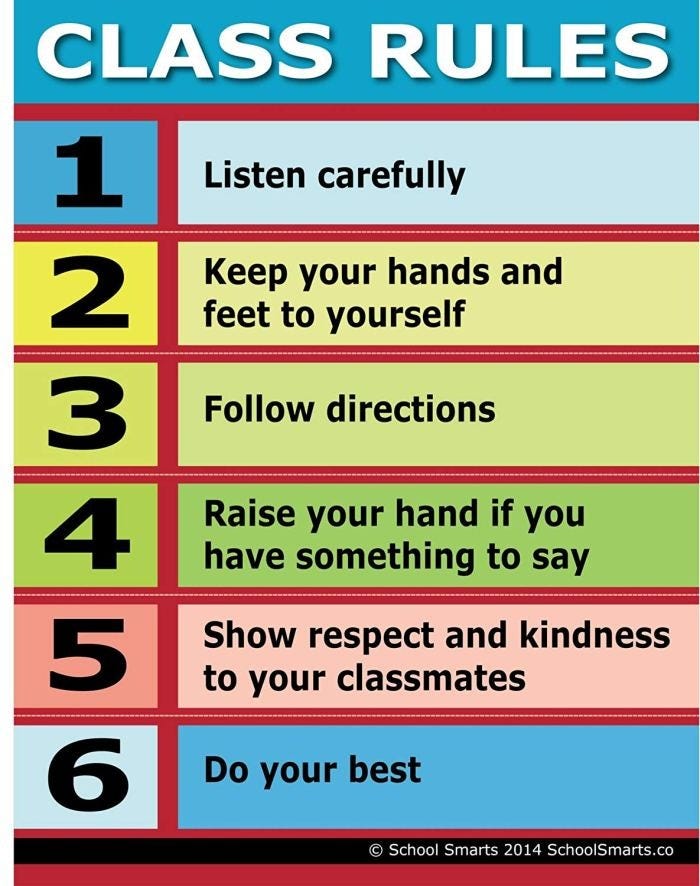
These posters were mass-produced, store-bought, glossy, and laminated. No editing possible, and no thought required. I imagine that on the first day of school, the teacher would read the rules aloud and then point to the poster whenever things got loud or rowdy.
“Now, children, remember Rule 4. No calling out unless I call on you.”
But occasionally the ubiquitous poster would be hand-made, clearly the work of students. If I asked the teacher for an explanation, the answer went something like this:
“On the first day of school I always ask my students what sort of classroom they wanted to spend the year in? What should be the rules? It takes a few days to develop the rules. Sometimes I present alternatives, such as “What if someone knows the answer to a question? Should they just yell it out, or should they raise their hand and wait to be called on?”
Or I might ask them “If one of you has to use the bathroom, should you just get up and walk out of class? Or should we have a signal? And what sort of signal should we use?”
It should not surprise you to learn that the students invariably came up with reasonable rules much like those on the laminated posters: Listen, Be Respectful, Raise Your Hand, Be Kind, and so forth. But there was a difference, teachers and principals told me: When students create the rules, they owned them and were more likely to adhere to them.
Schools can practice democracy in other ways. The adults in charge can give students more say in what they study. Again, not carte blanche but thoughtfully personalized. That means taking the time, early on, to figure out what students are interested in and then using those interests to see that they learn to read with comprehension, work with numbers, speak in public, and work well with others.
Of course, students should not get to make all the decisions about what they’re studying. After all, a central purpose of school is the transmission of knowledge, and so the basics are also part of the deal. Young children need to learn spelling rules (“I before E, except after C”), the multiplication tables, how to divide and carry, and other basics. They need to know that letters have sounds associated with them (i.e., Phonics and Phonemic Awareness). Someone has to teach them that, if you put an E at the end of words like ‘ton,’ the O sound changes from ‘short’ to ‘long.’
That democratic step–giving students power over their learning– will make teaching easier and more enjoyable. When I was a high school English teacher many years ago, my students were supposed to write ‘themes’ based on ‘Macbeth,’ ‘All Quiet on the Western Front,’ and whatever other plays or novels they were told to read. No choices–just rules from on high. However, if I were teaching high school English today, I would try to ask each student to identify three or four things they were curious about. Then I would spend a few minutes with each student, getting that list down to one topic for them to write about. I’d ask for a 1-page ‘memo’ of their thoughts about how they would approach the topic, followed a week or so later by an outline.
When I discovered that some students shared an interest in the same general topic, I would connect them and urge them to share their pursuit of knowledge.
Because I would be looking at drafts of their work, the chances of them using Artificial Intelligence (AI) to write their papers or downloading someone else’s work from the internet would be minimized.
Why not ask students to create a webpage where essays could be shared with students and the community at large? After all, pride of publication is a great motivator!
Math teachers could invite students to create word problems that reflect their own interests. A youngster interested in farming oysters might create problems that provide data about the cost of ‘seed,’ the rate of loss, the time involved in transferring the ‘seed’ as it begins to mature, the labor costs involved in harvesting. What’s the rate of return on investment if…..?
I also believe young people should be deeply involved in figuring out how their efforts will be measured. It makes no sense to wait for end-of-the-year bubble test results or for teachers to arbitrarily say ‘This passes” or “This doesn’t.” Teachers and students should assess progress frequently, take a clear-headed look at the results, and adapt accordingly.
As in a democratic society, choices in schools have consequences, and students could play a role in developing that system as well.
Rebuilding public education after the ravages of the Trump presidency should be recognized as a great opportunity. I am convinced that our rigidly undemocratic school system, with its tracking, constant testing, and bias in favor of the elite, undoubtedly contributed to Trump’s victories in 2016 and 2024. After all, living in an autocracy for 180 days a year, for twelve or thirteen years, seems to have produced millions of adults who are susceptible to, and comfortable with, autocrats and autocracy.
Creating schools that actually practice democracy will produce a more informed and more thoughtful electorate. That’s essential, today more than ever.

 What happens next in Washington is the big story, although most of the attention will be on Ms. Rhee. She’s a national figure, subject of much speculation. Will she go to California if Meg Whitman wins the gubernatorial race? What about New Jersey? Iowa? Funny how the Republicans love her to death now, even though she was chosen by an ardent Democrat and has been praised to the skies by President Obama.
 In that movie, Edward James Olmos brought to life Escalante’s inspiring story of his firm belief in the abilities of his inner city students at Garfield High School. He did what our best teachers do–he stood up for students, challenging them to strive. Escalante, 79, had bladder cancer.
 The Merrow Report