NAEP and “Getting Tough on Teachers”

When the scores on the 2013 National Assessment of Educational Progress (NAEP) were released, much was made of gains registered in Washington, DC, which led the nation in rate of improvement. Schools Chancellor Kaya Henderson called them “breakthrough gains” and attributed the increases to a stronger curriculum, better teachers, and the District’s ‘get tough’ approach to evaluating teachers. She told the New York Times, “When you raise expectations for students and teachers, they rise to the challenge and produce.” The Times noted that the “get tough” approach preceded Henderson’s tenure. “The district’s new policies, initiated by the former chancellor, Michelle A. Rhee, have come under criticism from teachers’ unions and others who say they put too much emphasis on test scores,” Motoko Rich wrote.

Teach for America issued a press release praising TFA alumna Henderson.{{1}} All in all, these NAEP improvements represented, much of the press and many politicians said or implied, the triumph of the no-nonsense, “get tough on teachers” approach begun by Rhee.

I understand spin and the desire of those responsible for current policies to want to make things look good, but the rest of us need to take a deep breath and a second look.

In fact, a closer look at the DC data reveals all sorts of contradictions. It raises the possibility that DC is celebrating prematurely. It could be that reports of the triumph of ‘get tough’ policies are misleading–and perhaps just plain wrong.

You know the old saw about “Lies, Damn Lies and Statistics,” of course. I offer a variation: “Lies, Damn Lies, and Headline Writers.” Take your pick, because the DC NAEP press reports could have been headlined “DC Achievement Gap Grows Wider.”

Or “District Schools Tied with Mississippi for Worst in the Nation.”

Or “DC’s 20 Years of Educational Progress Continues at Same Rate.”

And so with that, let’s take another, deeper look. NAEP scores began rising in Washington long before Rhee arrived in the summer of 2007. Take 4th grade math, for example. Fourth graders scored 193 in 1992, and in 2013 scored 229, a dramatic rise of 36 points in 17 years. But they had jumped to 214 before she was hired, meaning that 21 points of that 36-point gain, 60% of it, did not occur on Rhee’s watch or result from her policies.

Or look at 8th grade math, which has improved from 231 in the early 1990s to 265 in 2013, a gain of 34 points over 21 years. Again, much of the credit ought to go to those running the schools before Rhee arrived, because 17 points–half the gain–occurred before she came to Washington.

Graph the changes, as Guy Brandenburg has done, and you see that the steep climb began long before Rhee.

That the improvement has continued is praiseworthy. However, what most reports do not mention is that DC is still bringing up the rear, roughly even with Mississippi.

And if you dig deeper into the data, a disturbing picture emerges. Michelle Rhee came to Washington determined to close ‘The Achievement Gap,’ but–as I have reported before –it widened on her watch. The performance gap between higher performing students (those at the 75th percentile) and lower performing students (those at the 25th percentile) is now 47 points, and that is SIX points larger than it was in 1992.{{2}} Rhee and Henderson have widened The Achievement Gap, but of course they are not issuing press releases about that.

But maybe it’s not on them. There’s likely a demographic explanation, because DC is gentrifying. The percentage of White students has increased from 4.7 in 2003 to 11.2 today. Given DC’s history of racial and economic inequity, it’s likely that most of those new White families are middle- or upper-income, and we know that test scores are highly correlated with family income. That–and not the Rhee/Henderson policies–could explain both the gap and the NAEP increases.

The percentage of DC students scoring at Basic or Above increased from a mere 24% in 1992 to 66% today. That’s a praiseworthy jump, but the percentage of students scoring BELOW Basic remains at 34%, as contrasted to the national average of just 18%.

Combine “Basic” and “Below Basic,” and the news is still not good. Nationally, 59% of students are in that combined category, but in Washington an astonishing 73% of students score at that level. ‘Basic’ amounts to a grade of C, hardly a cause for celebration; rather, it’s questionable whether students scoring at Basic or below are adequately prepared for a fast-changing world.

Celebrating is premature for two other reasons: First, we don’t know how much of the increase can be attributed to students in private schools and public charter schools, close to 40% of total student enrollment.{{3}} Second, DCPS muddies the waters. It treats the scores of higher income students as ‘low income’ if they happen to attend a school where 40% qualify for free or reduced price lunch. That’s explained in detail in the footnote, {{4}} but the bottom line is that scores identified as ‘low income’ cannot be relied upon. That change is “masking whatever is actually happening,” Jack Buckley, the Commissioner of the National Center for Education Statistics, told the Washington Post. He cautioned against relying on the 2013 results to draw conclusions about the progress of the District’s low income children.

Sadly, DC students score significantly below students in every state except Mississippi; the two are now in what amounts to a dead heat for last place in the academic race to the bottom. For more state-by-state comparisons, see Gary Rubenstein’s blog or the NAEP website.

About the reporting: A small handful of critics, including Diane Ravitch and Bruce Baker, pointed out the contradictions that most of the press and politicians like Secretary Arne Duncan overlooked: the ‘get tough’ approach did not work across the board. Scores went up in DC and Tennessee and to a lesser degree in Indiana (all of which use what Ravitch calls “Test and Punish” strategies), but NAEP scores were stagnant or even declined in the “get tough” states of Wisconsin, Colorado, Delaware, Louisiana, Rhode Island, Connecticut and North Carolina. As Ravitch asks in her blog, “If test-and-punish strategies work, why don’t they work everywhere?”

Rhee is trying to rebuild her reputation, which is in tatters after USA Today, Frontline and this blog revealed the extent of the cheating on her watch and, more importantly, her failure to investigate. Given that reality, the press needs to be more vigilant and skeptical. Of course, she and Henderson will boast about these results, but there’s far less than meets the eye. And there’s nothing that I can see to support a “get tough on teachers” approach as a way of improving educational opportunities for children.

Since leaving Washington, Michelle Rhee has lobbied aggressively for ‘get tough’ teacher evaluation policies, with some success. But most places that are doing as she encourages did not do particularly well on NAEP, as Bruce Baker skillfully notes in his blog, School Finance 101.

Perhaps by now state policymakers and politicians have figured out that a “buyer beware” approach is in order when it comes to the “get tough on teachers” policies that Michelle Rhee and her lobbying group are peddling.

—-

[[1]]1. But pointedly did not mention Rhee, although she is arguably TFA’s most prominent graduate.[[1]]

[[2]]2. Another report says the gap was 55 points in 2013 and 62 in 1992, which would mean that it’s now slightly smaller. Whatever the 21-year spread may be, the gap between the groups widened on Rhee’s watch.[[2]]

[[3]]3. That information should become available in mid-December when the analysis of large school districts is released.[[3]]

[[4]]4. This from Mary Levy, a widely respected analyst: “DC changed the basis on which students receive free lunch in 2013, as described in more detail in the attached.  Most schools have stopped collecting the income-level forms.  Instead of free lunches for students whose families had submitted forms stating that their income was below the cut-off, all students at schools where at least 40% of the students are homeless, in foster care, or are from families receiving TANF or food stamps receive free lunch.  Most of the schools, both DCPS and charter, are in this category and are reported as having 99% free-lunch students, a big change from prior years.  This resulted in increasing the reported percentage of DCPS low-income students to 77%, which matches the percentage of DC NAEP test-takers.  This means that students in many schools who are not in fact low income would have their NAEP scores reported as free-lunch eligible.  Since these students in the past had significantly higher NAEP scores on average, shifting their scores into the low-income category almost certainly raised the low-income average.”

From the Washington Post:  “It is nearly impossible to track the performance of poor children because the method for identifying low-income students in the District has changed since 2011.

A child’s poverty status is measured by their eligibility for a free or reduced-price lunch. Until last year, children became eligible for free meals by turning in forms showing household income. Now, if 40 percent of children in a D.C. school are in foster care, homeless or receive welfare benefits, every child in the school is deemed eligible for free meals.

The change in the District is a test of a new federal policy meant to ensure that more hungry kids have access to free meals. It means that some children who are not actually poor but who attend high-poverty schools are now included in the low-income category, said Jack Buckley, commissioner of the National Center for Education Statistics.

That change is “masking whatever is actually happening,” said Buckley, who said his office is concerned about and working to address the inability to track the progress of poor children. He cautioned against drawing conclusions about the progress of the District’s poor children based on the 2013 test results.”[[4]]
News and a Request

Dear Friends and readers,

First the news, then a request.

A lot of our attention these days is focused on the debut on Netflix of our film, “Rebirth,” which covers the reconstruction of public education in New Orleans since Katrina and the flooding in 2005.  We hope you will take a look at this compelling story, one that has lessons for the rest of the country. (But perhaps not the lessons you are expecting.)

Here’s the basic information:

Netflix: This is the easiest way to watch the film. You have your choice of NINE languages, by the way.

Learning Matters Shop: If, on the other hand, you want more than an hour, then the DVD is what you need. It includes quite a few scenes that almost made the film. Some of this material is also available on our website.  You may purchase it from us directly, or you may head for Amazon.

Livestream Video: Recently I sat down with John Tulenko, my colleague, to answer his questions about the film. I hadn’t expected to be grilled, but I discovered that JT doesn’t believe in softball questions.

Next week our report on the arts in public schools should air on the NewsHour.

Finally, the request:  I had a 90-minute conversation with the editors of US Catholic Magazine today about No Child Left Behind, Race to the Top, charter schools, teacher training, pre-school and on and on.

At one point we played “If you were Arne Duncan, what would you do?”   It’s a popular parlor game for people like me–and perhaps you.  I’m curious to know what you would do–and hope you will post your thoughts.  Some of you will say “I’d resign,” but I hope most of you will take this more seriously. (The Secretary told me that he reads the blog, by the way).

My response was,”I would get the federal government out of the ‘teacher accountability’ business completely because that is simply not Washington’s business. Holding teachers accountable is the responsibility of principals, districts, state policymakers, other teachers and parents. It’s simply not in Washington’s power, interest or capability.”

Your thoughts?

A Rash of Studies

Fall brings the World Series, lots of football games, and–it would seem–almost as many reports on education. Here’s my summary of four recent studies, with close analysis of the most controversial, a study of Michelle Rhee’s IMPACT program in Washington, DC.

These reports claim 1) The teaching force is more qualified than it was 20 years ago;  2) The nation is getting tough on teachers and teacher education; 3) The skill levels of many American adults leaves a lot to be desired; and 4) Getting tough on teachers works.  With your permission, I will attempt to unravel these threads and, let’s hope, find a common meaning.

1. The teaching force seems to be more qualified academically. The average SAT score of new teachers climbed 8 percentage points between 1993 and 2008. That’s the takeaway from a new study from researchers Daniel Goldhaber and Joe Walch of the University of Washington, published in the magazine Education Next.  This is surprising{{1}} news, given the rash of criticism of teachers and teacher training, including the slam from the National Council on Teacher Quality (controversial rankings) and a tough op-ed by Bill Keller in New York Times.  He called teacher training programs “an industry of mediocrity,” a fairly typical example of the lack of respect shown schools of education.

2. Consistent with the rash of criticism of teachers, a public policy has emerged.  35 states now tie teacher evaluations and tenure decisions to student test scores. That’s the big takeaway from the National Council on Teacher Quality’s “state of the states” report. This follows a prior overview by the same organization in 2011. Thirty-five states are now tying teacher evaluations — and tenure decisions — to student test scores. NCTQ wants more of this.  “Get tough on teachers” is a pretty common mantra these days.

3. But it’s not just today’s students that (apparently) are being failed by their teachers. American adults aren’t doing all that well either. Should we blame their teachers? In math, reading and problem-solving using technology, American adults scored below the international average on a global test called PIAAC and released by OECD.{{2}}  (OECD Survey of Adult Skills)   In fact, nearly three out of 10 American adults (28.7%) perform at or below the most basic level of numeracy, compared to around one in ten in Japan (8.2%), Finland (12.8%) and the Czech Republic (12.8%).  We ranked below Italy (31.7%) and Spain (30.6%).  The study covered 20 countries and tested 166,000 people between the ages of 16 and 65.  These skills are, of course, widely considered to be essential for America’s economic strength and global competitiveness.

In other words, whatever’s wrong now has been wrong for a while.  The Associated Press has a good summary of the PIAAC report here.

US Secretary of Education Arne Duncan issued a statement saying that the country needs better ways for adults to upgrade their skills. Otherwise, he said, “No matter how hard they work, these adults will be stuck, unable to support their families and contribute fully to our country.”

While that’s undoubtedly correct, my reaction is different.  I think the data indicate that most of what we have been doing in the name of school reform for the past 30 years has been off-target–and perhaps misguided.  I say that because the PIAAC data reveal how much social background matters, and how little difference schooling seems to make.  In the PIAAC study, for example, those whose parents were college-educated did better in both reading and math than those whose parents did not complete high school.   Here in the US we talk about ‘the achievement gap,’ ignoring the fact that social class, parental income and parental education–not ‘teacher quality’–are the chief determinants of that gap.{{3}}  And what we are doing in schools is, by and large, not closing the gap.

This is not to say that schools don’t matter or that education cannot change lives.  What happens in classrooms matters, which suggests to me that we ought to re-examine what we are doing.

4. “Getting tough” on teachers works, or maybe it doesn’t. That’s the takeaway from a study by professors from Stanford and the University of Virginia, who asked whether IMPACT, {{4}}Michelle Rhee’s controversial teacher rating system, was having an impact.

NCTQ was, predictably, enthusiastic: “Yes, says a new study released today. Incentives, Selection, and Teacher Performance: Evidence from IMPACT, by James Wyckoff and Thomas Dee found that the IMPACT evaluation system implemented by Michelle Rhee during her tenure as DCPS Chancellor is indeed raising the performance of teachers.”

Current DC Chancellor Kaya Henderson also hailed the research as evidence that IMPACT is working. “We’re actually radically improving the caliber of our teaching force,” Henderson told The Washington Post’s Emma Brown.

Professors Wycoff and Dee report that low-rated teachers were more likely to resign and that highly-rated teachers were more likely to work harder to try to win the financial rewards the system promises.  In other words, it’s a win-win: the (supposedly) bad teachers left, and the (supposedly) good teachers got better IMPACT ratings and a bonus.

However, the study itself is full of caveats, such as “A notable external-validity caveat is that the workforce dynamics due to IMPACT may be relatively unique to urban areas like DC where the effective supply of qualified teachers is comparatively high.”{{5}}

And the study conspicuously does not say whether student performance improved, only that IMPACT ratings did. {{6}}

Mary Levy, a thoughtful analyst who is often asked to testify before the City Council on education matters, believes that the report is “highly misleading,” adding that “The report was worded carefully to avoid stating explicitly any assumption that the ratings system is valid.”  Or as analyst Bruce Baker put it, “Put simply, what this study says is that if we take a group of otherwise similar teachers, and randomly label some as ‘ok’ and tell others they suck and their jobs are on the line, the latter group is more likely to seek employment elsewhere. No big revelation there and certainly no evidence that DC IMPACT ‘works.’”

Ms. Levy has done a deep dive into the data, and her analysis reveals what the researchers apparently ignored: the impact of social class and income.  Through this lens, IMPACT emerges as deeply flawed.{{8}}

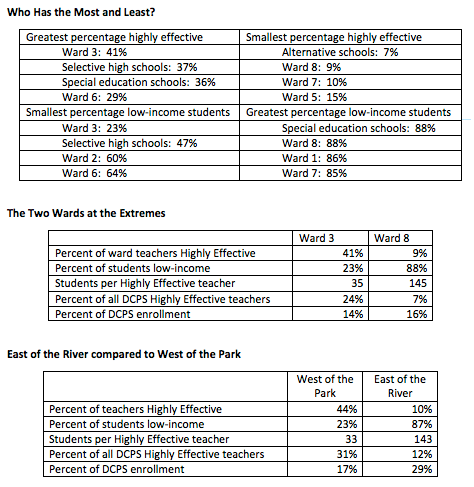
Below is the distribution of ‘highly effective’ teachers in Washington.  You need to know that Ward 3 is Washington’s wealthiest region by far, populated by upper middle class families. Only 23% of students in Ward 3 schools {{9}} are low-income.  By contrast, Ward 8 is one of the poorest parts of the city; 88% of students in Ward 8 schools are low-income.

Now look at the teacher effectiveness ratings. 41% of teachers in Ward 3 were rated ‘highly effective,’ while only 9% of Ward 8’s teachers made the grade.  Ward 3 had one ‘highly effective’ teacher for every 35 students, while the ratio in Ward 8 was 1:145.

The city is also roughly divided by Rock Creek Park and the Anacostia River. Upper income families are far more likely to live West of the Park, and 44% of teachers West of the Park were ‘highly effective.’  East of the River, where 87% of students are low income,  only 10% of teachers earned that distinction.  Just 23% of students who go to schools West of the Park are low income.  The correlation is pretty obvious, and while correlation is not causality, the implications are tough to ignore: If you want to be a highly effective teacher in Washington, choose your students carefully! On the other hand, if you want to increase the chances of losing your job, teach poor kids.

DCPS:  Distribution of Highly Effective Teachers {{10}}

DCPS:  Distribution of Highly Effective Teachers

Now let’s come full circle. What this study confirms are the findings of the PIAAC study of adults: when it comes to schooling, social and economic status are the greatest determinant of educational outcomes.

It doesn’t have to be that way, because schools and teachers can make a difference.  But when the system is narrowly focused on scores on bubble tests–as ours is–and on holding teachers ‘accountable’ for results–as we increasingly do–all bets are off.

—

[[1]]1. Some have predicted that the growth of high-stakes testing would drive competent college students away from teaching. That has not happened, the report says.  “We find that new teachers in high-stakes classrooms tend to have higher SAT scores than those in other classrooms, and that the differential in teachers’ SAT scores between the two classroom types grew by about 6 SAT percentile points between 1993 and 2008. Test-based accountability greatly increased after the 2001 passage of NCLB, but we see no evidence that more academically proficient teachers entering the workforce in the year immediately following graduation are shying away from (or at least are not being assigned to) high-stakes classrooms.”[[1]]

[[2]]2. PISA stands for Program for the International Assessment of Adult Competencies. OECD is the Organization for Economic Cooperation and Development.[[2]]

[[3]]3. It doesn’t have to be this way, of course, but as long as we remain obsessed with test scores, efforts to ‘close the gap’ will fail.  I think we may see more protests against standardized testing this school year, following last year’s refusal by some Seattle teachers to administer a test.  California seems to be the epicenter of concern and action.  Its efforts to eliminate some tests required under No Child Left Behind have produced a stern warning: it could lose as much as $15 million in federal education aid if it fails to toe the line.  John Fensterwald of EdSource has a good summary here. [[3]]

[[4]]4. Under IMPACT, which Rhee put into effect during her second year, teachers are rated on a 1-4 scale, with student test scores counting for half the rating, and observations by trained specialists from the central office counting for most of the rest of the score.  Get a ‘1’ and you’re fired, whether tenured or not.  Rhee’s successor changed the system slightly, and now student scores count for just 35%.  The flaw in this approach, as most veteran teachers know, is that teachers switch to the special “demonstration lesson” that they keep handy to impress observers.  This is often done with the knowledge and complicity of the students, I’m told.  Over the years, I have observed enough observations to be convinced of the unreliability of the approach.[[4]]

[[5]]5. This prose is worse than the usual education-speak because it’s also bad grammar: Nothing can be ‘’relatively unique.’ Just as the female of a species cannot be ‘a little bit pregnant,’ there are no degrees of uniqueness. A thing is unique–or it is not.[[5]]

[[6]]6. I asked Thomas Dee, a co-author, for more information, and he graciously replied as follows: “I think the “plain English” takeaway from our study is something like: The incentives embedded within IMPACT improved teacher performance and encouraged the voluntary attrition of low-performing teachers.

I’m seeing at least two issues about this takeaway that seem confused in the public discussion so far.

(1) A somewhat subtle issue of interpretation that seems invariably to get muddled in the broader public discussion is that we have estimated “the overall effect of IMPACT.” It’s not really possible to do that given that IMPACT went to scale district-wide and at once (it’s an experiment with a sample size of just 1!).

Our inferences are instead based on comparing the outcomes of teachers close to the rating thresholds (i.e., those with big, plausibly experimental incentive contrasts). There are at least two reasons this comparison differs from the “overall effect of IMPACT.” One is that all of these teachers are subject to IMPACT so any shared effects of this policy regime are washed out. Second, our inferences leverage only those teachers whose initial ratings placed them “close” to these thresholds. So, we can’t rule out the hypothesis that teachers who are consistently average in their measured performance perceive neither a threat of dismissal nor the lure of performance bonuses (i.e. IMPACT may have no effect on them). Interestingly, the recent redesign of IMPACT’s performance band appears designed to target the thick band of “effective” teachers.

Anyway, this interpretative issue (overall effects of a policy vs. effects of incentive contrasts within a policy) may simply be “inside baseball” for academic researchers like me. We try to be exacting in terms of what inferences we are making and we discuss this sort of issue all the time!

From a broader perspective, our results are strongly consistent with the logic model advocated by IMPACT’s proponents (i.e., these types of incentives coupled with the other design features and supports driving teacher performance and positive selection into the workforce). And this study has the imprimatur of credible causal inference (RD designs are coupled with RCTs in terms of the highest evidentiary standards in the What Works Clearinghouse). So, I think the reactions from Henderson, NCTQ, etc. are understandable.

(2) A second misunderstanding I’ve observed (possibly going back to Emma’s WaPo article) is that the study says nothing about achievement. In fact, we find effects on IVA for minimally effective teachers and effects among highly effective Group 2 teachers on their more flexibly designed achievement measure (TAS). Moreover, the results of the MET Project suggest that multiple measures (i.e., like those in IMPACT) are better at predicting future student performance than test scores alone. So, this meme seems off base to me.

I also asked Professor Dee, some other questions about the study, which he recalled began in 2011. “For most of this time, we had no external funding; no financial support (or in-kind) transfers from DCPS. We recently received a small grant from the Carnegie Corporation of NY to support this work and we’re currently seeking other research grants for further studies.”[[6]]

[[8]]8. And potentially dangerous–if it encourages other efforts to use test scores as the chief determinant of teacher effectiveness.[[8]]

[[9]]9. Mary Levy added, “Almost none of the students in Ward 3 schools who are low income live in Ward 3.”  A few schools West of the Park, including Wilson High School,  draw students from outside Ward 3.[[9]]

[[10]]10. Data provided by Mary Levy[[10]]

“Rebirth” on Netflix

I have just returned from Tokyo, where I had the honor of being the American judge for The Japan Prize. While I was away, “Rebirth: New Orleans” began live-streaming on Netflix, and I hope it’s in your queue–or that you have already watched the 1-hour film. It’s based on 6 ½ years of filming, and so the DVD, now available on the Learning Matters website, includes a lot more footage that you wonks will want to watch.

The folks in the Learning Matters office have decided to webcast a live-streamed conversation between John Tulenko and me on Monday, October 28th at 4PM Eastern. John will be asking the questions, yours and his own, and so I hope you will join us or submit your questions directly.

We would love to have your participation:
a) Tune in on Monday, October 28 at 4pm.
b) Spread the word with your network.
c) Submit any questions you or others may have about the film!

The Livestream event page

Watch REBIRTH: New Orleans on Netflix

There’s a lot more news, of course: international data, more controversy about the Common Core Standards and the like. I will weigh on next week, in case anyone is interested.

A Professional At Work

First I want to tell you about a terrific teacher–and then invite you to watch her at work. When I met Maria Eby, she was wearing a fluorescent green wig and was dressed all in green. As she passed me, I smiled and said something like “You’re either early for Halloween or late for St. Patrick’s Day.” She smiled and said something that I didn’t catch, but it didn’t matter. After all, we were filming in an arts-oriented elementary school, so it was perfectly logical that an arts teacher would appear in a weird costume.

As it happened, the film crew, producer Cat McGrath and I walked into Mrs. Eby’s class shortly afterwards, just as she was telling the first-graders that it was time to hear the story of Jack and the Beanstalk from the point of view of the Beanstalk. The light bulb went on in my head: She was the Beanstalk!

As you will see in the video, once she got into that role, she inhabited it. Not only did she explore the characters and elements of the story from the Beanstalk’s perspective, she also, as a representative of all plants, demanded to know from the kids what plants contribute to the world. The first graders knew the answers: oxygen, food and shade. Before long she invited students to join in the drama by playing other parts: the ogre, Jack and so forth, and they got into and stayed in their roles.

At one point I whispered to Cat that this woman was a terrific arts teacher. “No,” Cat whispered back, “She’s a regular first grade teacher.” Oh, wow…..

I asked Mrs. Eby to tell me how she came up with this approach. Here’s her response: “You look at your objectives for the upcoming week and you say, OK, I need to cover this, this this and this. (you ask yourself) what is the best way I can do this? What’s going to be engaging? What integrates more than one of the things at a time?”

Me: So you sat home and thought and thought, ‘I’m going to figure out a way to teach science, higher level thinking, literacy.’ Did you just dream this thing up?
Maria Eby: You kind of start at the end. You start off with what you want to accomplish and then you decide what is the best way to accomplish that, and which part of the arts can I bring into this to meet the needs of the goals and the objectives of my kids.

In other words, no one told Mrs. Eby how to get across the concepts of photosynthesis and role-playing and empathy. She’s trusted to be a the professional that she is. What a concept!

The teachers in her school, the Charles R. Bugg Creative Arts and Science A+ Magnet Elementary school in Raleigh, North Carolina, work together on curriculum, doing their best to integrate the arts into all aspects of learning. (You will see more of the school on the NewsHour soon.)

My favorite moment in the entire class was when one student said she did not want to take a role in the play because….well, you really have to see that play out, especially Mrs. Eby’s response.

Please watch this edited version of her class below (or click here.)

Maria Eby, 1st Grade Teacher, Charles R. Bugg Creative Arts and Science A+ Magnet Elementary
For 20 years Maria Eby worked in Michigan as a graphic arts designer in a company she ran with her husband. Feeling a need for a change after her 2 boys started school, she became a teacher’s assistant and eventually earned a teaching certification through Saginaw Valley State University. In 2008, when Michigan’s economy crashed, she looked for jobs in other, warmer, states. Because North Carolina and Michigan have reciprocal licenses and Wake County was recruiting, she found it an easy transition to move her family to Raleigh. Mrs. Eby took her first teaching position in her early 40s and over the past 6 years has had the opportunity to teach 1st, 3rd, 4th and 5th grade. A self proclaimed “life-long learner” Mrs. Eby is currently in the process of obtaining her Masters degree in arts integration at Lesley University. This year, in addition to Jack and the Beanstalk, Mrs. Eby has integrated Theatre Arts into teaching her 1st grade class The Three Little Pigs and the The Three Billy Goat’s Gruff. Although she enjoyed dressing up as a pig and a troll, she says the beanstalk has been her favorite role because it is a unique perspective to think about how the beanstalk might have felt.

Education Nation IV

What to make of “Education Nation,” which took over the magnificent New York Public Library for two days earlier this week and focused a great deal of national attention on a topic most of us care about?   In all, Education Nation consisted of 29 separate segments{{1}}, generally organized around the theme “What It Takes.”  I made it to 15 in person{{2}} and watched three more online.

If you are doing the math, you’ve figured out that cramming all those sessions into two days means they had to be short because this was an event made for television and the web.  And from what I saw online, it worked very well.

Education Nation has come a long way since the first one in 2010, which old NBC hands remember as “Evacuation Nation,” because a torrential downpour and windstorm forced everyone to flee Rockefeller Center for the halls of NBC’s headquarters.

These two days had some highlights and surprises.  I thought at least two stars emerged: Delaware Governor Jack Markell, who spoke forcefully about the importance of early education, and Joshua Starr, the Superintendent of Schools in Montgomery County, Maryland, who argued persuasively for multiple measures to assess both students and teachers.

The best sessions involved some give-and-take among opposing views. In one entitled “A Reality Check on Testing,” Randi Weingarten of the AFT, former Louisiana State Superintendent Paul Pastorek, New York Chancellor Dennis Walcott and the aforementioned Josh Starr disagreed, often eloquently. It helped that the session was skillfully moderated by Rehema Ellis, NBC’s reliable Chief Education Correspondent.  Weingarten told the audience about a new study of test prep (.pdf), contrasting how much time two different districts devote to getting their kids ready to take standardized tests.  Some in the audience gasped when she presented the figures: In one district, students in grades 6-11 spent 100 or more hours on test prep, the equivalent of nearly one month of school. In another district, students in grades 3-8 spent 80 hours on test prep, the equivalent of 16 days of school.  But that was the last time that issue surfaced, unfortunately.

Some sessions were content-rich, particularly the presentation by Professor Caroline Hoxby of Stanford about “Opportunity, Meritocracy and Access to Higher Education.”

She taught what Education Nation called–appropriately–a “Master Class” that showed just how many talented but poor kids fall through the cracks–and what can be done about it.

However, that was as close as Education Nation came to confronting the elephant in the room, poverty.  The disgraceful fact that nearly a quarter of American children are growing up poor simply wasn’t on the agenda, although Marian Wright Edelman, Freeman Hrabowski and John Deasy, the Los Angeles Superintendent, raised the issue during their panels.

Instead, Education Nation focused on getting parents involved, using technology to improve learning, urging students to live healthier lives, and praising students who had overcome their difficult circumstances.  It struck me as a bit like praising people for getting out of a burning building–but not calling the fire department.

In truth, many of the sessions were closer to show-and-tell infomercials than to probing journalism.  The worst offender was “Personalized Learning,” where four panelists{{3}} sang the praises of technology with nary a dissenting word or hint of skepticism.

The tone of “Education Nation” was generally pretty chummy, with very little wave-making. For example, I thought the usually reliable Brian Williams let former Florida Governor Jeb Bush off the hook in their one-on-one conversation. He began with a tough question: “Do we test our kids too much?”  Mr. Bush acted as if he had been asked “Do we need testing?” and went into a polished riff about how “you can’t become a doctor without taking tests, and you can’t get in the military without taking and passing tests,” and so on.  His “life is tough, so stop whining” routine plays well with crowds, but that was not what Brian Williams asked, and I wished he had insisted that the former Governor answer the original question.   Governor Bush also boasted about his state’s approach to high-stakes testing, the FCAT, which has been riddled with problems, and closed with a gratuitous slam on teacher unions.

Education Secretary Arne Duncan got kid gloves treatment from Matt Lauer when he appeared via satellite, so I guess that was the event’s M.O.

Four authors{{4}} participated in the 2-day event, but not Diane Ravitch, whose book, “Reign of Error,” may be outselling the other four books combined.  Her absence infuriated her supporters even more when they realized that one of the authors at Education Nation was a Hollywood screenwriter/film producer and another a first-time author.

Why wasn’t Dr. Ravitch there?  That depends on whom you ask.  A spokesman for Education Nation said that she was sent the general invitation asking her to hold the dates because, he said, “We had her here last year and wanted her here again.”  Later, he said, they asked her to be on a panel, and she declined.

I emailed Diane for her side of the story and got back this explanation:

I received an invitation to sit in the audience.

I received a second invitation to sit in the audience.

Then the list of speakers and panelists was published.

I was not invited.

I heard that many people complained–not me–that I was not invited.

Three days after the list of speakers was announced, I got a call from a producer asking if I would serve on a panel where they had an opening.

I said that they had already published their A list and I wasn’t on it. I don’t like the idea of being an afterthought. I also found it offensive that their A list was heavily weighted with CEOs and right wing governors.

I said no thank you.

So it is true that I was not invited. And true that when they reacted to pressure and invited me, I turned them down.

Here’s the irony: The media room distributed a 5-page fact sheet (.pdf) about the state of American education, including these bold points:

HIGH SCHOOL GRADUATION RATES ARE AT THEIR HIGHEST LEVEL IN 40 YEARS.
HIGH SCHOOL COMPLETION AMONG MINORITY GROUPS HAS IMPROVED DRAMATICALLY.
NUMBER OF STUDENTS ATTENDING COLLEGE CONTINUES TO INCREASE.
U.S. RANKING FOR COLLEGE COMPLETION CONTINUES TO IMPROVE.

Where else could you find that kind of positive information?  (Answer: “Reign of Error”)

Wouldn’t it have been valuable to debate whether these improvements are occurring because of the accountability movement–or in spite of it?  And who better to argue one side of that than Dr. Ravitch?

Many accuse “Education Nation” of tilting to the right and blame Pearson, Exxon-Mobil and the University of Phoenix, three of its five lead sponsors.  That’s not my problem.  My issue with the enterprise is that its tone is almost relentlessly positive, focusing on ‘What It Takes’ but then failing to ask tough follow-up questions like ‘What Stands in the Way?’ or ‘Who Benefits from Failure?’ or any other questions whose answers might afflict the comfortable.

Because Education Nation is purporting to show America that we know ‘What It Takes’ to succeed, then someone must ask logical follow up questions like ‘Why Aren’t We Doing It?’

But, that criticism aside, NBC deserves great praise for the venture, which is, after all, a work in progress. More than any other education conference, Education Nation has the potential to move the needle.  The event has become education’s Super Bowl, which is why I’m already looking forward to attending “Education Nation V” next year.{{5}}

—-

[[1]] 1. Plus three Innovation Competition segments and a bunch of breaks.[[1]]

[[2]] 2. I was part of the final event, a gaggle of journalists ably moderated by Chelsea Clinton.  The panel (Jane Williams, Andy Rotherham, and Rehema Ellis were the other three) was a last-minute addition when the government shutdown prevented the First Lady from making a ‘surprise’ appearance.[[2]]

[[3]]3. Joel Klein of Amplify, Jose Ferreira of Knewton, Diane Tavenner of Summit (Charter) Public Schools and Joel Rose of New Classrooms Innovation Partners.[[3]]

[[4]]4. Amanda Ripley (The Smartest Kids in the World), Anne Henderson (Beyond the Bake Sale), Alison Stewart (First Class: The Legacy of Dunbar, America’s First Black Public High School) and M. Night Shyamalan (I Got Schooled).[[4]]

[[5]]5. If I am invited……[[5]]

Valuing Teachers

How do we–the collective we–feel about teachers? The granddaddy of all surveys about public education is The MetLife Survey of the American Teacher. It established the brand in 1984 and has, to this observer anyway, become better,deeper and more nuanced over time. {{1}}

There are other education surveys, of course.{{2}} The Bill and Melinda Gates Foundation and Scholastic produce an important survey of 40,000 US teachers they call “Primary Sources.”

And every year Gallup and Phi Delta Kappa survey registered US voters on their attitudes toward public education.

Surveys can be misleading or wrong; much depends on the quality of the process, the reliability of the sample and the way the questions are phrased, but, that said, it’s worth surveying the surveys, especially now that there’s a new kid in town, an international (21 countries) survey of public attitudes toward teachers and teaching [.pdf].

The Varkey GEMS{{3}} Foundation reports that it surveyed 1000 representative adults in each of 21 countries{{4}} including the United States. A major conclusion drawn by the Foundation, which is based in the United Kingdom, is that teaching is not held in high enough esteem. “Unless teaching is valued culturally, then the incentive of better pay will not be enough,” the introduction notes, adding: “There are many fictional representations of heroic doctors saving lives on television — from Grey’s Anatomy to ER and House — but hardly any equivalent stories of teachers turning lives around. Every year International Nurses’ Day is celebrated in the UK with a service in Westminster Abbey. President Reagan introduced National Nurses’ Day in the US, which is an opportunity for the media to highlight the achievements of nurses. However, the equivalent in education, World Teachers’ Day, is mostly ignored. We need to think harder, push further, and dream bigger, if we are to find ways of truly celebrating the ‘noble’ profession.”

But the finding that jumps off the page is the overwhelming support for pay-for-performance.

If you don’t have time to go through the document, I offer this review of the highlights regarding teacher status, pay and respect; the role of unions; and that always-interesting question, “Would you want your child to become a teacher?”

STATUS: Teaching ranked 7th of 14 professions across the 21 nations, highest in China, where teachers are most often likened to doctors, and lowest in Israel. In the US, teachers are seen as culturally similar to librarians. These findings struck Andreas Schleicher, the guiding light behind PISA, as questionable because, as he notes in his lukewarm introduction to the survey, Finland ranked 13th {{5}} in public status, while Greece ranked 2nd despite its poor academic performance on PISA. In fact, public status was often inversely correlated with academic performance. Go figure. (See Fig. 11 [.pdf])

TRUST: As the PDK/Gallup survey also reported, teachers are generally trusted. Across the 21 countries, the average “trust” score for teachers was 6.3 out of 10, and no country scored below 5. Finland and Brazil score highest in this category, while Israel, South Korea, Egypt and Japan are the least trusting of teachers.

PAY: Respondents in most countries think teachers should be paid more, but many adults have no clue about how much they actually earn. Respondents in the US are a great example. They think that teachers make about $36,000 a year but believe they should paid about $40,000. However, the true average salary, the study says, is $46,000. This falls in the category of “If they only knew…..”

PAY-FOR-PERFORMANCE: In a section that is unrelated to the actual survey, the Varkey GEMS report links PISA scores and teacher pay, and reports that there is little or no correlation between the two. In other words, right now most teachers are not paid according to their students’ performance. That sets up what follows.

The report poses a question: “Should teachers be rewarded in pay according to their pupils’ results?” That elicited an overwhelmingly positive answer in every country. The US was one of eight countries where 80% of respondents said “Yes.{{6}} That’s higher than I’ve seen in other surveys, but, if the question was actually phrased that way without any discussion of the complexities of the issue, how else could it have turned out?

Scroll down to the bottom, and you can read the actual questions. Here’s how the “Pay for Performance” approval numbers were produced, not by a direct question but by this list.

Q11 To what extent do you agree or disagree with each of
the following statements?
A. Being an effective teacher requires rigorous training
B. It is too easy to become a teacher
C. The quality of teachers is too variable
D. Pupils respect teachers
E. The teachers in my children’s school are respected
by their pupils
F. Teachers work hard
G. Teachers should be rewarded in pay according to
their pupils’ results
H. Teachers should be rewarded in pay for the effort
they put into their job

Unfortunately the survey does not report how the public feels about pay for effort, or whether people believe that teachers work hard. And wouldn’t you like to know if most people feel it’s too easy to become a teacher?

UNIONS: Do unions have too much influence? The results are mixed, but the interpretation is fascinating. Here’s the relevant passage: “Interestingly, some of the countries with the most recent history of teacher union unrest and direct action, such as Japan, Greece, France and the US, have the highest proportions of people who think teacher unions have too much influence. In contrast, the Czech Republic, China, Egypt and Turkey have the lowest number of people who suggest that teachers unions have too much influence. It is also these countries where teacher unions have played a less important political role.”

They seem to be telling us “The less people know about teacher unions, the more they like them.” And its converse: ”The more they know about unions, the less they like them.” I wonder whether that passage reveals more about the survey’s funders and designers than about the survey results.

To me, the money questions are the personal ones, such as “Would you want your child to be a public school teacher?” According to the survey, only ⅓ of US respondents would ‘probably encourage’ or ‘definitely encourage’ their child to become a teacher. Still, that’s higher than in 14 other countries. At the bottom are Israel, Portugal and Japan, but supposedly only 20% of Finnish adults would encourage their child to teach. Parents in China, South Korea, Turkey and Egypt are most likely to give encouragement to children to become teachers.

Surveys like this one are broad-brush at best. As for this particular study, I am reluctant to place much trust in its conclusions, because I suspect the folks in charge began with some biases about teacher pay and the role of unions.

The nitty-gritty requires a fine-tuned instrument. I want to know whether the chef eats in his or her own restaurant. Do teachers and administrators enroll their own children{{7}} in the schools they work in? If the answers are in the negative, then I would choose another restaurant for my family and would want my grandchildren in some other school.

—–
[[1]]1. I learned recently that the parent company, Met Life, is seriously contemplating abandoning the survey. I hope that’s not true because it really has branded Met Life as a serious and socially-concerned company.[[1]]

[[2]]2. When the US government reopens for business, go here. ‎[[2]]

[[3]]3. Varkey GEMS seem to have some skin in the game. From the company website: “GEMS Education is the largest kindergarten to grade 12 private education provider in the world.” and “GEMS Education is an international K-12 education company that owns and operates high performing schools. It also offers consulting services to both the public and private sectors. For over 50 years, GEMS Education has provided high quality education to hundreds of thousands of children around the world.
GEMS has a global network of award winning schools which provide high quality holistic education to more than 142,000 students from 151 countries. It employs over 11,000 education professionals, specialists and staff. GEMS has a world class leadership team that combines business and education expertise from around the globe.
The GEMS Education school model is unique in the world because it offers a broad range of curricula across a range of tuition fees making private education more accessible to the broader community. GEMS Education also supports Governments’ education reform agenda by working with Ministries of Education to lift school performance and improve the standards and expertise in government schools across the globe.”[[3]]

[[4]]4. This was not the normal face-to-face or telephone survey but instead a computer-based process. That process was cheaper and more efficient (only 4 weeks), the survey report explains.[[4]]

[[5]]5. Every other report I have come across says that teachers and teaching in Finland are highly respected.[[5]]

[[6]]6. In Egypt the figure was over 90%, while in Israel, China, Brazil and New Zealand the figure was over 80%. The Czech Republic and Finland hit an even 80%. Portugal and Turkey were in the high 70s.[[6]]

[[7]]7. I just returned from a school where virtually all the teachers with school-age children enroll their children there. Watch for it on the NewsHour soon.[[7]]

Do We Need More Heroes?

The words ‘hero’, ‘heroic’ and ‘heroism’ are overused in America. Think, for example, how often those words are tossed around in reports about athletics, as if running with a football and dunking a basketball were acts of heroism.  People talk about ‘everyday heroes,’ as if doing your job every day–even a tough job like teaching in the inner city–was heroic behavior.{{1}}

We need to be more discerning in our use of those words.  We shouldn’t be so quick to crown people as heroes, because doing so dilutes the meaning of heroism.

Deep down, a lot of people realize this.  I say this because nowadays the word ‘genuine’ is often attached to the word, as in “She’s a genuine hero.”

Most of us will never–knock wood–know if we have what it takes to be a hero.  We will never face a raging fire, roaring flood waters, or a crazed gunman and have to make a split-second, life-or-death decision.

The teachers and administrators at Sandy Hook Elementary Schools–those who lived and those who lost their lives–are heroes.  They exemplify the best in the education profession, and they remind us of how good and strong people can be.

Those were my words on Saturday night in Washington while presenting an award from the Academy of Education Arts and Sciences to the teachers of Newtown. I have no doubt about their heroism. When they were tested, they responded heroically.

But I also have no doubt that we toss around that word, hero, far too easily. For example, Ted Cruz, the US Senator from Texas, is a hero to some on the extreme right because of his strident opposition to Obamacare.  Over on the left, Diane Ravitch is a hero to those who share her views on what is happening in public education.  Since when does taking a strong public stand qualify as an act of heroism?  Call them ‘crusaders’ or ‘principled leaders’ or some other term of approval if you wish, but not heroes.

I believe many people are uncomfortable with the way ‘hero’ is used.  Here’s my reasoning: When a noun needs modifiers, it’s a clear signal that the word has lost its original meaning. Take ‘politician’ as an example.  This word is rarely unadorned these days. Someone is a ‘thoughtful politician,’  ‘unconventional politician’ ‘not your typical politician,’ ‘a well-respected politician,’ or (shudder) ‘an honest politician.’  Enough said.

I think that is what has happened with ‘hero.’  Because of our culture of excess and a glut of ‘heroes,’ the noun is routinely modified.  We have ‘genuine heroes,’ ‘everyday heroes,’ ‘unassuming heroes,’ ‘hero worship’ and–of course–’Super heroes.’

So I am wondering how many of us have (genuine) heroes in our lives.  Do you?  Are there living people you identify as your heroes?  The only person who comes easily to my mind is Nelson Mandela.

An older friend told me that he didn’t have any living heroes, and he doubted whether most people did these days, because of the 24-hour news cycle and the power of the internet to allow everyone to dig up dirt on anyone of prominence.  No one can keep their feet of clay (or their sex tape) hidden for long, he said.

Some say we need more heroes in our lives, but I am more comfortable with “role model” than with ‘hero.’  There’s a long list of role models whose positions, behavior or humanity I wish to emulate.  I respect and admire these men and women, even though I know they are not perfect human beings.

Perhaps I am just getting crotchety as I get older, but I would like to see us tone down our language.  I am pretty certain that the same people who idolize Ted Cruz or Diane Ravitch are equally vehement in their disdain for anyone who dares to disagree with their hero (and them).  These people inhabit a comic book world without ambiguity where heroes require villains.  Our society makes it easy to live in a black-and-white world without nuances–you can watch either Fox or MSNBC, but not both!

Unfortunately, the hero/villain polarization can cause us to lose sight of all the good, decent (and flawed) people who are trying to make the world a better place.  Polarization not only doesn’t move the ball forward; it’s a step backward.

In his speech accepting the Harold W. McGraw Jr. Prize in Education Tuesday night, Dave Levin of KIPP reminded us that fixing public education was “messy” work.  Extreme positions weren’t effective, he told us.  “Should we use test scores to assess students and teachers?” he asked?  “Yes,” he said, “but we have to have lots of other measures as well.”  He called it “the messy middle” where the work is hard and the job is never done.

I know what Levin is talking about.  My colleagues and I spent 6 ½ long years documenting the struggle to rebuild New Orleans’ schools after Hurricane Katrina and the flooding.  On October 22, “Rebirth,” our 1-hour film will premiere nationwide on Netflix (and will be live-streamed for 24 months in nine languages).  I am sure it will inflame those on the extremes, both left and right, because it fails to either completely endorse what is happening there or to condemn it outright.  It’s that “messy middle” that Dave Levin was talking about.

There are no silver bullets, Levin said, and I agree.  Moreover, searching for them, like hero-worship, is a waste of precious time and energy.

—-

[[1]]1. CNN has an annual competition for the Top 10 unknown everyday heroes of the year.  The winners for 2013 will be revealed on October 10th.[[1]]

A Heartbreaking – And Preventable – Death

The official records note Rebecca Sedwick’s death as a suicide.  There’s no disputing that the 12-year-old jumped to her death from an abandoned cement plant in Lakeland, Florida, on September 9, but what happened to her requires new terminology.  Perhaps we should call it “peer-icide” or “peer-slaughter” to convey what killed Rebecca, who had been “absolutely terrorized on social media” by 15 middle school girls for over a year, according to the Sheriff of Polk County, Grady Judd.

Preventing tragedies like this requires more than vigilance by parents and educators. Anti-bullying campaigns can’t hurt, but unless schools are proactive in their use of technology so that the energies of young people are engaged in meaningful ways, idle hands (and thumbs) will continue to do the devil’s work.

‘Mean girls’ are not a new phenomenon.  What is new and frightening are the weapons at their disposal, an array of apps that allow users to post and send messages anonymously.  Rebecca’s mother singled out ask.fm, Kik Messenger and Voxer as three the girls had used to send messages like “You’re ugly,” “Can U die please?” and “Why are you still alive?”

Rebecca is one of the youngest children to die in what is reported to be a growing number of victims of cyberbullying.  About 20 percent of young people have been victimized, according to the Cyberbullying Research Center, a clearinghouse of information on cyberbullying. About 15 percent of teens admit that they have bullied or ridiculed others on social media, photo-sharing and other websites, according to the Center.

“It’s now 24-7. It’s not just something you can escape after the school day,” Sameer Hinduja, co-director of the Cyberbullying Research Center, told the Orlando Sentinel. 

Rebecca and her mother, Tricia Norman, fought back.  Ms. Norman told the New York Times that she closed down Rebecca’s Facebook page and monitored her cellphone use.  She changed the cellphone number and kept tabs on her social media footprint.  Rebecca changed schools, and, for a while, her life seemed to have turned around.  Then she began using the new Apps, setting off a new round of cyberbullying.  (Apparently her original ‘offense’ was showing interest in a boy that one of the other girls liked.)

“I don’t want parents to wait for a tragedy to have those conversations,” Cherie Benjoseph, Co-Founder of Boca Raton-based KidSafe Foundation, Inc told WPTV. “We’re all still pretty naive on many levels,” she said. “We’re all still crossing our fingers and hoping it doesn’t happen to our children.”

Benjoseph said that Sedwick’s suicide should be a wake-up call to all parents to demand to know what their their kids are really doing online. Keeping computers and phones out of a child’s bedroom is another good move, she says, because what teens do online must not be off-limits to parents. “Our children sometimes lead double lives,” she said.

It probably makes sense to have certain ‘device-free’ times at home, especially at meal times.  It’s difficult to know what’s going on in your children’s life if they are always looking at screens.

Bedrooms should be device-free.  I know parents who’ve placed a basket at the foot of the stairs, and everyone (including the adults) is required to leave their phones in the basket when they head upstairs to bed.  The phones recharge downstairs, the humans upstairs.  Computers and tablets belong in common spaces, not in bedrooms.

Getting all parents to adopt sensible policies and practices is unrealistic, particularly in a time when a lot of parents seem to negotiate every decision with their children, no matter how young they may be.  But even if all parents were to adopt these practices, little will change unless the schools do the right thing.

Schools are where most children are, and adults there can set the tone and–more importantly–determine what kids do with their devices. I often hear adults describing today’s young people as ‘digital natives,’ usually with a tone of resignation or acceptance: “They are so far ahead of us, but we can turn to them for help,” is the general message I hear.

That kind of thinking smacks of abdication of adult responsibility. Yes, most young people know more than we adults because the fast-changing world of modern technology is alien to us, wildly different from the one we grew up in. But being a ‘digital native’ is not the same as being a ‘digital citizen.’ Young people have always needed ethical guidance and the security of rules and boundaries. That’s truer now because apps like ask.fm, Kik Messenger and Voxer allow kids to ‘go nuclear’ without fear of being identified.  Kids who spend hours every day on their devices are unlikely to develop empathy for others, and it’s a lack of empathy that seems to fuel cyberbullying.

Photo Credit: Susan Landmann

Some experts say that kids spend ninety percent of their tech time consuming, and perhaps one percent doing creative work.  If that’s accurate–texting, playing Angry Birds and Grand Theft Auto, linking up on Facebook and Google Circles, sexting and cyberbullying 90 percent of the time–then we adults should be ashamed.

Unless, of course, we are equally guilty of obsessing over our devices.

A central function of schools is what’s often called ‘socialization.’  It might be more useful to substitute ‘developing empathy’ for ‘socialization.’  As Catherine Steiner-Adair notes in her new book, The Big Disconnect, “Empathy might seem a ‘soft’ skill when compared to reading, writing, and math, but it is actually a neurological phenomenon as well as a soulful one,” adding “The development of empathy comes from direct experience…”

Cathy Davidson of Duke says much the same thing: “The brain is what it does.”

Both are echoing the timeless wisdom of Aristotle: “We are what we repeatedly do.”

In my experience,  the education community uses technology 90 percent of its time to control, and perhaps 10 percent to create.  I mean ‘control’ broadly, everything from keeping the school’s master schedule, monitoring attendance and grades, tracking teacher performance, and imparting the knowledge we believe kids need to have.  That’s the complete opposite of what should be happening.

Because an important purpose of school is to help ‘grow adults,’ then the creative use of technology — by adults and young people — must be ramped up dramatically.

Students ought to be using today’s technologies to create knowledge and to find answers to important questions. If they aren’t doing that, then those idle hands and thumbs will be doing the devil’s work, as those girls in South Florida were doing.

Schools today must provide opportunities for young people to create knowledge out of the swirling clouds of information that surround them 24/7. You and I went to school because that’s where the knowledge was stored. That was yesterday. Think how different today’s world is. Today’s young people need guidance in sifting through the flood of information and turning it into knowledge. They need to be able to formulate good questions–because computers have all the answers.

Here are a few ways to harness technology and foster creativity.

1 Every middle school science class could have its own hand-held air quality monitor (under $200). Students could take air quality measurements three times a day, chart the readings, share the information in real time with every other middle school science class in the city, region or state, and scour the data for consistencies and anomalies. That’s creating knowledge out of the flood of information, and it’s real work, not ‘homework.

2. Students could use their smart phones’ cameras to map their own neighborhoods, documenting (for example) the number of trash cans on street corners. That information could be plotted and shared city-wide, and the data could be examined for patterns and anomalies. Are there more trash cans in wealthy areas? If so, ask the Mayor, the Department of Sanitation and the City Council for an explanation. Again, students will be turning information into knowledge. (I wrote about this in more detail here.)

3. Why not measure water quality? A hand-held monitor/tester of Ph costs under $100, and the instrument that tests conductivity (ion levels, which relates to purity) is available for under $100. Turbidity — how cloudy the water is — is important to measure as well, and that can be done with an inexpensive instrument and a formula. Students could also measure the speed of the current and keep track of detritus. Then share all the data with other science classes around the city, region and state. Everyone could dig into the information looking for patterns. If one river’s water seems relatively pure until it passes point X, students could endeavor to find out why.

Work like this is, well, real work. Students are creating knowledge; they are designing projects and seeing them through from beginning to end. These projects have to meet real-world standards because the results are in public view.

(The rest of the curriculum ought to be designed to engage learners, of course.  Project-based learning makes sense to me, if the projects are genuine explorations of meaningful topics.  Working together toward real goals is one avenue to developing empathy.  And I think it goes without saying that educators need to pay more attention to the social and emotional needs of students.  I’ve been in schools which set aside a period a day for the school equivalent of a hospital’s grand rounds: everyone who has Rasheed or Anita in class has the opportunity to talk about how those individual kids are doing–and not just in subject matter mastery.)

When schools do these things, young people will be learning (or reinforcing) real-world skills that will help them once they move out of school. They’re working together, they are gathering, assimilating and analyzing data, they are learning how to present what they are learning, and so on. They will be working with numbers and writing persuasive reports. No doubt some will be speaking publicly about their findings. This is career-track stuff, 180 degrees different from the ‘regurgitation education’ that is the hallmark of most education today.

And it’s a zero-sum game: The hours they spend on projects like these are hours they cannot spend consuming technology. And because they are using technology to create, they will not be bored–and will be less likely to use technology’s power negatively.  Stronger in their own sense of self, they will probably be less likely to feel the need to cyber-bully others.  Had Rebecca Sedwick’s schools taken this approach, she might be alive today.

We cannot wish today’s powerful technology away or keep it out of our children’s hands.  It’s naive to think that anti-bullying campaigns and posters will be sufficient.

Technology, which is value-free, can be used for good or ill. How it is used in schools depends in large part on us.

No More Rhee

I am done reporting about Michelle Rhee. For one thing, there are many education stories of greater national significance to cover. But I have also been advised by trusted friends to get off the Rhee story because, as one said, “It’s beginning to look like a vendetta, and some people say you are ‘picking on poor Michelle.’”

Another friend believes I’ve become obsessed. That stopped me in my tracks. Was I like Carrie, the heroine of “Homeland”? Think of the opening sequence of the series, where she (Claire Danes) is obsessing over having missed warning signs before 9/11. Her supervisor, Saul (Mandy Patinkin), attempts to reassure her by saying “We all missed something,” and she blurts out, “I’m not everyone.”

I guess I do feel a bit like Carrie. I had unprecedented access to Rhee during her Chancellorship, and I missed some warning signs that all was not legitimate. I was not skeptical enough back then, and my failure then partially explains my desire to get it right this time.

But there’s more to my ‘obsession.’ Once producer Mike Joseloff, researcher Catherine Rentz and I began tugging on threads during our Frontline investigation, the enterprise took on a life of its own. Learning that “the truth is out there” fueled my determination to uncover it. In the Cub Scouts we were taught that “cheaters never win, and winners never cheat,” and I’ve never completely lost that naive optimism, despite lots of evidence to the contrary.

If you have followed the story, you know that we did not get Dr. Sandy Sanford’s confidential memo in time to include it in the Frontline program. The memo (.pdf) showed up on my desk in a plain white envelope a few weeks later and proved to be ‘the smoking gun’ that showed just how much Rhee knew about the erasures–and made her failure to investigate all the more revealing about her educational priorities.

We reported on Frontline about the inadequacy of the DC Inspector General’s investigation into the widespread erasures–but not on the other investigations that Rhee and her successor, Kaya Henderson, regularly cite as ‘proof’ that they have been exonerated. So of course I then looked into those and discovered that they were superficial in nature and/or largely controlled by Rhee.

The Atlanta scandal was running on a parallel track, and so contrasting the two newspapers’ treatment was a natural story to follow. It was sad and disappointing to see how the Washington Post’s editorial pages have functioned as a cheerleader for Rhee, but facts are facts.

The refusal of Washington DC’s Mayor and the City Council to dig into this story also fueled my determination to get it out, particularly because the schools in DC are worse today by almost every conceivable measure. The leader of this ‘see no evil’ crowd has been Councilmember David Catania, who, as head of the education subcommittee, has made it clear that he has no interest in ‘digging up the past.’

Another factor in my obsession with getting at the truth was an “off the record” conversation with a top leader in DC who was in a position to intervene early but apparently lacked the courage. That same person had similar “off the record” conversations with at least two other reporters, giving them damning information that they were unable to use publicly. I can’t and won’t identify that individual, although I wish I could.

Our Frontline program introduced a whistle-blower, principal Adell Cothorne, to a national audience. I wrote about her in my blog, feeling that readers ought to know more about her courageous stand. As I reported, she gave up her DCPS principalship and opened a bakery, a loss to public education (and a huge salary cut for her). Well, I am happy to tell you that Adell Cothorne is back where she belongs, in education. She’s working with the great Catherine Snow at the Harvard Graduate School of Education in a project called SERP for “Strategic Education Research Partnership.” This work keeps her in schools, working with teachers, principals, district staff and students, as she helps implement a vocabulary building program for kids in 4th-8th grade. She is also a member of the Leadership Faculty for ASCD, providing professional development for current and aspiring administrators. Her new beginning is a well-deserved happy ending.

People often asked me how I feel about Michelle Rhee. She was great fun to cover, because she’s bright and confident and tireless. She was a great interview, candid and forthright (at least until she hired a slick PR person, Anita Dunn, to shape her image and teach her political tricks of the trade). As Rhee’s biographer, Richard Whitmire, told Frontline, Rhee is “a zealot.” As she told me, she does not look back and reflect; she does not have any regrets because she’s too busy moving forward. She lives in a black-and-white world. I don’t think she’s a cheater, but it’s clear that she failed a fundamental test of leadership when confronted with strong evidence that adults on her watch cheated.

But Michelle Rhee is not the point of all this. What matters much more is what she failed to accomplish in Washington. She espoused a certain approach to reforming failing schools, a path that she and her successor have followed for six years, and that approach has not worked. That’s the central point: Rhee’s “scorched earth” approach of fear, intimidation and reliance on standardized tests scores to judge (and fire) teachers and principals does not lead to improved schools, educational opportunities, graduation rates or any of the other goals that she presumably embraces.

Full disclosure: I am still trying to get copies of the emails between Sandy Sanford and his immediate supervisor, Erin McGoldrick, using the provisions of the Freedom of Information Act (FOIA). For over a year now, DCPS has managed to avoid finding any electronic communication between them, except for his invoices. It has been a comedy of errors: DCPS has entered incorrect search terms and even a wrong email address–and then reported (surprise!) that it could not find any communications. We’ve appealed each time, and each time the Mayor’s General Counsel has told DCPS to search again. If the Mayor’s General Counsel were to do more than chide DCPS, perhaps we would get their emails, and that might shed more light on the situation. If that happens, I will be back on the story.

And if another insider were to come forward with more information about the cover-up, I would return to the story.

But as of now, I’m back on the education beat where I belong.