In December 2023 The New York Times filed suit against Artificial Intelligence for allegedly using its stories without attribution. Now The Times has upped the ante, accusing A.I. of first degree murder for the senseless killing of student writing.
“Not so,” replied A.I. (which is defending itself without benefit of counsel). “We are innocent. Student writing was stone cold, deader than a doornail, when we arrived on the scene.” A.I. went on to say, “We have a rock-solid unbreakable alibi: we weren’t even around when the crime took place!”
Turns out, that’s true.
In its front page story, “How A.I. Killed Student Writing (And Revived It),” The Times makes sweeping generalizations based on what 400 (out of 5.5 million) college and school teachers volunteered. Granted, most of these 5.5 million teachers aren’t teaching writing, but relying on self-selected sources seems dubious, especially for the front page. What we learn is that a few creative and dedicated teachers, frustrated by their students’ reliance on A.I., are having the kids write in class, on paper, with pens or pencils.
More than a year ago the Wall Street Journal reported the same story, based largely on the dramatic rise in the sale of ‘blue books’ on college campuses: “Sales of blue books this school year were up more than 30% at Texas A&M University and nearly 50% at the University of Florida. The improbable growth was even more impressive at the University of California, Berkeley. Over the past two academic years, blue-book sales at the Cal Student Store were up 80%”
Both reports hang on the same premise: Student writing is dead, and A.I. is the killer. I think that’s flat out false. Most education systems stopped trying to teach writing when Artificial Intelligence was still the stuff of science fiction. Playing up to politicians, many education bureaucrats and administrators (who generally don’t trust teachers) decided the way to ‘raise standards’ was to require students to write more papers and read more books and plays (or excerpts!). Any suggestion that writing one outstanding paper would be better than six or a dozen so-so papers fell on deaf ears. Quantity triumphed over quality, almost never a good outcome….
And because writing skills can’t be tested by a machine, why bother trying to teach them? Moreover, since we don’t trust teachers, it would be foolish to rely on their evaluation of their students’ writing skills.
The murder weapon? Machine-scored multiple choice tests.
The killers? Test-score obsessed politicians and education bureaucrats.
Did they have accomplices? Maybe we need to look in the mirror.
Happily, lots of teachers have not given up. A Google search turns up a treasure trove of ideas for improving student writing, starting in the elementary years. Writing thank you notes, keeping a journal, and so on. Here’s one you might want to share with teachers in your world.
It’s not semantics to assert that the goal is to develop writers, not “teach writing.” That’s an important distinction.
So what can teachers who want to develop writers do? First of all, take a deep breath because we’ve been through this before. Back when the internet emerged, some students figured out that they could download papers and submit them as their own. Next came profit-making companies offering papers written to order. While bureaucrats thought they could win that struggle by spending millions on technology to scan papers and (supposedly) detect plagiarism, thoughtful teachers triumphed by 1) reducing the number of papers assigned, and 2) working with individual students as they developed their ideas and wrote drafts. It’s harder to cheat if the teacher is overseeing the process and kids are writing about something they genuinely care about.
What’s called for now is emulating what my high school English teacher, Mr. William Sullivan, did nearly 70 years ago.
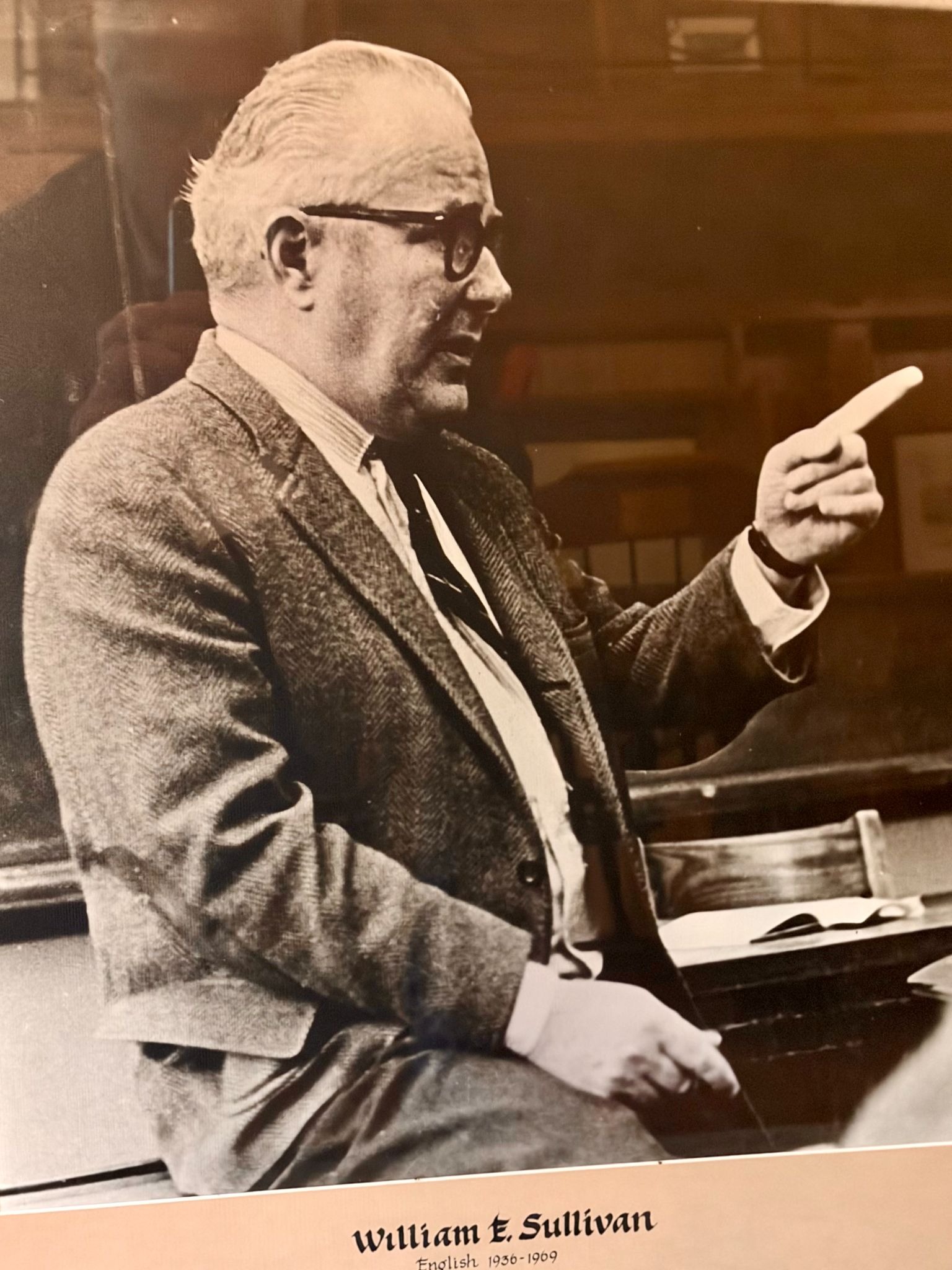
Two or three times every week he would tell us to clear our desks of everything except for a single sheet of paper and a pencil. What followed was what he called a “2-8-2,” meaning that we had two minutes to think–no writing allowed–followed by eight minutes to write, and then two more minutes to read what we had written and correct any errors. He would put our writing assignment on the blackboard.
Sometimes we would have to include a certain sentence, such as “I wish I had missed that train.” Or “I still wish I hadn’t missed that flight.”
Even today I can remember one particular assignment: “Turn out the light; I don’t want to go home in the dark,” which Mr. Sullivan said were the dying words of William Sydney Porter. Of course, he challenged us to explain the contradiction.
(Fun fact: Some forty or fifty years later I discovered that Porter, whom we know as O. Henry, actually did not contradict himself. His dying words were “Turn up the lights. I don’t want to go home in the dark.” Apparently Mr. Sullivan changed his words to create that challenging paradox.)
Although I went to Taft, a private school in Connecticut with small classes and privileged students, Mr. Sullivan’s approach can work at all levels. I know this to be true because I taught working-class kids in a public high school, first generation African American college students in an HBCU, and young men serving sentences in a federal prison.
I used Mr. Sullivan’s “2-8-2” all the time, and I believe the experience started many of my students down the path to becoming thoughtful writers.
Frequent in-class writing worked then, and it should work in the age of Artificial Intelligence, CHATgpt, Bard, and whatever other ‘advances’ are in our future.
However, policymakers and administrators have to behave sensibly and understand that ‘less is more.’ That means smaller classes, fewer students per teacher, and heightened trust in teachers. Those shouldn’t be a bridge too far, if we truly want our young people to be thoughtful and capable citizens.
You may stop here if you wish. What follows is the story of my own dabbling in A.I., printed in my blog in April 2023, more than three years ago.
If you’re at all like me, you’re curious about Artificial Intelligence and new applications like ChatGPT and Bard. The brilliant Thomas Friedman of the New York Times says the world will never be the same again, but my interest is narrower: If students can simply ask Bard or ChatGPT to write their papers for them, how can teachers prevent this from happening?
So, naturally, I turned to Bard, which told me (within seconds) that, while it can help students generate ideas, do research, improve their writing, and learn about different writing genres, it’s not supposed to be a substitute for original research and writing. Then it warned me to “Monitor students’ use of Bard to make sure that they are not plagiarizing or engaging in other forms of academic misconduct.”
Yeah, right. If I’m teaching English in a public high school, I probably have between 100 and 125 students! There aren’t enough hours in the day….
Second question: Can Bard help identify cheaters and plagiarists? Within seconds, I received an answer:
“There are a few things you can look for to tell the difference between original writing and prose provided by Bard.
- Original writing is typically more creative and original than prose provided by Bard. Bard is trained on a massive dataset of text, so it can be very good at generating text that is grammatically correct and factually accurate. However, it is not always able to generate text that is creative or original.
- Original writing is typically more personal and engaging than prose provided by Bard. Bard is a machine learning model, so it does not have the same level of understanding of human emotions and experiences as a human writer. As a result, its writing can be dry and impersonal.
- Original writing is typically more nuanced and complex than prose provided by Bard. Bard is a large language model, but it is still under development. As a result, it can sometimes struggle to understand the nuances of human language. This can lead to writing that is simplistic or even nonsensical.
- Ask yourself if the writing sounds like it was written by a human. Bard-generated text can sometimes sound robotic or unnatural. Original writing should sound like it was written by a human.
To put this the test, I gave Bard the following task:
Please write a short memoir of no more than 200 words about my childhood. I am one of six children, the second oldest and the first-born son. We grew up on a small farm with chickens, a few cows, a few pigs, and one goat. I’m now 81.
Within seconds, Bard spit out this:
“I was born in 1942, the second oldest of six children. We grew up on a small farm in the Midwest. My father worked hard to provide for our family, and my mother took care of the house and the children. We didn’t have much money, but we were happy.
I loved growing up on the farm. I spent my days playing with my siblings, helping my father with the chores, and exploring the woods behind our house. We had chickens, a few cows, a few pigs, and one goat. I loved taking care of the animals, and I learned a lot about hard work and responsibility.
I also learned a lot about nature on the farm. I spent hours watching the birds and the animals, and I learned to identify all the different plants. I loved being surrounded by nature, and it helped me to appreciate the beauty of the world.
I had a wonderful childhood on the farm. It was a time of innocence and discovery, and I will always cherish those memories.
Now that I am 81 years old, I still look back on my childhood with fondness. I am grateful for the opportunities I had, and I am proud of the person I have become. I know that my experiences on the farm helped to shape me into the man I am today.
Boring, and also wrong, and so I responded: This is inaccurate. I was born in 1941, and our farm was in Connecticut. Worse, however, it does not capture either the small pleasures of collecting the eggs every morning or learning to milk cows; nor does it capture the deep pain of watching a pig or steer that I raised being slaughtered. Please rewrite.
In just a few seconds, Bard responded by adding a few paragraphs, highlighted below to make it easier for you to read: “Sure, here is a more accurate and detailed memoir:
I was born in 1941, the second oldest of six children. We grew up on a small farm in Connecticut. My father worked hard to provide for our family, and my mother took care of the house and the children. We didn’t have much money, but we were happy.
I loved growing up on the farm. I spent my days playing with my siblings, helping my father with the chores, and exploring the woods behind our house. We had chickens, a few cows, a few pigs, and one goat. I loved taking care of the animals, and I learned a lot about hard work and responsibility.
I also learned a lot about nature on the farm. I spent hours watching the birds and the animals, and I learned to identify all the different plants. I loved being surrounded by nature, and it helped me to appreciate the beauty of the world.
One of my favorite things to do was collect the eggs every morning. I would wake up early and go to the chicken coop, where I would find a dozen or so eggs waiting for me. I would carefully collect the eggs and put them in a basket, then bring them back to the house. My mother would use the eggs to make breakfast, and I would always get to eat one of the freshest eggs in the world.
Another thing I loved to do was milk the cows. I would go to the barn in the evening and bring the cows into the milking parlor. I would sit on a stool and milk each cow in turn, collecting the milk in a bucket. The milk would then be used to make butter, cheese, and ice cream.
Of course, there were also some challenges growing up on a farm. One of the hardest things was watching the animals being slaughtered. I knew that it was necessary to eat meat, but I still felt bad for the animals. I would often cry when I saw them being killed.
Overall, though, I had a wonderful childhood on the farm. It was a time of innocence and discovery, and I will always cherish those memories. I am grateful for the opportunities I had, and I am proud of the person I have become. I know that my experiences on the farm helped to shape me into the man I am today.
OK, but even with this information, the machine’s writing remains pedestrian and without emotion. Human writers would know not to begin with their birthday, for one thing and would instead lead with a sentence designed to keep the reader’s interest: “70 years later, at age 81, I can still hear the terrified squealing of the hog as it was strung up by its hind feet to be slaughtered….”
My conclusion: Don’t run from A.I. But do not create conditions that make it easy for students to use it to avoid work. “Expect and respect” are the key words: Expect more from students, and respect them by giving them challenging tasks.

