A speech I’d like to hear

http://www.facebook.com/plugins/likebox.php?href=http%3A%2F%2Fwww.facebook.com%2Flearningmatters&width=292&colorscheme=light&show_faces=false&stream=false&header=true&height=62

As always, remember that John’s book The Influence of Teachers is for sale at Amazon.

This is a speech I hope Arne Duncan will give one day. I don’t necessarily expect you to write a FULL SPEECH back in the comments, but I’d love to know the issues you hope the Secretary will touch on in major future addresses.


With my basketball playing limited recently because of my schedule and a nagging injury, I have been thinking about the sport and its similarities to education. That’s what I want to talk about today.

Some of you may know that I am comfortable on the court. I played a lot as a kid, was team co-captain at Harvard and then competed in an Australian pro league. I still play regularly and have been on the team that has won three national Three on Three titles in the past few years.

I know something about education too — maybe even more than my critics would have you believe. I grew up in my mom’s early childhood program, and I was CEO of CPS (Chicago Public Schools) for seven years.

What I have come to realize is that we are focusing too much on test scores — to the detriment of real learning. That’s like a basketball coach paying attention only to wins and losses while neglecting the fundamentals of the game.

Here’s what I mean. In basketball you compete to win, of course, but you play and practice a heck of a lot more than you actually compete in games against other teams. And that’s what should happen in school, if you think of big high-stakes tests as those competitive games.

In both, of course the scores matter, because winning is better than losing, but think about how you get those good scores in basketball. It’s not by practicing ‘winning.’ No, it’s by working on the elements that make up the game: passing, foul shots, jump shots, rebounding, diving for loose balls, defending, and so on.

When teachers devote a lot of time to practicing test taking, they are going down the wrong path. That’s like trying to practice ‘winning’ when they should be working on the essentials of the subject, the elements of ‘victory.’ Teachers should be helping with the academic equivalent of rebounding, passing, defending and so on. If you’re an English teacher, your students should be reading, writing, rewriting and arguing their points, and so on. As E. D. Hirsch, Jr. has noted, “If we want our children to do well on reading tests, they should be reading — not practicing taking reading tests.”

Friends who have been around Washington longer than I point out that, ever since No Child Left Behind, we have gotten away from the essentials of learning and focused instead on high stakes tests. We used to give high stakes tests just three times — in 4th, 8th and 12th grades — but now, because of NCLB, schools are required give them every year. In my basketball analogy, that’s like sending teams out to play in tournaments all the time, without giving them time to get game-ready.

Want an example? Take Connecticut, which had invested a fair amount of money to develop some pretty good (largely non-bubble) tests that were going to be given every other year, until the previous administration made it stop, effectively saying, ‘Test every year or lose your federal dollars.’ Connecticut fought back but lost the battle. Washington forced it to throw out its much better tests and replace them with cheap, off-the-shelf bubble tests.

And so, from now on, our policy will be to encourage more of the basketball equivalent of practicing the elements of excellence. I urge teachers to translate ‘rebounding, passing, defending, foul shots, three pointers, et cetera’ into their academic counterparts in their particular subjects, and concentrate their efforts there. When a coach does that, winning takes care of itself. If we do that in our classrooms, winning — doing well on accepted measures — will also take care of itself.

The Department will do its part by granting waivers from some of No Child Left Behind’s rules, to states that apply and qualify. But it’s up to ordinary Americans to get involved, to help figure out what we want for our children.

Thank you.


What do you want to hear from Arne Duncan? Seriously!

A Paradox? Or a Genuine Contradiction?

http://www.facebook.com/plugins/likebox.php?href=http%3A%2F%2Fwww.facebook.com%2Flearningmatters&width=292&colorscheme=light&show_faces=false&stream=false&header=true&height=62

As always, remember that John’s book The Influence of Teachers is for sale at Amazon.

Can something really be good and bad at the same time? How about that delicious but fattening dinner you had last week? It was great, until you added up the calories, right?   Now what about a school? Can it be both good and bad at the same time?  Is educational quality — like beauty — in the eye of the beholder or do test scores say it all?
Good/ Bad blog

More precisely, can a school with only 18% of its 4th graders at grade level in reading be considered a good school? Before you say, “Of course not,” please read on.  Because we discovered that the FIRST graders at that school were reading confidently and competently. That’s right: the first graders were readers, but the fourth graders weren’t according to the results of the state test.

Is this a paradox, or a full-blown contradiction?

I’m asking these questions of you because we are asking them of ourselves, in our reporting for the NewsHour. It actually began with a different question: “Are the Reading Wars (phonics versus whole language) over, or do they rage on, but under the radar?”

As a starting point, producer Cat McGrath and I decided to see if we could get into some schools with terrible reading scores.  While a couple of principals turned us down, the principal of PS 1 in the South Bronx in New York City, said, “Come on up. We are a great school.”

“Yeah, right,” we thought. After all,  we had the scores in front of us: not even 18% of the school’s 4th graders were competent readers.

We went up to that high poverty neighborhood, where crime scene tapes proliferate and unemployed men linger on street corners. PS 1 fits right in. It is grim looking from the outside, a fortress-like building with few windows.  Inside is different, however. The classrooms and corridors of PS 1 are bright and full of energy, with student work displayed everywhere.   Jorge Perdomo, who’s led the school for  five years, took us to his first grade classes.  “Our first graders are reading,” he claimed, “and writing too,” pointing to their papers on classroom walls.

Our skepticism did not seem to bother him or diminish his enthusiasm.  “Come on back anytime — with your cameras — and see for yourself.”

We did.  We saw veteran and rookie teachers giving their first graders a strong (and essential) foundation in phonics.  First graders were learning that letters make sounds, that combinations of letters make different sounds, and that, when letters are strung together, they can make words.  They were decoding.

That’s only part of the battle, of course.  Comprehension, actually understanding what the words mean, is a tougher challenge.  To test that skill, I asked the first graders to close their eyes while I wrote a nonsense story on the board: “The blue pancake went swimming in the lake and ate a frog.”

They read it eagerly and confidently.  When I asked what they thought of the story, they said without much enthusiasm, “It’s OK,” but that was because they were just being polite to the white-haired stranger.  When I asked, “Is there anything wrong with that story?” (a question that gave them permission to be critical), they were impossible to contain.  Pancakes aren’t blue, pancakes can’t swim, pancakes don’t have a mouth, and pancakes can’t eat a frog.  The words tumbled out of their mouths.

The principal was right about his first graders, but what about the fourth graders and their 18% competency?

Adults offered several possible explanations.  By the time they’re fourth graders, one teacher said, they are no longer naive. They know that their Dad is in prison, or their Mom has a drinking problem, or maybe they now have to be responsible for their younger siblings. Life has caught up with them, and reading no longer matters.

The test is much harder, several offered.  Now they have to reach conclusions and draw inferences, and that’s much tougher.

We looked over past tests, and, sure enough, the passages were about subjects that poor kids in the south Bronx may not be familiar with (cicadas or dragonflies were two of the subjects, for example). Answering the questions did require inferential leaps, just as we had been told.

So we asked to talk with a couple of fourth graders who were reading below grade level, and here’s where it got complicated.  As you will see in the NewsHour piece (embedded below), both children, one age 9 and the other 11, handled the passages and answered all the questions. Maybe the personal attention helped, but they read easily and drew inferences correctly. We only ‘tested’ a couple of kids, but both were below grade-level, their teacher assured us.

Where does that leave us? Maybe the kids are terrible test takers? Maybe there’s too much stress (there’s a couple of weeks of test-prep build into the schedule)?  Perhaps there’s a fundamental contradiction between testing reading and reading itself?

I have a theory, but I would love to know what others make of this.

You can view the completed piece from PBS NewsHour (it aired on June 6, 2011) here:

http://learningmatters.tv/wp-content/plugins/wordtube/player.swf

Test question — can you spell ‘blackmail?’

http://www.facebook.com/plugins/likebox.php?href=http%3A%2F%2Fwww.facebook.com%2Flearningmatters&width=292&colorscheme=light&show_faces=false&stream=false&header=true&height=62

As always, remember that John’s book The Influence of Teachers is for sale at Amazon.

If memory serves, years ago a group of students at a California high school deliberately filled in incorrect answers on a test the state used to evaluate its schools, thereby guaranteeing that the school would sink in the rankings. They were upset because the principal failed to bow to their demand for a smoking area or some similar privilege.

Whether the principal was right or wrong is immaterial. What matters is that the state had put him in that position by creating a test whose results meant nothing to those being tested — but could lead to cash bonuses for schools doing well.

Students at other high schools apparently went to their principals and offered to do really well in return for privileges. Not sure how that turned out.

In 2006, according to California reporter John Fensterwald, students at a charter school in San Jose protested the dismissal of a couple of popular teachers by sabotaging a state test. The school’s score on the all-important Academic Progress Index dropped 203 points, from 731 to 528.

What brings that to mind is the news that New York City is going to spend at least $25 million to create tests whose scores will, they hope, allow them to judge teachers (not students).

As Chief Academic Officer Shael Polakow-Suransky said to the New York Times, “How do you create an additional assessment that is actually going to strengthen instructional practice, rather than divert time away from instruction?”

That, he added, “is what we set out to solve.”

From my vantage point, there is so much wrong with this thinking as to be laughable — although maybe Dr. Polakow-Suransky (by all accounts a brilliant man) is being logical given that the legislature passed a law last year that requires districts to find ways to rate teachers on a scale from ‘highly effective’ to ‘ineffective.’ The legislature was doing Washington’s bidding, to help the state win the Race to the Top competition, so perhaps the madness starts in the Congress and the White House.

But madness it is, because New York City will be piling more tests on top of those already being administered. The Times reports that, if the plan is carried out, high school students could end up taking as many as eight additional tests a year, because, after all, not everyone teaches math or language arts. As spokeswoman Natalie Ravitz said in an email, “Some of the things that need to be determined are how are we going to ‘test’ students in art classes…students in Physical education… students in Spanish.”

There will be more tests for elementary and middle school students as well.

Now about the blackmail: When New York City rolls out the test exams next year in 100 or so schools, how long before some savvy students let teachers know that they know what’s going on — and are willing to try their best if the teacher will agree to (fill in your own answer here).

Reporters have to be salivating at the prospect of some really juicy stories emerging from this idiotic policy. If it weren’t so stupid, I would be really pumped too.

According to the Times article, sample tests were given in 11 schools this spring, but no one told the students what the deal was. Good luck with keeping that a secret as the tests spread to other schools.

And in fact, Dr. Polakow-Suransky urged full disclosure. “I don’t think it should be a secret that part of how teachers are evaluated is how kids’ learning goes on in their class,” he said.

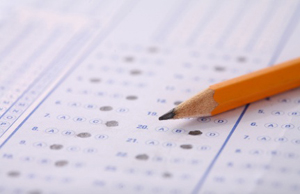
Bubble Test

(Perhaps I should say ‘if the tests spread,’ because spokeswoman Ravitz says they have only put out the RFP but “haven’t made decisions.”)

Doesn’t anybody have the courage to challenge this slavish devotion to standardized testing (mostly bubble tests, by the way)? Students in New York City finished taking their ‘end of the year’ state test in mid-May, but school itself doesn’t get out until the end of June. For kids (and for the policy types in their comfortable offices), the tests are everything. Teachers, of course, have to hold their students’ interest for another six weeks or so.

Dr. Polakow-Suransky said the challenge was to create an additional assessment that will ‘strengthen instruction.’

I say he ought to examine the premise of the law and challenge it, because the goal ought to be to strengthen teaching and learning. This entire exercise strikes me as a ‘gotcha game’ whose outcome will undermine the teaching profession, increase disrespect among students for schooling, and take time away from teaching and learning. It will, however, allow students to strengthen their bargaining and blackmailing skills.

Assessments can strengthen instruction, of course. Frequent school-based tests in math, for example, can pinpoint which teachers are having difficulty getting certain concepts across; they can then learn different approaches from their more successful peers. That’s not ‘gotcha’ testing but sensible assessment with an immediate feedback loop.

I write about many of these issues in my book, The Influence of Teachers. A lot of our problems in public education stem from a dearth of respect. We don’t respect students’ intelligence; hence we focus on the lowest common denominator in skills. We don’t respect teachers, which is why we turn to standardized testing as the be-all and end-all of evaluation. I’m not sure we even respect learning itself.

Nor do we expect very much from our kids, frankly. Imagine setting the bar for reading at third grade, when most first graders are fully capable of learning to read and learning to enjoy reading?

But enough of this rant. The questions are:

How do we raise expectations?

How do we get beyond the insult of ‘the basics’?

How do we wean ourselves away from our addiction to more and more standardized testing?

The floor is open for suggestions (I’ve done the ranting).

The international divide

http://www.facebook.com/plugins/likebox.php?href=http%3A%2F%2Fwww.facebook.com%2Flearningmatters&width=292&colorscheme=light&show_faces=false&stream=false&header=true&height=62

As always, remember that John’s book The Influence of Teachers is for sale at Amazon.

Is it possible that the US has been heading in the wrong direction for most of the 30 years it has been focused on school reform? That’s the conclusion a reader of “Standing on the Shoulders of Giants” would be hard pressed not to draw. The paper, written largely by Marc Tucker of the National Center for Education and the Economy, contrasts the approaches taken by five high performing (but quite different) entities — Toronto, Japan, Finland, Shanghai and Singapore — with what we have been doing here.

You can read the paper here.

Continue reading

Can this marriage be saved?

http://www.facebook.com/plugins/likebox.php?href=http%3A%2F%2Fwww.facebook.com%2Flearningmatters&width=292&colorscheme=light&show_faces=false&stream=false&header=true&height=62

As always, remember that John’s book The Influence of Teachers is for sale at Amazon.

With all the attention on marriages these days (the Royal Wedding, Newt Gingrich and wife No. 3, Mitch Daniels and his happy remarriage to his ex, and so on) shouldn’t we be paying more attention to one very troubled marriage: the one between the American public and our teachers?

No doubt it’s troubled, but can this marriage be saved? Continue reading

What do teachers want?

http://www.facebook.com/plugins/likebox.php?href=http%3A%2F%2Fwww.facebook.com%2Flearningmatters&width=292&colorscheme=light&show_faces=false&stream=false&header=true&height=62

As always, remember that John’s book The Influence of Teachers is for sale at Amazon.

Readers of this blog or of my book, The Influence of Teachers, know that I believe that the harsh criticism of teachers and their unions is largely undeserved. I also believe it is hurting public education.

In the clamor, the voices of regular classroom teachers are difficult to hear, which is why I am devoting this blog to them. With apologies to Sigmund Freud, “What do teachers want?”

Some answers to that question can be found in recent surveys by Met Life and the Gates Foundation/Scholastic. I include some of those findings below.

Renee Moore, a veteran teacher who is certified by the National Board for Professional Teaching Standards, says it’s all about respect. “Highest on my list,” she wrote, “would be more respect for the professional expertise of teachers, particularly for those of us who have shown consistently, year-after-year that we are highly accomplished teachers.”

That seems to be consistent with a Met Life finding that most teachers feel they are being ignored. “A majority of teachers do not believe that teachers’ voices are being heard. Seven in ten teachers (69%) disagree with the statement that “thinking about the current debate on education, teachers’ voices in general have been adequately heard.”

Ms Moore continues: “By every means we currently have for measuring teacher performance, I am considered an excellent teacher; yet, when it comes time to decide what should be taught and how my students’ learning should be measured, I have little or no say. This is also true for teachers as a group.”

What form would respect take? “The reward for excellent teaching should be increased responsibility for the policy decisions that govern our work.”

In other words, pay attention!

The Gates/Scholastic Survey of 40,000 teachers reveals that paying attention would also entail giving equal weight to teachers’ assessments of student achievement. “From ongoing assessments throughout the year to student participation in individual classes, teachers are clear that these day-to-day assessments are a more reliable way to measure student performance than one-shot standardized tests. Ninety-two percent of teachers say ongoing in-classroom assessment is either very important or absolutely essential in measuring student performance, while only 27% say the same of state required standardized tests.”

Another Board-certified teacher, Kenneth Bernstein of Maryland, calls for an end to micromanaging: “Treat us as a profession,” he wrote. “That is, require appropriate training, which is not five weeks before turning us loose in a classroom. Give us appropriate support, which means do not overburden us with too many students in a class or too large a student load. And pay us as the professionals we are so that we do not lose so many of our gifted teachers because they cannot afford to raise a family on what they are paid.”

I also directed my question, “What do teachers want?” to Anthony Cody, a veteran teacher in Oakland. High on his list was collaboration. “American teachers get a fraction of the time our counterparts overseas get, and most of the time is filled with either top-down professional development or administrative staff meetings. We need dedicated time to look at student work, to reflect and engage in these processes.”

The Gates/Scholastic Survey emphatically supported Anthony’s point. “When asked about teacher retention, nearly all teachers say that non-monetary rewards like supportive leadership and collaborative working environments are the most important factors to retaining good teachers. Fewer than half of teachers say higher salaries are absolutely essential for retaining good teachers and only 8% say pay for performance is absolutely essential.”

Money matters less than collaboration!

According to the Gates/Scholastic survey, “Teachers are skeptical of current measures of teacher performance, with only 22% indicating that principal observation is a very accurate measure. At the same time, more than half of teachers indicate that student academic growth (60%) and student engagement (55%) are very accurate measures of teacher performance — much more so than teacher tenure, which a significant number of teachers said is not at all accurate.”

The Met Life survey reveals a crucial nuance: the newer the teacher, the more likely they are to want to collaborate. “Regardless of their specific path to teaching, new teachers are strong proponents of collaboration. Although teachers across experience levels agree on many of the topics in the Survey, new teachers (those with five years of experience or less) emerge as having a particular affinity for collaboration. New teachers strongly agree in greater numbers than do veteran teachers (those with more than 20 years of experience) that their success is linked to that of their colleagues (67% vs. 47%).”

And the newbies are ready to collaborate with anyone who shares their concern for student learning. “New teachers are also more likely to emphasize the importance of collaborating with other groups to improve student achievement. They are more likely than veteran teachers to say that strengthening ties among schools and parents is very important for improving student achievement (95% vs. 85%).”

These are hopeful signs, because our teaching force is growing younger by the year. In 1987 the modal ‘years of experience’ was 15 years. In 2007 (the last year we have data for) the mode was one year!

The comments of all three veterans indicate their agreement with another Gates/Scholastic finding: they want the freedom to innovate. Here’s how the survey put it: “To keep today’s students engaged in learning, teachers recognize that it is essential for instruction to be tailored to individual students’ skills and interests. More than 90% of teachers say that differentiated assignments are absolutely essential or very important for improving student achievement and engaging students in learning. Also, showing a clear understanding of the world students inhabit outside of school, 81% of teachers say that up-to-date, information-based technology that is well integrated into the classroom is absolutely essential or very important in impacting student achievement.”

But innovation is not high on the list of those running the show. As Anthony Cody noted, “Modern ‘education reform’ has redefined the purpose of schools to be to raise scores in tested subjects. As teachers we feel responsible for so much more, and we find other things we value — critical thinking, creativity, compassion, civic engagement, even knowledge of history and science — crowded out when we are coerced by threats of school closures, pay cuts or the loss of job security if our test scores do not rise.”

And while Moore, Bernstein and Cody did not speak directly to the question of higher and common standards, my hunch is that they tilt in that direction—as long as teachers play a significant role in their development. Here’s what Gates/Scholastic said on that point: “Teachers see the role clear common standards can play in preparing students for their future, but want clearer standards and core standards that are the same across all states. Nationwide, 74% of teachers say that clearer standards would make a strong or very strong impact on student achievement, with only 4% saying they would have no impact at all. 60% of teachers say that common standards would have a strong or very strong impact on student achievement, with only 10% saying that they would have no impact at all.”

So what do we know? What’s the answer to my question? What do teachers want?

Aretha Franklin said it best: R-E-S-P-E-C-T.

It takes different forms, but that’s what they want — and it’s what they deserve.

Your thoughts?

Appreciate a Teacher

http://www.facebook.com/plugins/likebox.php?href=http%3A%2F%2Fwww.facebook.com%2Flearningmatters&width=292&colorscheme=light&show_faces=false&stream=false&header=true&height=62

As always, remember that John’s book The Influence of Teachers is for sale at Amazon.

On Saturday I had the honor of being the commencement speaker at the University of Michigan’s School of Education. With an audience of 394 men and women who had earned their degrees and their families and friends, I focused on the opportunities — not the challenges — facing them. Here’s an excerpt.

Continue reading

The joys of jargon

http://www.facebook.com/plugins/likebox.php?href=http%3A%2F%2Fwww.facebook.com%2Flearningmatters&width=292&colorscheme=light&show_faces=false&stream=false&header=true&height=62

As always, remember that John’s book The Influence of Teachers is for sale at Amazon.

At Harvard recently a young graduate student asked me a tough question:

Mr. Merrow, you have been interviewing educators for 35 years. How do you know when an educator is sincere and can be trusted?

It’s a great question, but before I tell you how I answered her, let me admit that, once I got back to New York, I queried other education reporters on the subject. Is there language — jargon — that makes you suspicious of educators, I asked?

The flood of responses surprised me. It seems that a lot of reporters have had it up to here with educational jargon. Their (non) favorites include phrases like: ‘at risk,’ ‘scaffolding,’ ‘value-added,’ ‘best practices,’ ‘state of the art,’ ‘laser-like focus,’ and ‘raising the bar.’

For about half a dozen reporters the absolute nails-on-the-blackboard term is ‘stakeholders.’

I can’t resist stringing together expressions, like so:

“Aligned instruction with buy-in by highly qualified teachers for authentic inquiry-based learning and student engagement in professional learning communities will produce 21st Century skills in our youngsters.” (And I’ll bet some educator somewhere has actually said that!)

(But not in my new book, The Influence of Teachers.  I did my best to make it a jargon-free zone and will refund your purchase price if you can find examples of my — non-ironic — use of ‘educationese.’)

Educators apparently adore alliteration: ‘Scaffolding for success,’ ‘ramp up for rigor and readiness,’ ‘data-driven,’ ‘drilling down,’ ‘authentic assessment,’ ‘teaching to the test,’ and ‘rigorous research.’

Reporter Jackie Borchardt of the Casper Star-Tribune made a school board bingo card last year that included ‘literacy,’ ‘goal team,’ ‘rigor,’ ‘pathways,’ ‘research-based,’ ‘engaged,’ ‘high-access,’ ‘what’s best for kids,’ ‘cohort,’ ‘strategic plan,’ ‘and ‘21st century education. She didn’t say whether she called out “Bingo” during a School Board meeting!

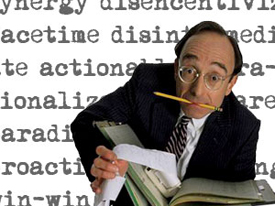
JargonDoes jargon disguise vacuity? Anne Lewis, a veteran reporter, offered this analysis: “I have come to the conclusion that it exists because of a professional lack of esteem. Other professions requiring college degrees have a specific language — medicine, the sciences, engineering, law. But educators only have plain English, so they change it into a ‘professional’ language that sounds fancy and inaccessible when it ought to be the most accessible profession of all.”

Do some educators obfuscate because they think it makes them sound more professional? Are some educators so deep in the weeds of their profession that they have forgotten how to communicate with ordinary folks?

And are some being duplicitous, saying, ‘We know what works’ when in fact they do not?

I suspect it’s “Yes” to all of the above.

So how did I answer that young woman?

I told her that two terms make me hyper-vigilant: rigorous and ready to learn. ‘Ready to Learn’ tells me one of two things: either the educator hasn’t thought about the difference between being ‘ready to learn’ and being “ready for school” OR she actually believes they mean the same thing. If the latter, that’s remarkable arrogance. If the former, let’s hope the leader can be taught the difference.

I hate it when educators talk about the need for a ‘rigorous curriculum’ because that tells me they haven’t thought much about the meaning of the adjective (harsh and unyielding). Perhaps they think it makes them sound tough, as if that were a good thing, but I associate rigor with death (‘rigor mortis’). Who needs that in our classrooms? Why not say ‘challenging’ instead?

But what I listen for are clues about beliefs. When an educator looks at a child, I want to know if he wonders, “How intelligent is this kid?” — or is he thinking “How is this child intelligent?”

If the former, then the educator is operating from a medical model, with himself as the doctor and provider of cures. I don’t like that philosophy. If the latter, he is working from a health model and is ready to build on the child’s strengths.

I advised the young woman that one cannot simply ask educators which way they look at the world, because they will spit back the politically correct response. Instead, I said, watch and listen carefully. Cut through — or even ignore — the jargon, which at the end of the day is a nuisance and a distraction. It’s the core beliefs that matter.

ADD trash to the curriculum?

http://www.facebook.com/plugins/likebox.php?href=http%3A%2F%2Fwww.facebook.com%2Flearningmatters&width=292&colorscheme=light&show_faces=false&stream=false&header=true&height=62

As always, remember that John’s book The Influence of Teachers is for sale at Amazon.

Looking out my living room window, I see five large trash receptacles on the four corners of the intersection of 3rd Avenue and 79th Street that our east side Manhattan apartment overlooks. And, probably as a consequence, there’s very little garbage on the street and sidewalk.

In fact, most intersections in my neighborhood seem to have a trashcan on each corner, something I have been aware of — and grateful for — when I walk our yellow Lab in the morning and at night.

But when I was visiting a school in the South Bronx last week, I couldn’t help but notice that sidewalks and streets were littered and there weren’t very many public trash receptacles. Just one per intersection, not the four (or five) in my neighborhood.

Now, a couple of casual sightings and an anecdote do not constitute data, but this is a great opportunity for social studies teachers to use technology to enliven their classes, energize their students, and perhaps provide real life lessons in how cities distribute resources.

Continue reading

My parents’ mixed marriage

http://www.facebook.com/plugins/likebox.php?href=http%3A%2F%2Fwww.facebook.com%2Flearningmatters&width=292&colorscheme=light&show_faces=false&stream=false&header=true&height=62

Not many people know this, but I am the product of a mixed marriage. I was blissfully unaware of it growing up, which I think speaks well of my Mom and Dad, who apparently wanted to protect their six children from the raw emotion and even hatred that was out there then — but seems to me to be out of control today. Continue reading