“PRACTICE, PRACTICE, PRACTICE”

Let’s suppose you decided to run a marathon. How would you prepare for a 26.2 mile running race? You’d probably create a schedule that called for runs of different distances, some of just two or three miles, quite a few 5-10 miles runs, and at least one of about 20 miles. Maybe you’d join a running club or seek out others who were preparing for that particular marathon. You’d think about your diet and your sleep patterns. You might even visit the actual course, just to get a feel for what was to come.

In short, to get ready to run a marathon, you would do whatever seemed necessary to simulate the actual race.

Now imagine that you’ve been cast in a play. How would you prepare? You would set aside time to memorize your lines, and perhaps you would ask a friend or a family member to give you your cues. At some point, you’d join the cast for a reading, then a walk-through, and finally lots of rehearsals. You would need to be aware of your inflection, your facial expressions, and your body language…but also of the team-building process.

In short, to prepare to act on stage, you would do whatever seemed necessary to simulate the actual on-stage performance.

Now let’s think about preparing to live in a free society, a democracy. What would be a sensible approach to preparing young people for a world in which they are generally free to decide what to wear, when to speak up and when to remain silent, what to say, when to eat, how to work with others, and so on? What’s the best way to prepare young people to carefully examine propositions, instead of automatically saying ‘Yes’ or robotically doing what someone tells them to do?

Should they, to get ready to be successful in a democratic society, actually practice democracy while they are growing up?

Right now, we don’t allow children to practice democracy, not in schools anyway. In fact, with the exception of our prison system, public schools are the most undemocratic institutions in our society. Even the branches of the military offer choices to those who enlist, but American public schools tell students (and teachers too, for that matter) where to be and when to be there, when to eat, and what to wear. Most public schools teach students to regurgitate information, not to think critically or to question. Schools are set up to sort, not to individualize. Their basic question about each child is “How Smart Are You?” which they seek to answer by subjecting children to a constant battery of standardized (and most often multiple-choice) tests.

Perhaps our schools are anti-democratic to make it easier for the adults. Perhaps because long ago we adopted the Prussian education model: lectures to children grouped by age. Or perhaps because we adults haven’t had much experience with democracy in our own lives.

Could public schools actually be ‘democratic’ in nature? Could a system of mass education ask a fundamentally different question about each child, “How Are You Smart?” and then adapt the pedagogy to fit a child’s needs, aptitudes, and inclinations?

Not only is it possible; it’s essential going forward, if we are going to rebuild America after Trump.

This is not an argument for letting children do whatever they want, whenever they want. That’s chaos, and no one–not even the kids–wants that. Instead, it calls for thoughtful practice, cooperation, an end to age-segregation, lots of project-based learning, and a focus on social and emotional learning.

Here’s an example that may shock you: Letting students make the rules for classroom behavior. That’s democracy in its purest form, and it can work, although it’s rarely tried. I’d wager to say every elementary school classroom I visited in my 41 years of reporting had a poster listing the rules for classroom behavior. Almost always laminated, these posters generally included obvious rules like “Listen Carefully,” “Follow Directions,” and “Raise Your Hand When You Want to Say Something.”
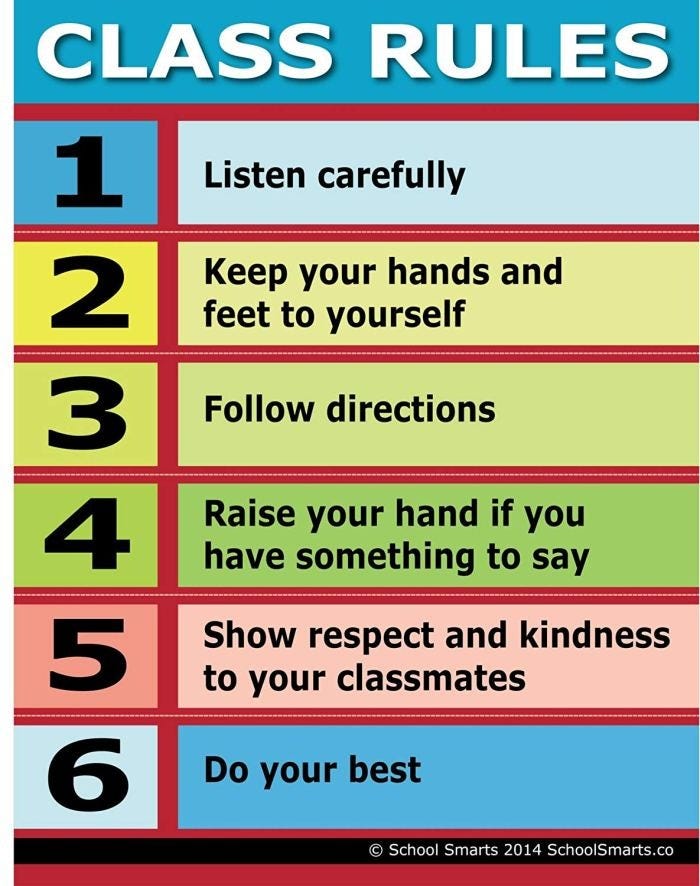
best 'class rules'

These posters were mass-produced, store-bought, glossy, and laminated. No editing possible, and no thought required. I imagine that on the first day of school, the teacher would read the rules aloud and then point to the poster whenever things got loud or rowdy.

“Now, children, remember Rule 4. No calling out unless I call on you.”

But occasionally the ubiquitous poster would be hand-made, clearly the work of students. If I asked the teacher for an explanation, the answer went something like this:

“On the first day of school I always ask my students what sort of classroom they wanted to spend the year in? What should be the rules? It takes a few days to develop the rules. Sometimes I present alternatives, such as “What if someone knows the answer to a question? Should they just yell it out, or should they raise their hand and wait to be called on?”

Or I might ask them “If one of you has to use the bathroom, should you just get up and walk out of class? Or should we have a signal? And what sort of signal should we use?”

It should not surprise you to learn that the students invariably came up with reasonable rules much like those on the laminated posters: Listen, Be Respectful, Raise Your Hand, Be Kind, and so forth. But there was a difference, teachers and principals told me: When students create the rules, they owned them and were more likely to adhere to them.

Schools can practice democracy in other ways. The adults in charge can give students more say in what they study. Again, not carte blanche but thoughtfully personalized. That means taking the time, early on, to figure out what students are interested in and then using those interests to see that they learn to read with comprehension, work with numbers, speak in public, and work well with others.

Of course, students should not get to make all the decisions about what they’re studying. After all, a central purpose of school is the transmission of knowledge, and so the basics are also part of the deal. Young children need to learn spelling rules (“I before E, except after C”), the multiplication tables, how to divide and carry, and other basics. They need to know that letters have sounds associated with them (i.e., Phonics and Phonemic Awareness). Someone has to teach them that, if you put an E at the end of words like ‘ton,’ the O sound changes from ‘short’ to ‘long.’

That democratic step–giving students power over their learning– will make teaching easier and more enjoyable. When I was a high school English teacher many years ago, my students were supposed to write ‘themes’ based on ‘Macbeth,’ ‘All Quiet on the Western Front,’ and whatever other plays or novels they were told to read. No choices–just rules from on high. However, if I were teaching high school English today, I would try to ask each student to identify three or four things they were curious about. Then I would spend a few minutes with each student, getting that list down to one topic for them to write about. I’d ask for a 1-page ‘memo’ of their thoughts about how they would approach the topic, followed a week or so later by an outline.

When I discovered that some students shared an interest in the same general topic, I would connect them and urge them to share their pursuit of knowledge.

Because I would be looking at drafts of their work, the chances of them using Artificial Intelligence (AI) to write their papers or downloading someone else’s work from the internet would be minimized.

Why not ask students to create a webpage where essays could be shared with students and the community at large? After all, pride of publication is a great motivator!

Math teachers could invite students to create word problems that reflect their own interests. A youngster interested in farming oysters might create problems that provide data about the cost of ‘seed,’ the rate of loss, the time involved in transferring the ‘seed’ as it begins to mature, the labor costs involved in harvesting. What’s the rate of return on investment if…..?

I also believe young people should be deeply involved in figuring out how their efforts will be measured. It makes no sense to wait for end-of-the-year bubble test results or for teachers to arbitrarily say ‘This passes” or “This doesn’t.” Teachers and students should assess progress frequently, take a clear-headed look at the results, and adapt accordingly.

As in a democratic society, choices in schools have consequences, and students could play a role in developing that system as well.

Rebuilding public education after the ravages of the Trump presidency should be recognized as a great opportunity. I am convinced that our rigidly undemocratic school system, with its tracking, constant testing, and bias in favor of the elite, undoubtedly contributed to Trump’s victories in 2016 and 2024. After all, living in an autocracy for 180 days a year, for twelve or thirteen years, seems to have produced millions of adults who are susceptible to, and comfortable with, autocrats and autocracy.

Creating schools that actually practice democracy will produce a more informed and more thoughtful electorate. That’s essential, today more than ever.

It’s Never Too Late to Say “Thank You”

When you finish reading this paragraph, I hope you will close your eyes and think about the teachers who made you a better person or helped shape the future direction of your life.  Picture in your mind’s eye your old classrooms and what happened there.  What did those teachers do to make you feel smart, special, safe, or valued? Did they believe in you when you were doubting yourself?  Or refuse to let you do substandard work? 

I did this exercise when writing an earlier draft of this essay, and I promise you it’s a rewarding experience.  

Please do it now.

OK, now I have a question: Have you thanked those teachers, either in person, in a letter, or on the telephone?  I ask because thanking your special teachers personally will mean more to them than you can begin to imagine. It will lift their spirits, rejuvenate them, and give them a renewed sense that what they spent their lives doing did matter.  

If it’s too late to make a personal connection because they have shuffled off this mortal coil, then you might consider writing an appreciation and sharing it with friends and family members.  Submit it to your local newspaper, or post it on Facebook or a blog.  Just get the word out there, because that will inspire others to express their own gratitude.

I want to share a story about a former student who called me, out of the blue, a few months ago.  His call could not have come at a better time, because 2025 has not been a particularly good year for me: Brain cancer killed my youngest brother this Spring, a handful of family members whom I dearly love are struggling with significant health issues, Joan and I have lost some good friends to death and dementia, and our country seems to be sinking deeper and deeper in crude bigotry and crypto-fascism.

One day this June I was riding my bike in a hilly part of western Massachusetts when my phone rang.  I normally don’t answer the phone when I’m biking, and I’m pretty sure that I would have ignored the call if I had been coasting down a hill. However, I was approaching a very steep hill that I dreaded climbing, and so I jumped at the chance to take a break.

Hello, I said, tentatively.  “Is this John Merrow,” a man asked?  Who’s calling, I asked suspiciously.  “My name is Paul (redacted). Mr. Merrow was my high school English teacher 60 years ago, and I’m trying to reach him, so I can say ‘Thank you.’”

After I admitted to being John Merrow, we talked for about 15 minutes.  He told me that I had set him on a track to become an avid reader. How, I asked?

“One time your assignment was to analyze some poetry,” Paul told me, “And, because I was kind of a wise-ass, I wrote a careful analysis of the lyrics of a popular folk song, Pete Seeger’s “Where Have All the Flowers Gone.”  I expected you to get angry because I hadn’t done the assignment, but you went out of your way to praise me.  I think you even read it aloud to the class.”

And Paul, until then a self-described indifferent student, became a voracious reader. He told me that during his four years of college he read the complete works of Dosevesky, Hesse,  Steinbeck, Salinger, Orwell, Tolstoy and Nietzsche.

“Want to know how I ended up in your class,” he asked?  

Before I share that story, you need to know about the high school where I taught for two years, 1964-65 and 1965-66.  Like most large high schools back then, Schreiber High in Port Washington, NY, was rigidly tracked, levels One through Five.  As an untrained rookie teacher, I wasn’t allowed anywhere near the One and Two level students, who were, in truth, the students the people in power cared most about.  Their parents were probably professionals with multiple degrees, and so these privileged kids were on track to attend prestigious colleges. 

Most of the Threes had a shot at college, while the Fours were headed straight to work or the military, and the small number of Fives, many with severe handicapping conditions, were basically being warehoused.

At Schreiber, I taught five classes–125 students –of 10th, 11th, or 12th grade English, mostly Threes and maybe one or two classes of Fours.  

By the way, I cannot imagine a better gig than teaching Threes and Fours. Those young people, who felt the opposite of entitled, responded eagerly to any and all positive attention, including challenges.  

Teaching Threes and Fours had other benefits: As long as my kids read a couple of Shakespeare’s plays and weren’t disruptive,  administrators paid no attention to what we did in my classroom. It wasn’t that they trusted me; they really didn’t care.

**That meant we could put MacBeth and Lady MacBeth on trial for first degree murder, with students (in every role) ‘testifying under oath.’  And so we did that. 

**That meant I could invite the kids to set the poems we were reading to music, which they did.  I still remember a trio/quartet performing Edna St Vincent Millay’s “Renascence.” 

**That meant I could encourage my students to “elevate the quality of the bathroom graffiti” by erasing the scatological slurs and replacing them with lines from TS Eliot, John Donne, Robert Frost, and others–and we did that too.

**That meant I could create a stand-alone unit of anti-war poetry–during the growing  VietNam war protest movement–to introduce my students to Wilfred Owen, Stephen Spender, Rupert Brooke, and Siegfried Sassoon. 

**That meant I could challenge my kids to write and stage their own play, which they did. You can read about it here.

Back to Paul’s story: Apparently he was a Four when he got called into the Guidance Councillor’s office. “My father came with me, and when the Councillor said that I should either drop down to level Five or transfer to trade school and become an electrician or a plumber, my Dad erupted.  ‘Bullshit!,’ he shouted, as he slammed his fist on her desk.  ‘My son is going to college! I want him in college level classes!’ 

“And that’s how I ended up in your class,” he concluded.

He told me that he graduated from college with 3 majors: History, Political Science, and Sociology.  “I’m pretty sure I was the only student carrying three majors.”  After college Paul worked for Xerox for a few years before starting his own financial advising company.

Paul’s story about his Dad proves another point: Thanking our teachers is necessary but not sufficient.  For more on parents, please read Billy Collins’ superb poem, “The Lanyard.”  

Have you thanked other teachers, I wanted to know?  “Yes, my sixth grade teacher,” he replied. “I called him years ago and thanked him. This was about a year before he passed away.”

The list of teachers who changed my life for the better includes Catherine Peterson, the First Grade teacher who taught me and most of my siblings to read–and to love reading; two high school English teachers, William Sullivan and Roland McKinley; a writing teacher at Dartmouth, Alexander Laing; an English professor at Indiana University, Donald Gray; and David K. Cohen, my doctoral thesis advisor at Harvard.  I thanked the first and last in person and another, Professor Gray, by letter, but I never had the opportunity to tell the others how much they meant to me. 

By the way, Saying “Thank You” feels really good.  It’s satisfying to close a door left open from your past.  Try it!

I don’t think I will ever forget how being thanked by a former student made me feel. My spirits were lifted, and my troubles disappeared. Of course, Paul’s phone call couldn’t bring back my brother Jim or help my ailing family members recover, but hearing from Paul—60+ years after I taught him—made me feel that I had made a difference. There’s no better feeling.

Teaching has always been–often literally–a thankless job, but it doesn’t have to, and shouldn’t, be that way. So, please, express your gratitude.

“A Third of Teachers Are Terrorists”

The US has nearly 3.6 million K-12 teachers, and another 1.5 million college teachers. One-third of 5.1 million is 1.7 million. Who knew that we have 1,700,000 terrorists in our classrooms!

I certainly had no idea things were that bad, and I’m kicking myself for not knowing. After all, I spent more than 67 years in American classrooms, as a student, a teacher, a parent, and a reporter. I must have interviewed and maybe even socialized with thousands of these terrorists, and I didn’t have a clue.

My 4th grade teacher yelled a lot and banged desks (and some ears too), so I supposed she “terrorized” us, but I don’t think that’s what the accuser had in mind.

I can think of one other possible example of ‘terrorism’ in the classroom: My 10th grade English teacher, Mr. McKinley, would deliberately make mistakes when he wrote stuff on the blackboard and then erupt in (faux) fury if we failed to catch his flubs. Somehow, I don’t think that’s what the accuser had in mind.

Are you questioning the accuracy of the accusation? OK, it came from President Donald Trump’s buddy Steve Bannon, who opened his mouth while in Arizona to pay tribute to Charlie Kirk, the assassinated leader of Turning Point. The podcast host was saying to Bannon that Kirk’s ideas about marrying early and having lots of children were actually not popular with young people, which prompted Bannon to blame teachers for brain-washing their students. Here’s what he said:

“…..those kids — look, from kindergarten all the way up, they are essentially, you know, a third of the teachers are terrorists that are trying to form them.”

Predictably, the right-wing podcaster didn’t challenge Bannon’s wild accusation or even ask him what he meant by ‘terrorist,’ so I’m going to go out on a limb and suggest that Bannon meant that teachers were teaching values that Bannon disapproves of, like tolerance and cooperation. I have seen lots of teachers work hard to inculcate such values, and, if that’s ‘terrorism,’ I approve.

Mocking Bannon is a woefully insufficient response, however, because his blatant teacher-bashing is part of the right wing’s persistent, harsh, and (unfortunately) often successful campaign to bring down public education.

And Bannon’s not even a field general in this war. He’s clearly outranked by Oklahoma’s State Superintendent of Education Ryan Walters, who in January reacted to violence at the Mardi Gras in New Orleans. You may recall that, early on New Year’s Day an army veteran carrying an ISIS flag drove his pickup truck down Bourbon Street and killed 14 people and injured dozens more before the police killed him. It was labeled a possible terrorist incident, prompting Mr. Walters to go off: “We also have to take a look at how are these terrorists coming from people that live in America. …. You have schools that are teaching kids to hate their country, that this country is evil. You have the teachers’ unions pushing this on our kid (sic).”

Mocking the hyperbole of school critics like Walters and Bannon is ineffective, because culture warriors are immune to humor. Instead, they are seriously opposed to just about everything that some of us believe is in the public interest, such as public education, public transportation, public libraries, public parks, public health, and so on. They recognize that public education is a cornerstone of our democracy, and they are going after it, with sledgehammers and other implements of destruction, including lies and absurd accusations from the likes of Bannon and Walters.

(They are anti-public-everything, acronym APE. Don’t be an APE!)

Early in September, the New York Times reporter Dana Goldstein did a deep dive into the impact of vouchers, education savings accounts, tax credit scholarships, and other programs that divert funds from public schools to non-public schools. The entire article is well worth your time.

The number of students whose parents are using these programs has doubled since 2019, nearly all in Republican-led states. Five years ago, only about 20,000 students had education savings accounts (ESA), which allow deducting any ‘educational’ expense from one’s taxes; today, more than 500,000 families have ESA’s.

In the past, eligibility for most of these programs was means-tested because the stated goal was to help low income families. That’s changed, and in the new programs, any family can take advantage, regardless of income.

This ain’t cheap. Indiana’s program, for example, is costing more than $600 million a year, dollars that might have gone to public education.

Joining the 14 states with voucher-type programs is your federal government, because the “Big Beautiful Bill” passed by Congress earlier this year includes a $5,000 voucher.

Do these voucher programs work? The evidence is mixed, at best.

Are they popular with voters? Here the answer is crystal clear: NO! In the 17 opportunities that voters have had to weigh in on vouchers since 1970, they’ve said NO, including three votes in Republican-led states in 2024.

For a critical view of what’s going on, read David Osborne’s analysis here.

If you support public education, begin by thanking teachers. Take a minute to picture the teachers who changed your lives for the better…and then to ask yourselves if you ever said ‘Thank you’ to those women and men. If it’s too late to connect directly with them, you might write something about them and share it with others.

That’s only the first step. Consider attending school board meetings, perhaps even running for election to your local school board. You might join the parent-teacher organization, or volunteer as a tutor. You might contribute supplies, or help with school fund-raising efforts. Let your elected officials at all levels know that you support public education. If you’re a public school parent, move beyond ‘involvement’ to ‘engagement,’ by getting to know your children’s teachers.

(I’ve written about this in more detail in “Addicted to Reform: A 12-Step Program to Rescue Public Education,” which is available at most public libraries, some bookstores, and Amazon. It’s reviewed positively here and negatively here.)

It’s not pie-in-the-sky idealism to believe that a strong public education system is the road to equality and citizenship, or that the real safeguard of democracy is education. Those insights came from FDR and Martin Luther King, Jr., among others.

Please make certain that you are registered to vote, and that your friends and neighbors are as well. This attack on public education is serious, folks. Don’t take our democracy for granted.

“The Play’s the Thing….”

Before I get to the point of this essay, I want to tell you a story that I hope you will find interesting. Paul D. Schreiber High School is in Port Washington, New York, only 23 miles from Times Square, the beating heart of New York City. Like most public high schools sixty years ago, Schreiber was rigidly tracked, 1-5. The Ones and the Twos, clean cut kids with last names like Wilshire and Braddock, were destined for college and success, so they got the most attention. Threes, the ‘average’ kids, were on track to become mechanics and hairdressers; many of their surnames ended with a vowel. As for the Fours and Fives, the system didn’t really care much about them, although a few teachers dedicated all their energy to getting them through high school.

I was teaching in a public school only because I had failed the Peace Corps physical, and because I was an untrained rookie, the system didn’t let me anywhere near the Ones and the Twos; instead, I had five classes of Threes and Fours, maybe 130 students in all. And when a young history teacher suggested that she and I combine our classes and team teach our 10th grade Fours for the second semester, the powers-that-be just shrugged and gave their approval.

Patty, who was tall, blonde, and attractive, was also a few years older, so perhaps the motivation wasn’t entirely pedagogical, but it took me a while to figure that out. Anyway, she and I now had 25 or 30 disinterested kids for a double period, about 90 minutes, every day. We needed something big to hold their attention. I think I got the idea of having students write a play from The English Journal, one of the magazines I started reading when I realized I had no clue about teaching.

Patty liked the idea, and that was that. We didn’t have to ask permission or even inform our supervisors, because, after all, we were teaching Fours. We presented it to the kids as a challenge and an opportunity, and perhaps because I had taken my Fours to a Broadway play during the first semester, most were willing, even eager to try something different.

We told them about plot, character, story arc, scenes, and acts, but what I remember is the story they wanted to bring to life. At its center was a group of teenagers that no adults seemed to care about, students who went through the motions in school but who led full lives outside of school as members of a group (not a gang!) that took care of each other and also helped elderly neighbors by repairing their cars, etc etc. Rough-looking and tough-talking, these kids were misunderstood.

They were also scorned by the elite students in their school, largely ignored by teachers, and looked upon with suspicion and hostility by local merchants.

Art imitating life, you’re thinking? Yup.

So those were their characters. What was the plot? What would be the arc of the drama?

What I remember is that it involved shop-lifting. The owner of the neighborhood ‘five and dime’ store had accused a couple of the teenage ‘roughnecks’ of regularly stealing packs of cigarettes, and he banned them from the store. Their friends knew they were innocent, because they had seen two other kids, the football captain and the head cheerleader, taking the cigarettes, but they had to catch them in the act.

Our students were on fire, and we would spend class time trying out lines, acting out scenes. We tried to convince them to introduce some complexity into the plot, so the ‘bad guys’ weren’t all bad, the ‘good guys’ not entirely good. Shouldn’t there be some sympathy for the store owner, who was losing money every day, for example, even though he was lashing out at the wrong kids? I don’t know if we were successful at that, but I remember that I had the kids doing a lot of writing and rewriting, not just of the play itself but also about the process of creating a play, what they were learning about that.

Soon the students were pushing to stage their play, not just in our classroom but on the school’s stage! Word had gotten out that Miss Ecker and Mr. Merrow’s class was doing something cool, and eventually the Principal gave his OK.

That brought a whole new level of energy, because it meant creating and building sets, finding costumes, and rehearsing after school. It meant significant responsibilities for a lot more students, not just acting and directing but also set design and construction, lighting, etc etc. Suddenly these Fours had real status in the halls of Schreiber.

We–they–put on the play, maybe two or three performances, and it was a hit. Students loved it, and some of the parents were overjoyed to see their children succeeding. In the eyes of other Threes, Fours, and Fives, our kids mattered. They were now achievers, a status they had never attained–and perhaps had never had the chance to attain. How the school’s elite students, the Ones and the Twos, felt, I don’t remember, but that didn’t matter.

What I realized only later is that Patty and I had inadvertently and accidentally invited our students to become producers; we’d given them permission to seemingly take control over their own learning.

I say ‘seemingly’ because she and I, their teachers, still held the reins, albeit loosely. It was our responsibility to see that they became capable writers, learned some history of theatre, learned to work together, to fail and try again, and so on, but we were using their energy and curiosity to make it happen.

Generally speaking, most of school back then and today (even for the Ones and the Twos) requires Consumption, not Production. Students are expected to absorb and regurgitate information, but we had invited our kids to become Producers, and not just of a play that allowed them to work out their resentments. They produced real knowledge, and they went forward knowing that they had achieved something significant.

That opportunity can and should be extended to all students, as often as possible.

(Incidentally, the next year I invited/challenged my Threes to put MacBeth and Lady MacBeth on trial for First Degree Murder, and they jumped at that chance. We had defense and prosecuting attorneys, a judge (the Principal!), and lots of witnesses like Banquo’s Ghost and MacDuff. The only down side was there weren’t enough parts, so a handful of students had to be jurors. If any teacher reading this decides to do it, I recommend that those ‘extra’ students be reporters, assigned to produce a news report at the end of each trial day. Talk about learning opportunities!)

I wanted to tell you that story because I am concerned about what’s going to happen–or not happen–because so many schools are banning cellphones.

Simply put, banning is the right thing to do, but if that’s all schools do, it’s going to be a disaster. That’s the negative step: “NO YOU CAN’T DO THAT.” But have the adults given serious thought about what new opportunities they’re going to offer students?

That’s why this essay is entitled “The Play’s The Thing….” Shakespeare uses the staging of a play to ‘catch the conscience of the King’ who had murdered Hamlet’s father, but schools could use drama, music, other creative arts, and sports to catch and engage all the creative energy that kids bring to school, lest it turn negative and destructive.

As I write this, at least fourteen states, and thousands of school districts and individual schools (public and private) have banned or severely restricted the use of cellphones. That number is certain to increase. This is a good thing, a necessary but hardly sufficient step forward. In addition to banning cellphones, schools must provide stimulating opportunities and experiences; they must bring back theatre, art, music, and other ‘extra-curricular’ activities that all but disappeared when George W. Bush’s disastrous “No Child Left Behind” bill became law in 2001.

First, here’s why a complete ban makes sense:

  1. Nearly all teenagers–95%–are on social media like TikTok, WhatsApp and their counterparts. One-third of teens admit to using social media “almost constantly.”
  2. Social media is damaging our kidsaccording to the U.S. Surgeon General: “The types of use and content children and adolescents are exposed to pose mental health concerns. Children and adolescents who spend more than 3 hours a day on social media face double the risk of mental health problems including experiencing symptoms of depression and anxiety. This is concerning as a recent survey showed that teenagers spend an average of 3.5 hours a day on social media. And when asked about the impact of social media on their body image, 46% of adolescents aged 13-17 said social media makes them feel worse.” A ‘national mental health emergency’ for children and adolescents was declared by the American Academy of Pediatrics back in 2021. The Kaiser Family Foundation reports that “In 2021 and 2022, 21% of adolescents reported experiencing symptoms of anxiety in the past two weeks and 17% reported experiencing symptoms of depression.” Undoubtedly, matters have only gotten worse, as teens’ use of social media has increased.

Unrestrained use of social media damages children in many ways:

  • Social media exposes young people to “extreme, inappropriate content.”
  • Social media makes them–especially adolescent girls–feel bad about their bodies.
  • Social media is a haven for predators. Nearly 6 in 10 girls say they’ve been contacted by strangers online “in ways that make them feel uncomfortable.”
  • Social media can overstimulate the brains in ways similar to addiction, leading to problems sleeping and difficulty paying attention.
  • Time on social media is time that is NOT spent with peers, developing relationships, learning about life’s give-and-take, what Erik Erikson calls ‘identity formation.’
  1. Teenagers access social media on their cellphones, and 95% of teenagers have their own cellphone. These ubiquitous devices are their portal, their entry point, their lifeline to social media. Without cellphones, teenagers have extremely limited access to social media. Cellphones, which are ubiquitous, are the lifeline and portal to social media.

(It’s not just teens, of course. According to the National Institutes of Health, “Mobile phone adoption in the United States is starting in late childhood and early adolescence; currently, 53% of children have a smartphone by age 11.”)

Without cellphones, teenagers won’t be taking 100 or more selfies to get the ‘perfect’ photo to post. They won’t be making 10-second videos for TikTok or spending hours watching cats being cute. If they aren’t on social media, the thinking goes, they will be more social. If they aren’t communicating with a machine, they will engage in genuine personal communication.

Banning phones is necessary, but it is not sufficient, not even close. What are adults offering in exchange? What’s the rest of this bargain? Without some other steps, some quid pro quo, this will be perceived by most teens as heavy-handed and punitive, something being done to them against their will, something that makes school even less appealing.

Of course many kids see the ban as punitive, and why wouldn’t they? When adults try to reassure them by saying, “Trust us. This is for your own good,” that only confirms their suspicions. This is being done to them–and so they are going to devote a lot of energy to beating the ban.

Unfortunately, schools and the adults who run them are too often reactive, when thoughtful proactive behavior is called for. Instead of simply banning phones, the adults ought to be trying to get young people to want to come to school regularly, not simply ‘to attend school.’ To do that, schools (with or without cellphones) need to be interesting, challenging, and safe.

Let me suggest four specific steps that should, I believe, accompany the cellphone ban:

1) Restore the full range of extra-curricular opportunities–because most kids come to school so they can do interesting stuff with their friends! Invite them to write and perform their own plays, as Patty and I did back in school year 1965-66. While schools today aren’t officially tracked, most students know whether they are unofficial Threes or Fours. That energy can be tapped into, for good.

Recently I heard Oskar Eustis, the theatrical director of New York City’s Public Theatre, speak about the value of theatre. He argued persuasively that participating in theatre brings kids together and teaches all the skills and virtues we hope all children will acquire: teamwork, self-discipline, compassion, courage, a strong sense of their own worthiness, and more.

As I related at the top of this essay, I can attest to that.

2) Homeroom could become an extended period, not just a quick five minutes when attendance is taken. Make daily homeroom a pressure-free time when students–without phones to distract them–can catch up with friends, forge new relationships, finish homework, or even take naps. “Home” is the operative word here. For most high school and middle school students, “Homeroom” is the equivalent of the starting blocks in a track meet. They touch base, listen to (or maybe ignore) morning announcements, and, when the bell sounds, dash off to class. In truth, “Homeroom” matters to school administrators only because it gives them a head count, but it’s a meaningless perfunctory exercise for kids. For them, “Homeroom” is just a room, about as far from actually being a home as one can imagine.

That could change. America’s teenagers desperately need more “Home” in their lives, more opportunities to connect with others, more moments that tell them they matter. The rigidity of today’s high-pressure school schedules makes matters worse, not better.

The simple—not easy, but simple–fix is to make “Homeroom” more of a HOME, not just another room. Some teachers will have to be convinced that this new time period is an opportunity for them to expand their own professional repertoire of skills to include their students’ social and emotional growth. The challenge may be to train teachers to listen and not react, in order to allow young people to identify and share their feelings. NewsWeek magazine reports that Tacoma, Washington, schools are doing this, training not only teachers but also parents and school bus drivers.

In each of these new extended Homerooms, teachers and their students will have to work together to figure out how they want to use this time. Some students may want to finish homework, or sleep, but the teacher could steer the conversation in the direction of “team building.”

Perhaps one day a week could be set aside for discussion of some interesting questions (“If you could meet one figure from history, who would it be, and why?”), even trivial ones (“What questions would you like to ask Taylor Swift?”).

Ideally “Homeroom” will turn into a safe space where students can learn to share and will agree that what’s shared there stays there. No bullying allowed.

3) Expand course offerings to include some college classes and vocational training opportunities. Meet kids where they are, not where you think they should be.

4) Work harder to make schools safe in three vital ways: physically, emotionally, and intellectuallyEmotional safety means that bullying and cyber-bullying are not tolerated. Intellectually safe schools celebrate curiosity and honor academic achievement. In these schools, adults encourage students to admit when they do not understand or are confused, often by modeling that behavior. Intellectually safe schools don’t treat kids as numbers but as growing and changing individuals. (And young people who are treated with respect are unlikely to bring their dad’s AK-47 to school.)

Without cellphones as a crutch and given a more stimulating environment, most young people will be inclined to engage with each other. With adult guidance, they can explore new ideas, share curiosities, make plans, and so forth. They can learn that there is life without cellphones.

Removing cellphones creates new opportunities and challenges, but that won’t happen if adults simply enforce the ban. That is, banning cellphones in school is NECESSARY but not SUFFICIENT.

It’s time for the grownups to grow up and step up!(POST

(POSTSCRIPT: Miss Ecker was a marvelous teacher who cared deeply about her students and about standards. I left Schreiber after two years and lost track of Patty, but about 10 or 12 years later I was in Los Angeles reporting for NPR and happened to turn on the TV in my hotel room–and there she was, an anchor for a local station! We had a cup of coffee and a pleasant reunion. A few years later she married a colleague, Joe Benti, and in 1982 gave birth to twins.)

NECESSARY, BUT HARDLY SUFFICIENT

Banning cellphones in public schools seems to finally be happening in lots of states and school districts, but, unfortunately, the numbers are slippery. One source reports that, as of January 17th, 8 states had passed either bans or restrictions on cellphone use in schools, and another 15 states were considering legislation.  The newspaper Education Week, using a slightly different metric, reports that at least 19 states have laws or policies that ban or restrict use OR recommend that local districts enact their own bans.   Meanwhile, the federal government’s National Center on Education Statistics reports that in 2022 at least 77% of schools had “some sort” of ban in place–whatever that may mean!

The US has over 14,000 public school districts, with about 96,000 schools. We have another 20,000 private schools.  How many actually ban cellphones? No one knows, unfortunately. However, the evidence against cellphones in schools is mounting.  The New York Times covered the issue of violence in detail in December.  

Across the United States, technology centered on cellphones — in the form of text messages, videos and social media — has increasingly fueled and sometimes intensified campus brawls, disrupting schools and derailing learning. The school fight videos then often spark new cycles of student cyberbullying, verbal aggression and violence.

A New York Times review of more than 400 fight videos from schools in California, Georgia, Texas and a dozen other states — as well as interviews with three dozen school leaders, teachers, police officers, pupils, parents and researchers — found a pattern of middle and high school students exploiting phones and social media to arrange, provoke, capture and spread footage of brutal beatings among their peers. In several cases, students later died from the injuries.

That cellphones are damaging the mental health of our children is beyond dispute. As the Columbia University School of Psychiatry reported: 

Smartphones have transformed the way we communicate, learn, and entertain ourselves. However, their omnipresence can lead to compulsive use and a sense of dependency. The constant stream of notifications and updates can create a sense of urgency and a fear of missing out, leading to increased anxiety and stress. Furthermore, the excessive use of smartphones can interfere with sleep, which is crucial for mental health.

Social media platforms, while enabling us to connect with others and share experiences, can also contribute to feelings of inadequacy and low self-esteem. The tendency to compare oneself with others and the desire for validation through likes and comments can lead to a distorted self-image and feelings of worthlessness.

Moreover, studies have shown a correlation between heavy social media use and depression, anxiety, loneliness, and suicidal ideation.

What changes when cellphones are banned?  As far as I know, the evidence is anecdotal;  here’s a typical story, this one from The American Prospect:  “One Minnesota school discovered, as do many schools with similar policies, that teachers and principals notice positive developments in student behavior. And even students, when prodded, agree that taking cellphones out of the school-day equation has made them more productive, social, and happier overall.


Reliable data doesn’t exist in part because “ban” means one thing here, another there.  Some schools require students to deposit their phones whenever they enter a classroom but allow usage in the halls and lunchrooms.  Others rely on the honor system, and some have full-fledged bans that do not allow cellephones inside school buildings.

Banning cellphones is, in my view, necessary but hardly sufficient.  In fact, it may turn out to be counterproductive unless we change our approach to teaching.  What’s essential are new approaches to instruction that give students more reasons to engage in learning.  

Let me give you one example of teaching differently, a 5th Grade class that is studying US geography.  In normal times, the teacher might hold the students responsible for knowing all 50 state capitals, and perhaps their major cities, rivers, and industries.  That’s largely rote memorization, the ‘drill and kill’ that turns off so many students.

Rote memorization makes no sense at all, because every kid knows that the information is readily available on their cellphones, with a few keystrokes. (The teachers know it too!)

Instead, let’s imagine the teacher saying, “Well, there are 25 students and 50 states, so each of you is responsible for two states.  Let’s figure out how to assign them.  Anybody have a favorite state, perhaps one your grandparents might have lived in, or one you’ve always wanted to visit?”

Once the states are assigned, the teacher might say, “Now what I want you to do is find out–using your cellphone for research, if you wish–the capitals of your two states, why it was chosen as the capital, whether the state has had more than one capital over the years, and so on.  Whatever seems interesting, write it down, learn as much as you can, and be prepared to share what you’ve learned with the rest of us.”

“One of you is going to discover that one of your states has had EIGHT capitals over the years.  A couple of other states–including one of the smallest–have had at least SIX.  Maybe you will be able to tell us why they changed capitals. Was it money, religion, the environment, or what?  Have fun digging.”

“Maybe you can also try to figure out how the capital cities got their names.  For example, the capital of Ohio is Columbus.  How did that happen? Columbus came never within a thousand miles of what’s now Columbus, so why is the capital city named after him?  And, while you’re digging into that, check to see whether other cities are named after Columbus, and when they were named.”

“What I want you to be, kids, is curious.  You have a world of information on those phones you carry, but let’s never forget that information and knowledge are not necessarily the same thing.”

What’s happening here, in the age of cellphone bans, is actually revolutionary, because the students are in the business of creating knowledge, knowledge that they will own and share with others.  

That beats texting and TikTok any day….

Appreciating Teachers

As another ‘Teacher Appreciation Week’ comes to a close, let’s ask whether classroom teaching is truly a profession. Perhaps it’s a calling. Or maybe it’s just a job…and not a very good one at that.

Whatever the case, these are tough times for teachers and teaching. Here’s why:

Not enough of us want to become teachers: Between 2008 and 2019, the number of students completing traditional teacher education programs in the U.S. dropped by more than a third, according to a 2022 report by the American Association of Colleges for Teacher Education. The report found that the steepest declines were in degree programs in areas with the greatest need for instructors, such as bilingual education, science, math and special education.

Too many teachers leave the classroom every year: With 3.6 million teachers in employment, roughly 288,000 leave each year. If the US had a similar attrition rate to Finland, only 108,000 teachers would leave each year. That would mean an additional 180,000 teachers for schools to choose from, according to this report.

Here’s why many of them are leaving:  According to Dr. Richard Ingersoll of the University of Pennsylvania, teacher turnover is mostly driven by dissatisfaction. Ingersoll says this dissatisfaction is a result of a lack of freedom. Teachers are micromanaged. While they are being told to differentiate and tailor to each specific child, they must also stick to a scripted curriculum. At the same time, they have no say in school-wide decisions.

And so our schools have real teacher shortages: Based on data from the states with published information, 47 states plus the District of Columbia had an estimated 286,290 teachers who were not fully certified for their teaching assignments, according to the Learning Policy Institute.

States having the most trouble filling vacancies: Illinois, Kansas, Michigan, Montana, Nevada, New Mexico, North Dakota, Oklahoma, and Rhode Island.  Not far behind are Alaska, Arizona, Colorado, Florida, Indiana, Maryland, Massachusetts, Nebraska, North Carolina, West Virginia, and Wyoming, according to data compiled by the Learning Policy Institute.

“So, are they quitting because they’re fed up with their heavy-handed union bosses?” The hostility of the question took me by surprise. I was explaining to my dinner companion, a veteran lawyer, that 40% of new teachers leave the field within five years, and right away he jumped to his anti-union conclusion disguised as a question.

No, I explained. Unions don’t seem to have anything to do with it; it’s most often related to working conditions: class size, discipline policies, and how much control and influence they have over their daily activities.

“It’s not money?” he asked, aggressively suspicious. Not according to surveys, I explained.

I described what I’d seen of a teacher’s daily work life. He interrupted, “How can it be a profession if you can’t take a leak when you need to?

While that’s not a criterion that social scientists use to define a profession, my cut-to-the-chase acquaintance might be onto something.

Can teaching be a true profession if you can’t take a bathroom break when nature calls?

When I wrote about this a while back, many teachers were upset by that comment, including Susan Graham, who wrote, “It seems to me that taking a bathroom break whenever the individual feels the urge has little to do with professionalism and a lot to do with time, context and management of workflow.  Do lawyers take a “potty break” whenever they want? I can’t remember a single episode of Law and Order where a recess was called for Jack McCoy to ‘take a leak’ or for Claire Kincaid to ‘go to the ladies room.’ Of course that’s just TV. A lawyer would tell you that they spend most of their time meeting with clients, collecting information, reviewing case history, meeting, analyzing potential outcomes, negotiating with other lawyers, and preparing presentations. The courtroom is just the tip of the iceberg. 

The problem is that there doesn’t seem to be an awareness that the time in front of the classroom is the tip of the iceberg of teaching. No, teachers don’t get to “go” whenever they need to. For one thing, teachers are expected to practice in isolation, something neither “professionals” or “knowledge workers” rarely do. Not having “enough time to pee” isn’t as much of a complaint as not having enough time to plan, to assess student work, to collaborate with colleagues, to do or read research, to make meaningful contact with parents. Teachers don’t expect to stroll out of the classroom for a potty break any more than lawyers expect to “take a leak” during the middle of cross examining a witness. What they seek is acknowledgement that teaching is highly complex work.
Whether you call us “professionals” or “knowledge workers”, what we want is enough time to do our job well; the discretion to apply the knowledge and skills we have worked to acquire; sufficient collaboration to continue to inform and improve our practice; and respect for our intention to act in the best interest of our students.”

Certainly, teachers and their supporters want teaching to be seen as a profession. They’ve won the linguistic battle. Googling ‘the teaching profession’ produced nearly 3 billion references, while ‘teaching as an occupation’ and ‘the teaching occupation’ produced only 69 million.

Social scientists have no doubt about the status of teaching.  According to Richard Ingersoll of the University of Pennsylvania, “We do not refer to teaching as a profession. It doesn’t have the characteristics of those traditional professions like medicine, academia, dentistry, law, architecture, engineering, et cetera. It doesn’t have the pay, the status, the respect, or the length of training, so from a scientific viewpoint teaching is not a profession.”  He carefully refers to teaching as an occupation, noting that it’s the largest occupation of all in the USA. And growing at a faster rate than the student population.

Jennifer Robinson, a teacher educator at Montclair State University in New Jersey, believes our familiarity with teachers and schools breeds disrespect for teaching. “We don’t treat teaching as a profession because we’ve all gone to school and think we’re experts. Most people think, ‘Oh, I could do that,’ which we would never do with doctors.”

Robinson suggests that a significant part of our population–including lots of politicians–does not trust teachers. She cites the drumbeat of criticism in the media, blaming teachers for low test scores.

A common criticism is that teachers come from the lowest rungs of our academic ladder, a charge that Ingersoll says is simply not true. “About 10% of teachers come from institutions like McAlester, Yale and Penn,” he says. “Perhaps 25% come from the lowest quartile of colleges,” meaning that close to two-thirds of teachers attend the middle ranks of our colleges and universities.

According to Ingersoll, one hallmark of a profession is longevity, sticking with the work. In that respect, teaching doesn’t make the grade. As noted above, his research indicates that at least 40% of new teachers leave the field within five years, a rate of attrition that is comparable to police work. “Teaching has far higher turnover than those traditional professions, lawyers, professors, engineers, architects, doctors and accountants,” Ingersoll reports. Nurses tend to stick around longer than teachers. Who has higher quit rates, I asked him. “Prison guards, child care workers and secretaries.”

The always thoughtful Curtis Johnson weighs in: “There are now some 75 schools where teachers are in charge, have authority over everything that counts for student and school success. At EE we called them ‘teacher-powered’ schools. In these schools, the teachers are in fact professionals, and turnover is very low.” For readers who find this interesting, check it out here.

James Noonan has a contrary view: “Harvard’s Howard Gardner may be best known for his theory of multiple intelligences, but he has spent a far larger proportion of his esteemed career studying the role of the professions in creating a more just and ethical world (see http://www.thegoodproject.org). The framework that he and his colleagues developed would suggest that teaching (in the U.S.) is not a profession, but that’s not to say that its status is inevitable or immutable. Many countries and systems of education (like Finland, as you suggest, and Ontario and Singapore and a host of others) have placed teachers on par with other professionals and they have found great success.
        … Teaching is not a profession currently, but the first step in changing that is envisioning something different and creating spaces (like the “teacher-powered” schools mentioned above) where teachers can experience what true professionalism feels like.”

Perhaps teaching is a calling? Those who teach score high on measures of empathy and concern for others and social progress, Ingersoll and others have noted. As a reporter and a parent, I have met thousands of teachers whose concern for their students was visible and admirable.

Trying to elevate the profession’s status (or arguing about it) is a waste of energy, according to Robert Runté, an associate professor of education at the University of Lethbridge in Alberta, Canada. More than 20 years ago, he wrote,

“Since one needs schools before one can have school teachers, teachers are stuck with their status as salaried employees working within large organizations. Teachers have always been and will always be subject to direction from their school board and the provincial bureaucracy. They are, to that degree at least, already proletarianized.  Consequently, the whole question of whether teaching is a profession, or can become one, is a red herring. The real issue is the degree to which teachers can resist deskilling and maintain some measure of autonomy within the school bureaucracy.”

To some, he may be going off the deep end when he asserts that the construct of ‘profession’ is a trumped-up label created to flatter workers and distinguish themselves from others.

The essay continues: “The only feature that ever really distinguished the professions from other occupations was the “professional” label itself. What we are is knowledge workers, and as such we have a responsibility to both ourselves and to the public to become reflective practitioners. As reflective practitioners we can reassert, first our ability, and then our right, to assume responsibility for the educational enterprise. We must stop worrying about unimportant issues of status and focus instead on the real and present danger of deskilling.”

When I first wrote about this, reader Susan Johnson responded: A student of history knows that professions evolve over time. There was a time when a barber could do “surgery” and a lawyer could practice after being apprenticed to another lawyer. My own grandmother ran into trouble for delivering babies without the benefit of specialized training and credentials because that practice was fairly common in her place and time.
        When teachers first formed an association, they wanted the authority to make decisions about curriculum, instruction and personnel, but were only granted the ability to bargain for salaries, benefits, and working conditions. And so, this association became a union, which will only exist as long as teachers are not the decision-makers. So it is likely true that union bosses do not want to see professional independence for teachers. However, these unions have the potential to evolve into powerful professional organizations similar to the American Medical Association.
        But change is on the horizon: teachers are starting to take control of the schools in which they teach. When schools are run by teachers who make almost all decisions regarding curriculum, instruction, selection and retention of personnel, then they will be full professionals. When the next teacher shortage hits, and the “captive women” are no longer available to teach our children, I believe districts will start to offer professional autonomy to people willing to staff the nation’s classrooms.”

“Deskilling,” a concerted effort to reduce teaching to mindless factory work, is the enemy of professionalism.  Remember that awful graphic in the film “Waiting for ‘Superman’” where the heads of students are opened up and ‘knowledge’ is poured in by teachers?  That’s how some politicians and education ‘reformers’ understand the role of schools and teachers. And how much skill does it take to pour a pitcher? Not much, and so why should we pay teachers more, or even give them job protection? Just measure how well they pour (using test scores of course), compare them to other teachers (value-added), and then get rid of the poor pourers. Bingo, education is reformed!

Teaching has taken some big hits in recent years, driven in great part by the education reform movement that argues, disingenuously, that “great teachers make all the difference.” This position allows them to ignore the very clear effects of poverty, poor nutrition, poor health and substandard housing on a child’s achievement.

Most parents are not fooled by this. Their respect for their children’s teachers and schools remains high.

So what’s to be done?  I believe that schools ought to be viewed as ‘knowledge factories’ in which the students are the workers. In this model, teachers are managers, foremen, and supervisors, and knowledge is the work product of their factory. In that model, students must be doing real work, an issue I have written about.

Here’s an excerpt from “Teaching Ain’t Brain Surgery–It’s Tougher,”  a provocative essay by Richard Hersh, a distinguished former college president and a friend:

(In the) face of an acknowledged short and long-term teacher shortage, the imperative for excellent teachers and teaching conditions is profoundly undermined by a patronizing “teaching ain’t brain surgery” mentality–the belief that anyone with an undergraduate degree can teach. Teachers in a very real sense operate on the brain too but teaching ain’t brain surgery–it’s tougher!

How are brain surgeons educated? Four years of undergraduate work, at least four arduous years of medical school, and several additional years of internships and residencies are required to master the knowledge and skills to operate on the finite topography of the brain. With such training, these superbly prepared surgeons are expected by society to operate on one anesthetized patient at a time supported by a team of doctors and nurses in the best equipped operating rooms money can buy. For this we gladly pay them handsomely.
How are teachers educated? They receive a spotty four-year undergraduate education with little clinical training. At best, an additional year for a Master’s degree is also required for professional certification. Teachers are expected by society to then enter their “operating rooms” containing 22-32 quite conscious “patients”, individually and collectively active. Often the room is poorly equipped, and rarely is help available as teachers also attempt to work wonders with the brain/mind, the psychological and emotional attributes of which are arguably as complex to master as anything a brain surgeon must learn. For this we gladly pay teachers little.

Conditions for professional service matter. Contemplate the results if our highly educated and trained brain surgeons were expected to work in the M.A.S.H. tent conditions equivalent to so many classrooms. In such an environment we would predictably see a much higher rate of failure.                                                                         

Or, consider if the roles were reversed-that brain surgeons were educated and rewarded as if teachers. It is virtually impossible to contemplate because it is hard to conceive of any of us willing to be operated on by someone with so little education or clinical training in a profession held in so much public disdain.                       

We take for granted that the current professional education, training, rewards, and working conditions for brain surgeons are necessary and appropriate for the complexity and value of the work performed. Not so obvious is that teaching well in one elementary classroom or five or six secondary school classes each day is as difficult, complex, and as important a task as brain surgery. But to do it well, to be truly a profession, teachers require exponentially more education, training, better working conditions and rewards than are currently provided. Unless and until we acknowledge this reality we will not solve the teacher shortage crisis, and school reform will inexorably fail.                                                     

To show respect for teaching and teachers, I suggest we leave the ‘profession/occupation’ argument to academics. Instead, let’s consider taking these  steps:

1) Support leaders whose big question is “How is this child intelligent?” instead of “How intelligent is this child?”

2) Elect school board members who believe in inquiry-based learning, problem solving, effective uses of technology, and deeper learning.

3) Insist on changes in the structure of schools so that teachers have time to watch each other teach and to reflect on their work. These are standard operating procedures in Finland and other countries with effective educational systems.

4) Ban cell phones so kids can focus on the present and their immediate surroundings.

5) Expand and improve extracurricular activities, because they are often the most important part of school for many students

Oh, and bathroom breaks for teachers when necessary….

So, as another Teacher Appreciation Week ends, consider the costs of continuing to under-appreciate teachers and public schools generally. We are truly eating our seed corn when we devalue public education. 

Pay attention to politics, to local, state, and national candidates. Listen to students, particularly to those who are staying away from schools.

Public schools don’t need to be more ‘rigorous,’ and anyone who says that ought to be drummed out of the public sphere. Our schools need to be more welcoming, more interesting, and more challenging, for students and for teachers.  

Guess Who’s NOT Coming to School!

American students are skipping school in record numbers, a crisis that is so acute that it became the lead story in The New York Times recently, as well as the subject of the Times’s podcast series, The Daily.   The lead story is long on anecdotes, graphs, and other data. It’s also chock full of quotes from experts, but no students are heard from. No teachers either.

Another serious problem with the reporting, in my view, is the lack of context. The reporters place the blame for the epidemic of chronic absenteeism on COVID, making no mention of three other deep-rooted causes, 1) the right wing’s long campaign against ‘government schools,’ which has helped create widespread distrust of many other public institutions; 2) a decades-long obsession with standardized testing that has made many kids feel like numbers, objects to be manipulated; and 3) a mental health crisis among adolescents, caused in part by their heightened anxiety about school shootings, that makes many kids genuinely afraid to go to school. 

Let’s start at the top. Ronald Reagan routinely referred disparagingly to public schools as ‘government schools,’ meaning, of course, that they could not be trusted.  The MAGA movement has amplified that cry, politicizing education, taking over school board meetings (and actual school boards as well), driving away qualified veteran educators, and causing would-be teachers to decide to find other lines of work.  Schools that ban books and restrict discussions are not exactly welcoming environments for young people.  

Although the trend to see students in terms of their test scores probably dates back to the 1988 publication of “A Nation at Risk,” George W. Bush and Barack Obama ramped it up, big time. In other words, Democrats and Republicans are equally responsible for the second major cause of absenteeism.  Bush’s “No Child Left Behind” and Obama’s “Race to the Top” prioritized student test scores in math and English–at the expense of almost everything else.  Most public schools either reduced or eliminated extra-curricular activities like drama, journalism, and music.  Recess and free play also went by the wayside, as did ‘non-essential’ courses like foreign languages and social studies. The message to students was clear: the school cares only about my test score, not me….so why bother?

Cause #3: Yes, COVID shut down many public schools, depriving young people of the opportunities to socialize, to get accustomed to being with others and dealing with whatever issues arose, but the rash of widely-publicized school shootings–and government’s failure to address the crisis–have created another legitimate reason for students to opt out of school.  I met recently with a high school history teacher, a 17-year veteran, who told me his students regularly practice how to respond to ‘an incursion.’ Mental health challenges are genuine, widespread, and perfectly understandable, he told me.   

The next day I met with another teacher, a young woman who is just finishing her 5th year teaching 4th grade in a charter school in Brooklyn. Students at her school have learned what to do if trouble arises. She also said absenteeism is an issue, and she’s certain that it will spike dramatically in a week or two–once the state tests are over.  Both teachers are concerned about the quality of incoming teachers–the pool of talent is smaller and less impressive.  I infer from their comments that this development is a consequence of the attacks on teaching and teachers–“Who in their right mind would want to teach today?” is the question that hung in the air.

If I were reporting this story, I would do what we did in 2012, talk to young people. This school district on the Mexican border had an abysmal dropout rate, so its new superintendent went out and found kids who had dropped out and asked what it would take to get them to come back.  More challenges, he learned, and so he created opportunities for kids to earn college credits while going to high school.  A few years later, a bunch of high school seniors received both their HS diplomas and their 2-year community college degrees.  Remarkable story, and a win-win-win for everyone. Please click on the link to see what I mean.

Adults concerned about chronic absenteeism ought to be trying to get young people to want to come to school regularly, not simply ‘to attend school.’  To do that, we need to make schools interesting, challenging, and safe.  Stop treating kids as numbers (their standardized test scores).  Stop asking “How smart are you?” and ask a different question about each child: ‘How are you smart?”  

Here are four specific steps that will bring kids back:  1) Restore the full range of extra-curricular opportunities–because most kids come to school so they can do interesting stuff with their friends!  2) Homeroom in middle and high school should become an extended period, not just a quick five minutes when attendance is taken. Make daily homeroom a pressure-free time when students can catch up with friends, forge new relationships, finish homework, or even take naps.  “Home” is the operative word here.  3) Expand course offerings to include some college classes and vocational training opportunities. 

Step number 4 deserves its own paragraph!  To end chronic absenteeism, make schools safe. The first step toward safety is to acknowledge that school safety is a 3-part concept. Students deserve schools that are physically, emotionally, and intellectually safe.  Emotional safety means that bullying and cyber-bullying are not tolerated.  Intellectually safe schools celebrate curiosity.  In these schools, adults encourage students to admit when they do not understand or are confused, often by modeling that behavior. Intellectually safe schools don’t treat kids as numbers but as growing and changing individuals.  (And young people who are treated with respect are unlikely to bring their dad’s AK-47 to school.)

More can be done to bring young people back to school, but concerned local educators can take those four steps to begin the process. 

Improving Public Schools: A Final Thought

Back in August I began using this space to suggest simple changes that would, I believe, improve public schools significantly.  Five months and fourteen suggestions later, it’s now time to wrap this up, not because I’ve run out of ideas but because I’m hoping some readers will take this list of ideas and run with it. Perhaps some of you will work with your local school boards to implement these changes. I hope that, if candidates for school board start ranting about “DEI” or “Critical Race Theory,” you will confront them, because those aren’t real issues; what matters are specific changes that can make schools more interesting, challenging, and effective.  Perhaps some of you might even run for your local school board!  

With that in mind, I have one final suggestion: Consider adopting as your guiding principle the wisdom of Aristotle: “We are what we repeatedly do. Excellence, then, is not an act but a habit.”  Applying that to schools and education suggests to me that:

   *Because we want children to be able to write well, they need to write often in their classes.  

  *Because we want them to be comfortable speaking in public, they need to practice that in school. 

  *Because we want them to work well with others as adults, they ought to be working together on projects, teams, plays, bands, et cetera, in school. 

  *Because we want them to be successful as adults in a rapidly changing world, they ought to learn at least two languages in school. 

*And so forth….

Here, briefly, are the other suggestions: 1) Looping, which I expanded upon a short time later in Looping (revisited).  Looping means a teacher moving up with her or his students.  It’s quite common in other countries because it’s been shown to improve both student learning and behavior, for openers.  

2)Play. Simply put, kids need to be kids.  And for those who are concerned about learning, stop worrying because free play contributes to improved learning.

3) Practice Democracy. Apply Aristotle here: If we want children to function well in a democratic society, they need practice.  Right now, schools are essentially undemocratic–by design. That’s the worst possible preparation for adulthood.  And giving young people more ‘agency’ over their own learning actually works!  

4) Business Cards for Teachers.  If you are a professional, you carry business cards, which you give out to people you want to stay in contact with. Teachers are professionals!  Treat them as such.  

5) Involve Outsiders. The vast majority of households do not have children in public schools,  and schools need public support.  The best advertisement for public education is the kids.  Let them strut their stuff!  

6) Multiple ‘Talent Nights.’  This is an easy way to make parents feel at home in school.  Education is a team sport, and educators need to welcome parents, not treat them as extraneous (or worse).

7) Extended Homeroom. Right now most homeroom periods are short, really just a way for administrators to take attendance.   After Covid, kids need more down time.  Extending homeroom into a full period provides that.

8) Ask the Right Question.  I’ve been pushing this for a long time, but it’s worth repeating: The most important question to ask about all children is ‘How Are They Smart?’ and not ‘How Smart Are They?’ because every child has skills, abilities, and interests that can be tapped into and developed.  

9) “Education Grand Rounds.”  Teachers need opportunities to watch each other at work so they can improve their own practice.

10) “Making Stuff”.  There’s nothing more satisfying than creating something useful.  Bring back wood shop!   

11) Make the School Safe. Schools need to be physically, emotionally, and intellectually safe.  Stop focusing only on physical safety. In intellectually safe schools, it’s cool to be curious, and it’s OK to admit ‘I don’t understand.’  In emotionally safe schools, bullying is not tolerated…and adults and student leaders step up to prevent it. 

12) Serve Your Community  This is NOT the same as ‘Community Service.’ The distinction makes all the difference.

13) Ban Cell Phones. Completely!  That’s right, ban them completely!

14) Acknowledge the “Opportunity Gap”.  Most school districts and policy makers focus their attention on ‘The Achievement Gap,’ but, if we close the “Opportunity Gap” (and its companion, the “Expectations Gap”), outcomes will improve across the board.  One way to do this is to adopt a proven curriculum like Core Knowledge, EL Education, or the Comer School Development Program. Another option to explore: become a Community School.

Reactions from readers convinced me that I stopped making recommendations too soon, so here are three more

15) Change the opening time for adolescents, who need more sleep and aren’t getting it.  This important piece by Dr. Mary Carskadon and Lynne Lamberg (a reader of this blog) is both comprehensive and persuasive.  Here’s more on the issue.

16) Improve school food because better nutrition is a cost-effective way of improving students’ life chances, and because, sadly, for many kids their school meals are the only healthy ones they get. Changing the cafeteria is a good opportunity to Practice Democracy (suggestion #3).

17) Teach reading effectively by avoiding the extremes. Don’t let the ‘Reading Science’ craze push schools into going mad for phonics. Phonics is necessary but not sufficient, because our English language is complex and contradictory. (eg, why don’t ‘anger,’ ‘danger,’ and ‘hanger’ rhyme?)

Other changes, especially reducing class size and repairing or replacing dangerously dilapidated facilities, are also called for, but these will cost real money. None of the 17 changes I am suggesting will cost school districts big bucks, but some do involve changes in habits and schedules, which often makes adults uncomfortable.  That is, these changes are simple, but that does not mean they will be easy. I believe, however, that they are the path forward, toward schools that are effective and challenging, places that children will want to be.

A Tale Of Three Teachers

http://www.facebook.com/plugins/likebox.php?href=http%3A%2F%2Fwww.facebook.com%2Flearningmatters&width=292&colorscheme=light&show_faces=false&stream=false&header=true&height=62


The young teacher started right off making a rookie mistake in the opening minutes of his first class, on his very first day. “How many of you know what a liter is?” he asked his high school math class. “Give me a thumbs up if you know, thumbs down if you don’t.” None of the kids responded, so he entreated, “Come on, I just need to know where you are. Thumbs up if you know, thumbs down if you don’t.”

An experienced teacher would not have asked students to volunteer their ignorance. An experienced teacher might have held up an empty milk carton and asked someone to identify it. Once someone had said, “that’s a quart of milk,” the veteran might have pulled out a one-gallon container to be identified. Only then would she have shown them a liter container, explaining that most countries in the world use a different measuring system, et cetera.

But the rookie didn’t know any better. He’d graduated from Yale that spring, had a few weeks of training that summer, thanks to Teach for America, and then was given his own classroom.

Another first year teacher made a rookie mistake in the spring. “How many of you dislike poetry,” he asked his high school seniors? “How many of you really hate poetry?” When most of the hands went up, he announced, “That’s going to change, because I am going to turn you into poetry lovers.” With that simple — and stupid — declaration, the rookie had made it all about himself, not about the poems. He had challenged his class on personal terms, making it an ego trip for himself, not an educational journey for his students.

Matters never really improved for the first rookie that year, and he was not invited back for a second year. I was the second rookie. I taught for two years and then moved on, but it wasn’t until years later that I recognized how counterproductive my approach to that poetry unit was.

So what’s the point? Rookies make rookie mistakes? Or is it that teachers need serious training (I had none whatsoever, not even the equivalent of a TFA summer) before taking over classrooms?

This brings me to the third teacher in this short essay, a young woman I observed doing a bang up job of teaching first graders to read. She seemed to have all the moves down, phonemic awareness, chunking, words that must be memorized (like ‘the’) because they don’t follow the rules, and so forth. Her first graders were reading confidently and competently. We made a piece about it, for the NewsHour:

I knew that she had completed a five-year program at a reputable state university, giving her both a bachelor’s and a master’s in elementary education and a certificate to teach. In short, she had it all.

Or did she? “That’s where you learned how to teach reading,” I stated as a half-question. “No,” she responded emphatically! “They never said a word about phonics in any of my classes. I had to learn all of that here, on the job.”

I was dumbfounded and disbelieving, but a search of that education school’s course syllabus and a phone call to a now-retired professor there confirmed what she had said. Phonics was barely acknowledged. Apparently the reading wars continue, at least on that campus, with ‘whole language’ still planted firmly in the saddle.

Given a choice between bad training and little or none, what is one to do? And if that’s the choice right now, what can we do to change the odds? Let me suggest it’s time for a 180-degree turn. We need to make it more difficult to become a teacher, which we could do by raising standards for admission into training programs and then providing one-year apprenticeships before teachers are given their own classrooms.

Teacher
How are we going to raise the bar for entering the teaching profession?

The first change — tougher admission standards — applies to virtually every school and college of education: Raise the bar for getting into the profession. Improve programs by weeding out professors who are still waging old battles. Do much more of the training in real schools and real classrooms.
(Some schools and colleges of education are already going down this road, including Arizona State, Michigan, Berkeley, and Teachers College. All led by women, by the way. Add to that list Stanford, which was, until recently, also led by a woman.)

The second change — a one-year apprenticeship — applies to TFA, which already has remarkably high admission standards to its two-year program. But it’s the rare individual who can take over a class after a few weeks of summer training and be genuinely effective. Even successful TFA teachers often admit that much of their first year was a wash, at best. What if TFA were a three-year program, with the first year being an apprenticeship? Would that produce better teaching and also help TFA weed out the ambitious ones seeking largely to punch up their resumés?

As I say, I think the country needs to make a U-turn. Because most schools of education have low admission standards, it’s far too easy to become a teacher. And because many of our policies and practices are hyper-critical, and even punitive, toward teachers, it’s now very difficult to be a teacher.

It will take a concerted effort on the part of governors and university presidents to make it harder to become a teacher. Governors have to be convinced of the economic and political benefits of having their constituents’ children taught by skilled professionals. I fear that the leadership at many universities is comfortable with the ‘cash cow’ aspect of their education programs, which take in more than they spend. What sort of pressure would be required to get them to change?

But making those changes seems like a walk in the park compared to what it would take to do to reverse our current ‘blame the teacher’ approach. Making it easier for today’s teachers to teach won’t happen unless and until we come to our senses. Does anyone see that happening soon?


More of our videos | Our YouTube Channel | Our Podcasts | iTunes |
Donate | Join our e-mail list | Debate the issues | Facebook | Twitter | Google+

What Do Teachers Do?

http://www.facebook.com/plugins/likebox.php?href=http%3A%2F%2Fwww.facebook.com%2Flearningmatters&width=292&colorscheme=light&show_faces=false&stream=false&header=true&height=62

Last night over dinner, a retired educator — still very involved — suggested that the job of a teacher today was fundamentally different from what it was ten or so years ago. “Teachers are more like coaches now,” he said. I chimed in with the view that, in the best of circumstances, teachers were explorers, and I riffed about the changed world, the internet, and the importance of adults helping kids formulate questions, not regurgitate answers. (If you’ve read The Influence of Teachers, you know the drill).

Listening quietly to us two old guys were two relatively young history teachers from an independent school. At one point one of us (finally) asked what they thought. The younger of the two smiled politely and said, in effect, “Your theories are fine, but we teach Advanced Placement History, and there’s not much time for ‘coaching’ or ‘exploring.’

Later, as I was walking to the subway, I wondered what the right word would be to describe what teachers do. If they’re not ‘the sage on the stage’ or ‘the guide on the side’ and if they’re not ‘coaches’ or ‘explorers,’ then what exactly are they today?

Teacher
If you could sum up this man's job in one word...

And, if it’s true that in the best of worlds, teachers would function as coaches and explorers (guiding learning while also learning themselves), what stands in the way?

I am familiar with the complaints from teachers that they have to be social workers, surrogate parents, counselors, health care providers, nutritionists and more, and I have no doubt that is often true.

Crowded classrooms and other factors mean that teachers are often in the role of policemen, which is not what they signed up for.

New approaches to accountability also mean that teachers have to be ringmasters, whipping their unruly ‘animals’ so they will jump through the hoops of standardized tests — or the hoops of a curriculum that is handed down from on high (and designed to be ‘teacher-proof’). Someone up there still believes that knowledge is something to be poured into children’s heads, like that awful graphic in the infamous movie “Waiting for ‘Superman.’” I am reminded of John W. Gardner’s observation, “All too often, we are giving young people cut flowers when we should be teaching them to grow their own plants.”

Today’s approaches to accountability may also be turning teachers into competitors, not teammates in a shared enterprise. If keeping my job depends on my students’ test scores, then why should I help my colleagues improve?

My own belief is that most teachers would happily be teaching children ‘to grow their own plants,’ but that’s not their decision. In my experience, many of their supervisors do not have much faith in their teachers. I think of the Director of Professional Development in the Washington, DC, schools who told me in 2007 that in her opinion 80% (not a misprint) of the teachers in DC had neither the skills nor the motivation to be successful.

The sentence that precedes Gardner’s pithy observation about flowers is descriptive. “Much education today is monumentally ineffective,” he wrote in 1963, and one can only wonder at what he would be saying now.

I am still searching for the one right word to describe teachers today. Reviewing the candidates: competitors, policemen, social workers, surrogate parents, counselors, health care providers, nutritionists and ringmasters.

I happen to be a fan of well-designed charter schools, of which there are a fair number. These schools are found in systems that have refused to hand out charters like Halloween candy but instead set a high bar for approval. We’re working on a documentary right now at Learning Matters about how charters helped transform New Orleans, in fact:

(We have a lot of lousy charter schools because of low standards — garbage in, garbage out. Too many charter authorizers have made it too easy to get a charter, with predictable consequences. Therefore, no one should judge a charter school without taking a hard look. It would be like evaluating a car based on its color, as Ted Kolderie has observed.)

The schools I am writing about here have strong leadership, a balanced curriculum that includes art and music, and (most often) a strong working relationship with families. Inside these schools you find students and teachers who want to be there.

In these schools, the principals protect their teachers, enable them to be coaches and explorers, and hold them accountable for results. Learning is a team sport in these special places, as it should be. The adults in these schools recognize that the (paradoxical) goal of this team sport is to produce strong individuals, because (again quoting John Gardner), “The ultimate goal of the educational system is to shift to the individual the burden of pursing his own education. This will not be a widely shared pursuit until we get over our odd conviction that education is what goes on in school buildings and nowhere else.”

And we have to get over our ‘odd conviction’ that teachers are the problem in education. It’s not merely ‘odd;’ it’s downright destructive of a vital profession.

Given all that many teachers are called upon to do, perhaps the one best word is ‘juggler.’

On the other hand, if they are at various times policemen, social workers, surrogate parents, counselors, health care providers, nutritionists and ringmasters, then the one best word for ‘teacher’ has been staring me right in the face the entire time: teacher.