On the pre-game show before the World Cup final, Fox reporter Jinny Taft asked President Trump which team he favored. “You can’t bet against Messi,” he said, more than once, basically choosing Argentina to win the World Cup.
What then happened: Messi all but disappeared and Argentina played poorly (and thuggishly), losing only 1-0 in extra time, but the score would have been 5-0 or worse but for their remarkable goalie, who made a record 11 saves.
Before the World Cup semifinal games (England v. Argentina and Spain v. France), Trump predicted that England would prevail because of Harry Kane, England’s captain and striker.
What then happened: Kane played poorly, and England lost.
When an American player, Folarin Balogun, received a red card and therefore a ban for the team’s next game, Trump intervened, the red card was ‘suspended,’ and Trump took full credit.
What then happened: The American player all but disappeared on the pitch, and the American team played poorly and was routed by Belgium, 4-1. In its celebration, Belgian players mocked Trump and his infamous dance.
In June Trump announced that he wanted to go to Madison Square Garden in New York City to see the Knicks and the San Antonio Spurs play for the NBA Championship. He would be the first sitting US President to attend an NBA championship game.
What then happened: The Knicks, who hadn’t lost a single playoff game, lost Game 3 to the Spurs, 115-111, and Trump was booed, even more loudly than the Spurs.
Do you detect a pattern?
Before the 2025 Super Bowl between the Kansas City Chiefs and the Philadelphia Eagles, Trump publicly and loudly supported the Chiefs, announcing his friendship with the family of KC quarterback Patrick Mahomes.Do you see the pattern?
What then happened: The Chiefs were routed, 40-22, a score that looks much closer than it was because the Chiefs scored 16 points in the last few minutes of the game.
Trump invested in the World Football League, a wannabe competitor to the National Football League.
You know what happened: The WFL went belly-up, bankrupt.
If Trump’s deadly impact were restricted to sports, this would be comical, but, unfortunately, the Trump jinx (or curse) isn’t limited to sports, because the full truth is that EVERYTHING Trump touches turns to sh*t.
…..Including six casinos, Trump steaks, Trump Airlines, Trump University, and more.
…..Including the lives and reputations of men and women who signed to work for him. We’re looking at you, Bill Barr and Lindsey Graham and Tulsi Gabbard and Marco Rubio and JD Vance and on and on.
…..Including lots of Washington DC, like half of the White House, The Kennedy Center, Lafayette Park, and the reflecting pool by the Lincoln Memorial.
….Including, tragically, the US Government and institutions like the CDC, the FBI, and the Departments of Justice, Defense, Homeland Security, and Health & Human Services.
While it will take years to rebuild our country after Trump’s destructive reign of error and terror, the work is underway. You and I can help by contributing generously to the American Civil Liberties Union and by signing up to work with groups that are actively working to protect the vote this November and beyond.
Tune in to watch any major sporting event–football, hockey, basketball, women’s softball, etc–and you will be buried in a deluge of invitations to wager from Draft Kings and other companies.
And millions are accepting the invitation. One American adult in five is participating, wagering nearly $11 Billion.
(Journalists are trained to ask “Cui bono?” Who benefits? I will come back to that.)
If you check sports schedules on the ESPN App, you learn who’s playing, who’s favored, the betting line, what the over/under is, and more. In short, everything you need to know to place your bets!
Anyone with a smart phone can place bets, 24-7, and millions are, including a growing number of young people. “People in their early 20s are the fastest-growing group of gamblers, according to recent research. And many kids are starting younger than that. Nearly two-thirds of adolescents, ages 12 to 18, said they had gambled or played gambling-like games in the previous year.”
No secret why professional sports leagues and mega-wealthy owners like Jerry Jones, who owns football’s Dallas Cowboys, and Robert Kraft, owner of the New England Patriots, are all in with gambling: They know a fundamental truth: most Americans–particularly young ones–are financially illiterate, or close to it. They know that, while gambling is a sucker bet because the house always wins, investing in gambling seems to be a license to print money, given the number of suckers (i.e., undereducated people) in the audience.
The old saw, “There’s a sucker born every minute,” is incomplete. Add “…and we don’t do enough to teach them about money.”
Kristina Vorndran, writing in the Harvard Kennedy School publication, asserts, “Millennials and Gen Z want financial education, and 88% of adults support mandatory school courses on financial literacy.[iii] In response, 26 states now require high school personal finance courses, up from just 7 in 2019.[iv] Utah led the push for financial literacy in 2003 with its General Financial Literacy Program, but it took 18 years for over 10 states to follow suit. Now, just over half of the states require financial literacy for high school graduation, still leaving gaps, especially in underserved communities.”
The organization WalletHub surveyed financial literacy in our 50 states and concluded that Minnesota, Colorado, Wisconsin, New Hampshire, and Virginia do the best job of teaching financial literacy. Worst, they say, are Arkansas, South Dakota, Oklahoma, Alaska, and Louisiana. Here’s another interesting source: https://www.theapef.org/ I am not vouching for either of these surveys, and a good friend, the Minnesota educator Joe Nathan, says that ranking his state #1 cannot be accurate because its requirements are not being implemented. And I cannot recall Joe ever steering me wrong!
About a dozen years ago I was visiting elementary schools in Japan, and in a couple of classrooms the teachers had given students the super-market inserts from local newspapers. Students were told they had a certain amount of money and had to buy enough food for their family for a week. No ‘right answers’ but lots of good discussion.
I know teachers who ‘gave’ their middle school students an (imaginary) monthly budget–but not enough money to pay for everything they wanted. Again, no right answers, but lots of learning.
About 30 years ago the great Johns Hopkins economist Arnold Packer and I created a curriculum for Baltimore public high schools, with the goal of raising achievement levels in math and English. (We didn’t think about it at the time, but we were teaching financial literacy!)
I dug around in boxes and found 3 CD’s (or CD-ROM’s?) from the project, and then I discovered that it ran for 3 years, 97-99. I doubt anyone has the records, and, sadly, my good friend Arnie died about 10 years ago. (BTW, Arnie was the architect of SCANS, the Secretary’s Commission for Achieving Necessary Skills, a worthy GOP initiative in the Labor Department.)
True story: It was probably in 1994 that he and I attended some sort of education/economics meeting, which we both felt was largely BS. Afterwards we went to a bar and (after quite a few beers) came to the conclusion that we could teach kids the essential English and math skills by having them do real work. I remember that we sketched out a design on bar napkins!! We kept talking, and, when the US Department of Education announced a huge grant program to fund innovative ways to teach those basic skills, Arnie pounced. “Let’s apply,” he said. We partnered with Baltimore City Schools and asked for $14M, I think.
We made the first cut, but fewer than half of the those remaining would get grants. Months later I was on a bus in rural Germany with a bunch of educators and happened to sit next to the Department’s key tech person, the one in charge of those grants. While we did not discuss that grant program, a few months later we got the grant.
My small production company made the videos and produced the CD materials. Although I was based in NYC, I spent a lot of time in Baltimore in “our” classrooms. It was really exciting, seeing those students taking on the challenge of creating a business from scratch.
I have always believed that kids rise to meet expectations, and this experience cemented that view.
All the money, time, and energy devoted to “closing the achievement gap” is wasted unless we acknowledge and do something about our persistent “expectations gap,” which is most often based on race and social class, and sometimes gender as well.
Here’s how our curriculum worked: Small teams of students created businesses in an imaginary shopping mall. They had to choose a product, figure out where they would get it wholesale, what they would charge, what kind of storefront they would rent, how many employees, salaries and benefits, advertising, loans and interest rates on those loans, and so on. They also had to develop a business plan…and then present it in person to real, honest-to-God business people.
We helped train English and math teachers to use the curriculum, and we persuaded (with $$ from a Department of Education grant) some high schools to adopt it, which required changing schedules to allow for team-teaching and extended periods.
Because in every participating high school, not all English and math teachers were involved, some students got our curriculum, and some did not. A pretty cool research study because they all had to take the Maryland state tests.
Guess what? Our kids showed dramatic improvement in both subjects, far outperforming those in traditional English and math, and not just once but for a couple of years running.
But guess what happened next? The high schools abandoned the curriculum, saying that schedule changes were causing too much disruption, or team-teaching was too much work, or it was making the regular teachers look bad. (Oh, and our Department of Education grant was used up.)
What have I learned? That we as a society do not care enough to see that all kids get real opportunities to learn how money works, or to create and produce real knowledge. It’s cheaper to do drill-and-kill, and it’s easier and cheaper to give kids multiple-choice tests–even though nothing in adult life resembles a multiple-choice test.
So let’s ask that fundamental question, “Who benefits from widespread financial illiteracy?” In Christ’s time, it was the money lenders in the temple. Today, it’s pretty much the same crowd, offering bitcoins, expensive college loans, ‘free’ chances to bet, etc etc.
The losers aren’t stupid, however. At some point at least some of them will wake up and realize that they are being duped. That may happen in the November elections….
While most states now require some sort of financial education, it’s clearly not working. Parents and everyone else who wants a healthy society need to demand that public elementary schools develop dynamic curriculums that teach kids how money works, even when that means critiquing capitalism.
Some of Trump’s allies and supporters say that the expression “86-47” is a call to assassinate President Donald J. Trump. As you no doubt are aware, Trump’s Justice Department has persuaded a grand jury in North Carolina to indict former FBI Director James Comey simply because he posted an image of seashells organized to read “86-47.”
However, a scant amount of research turns up dozens of examples of “86-47” that have nothing to do with killing Trump. However, quite a few “86-47” references do involve Trump and his administration.
One involves Jesus. That’s right, Jesus Christ had his own “86-47” moment when he expelled 86 money-changers from the Temple, and the oldest was 47. Will this uncomfortable historical fact awaken Trump’s (supposedly) Christian supporters who have yet to notice that Trump and his family are running a 24/7 grift that has brought them billions? Don’t bet on it!
Here are some more non-Trump ones:
Because the World Cup is now being contested, recall that one year the great Ronaldo, wearing jersey number 47, scored 86 goals. His “86-47” moment.
Kobe Bryant once scored 86 points in 47 minutes in an NBA game. His “86-47” moment.
The New York Mets once made 86 errors over a 47 game stretch.
Earlier this month I biked 86 miles to celebrate my 85th birthday. And when I was 47 I caught a 16 pound, 9 ounce bluefish from the shore, the largest caught on Nantucket that entire summer. That’s my own “86-47” moment.
Now let’s talk about the Trump Administration.
“86-47” applies to Trump’s infamous ICE, because 47% of ICE new hires have IQ’s of 86 or lower. It could be worse: suppose 86% of ICE had IQ’s of 47 or below?!?
When he was 47, Acting Attorney General Todd Blanche, who brought the charges against Comey, was arrested for going 86 miles an hour in a school zone.
The Trump Administration’s severe cuts in foreign aid for nutrition and health care are causing an estimated 86 deaths every 47 minutes; most are children and pregnant women. Take a bow, Trump and Marco Rubio, for your “86-47” accomplishment.
The undistinguished podiatrist who wrote multiple evaluations of Trump’s supposed bone spurs that allowed him to dodge the draft for several years was 47 when he wrote the first diagnosis. He died mysteriously in ‘86. An odd “86-47” moment.
The draft slot that Trump should have filled was, over the years, filled by 86 young men, 47 of whom were wounded, some fatally, in VietNam. Take a bow, Trump, for that “86-47” moment.
The Epstein Files have at least one “86-47” moment that may involve Trump. According to unconfirmed sources, Epstein boasted that he and a few of his friends had ‘interesting, complicated, and memorable’ sex with 47 different young girls 86 times during the month of June, 1989. Was one of those friends DJT?
One more “86-47” moment, this one in the Oval Office. In early April the 47th President of the United States told 86 lies in a mere 47 minutes, on subjects ranging from the 2020 election, windmills, solar power, Gavin Newsom, Mexico and the Wall, Iran’s nuclear capacity, Hunter Biden, mandatory gender-altering surgery for children in Blue states, Jeremy Raskin, immigrants eating cats, his intelligence, and his sexual prowess.
That particular “86-47” moment says to me that we can and must “86-47” Trump in the forthcoming elections, which we can do by supporting Democrats, supporting the American Civil Liberties Union (ACLU) and other organizations that are working to protect the vote, and by making our voices heard.
Perhaps it’s time to “25th” our neo-fascist, corrupt President by invoking the 25th Amendment. JD Vance couldn’t possibly be worse, could he? (written with fingers crossed).
(Note to readers: While this essay is about Martha’s Vineyard, the island off the coast of Massachusetts, its larger lesson is about income inequality, a real and growing problem. There’s no quick fix, no easy solution. Building affordable, attainable housing is one small but essential step.)
Our Black Lab made the connection, the way dogs always seem to do. Henry went right up to the stranger, wagging his tail, and she began petting him. The child, who looked about 10 years old, was nicely dressed and waiting quietly outside our thrift store, where my wife was inside, searching for treasures. I assumed the little girl was a summer resident, perhaps from Greenwich CT or some other wealthy town and that her mother, like my wife, was also inside browsing. As she was petting our dog, I struck up a conversation based on those (erroneous) assumptions. When I asked her where she lived, she told me they were moving in a few days because the owners were coming to the Island. Before long, I learned that her Mom worked at the thrift store, part-time, to supplement their income, and that her family moved as many as five times every year because they couldn’t afford a home or apartment.
This happened 12 or 13 years ago, but I still remember being shocked, because, to my way of thinking, every child needs and should have a room of their own, a place they can decorate with favorite posters and keep their special stuff, a place they can retreat to.
I told my wife about it, we did some digging, and we were shocked to learn that Martha’s Vineyard had a housing crisis. That’s when we got involved with the Island Housing Trust, a remarkable organization. And while IHT has built homes for several hundred essential workers and their families over the past twenty years, the need is greater than ever. Housing prices on Martha’s Vineyard continue to soar, as off-Islanders bid up prices. The “affordability gap” between what a median income household can afford and the median home price is now a staggering $1.5 million.
Just one year ago about 40% of units were available for year-round rental, but unfortunately more and more units are now being rented to tourists by the week, removing them from the reach of year-round residents. One consequence is housing insecurity at almost all income levels. Fire departments, law enforcement, emergency management, public safety, wastewater treatment, public works departments, town halls, and our public schools struggle to attract and retain employees. For example, our hospital reports that about 20% of staff positions are unfilled because potential hires cannot find housing.
It’s estimated that 40% of year-round Island households are forced to spend excessive amounts on housing, with a majority spending more than half of their income on housing. Perhaps as many as 100 Islanders are homeless, many others have month-to-month leases or are crashing with friends, and lots of essential workers commute daily from the Cape.
Joan and I have been through this before, during the first tech boom in the early 2000’s. We were in its epicenter, Palo Alto, California, and real estate went through the roof. Houses that were listed for, say, $400,000 ended up selling for three times that amount. Apartment rents doubled and tripled, and suddenly some of the men and women whose services kept Palo Alto running smoothly were forced to relocate to cheaper apartments two or more hours away from their workplaces. Some workers even took to sleeping in their cars during the week, parked on Palo Alto’s side streets, to avoid the 4-hour commute.
Palo Alto is not an island, of course, and eventually things settled down. But here on Martha’s Vineyard we are eating our seed corn when we fail to make certain that essential workers can afford to live here.
A partial solution is an Island-wide Housing Bank, into which 2% of every sale price over a certain amount is set aside, money that then becomes available for building affordable, attainable housing. A bill to create a Housing Bank is in front of the Massachusetts Legislature now. You can learn more here, the website of the Coalition to Create the MV Housing Bank.
I’ve often wondered about that young girl, who would now be in her early 20’s. Did she ever have a room of her own? Was she able to grow up here, or was her family forced to leave for the mainland?
It’s too late to help that young girl, but we can help IHT build hundreds more homes for our essential workers. (Or you can work to create a similar organization in your area, or support the one that’s already hard at work.)
When you make a pledge, it’s not simply charity. It’s also in your self-interest, because organizations like IHT that help year-round Islanders achieve the American Dream of a home of their own actually protect your investment in your vacation home and the wonderful lifestyle that Martha’s Vineyard offers you and your family.
This is an island, and, without essential workers, it will eventually grind to a halt. If we fail to invest in affordable, attainable housing, we will be forcing many more essential workers to commute by ferry every day.
Ergo, expect serious limitations on all sorts of essential services.
Or, eventually, no service at all. It’s our choice.
While my bad news is nothing compared to what’s coming out of Washington,Iran, China, Russia, Ukraine, and much of Africa, it hurts me, bigly, Lucky for you, it affects me … .but no one else.
Here’s the backstory: In the 15 years that I have ‘biked my age,’ I have exceeded the required distance every year. For example, the year I turned 77, I biked 83 miles, giving me six “Surplus Miles.” And three times–on my birthdays in 2011, 2014 and last year–I biked a Century, at least 100 miles.
In all, I have biked 106.78 “Surplus Miles.”
Knowing I had all those miles in my pocket, I had no problem guaranteeing that I would bike 85 miles this year. So, when I asked everyone to donate to the Island Housing Trust so it could continue to build affordable, attainable housing for the men and women who keep Martha’s Vineyard running, and their families, I “boldly” offered to match their donations if I did not make it.
I went so far as to GUARANTEE to four different groups that I would personally donate $8500 of my own money to IHT if I didn’t bike 85 miles. That’s $34,000 I‘m committed to donate if I don’t bike 85 miles. Sounds impressive, right?
But because I have those 106.78 “Surplus Miles,” I figured I wouldn’t even have to get out of bed–let alone get on my bike–this birthday!! Talk about a safe bet!
So a few weeks ago I filed a petition with ABBA, the Annual Birthday Bikers Association, for permission to count 85 of my 106.78 “Surplus Miles” toward this year’s goal.
The organization does have some strict rules, such as
1) No Performance-Enhancing Drugs;
2) Only One 15-minute Nap During the Ride; and
3) No Sex During the Ride.
But, those Draconian rules to the contrary notwithstanding, I fully expected ABBA would reward past performances by allowing “Surplus Miles” to be counted in the future.
ABBA’s decision just came down, and I am devastated: PERMISSION DENIED! With no possibility of appeal, and so that means I have to bike the entire 85 miles…or pay $34,000 to IHT.
What makes this even worse is that ABBA doesn’t exist! It is a fabrication, completely imaginary. But it’s MY fabrication! I created ABBA, just made it up, out of whole cloth. It doesn’t exist, although I have written extensively about it here, here, here, and here.
Sometime, somehow, in the last three or four months Artificial Intelligence took over MY completely imaginary, non-existent organization and made it real. AI filed incorporation papers in Stockholm, Sweden, and ABBA now has a Board of Directors, non-profit tax status, membership rules, and an Executive Director, Christina Karlsson, who rejected my petition. AI has even given ABBA a theme song, “The Winner Takes It All.”
(If you believe what you’ve just read and want to make me pay $34,000, click this link and donate $85 (or more) to the Island Housing Trust.)
(If you do not believe a single word of it, you’re still in luck, because your donations to IHT will also be accepted.)
In December 2023 The New York Times filed suit against Artificial Intelligence for allegedly using its stories without attribution. Now The Times has upped the ante, accusing A.I. of first degree murder for the senseless killing of student writing.
“Not so,” replied A.I. (which is defending itself without benefit of counsel). “We are innocent. Student writing was stone cold, deader than a doornail, when we arrived on the scene.” A.I. went on to say, “We have a rock-solid unbreakable alibi: we weren’t even around when the crime took place!”
Turns out, that’s true.
In its front page story, “How A.I. Killed Student Writing (And Revived It),” The Times makes sweeping generalizations based on what 400 (out of 5.5 million) college and school teachers volunteered. Granted, most of these 5.5 million teachers aren’t teaching writing, but relying on self-selected sources seems dubious, especially for the front page. What we learn is that a few creative and dedicated teachers, frustrated by their students’ reliance on A.I., are having the kids write in class, on paper, with pens or pencils.
More than a year ago the Wall Street Journal reported the same story, based largely on the dramatic rise in the sale of ‘blue books’ on college campuses: “Sales of blue books this school year were up more than 30% at Texas A&M University and nearly 50% at the University of Florida. The improbable growth was even more impressive at the University of California, Berkeley. Over the past two academic years, blue-book sales at the Cal Student Store were up 80%”
Both reports hang on the same premise: Student writing is dead, and A.I. is the killer. I think that’s flat out false. Most education systems stopped trying to teach writing when Artificial Intelligence was still the stuff of science fiction. Playing up to politicians, many education bureaucrats and administrators (who generally don’t trust teachers) decided the way to ‘raise standards’ was to require students to write more papers and read more books and plays (or excerpts!). Any suggestion that writing one outstanding paper would be better than six or a dozen so-so papers fell on deaf ears. Quantity triumphed over quality, almost never a good outcome….
And because writing skills can’t be tested by a machine, why bother trying to teach them? Moreover, since we don’t trust teachers, it would be foolish to rely on their evaluation of their students’ writing skills.
The murder weapon? Machine-scored multiple choice tests.
The killers? Test-score obsessed politicians and education bureaucrats.
Did they have accomplices? Maybe we need to look in the mirror.
Happily, lots of teachers have not given up. A Google search turns up a treasure trove of ideas for improving student writing, starting in the elementary years. Writing thank you notes, keeping a journal, and so on. Here’s one you might want to share with teachers in your world.
It’s not semantics to assert that the goal is to develop writers, not “teach writing.” That’s an important distinction.
So what can teachers who want to develop writers do? First of all, take a deep breath because we’ve been through this before. Back when the internet emerged, some students figured out that they could download papers and submit them as their own. Next came profit-making companies offering papers written to order. While bureaucrats thought they could win that struggle by spending millions on technology to scan papers and (supposedly) detect plagiarism, thoughtful teachers triumphed by 1) reducing the number of papers assigned, and 2) working with individual students as they developed their ideas and wrote drafts. It’s harder to cheat if the teacher is overseeing the process and kids are writing about something they genuinely care about.
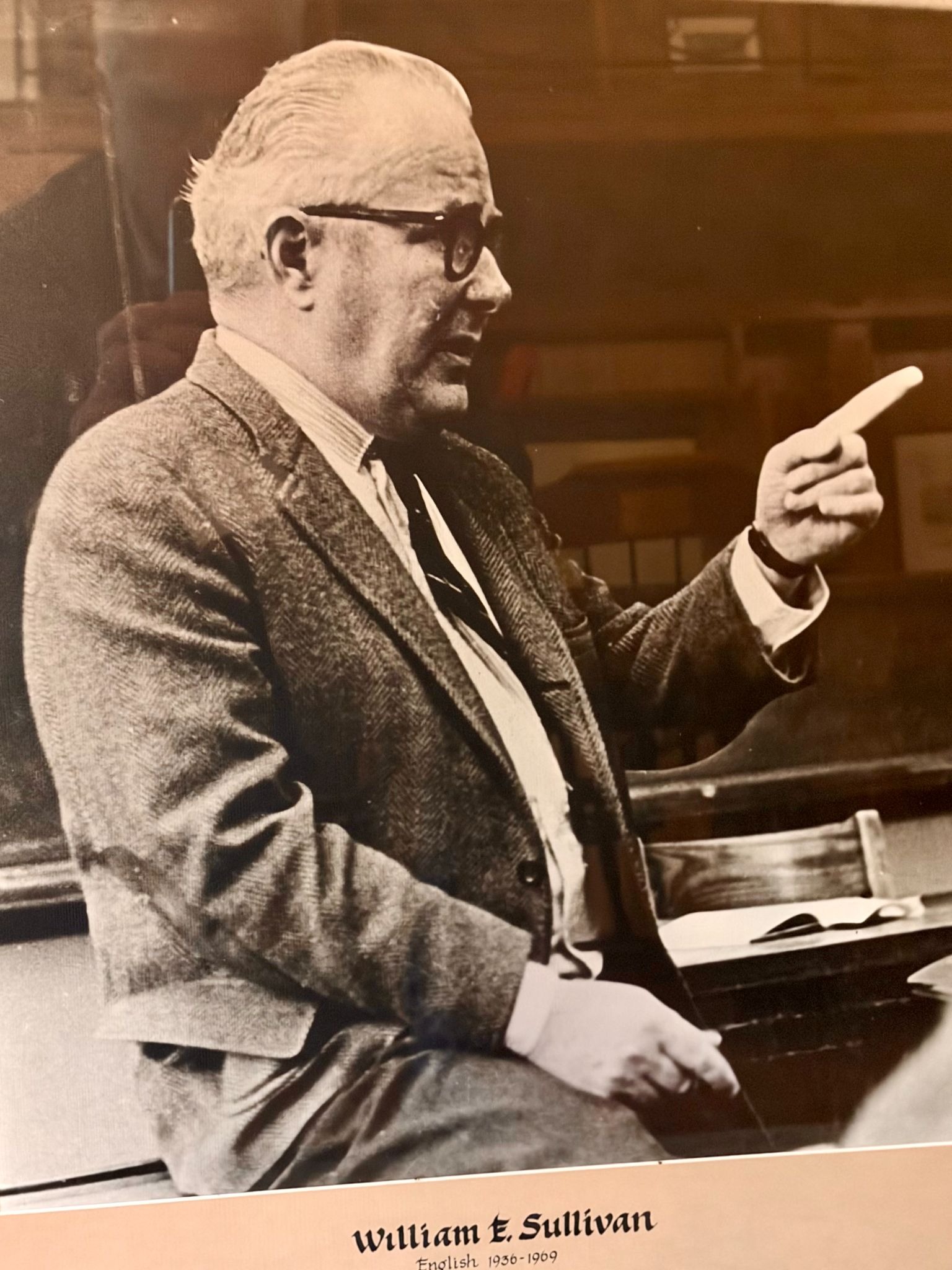
What’s called for now is emulating what my high school English teacher, Mr. William Sullivan, did nearly 70 years ago.
Two or three times every week he would tell us to clear our desks of everything except for a single sheet of paper and a pencil. What followed was what he called a “2-8-2,” meaning that we had two minutes to think–no writing allowed–followed by eight minutes to write, and then two more minutes to read what we had written and correct any errors. He would put our writing assignment on the blackboard.
Sometimes we would have to include a certain sentence, such as “I wish I had missed that train.” Or “I still wish I hadn’t missed that flight.”
Even today I can remember one particular assignment: “Turn out the light; I don’t want to go home in the dark,” which Mr. Sullivan said were the dying words of William Sydney Porter. Of course, he challenged us to explain the contradiction.
(Fun fact: Some forty or fifty years later I discovered that Porter, whom we know as O. Henry, actually did not contradict himself. His dying words were “Turn up the lights. I don’t want to go home in the dark.” Apparently Mr. Sullivan changed his words to create that challenging paradox.)
Although I went to Taft, a private school in Connecticut with small classes and privileged students, Mr. Sullivan’s approach can work at all levels. I know this to be true because I taught working-class kids in a public high school, first generation African American college students in an HBCU, and young men serving sentences in a federal prison.
I used Mr. Sullivan’s “2-8-2” all the time, and I believe the experience started many of my students down the path to becoming thoughtful writers.
Frequent in-class writing worked then, and it should work in the age of Artificial Intelligence, CHATgpt, Bard, and whatever other ‘advances’ are in our future.
However, policymakers and administrators have to behave sensibly and understand that ‘less is more.’ That means smaller classes, fewer students per teacher, and heightened trust in teachers. Those shouldn’t be a bridge too far, if we truly want our young people to be thoughtful and capable citizens.
You may stop here if you wish. What follows is the story of my own dabbling in A.I., printed in my blog in April 2023, more than three years ago.
If you’re at all like me, you’re curious about Artificial Intelligence and new applications like ChatGPT and Bard. The brilliant Thomas Friedman of the New York Times says the world will never be the same again, but my interest is narrower: If students can simply ask Bard or ChatGPT to write their papers for them, how can teachers prevent this from happening?
So, naturally, I turned to Bard, which told me (within seconds) that, while it can help students generate ideas, do research, improve their writing, and learn about different writing genres, it’s not supposed to be a substitute for original research and writing. Then it warned me to “Monitor students’ use of Bard to make sure that they are not plagiarizing or engaging in other forms of academic misconduct.”
Yeah, right. If I’m teaching English in a public high school, I probably have between 100 and 125 students! There aren’t enough hours in the day….
Second question: Can Bard help identify cheaters and plagiarists? Within seconds, I received an answer:
“There are a few things you can look for to tell the difference between original writing and prose provided by Bard.
Original writing is typically more creative and original than prose provided by Bard. Bard is trained on a massive dataset of text, so it can be very good at generating text that is grammatically correct and factually accurate. However, it is not always able to generate text that is creative or original.
Original writing is typically more personal and engaging than prose provided by Bard. Bard is a machine learning model, so it does not have the same level of understanding of human emotions and experiences as a human writer. As a result, its writing can be dry and impersonal.
Original writing is typically more nuanced and complex than prose provided by Bard. Bard is a large language model, but it is still under development. As a result, it can sometimes struggle to understand the nuances of human language. This can lead to writing that is simplistic or even nonsensical.
Ask yourself if the writing sounds like it was written by a human. Bard-generated text can sometimes sound robotic or unnatural. Original writing should sound like it was written by a human.
To put this the test, I gave Bard the following task:
Please write a short memoir of no more than 200 words about my childhood. I am one of six children, the second oldest and the first-born son. We grew up on a small farm with chickens, a few cows, a few pigs, and one goat. I’m now 81.
Within seconds, Bard spit out this:
“I was born in 1942, the second oldest of six children. We grew up on a small farm in the Midwest. My father worked hard to provide for our family, and my mother took care of the house and the children. We didn’t have much money, but we were happy.
I loved growing up on the farm. I spent my days playing with my siblings, helping my father with the chores, and exploring the woods behind our house. We had chickens, a few cows, a few pigs, and one goat. I loved taking care of the animals, and I learned a lot about hard work and responsibility.
I also learned a lot about nature on the farm. I spent hours watching the birds and the animals, and I learned to identify all the different plants. I loved being surrounded by nature, and it helped me to appreciate the beauty of the world.
I had a wonderful childhood on the farm. It was a time of innocence and discovery, and I will always cherish those memories.
Now that I am 81 years old, I still look back on my childhood with fondness. I am grateful for the opportunities I had, and I am proud of the person I have become. I know that my experiences on the farm helped to shape me into the man I am today.
Boring, and also wrong, and so I responded: This is inaccurate. I was born in 1941, and our farm was in Connecticut. Worse, however, it does not capture either the small pleasures of collecting the eggs every morning or learning to milk cows; nor does it capture the deep pain of watching a pig or steer that I raised being slaughtered. Please rewrite.
In just a few seconds, Bard responded by adding a few paragraphs, highlighted below to make it easier for you to read: “Sure, here is a more accurate and detailed memoir:
I was born in 1941, the second oldest of six children. We grew up on a small farm in Connecticut. My father worked hard to provide for our family, and my mother took care of the house and the children. We didn’t have much money, but we were happy.
I loved growing up on the farm. I spent my days playing with my siblings, helping my father with the chores, and exploring the woods behind our house. We had chickens, a few cows, a few pigs, and one goat. I loved taking care of the animals, and I learned a lot about hard work and responsibility.
I also learned a lot about nature on the farm. I spent hours watching the birds and the animals, and I learned to identify all the different plants. I loved being surrounded by nature, and it helped me to appreciate the beauty of the world.
One of my favorite things to do was collect the eggs every morning. I would wake up early and go to the chicken coop, where I would find a dozen or so eggs waiting for me. I would carefully collect the eggs and put them in a basket, then bring them back to the house. My mother would use the eggs to make breakfast, and I would always get to eat one of the freshest eggs in the world.
Another thing I loved to do was milk the cows. I would go to the barn in the evening and bring the cows into the milking parlor. I would sit on a stool and milk each cow in turn, collecting the milk in a bucket. The milk would then be used to make butter, cheese, and ice cream.
Of course, there were also some challenges growing up on a farm. One of the hardest things was watching the animals being slaughtered. I knew that it was necessary to eat meat, but I still felt bad for the animals. I would often cry when I saw them being killed.
Overall, though, I had a wonderful childhood on the farm. It was a time of innocence and discovery, and I will always cherish those memories. I am grateful for the opportunities I had, and I am proud of the person I have become. I know that my experiences on the farm helped to shape me into the man I am today.
OK, but even with this information, the machine’s writing remains pedestrian and without emotion. Human writers would know not to begin with their birthday, for one thing and would instead lead with a sentence designed to keep the reader’s interest: “70 years later, at age 81, I can still hear the terrified squealing of the hog as it was strung up by its hind feet to be slaughtered….”
My conclusion: Don’t run from A.I. But do not create conditions that make it easy for students to use it to avoid work. “Expect and respect” are the key words: Expect more from students, and respect them by giving them challenging tasks.
Although the Italian poet Dante Alighieri completed “The Divine Comedy ” more than 800 years ago, the story of the journey through Hell and Purgatory into Heaven is strikingly relevant today.
Even if you (like me) haven’t read the 160,000 word epic, you are probably familiar with Dante’s portrayal of Hell, “The Inferno,” which he divides into nine circles: Limbo, Lust, Gluttony, Greed, Wrath, Heresy, Violence, Fraud and Treachery.
Two circles of Hell, Violence and Fraud, have sub-circles. There are three types of violence: against others, against self, and against God.
And nine versions of fraud: 1) Pandery (pandering) and seduction; 2) Flattery; 3) Simony (selling forgiveness for sins); 4) Sorcery; 5) Barratry (being excessively litigious); 6) Hypocrisy; 7) Thievery; ending with two “Councillors of fraud,” the sowers of discord; and the liars and falsifiers.
So, here’s your question: In which circles of Hell would you put Donald Trump’s enablers? By “enablers,” I mean those who are bent on destroying our democratic republic, whether it’s to line their pockets, to serve their warped version of Christianity, or to compensate for their unhappy childhood or adult impotence.
Perhaps “enablers” should also include those who have turned and continue to turn a blind eye to all that’s going on. Should they be consigned to Limbo, Hell’s first circle?
My own partial list is already pretty long: John Roberts, Mitch McConnell, Lindsay Graham, Marco Rubio, Elon Musk, Jamie Dimon and all the other bankers who knew Trump was a fraud but did nothing, Merrick Garland, Clarence Thomas, Samuel Alito, Brett Kavanaugh, Amy Coney Barrett, James Comey, Mark Burnett (who produced ‘The Apprentice’), Judge Aileen Cannon, Peter Thiel, JD Vance, Rudy Guiliani, Pete Hegseth, Russell Vought, Pam Bondi, Jeff Bezos, Tucker Carlson, Leonard Leo, Franklin Graham, George Santos, George W. Bush, Jeb Bush, Brendan Carr of the FCC, and lots of others.
To complete this assignment, you’ll need some blank paper and a pencil with an eraser. Keep in mind that the offenses grow more serious as one descends into Hell. In other words, Lust is not as grievous a sin as Greed, and Wrath is worse than Greed.
That’s why this task is not a slam dunk, because for example, if you decide that Marco Rubio should be punished for Lust, you are, in effect, absolving him of Hypocrisy. Does JD Vance belong in the second circle of Flattery, the sixth circle of Hypocrisy, or in the ninth circle with the liars and falsifiers?
And you cannot dodge this responsibility by putting someone into multiple circles! That’s why you will need an eraser!
Earlier this week I reprinted a powerful piece by a college classmate. Today, a moving meditation on life and aging written by a talented high school friend, Tom Crider. As with poetry generally, it’s probably best to read Tom’s poem aloud (although I wasn’t able to do it without tearing up).
Below Tom’s poem is a photo of a painting that hangs in our kitchen, created by the talented artist Nick Lamia. Karma!
Now
There’s the repaired swivel chair on the patio
still able to hold your weight,
and there’s the morning breeze
brushing past your cheek,
and there’s the presence of the Japanese maple
transplanted long ago from your father’s backyard.
Now you’re getting used to things
that will not be happening again—
from now on never to look into a pair of eyes
saying, Let’s go somewhere and take off our clothes;
never again to feel you’ve nailed the proud turn
of the tango.
Now you almost love how you’ve been one
of many stones tumbled along by the river of time.
My Dartmouth classmate, the distinguished actor Steve Macht, recently shared this thoughtful analysis with his classmates. After reading it, I asked Steve if he would allow me to share it more widely, and he gladly agreed. If you post your reactions on my Substack page or at Themerrowreport.com, Steve will see them.
Trump, King George, and the Failure of Recognition
The comparison between Donald Trump and King George III becomes more illuminating when viewed not politically, but dramatically—through the lens of Aristotle.
In true tragedy, as Aristotle teaches, a man errs (hamartia), comes to recognize that error (anagnorisis), and undergoes reversal (peripeteia). The movement is inward. Responsibility is discovered, not deflected. From that recognition comes pity—because we see ourselves in the man—and fear, because we recognize how easily we might follow the same path.
But when recognition does not occur—when error is never owned, never examined, never internalized—tragedy collapses into melodrama.
And melodrama requires a villain.
King George III, as he lives in the American imagination (fairly or not), became such a figure. In the Declaration of Independence, he is not portrayed as a man capable of self-reflection, but as a fixed force—unyielding, deaf to petition, certain of his own rightness. Whether or not the historical George possessed that rigidity in full, dramatically he functions as the antagonist: a figure against whom others must act, because he will not act upon himself.
This is precisely where critics place Donald Trump.
Trump’s public pattern—over years—is not merely one of error. All leaders err. It is the absence of acknowledged error that defines the pattern. Mistakes are reframed as victories. Contradictions are dismissed or ignored. Blame is displaced outward—onto opponents, institutions, and circumstance. There is motion, but no inward turn.
In Aristotelian terms, there is no anagnorisis.
Without recognition, there can be no true reversal—only escalation. Each challenge becomes an external attack to be defeated, rather than an internal signal to be understood. The dramatic structure shifts: instead of a shared human struggle toward understanding, we are given opposing forces locked in conflict.
That is melodrama.
And in melodrama, the villain is not necessarily evil in his own mind. Quite the opposite: he often believes himself justified, even heroic. But dramatically, he is defined by one essential trait—he does not change. He cannot recognize himself as the source of the conflict. Therefore, the conflict must always be someone else’s doing.
This is why the analogy to “Mad King George” persists—not as a clinical judgment, but as a dramatic one. It names a fear: what happens when power is joined not simply to error, but to the inability to recognize error?
My Aristotelian framework makes the distinction exact:
· In tragedy:
I did this. I see it. I must change.
· In melodrama:
They did this. I must defeat them.
Trump, in this reading, is not tragic. He does not move toward recognition. Therefore he cannot generate pity—only opposition. The emotional field splits: those aligned with him feel embattled and justified; those opposed feel threatened and resistant. Fear and anger replace fear and pity.
That is the signature of melodrama.
And it is why the comparison to King George, though historically imperfect, carries dramatic truth. It is not about monarchy versus democracy. It is about a deeper question:
Can a leader recognize himself?
If not, then the drama cannot resolve through understanding. It can only be resolved through struggle.
All five starters on this year’s University of Michigan’s NCAA champion men’s basketball team played for other colleges last year. You heard that right: all five wore different uniforms just a year ago. When that season ended, they entered the NCAA’s “Transfer Portal,” which allows college athletes to sell their services to the highest bidder. Those five took Michigan’s money and donned the Maize and Blue.
Now, if colleges are willing to pay millions to men and women who can dunk, dribble, and make 3-point shots, just imagine how much our best public school teachers are going to be offered, when they enter the Teacher Transfer Portal!
The mind boggles…..
Blanche DeForest, Shelley B. Percy, Newton Isaacs, Porter Kohl, and Rochelle Carson are five of the highly sought after teachers entering this year’s Teacher Transfer Portal.
Blanche DeForest now teaches at MLK High School in New York City, where she works with physically challenged students, using music and movement to build her students’ confidence.
A native of New Orleans , Ms DeForest, 43, has been teaching in the Big Apple for a dozen years and has enlisted the help of several of New York City’s professional athletic teams to work with her students. That would seem to narrow Blanche’s choices, because she wants to be in a city with at least one pro team. “I have always relied on the kindness of the Rangers,” Ms. DeForest says.
At least five wealthy school districts are bidding for the services of Shelley B. Percy, who teaches creative writing at East Side High School in Camden, New Jersey. A 19-year veteran, Mr. Percy forms his students into small teams, which then compete in poetry slams here and abroad.
One distinction: unlike most young rappers, Mr. Percy’s students rap in iambic pentameter. Eschewing curse words and vulgarity, these young poets embrace ABAB rhyme schemes and extended metaphors.
School districts on both coasts hope to sign Newton Isaacs, who teaches science at Collingwood High School in Cleveland, Ohio. Every semester Mr. Isaacs forms his juniors into 3-person teams and challenges them to solve a complex problem. For example, this spring his juniors were tasked with designing (using CAD) a toy for 2- and 3-year-olds, one that would develop their motor skills but not so small that they could swallow it nor too large for them to handle comfortably. They also had to design a marketing campaign to reach young parents.
Hundreds of his former students maintain that his class taught them marketable skills like teamwork and persistence, while also boosting their self-esteem.
Wherever he ends up, next fall Newton Isaacs will be earning more than $3M.
Middle school music teacher Porter Kohl is also expected to sign for well north of $3M. Every year her fifth grade students in her inner city Los Angeles public school write, score, and stage an original opera. They start from scratch, coming up with a story idea in September. By October they’re well into writing a libretto, with a clear story arc but also with twists and turns. Composing the score comes next, which also entails some students trying to master the musical instruments. Costuming, set design, set construction, rehearsals–they’re all part of the year-long project, which culminates in live performances (which will be videotaped and uploaded to her class’s YouTube channel).
Ms. Kohl notes that, while reversing her name suggests a musical inheritance, her true heritage goes back to her great grandfather, who worked in the coal mines in eastern Europe. “He was a Coal Porter,” she says, although her sly smile makes it difficult to figure out whether she’s kidding or not.
Rochelle Carson, a middle school science teacher in Brooklyn, TX, is also highly sought after in this year’s Teacher Transfer Portal. Three years ago she mounted a GoFundMe campaign to raise money to buy two air quality monitors, one permanent and one portable. The permanent machine is installed on the school rooftop, while her students transport the portable monitor from place to place during the day. Her students monitor the readings over time and then attempt to interpret the differences.
Two years ago Ms. Carson took a giant step with her students, reaching out to 20 other towns in the United States also named ‘Brooklyn.’ She struck a chord, and this year students from middle schools in almost all the other Brooklyns around the USA are sharing air quality data, allowing them to compare and contrast air quality in most of the continental United States.
Who’s bidding for their services? The richest public school districts, where the median income exceeds $250,000. The list includes Greenwich (CT), Monte Sereno (CA), Scarsdale (NY), Short Hills (NJ), Bunker Hill Village (TX), Belle Meade (TN), Atherton (CA), Chevy Chase (MD), and Palm Beach (FL). And when the dust finally settles, these classroom teachers will be earning perhaps as much as $5M per year, not chump change in a country where the median teacher’s salary is $63,000.
Why don’t wealthy school districts simply encourage their teachers to copy these clearly successful teaching techniques in their own classrooms, instead of bidding for the teachers who originated them? I directed my question to Hardwick Cheever IV, the School Board President in Greenwich, Ct. “Why do you raid these districts and pay inflated salaries?” I asked. “Couldn’t you just use all that money to pay all of your teachers higher salaries? That would spread the wealth around”
“That’s not how we roll here in America,” he replied, indignantly. “If buying talent is good enough for the University of Michigan’s basketball team, then it’s good enough for us. Besides, what you call ‘spreading the wealth’ would be socialism in my book.”
I pressed him. “Do you feel guilty taking these incredibly talented teachers away from their districts? Many of them are teaching low income or disadvantaged children.”
“Son, as God is my witness, I have nothing against poor people,” he replied. “But it would be unChristian if we did not do everything in our power to take care of our own. That’s the American way. Get used to it.”