Improving Public Schools (#9): “Education Grand Rounds”

About six years ago I was in a New York hospital recovering from a near-fatal bout of sepsis when a large group of people, all dressed in white, came into my hospital room and gathered at the end of my bed.  I was groggy from drugs and had no idea about what was going on. In fact, the next day I wasn’t even sure it had actually happened. Perhaps I had been hallucinating?  I asked a nurse, who told me it was part of ‘Grand Rounds,’ when doctors, residents, interns, and medical students go from room to room to talk about the condition and treatment of patients with that particular condition, and about the larger picture: how that condition is treated elsewhere, its causes, the prognosis for survival, and so forth.  Teachable moments, created by those in charge of education.

I later learned that Grand Rounds may be live-streamed, sometimes with actors standing (lying in?) for patients because of complaints from actual patients about insensitive treatment. (IE, they didn’t like lying there hearing their condition discussed openly by strangers.)

But the idea of information-sharing appealed to me.  How could it be applied to public schools, I wondered?  Could teachers systematically and routinely share relevant information about how they were getting through to certain students….and having trouble connecting with others?  And then I flashed back to a series I had done for the NewsHour somewhere around 1990.  We followed two rookie teachers in a Maryland school district for a year, one in a public high school, the other in a public middle school.  While it wasn’t a particularly memorable series, one segment stayed with me: We filmed all the 7th Grade teachers getting together to talk about individual students.  Basically, they shared what seemed to work with particular kids, and what didn’t.  Some openly voiced their frustrations with–even dislike of–certain students, something I don’t remember being able to do when I was teaching, but a healthy way of ‘clearing the air,’ it seemed to me. 

What we discovered was that, at that middle school, teachers met weekly, by grade, to share insights, ask questions, and express concerns.  It was a team-building exercise focused primarily on improving student outcomes, something that made sense then and makes even more sense today. I’m calling this Education Grand Rounds….but hope someone will come up with a better name.

I think we filmed 10 or 15 conversations about individual kids during that time period.  I’m guessing that their shared insights resulted in more effective teaching, more satisfying results with students, and in some cases close attention to a student’s problems.  Because no teacher wants to be continually disciplining students and putting out fires, and because teachers are willing to share success stories, what I think of as Education Grand Rounds make educational sense.  

Absent Education Grand Rounds, information sharing is left to chance, during a lunch break perhaps.  A retired teacher, a good friend, told me this story, which I know is representative of what happens all too often: “Leodardis was a child from El Salvador in my class. No one had done anything for him in his life, but he loved my class. He couldn’t see without his glasses, and that’s when he would act out, which is why I always made sure he had his glasses.  I even bought him a string to hold them around his neck, like mine.  When Leodardis went onto the next grade, the teacher asked me if he was always so badly behaved. ‘Does he have his glasses,’ I asked?  The teacher didn’t even know he wore glasses. It was all written up in the report I had filed, but she had never read it.

While many private school faculty meet routinely to talk about individuals, it will be tougher for public schools, whose teachers are, in restaurant parlance, ‘fully booked,’ with perhaps only one free period a day, plus a few minutes for lunch.   Asking teachers to work longer hours–IE, meeting after school–probably won’t work. Schedules have to be redesigned.

As with creating extended homerooms, making Education Grand Rounds part of a school’s routine will involve reworking the daily calendar.  Like other changes I’m suggesting, this won’t be easy, but it can be done, because I saw it in action, albeit only a few times in my 41-year career as an education reporter.

(Interestingly, an Education Professor at the University of Newcastle in Australia, Dr. Jennifer Gore, and a colleague have developed what they call “Quality Teaching Rounds,” where groups of teachers watch each other teach and then share their thoughts about the pedagogy. Its focus is on improving teaching, not getting to know students better. I’m indebted to Professor David Imig of the University of Maryland for this information.)

Here are the other steps that I believe will improve public schools, with hot links to each: Looping, Play, Practice Democracy, Business Cards for Teachers, Involve Outsiders, Multiple ‘Talent Nights’, Extended Homeroom, and Ask the Right Question

I’m hoping you will share the links with people who have the power to change public schools, because it’s not enough to fight against those who would destroy public education. The system itself must improve, and that happens best at the level of the individual school.

Improving Public Schools (#8): Ask the Right Question

The campaign to undermine public schools has taken a new turn with North Carolina’s passage of Education Savings Account legislation. Passed with support of enough Democrats to make it veto-proof, the law will provide up to $7500 per child, depending on family income, to pay for private school tuition.  According to The 74, a right-leaning on-line education site, “Arizona, Arkansas, Florida, Iowa, Utah and West Virginia now have ESA programs open to all. Oklahoma has a universal tax credit program. Ohio has a universal voucher program and in Indiana, the family income ceiling for a voucher is set so high that it’s nearly universal.”

Even strong supporters of ESA’s agree that the amount available doesn’t cover tuition and that most beneficiaries already enroll their children in private schools; however, every dollar for every ESA comes from public school funds.

So what can public schools do in the face of deep hostility from many state legislators and activist groups like Moms for Liberty?   A strong clue comes from an ESA advocate, who told The 74 that “We know that parents are hungry for an education system that recognizes the uniqueness of their children…”

Sadly, those words should be the mantra and guiding philosophy of every public school educator, who could and should ‘recognize the uniqueness’ of children by asking one essential question about every child entrusted to their care, “How is he or she intelligent?”  Unfortunately, the system they work in, and perhaps their own training, leads most public educators to ask a very different question, “How smart is he or she?”

And then systems rely largely on scores on standardized bubble tests to provide the answers. That leads to sorting, stratification, inappropriate competition, humiliation, and more. 

So the simple (but not easy) step is to always ask the right question about every child: “How is he or she smart?”  Rephrase it if you wish: “What is this child curious about, and how can we harness that curiosity to achieve the core goals of helping him/her become literate, numerate, capable of working with others, and confident?” 

This step would be easier if reasonable class size limits were policy. Treating children as individuals is difficult enough with, say, 25 students; it’s probably impossible with 38.

The same people (Moms for Liberty, Christopher Rufo, for-profit Charter Schools, etc)  who are complaining that public schools don’t recognize the “uniqueness” of their children are also working overtime to undermine and underfund public schools. 

But it’s not enough to fight them. Public schools need to be proactive, and they need to get better. That’s why I hope at least some of you are taking these small steps seriously and sharing them with educators and others in a position to make changes.

Here are links to the seven previous steps, which endorse Looping, Play, Democracy, Business Cards for Teachers, Involving Outsiders, Frequent “Talent Nights,” and Expanded Homeroom.   Share them with others if you are so inclined.  And please stay tuned for more steps….

Improving Public Schools (#7): Expanded Homerooms

“Homeroom” for most high school students is the equivalent of the starting blocks in a track meet. They touch base, listen to (or maybe ignore) morning announcements, and, when the bell sounds, dash off to class. In truth, “Homeroom” is important to school administrators because it gives them a head count. It’s a meaningless perfunctory exercise for kids.

For them, “Homeroom” is just a room, about as far from actually being a home as one can imagine.

That has to change. America’s teenagers desperately need more “Home” in their lives, more opportunities to connect with others, more moments that tell them they matter. The rigidity of today’s high-pressure school schedules makes matters worse, not better. 

This has always been true, but during the pandemic, when many public schools were closed, students’ mental health deteriorated, and their problems skyrocketed, as measured by visits to hospital emergency rooms.  Adolescent girls, a 50% increase! 

A CDC survey covering the years 2011-2021 does not report on the full impact of COVID, but its findings are nonetheless disturbing.

  • In 2021, more than 4 in 10 (42%) students felt persistently sad or hopeless and nearly one-third (29%) experienced poor mental health.
  • In 2021, more than 1 in 5 (22%) students seriously considered attempting suicide and 1 in 10 (10%) attempted suicide.

There’s a simple fix—not easy, but simple: make “Homeroom” more of a HOME, not just another room. The essential step is to extend Homeroom from a few minutes to at least a half hour and perhaps more. 

Next, work with teachers to convince them that this new time period is an opportunity for them to expand their own professional repertoire of skills to include their students’ social and emotional growth. The challenge may be to train teachers to listen and not react, in order to allow young people to identify and share their feelings. NewsWeek magazine reports that Tacoma, Washington, schools are doing this, training not only teachers but also parents and school bus drivers.

In each of these new extended Homerooms, the teacher and his/her students will have to work together to figure out how they want to use this time. Some students may want to finish homework, or sleep, but the teacher could steer the conversation in the direction of “team building.”  (See #3 in this series for suggestions.)

Perhaps one day a week could be set aside for discussion of some interesting questions (“If you could meet one figure from history, who would it be, and why?”), even trivial ones (“What questions would you like to ask Taylor Swift?”). 

One ground rule I hope all would adopt: NO phones or electronic devices allowed! 

Ideally “Homeroom” will turn into a safe space where students can learn to share and will agree that what’s shared there stays there. No bullying allowed. 

Extending Homerooms is neither a new idea nor a pipe dream. The late Ted Sizer preached and practiced this in his Essential Schools reform, and I recall seeing how well it could work. Didn’t always work, of course, because some teachers either weren’t fully committed or skilled enough, and some kids were unwilling or unable to shed their tough outer skins. 

Like many promising reforms, the expanded Homeroom sputtered and died, the victim of 1) test mania, 2) administrative indifference, and 3) the unwillingness of some teachers to do the necessary work. 

I observed a fourth factor: outright vicious hostility from guidance counselors, who felt that teachers were “invading their territory” by tending to the emotional needs of students. To them, turf meant more than the well-being of young people. Ironically, that shouldn’t be a problem this time around…because guidance counselors have all but disappeared from most public schools.

If you want to help America’s young people recover from Covid, and if you want them to reconnect, give them time and space, expand Homeroom now!

(The first six steps in this series are here: Looping, Play, Practice Democracy, Business Cards for Teachers, Involve ‘Outsiders,‘ and More “Talent Nights” If you share my commitment to public education, please share these ideas with others.)

Improving Public Schools (#6): Frequent “Talent Nights”

I need to start with a story.  About 20 years ago the State of Virginia adopted a school reform strategy called ‘Turnaround Schools.’   To their way of thinking, the right way to turn around ‘failing’ schools was to recruit experienced and dedicated administrators and spend a summer teaching them ‘Turnaround Tactics.’  These newly-minted ‘Turnaround Specialists’ would then be assigned to lead ‘failing’ schools. 

Because to education reformers, “failing” meant low test scores, the Turnaround Specialist’s mission was straightforward: Produce higher scores on the state’s annual tests during his or her three-year tenure.  

Stuff like that was catnip for journalists, and so we went to ‘Turnaround Training Camp’ and recruited a promising candidate, an idealistic veteran principal named Parker Land, to follow throughout his Turnaround Years at Boushall Middle School in Richmond.  

Unfortunately, I wasn’t able to find the series on the PBS NewsHour website, but I can tell you that it didn’t turn out well. Standardized test scores didn’t go up, attendance did not improve, and most teachers rebelled against the increased pressure to ‘teach to the test.’  After just one year, Mr. Land was reassigned to a different school.

But what has stayed with me over the years was how he inadvertently hit upon a sure-fire way to connect with families–”Talent Night”–but unfortunately failed to recognize what he’d discovered. I don’t fault him, because making close connections with parents wasn’t an essential Turnaround Strategy. 

Here’s what happened: Early in the fall, Mr. Land scheduled ‘Talent Night,’ and he made it a big deal: Lots of performances by eager middle-schoolers, plenty of free food, live music, and even baby-sitting services provided by older kids–everything to make parents feel that Boushall was their school.  His goal was to make parents feel at home, and it worked spectacularly well. The pleasure was palpable, and I recall that it jumped off the screen in the segment we aired on The NewsHour.  Mr. Land was pleased, and we fully expected that he would make ‘Talent Night’ a regular event.  Why wouldn’t he, after seeing how happy and comfortable parents were in ‘their’ school?  What better way to get parents behind his effort to improve their school?

The right question, unfortunately, turned out to be Why Would He Even Bother?, because in public education, then and now, parent involvement is just a one-off, check-the-box activity, not integral to the system. 

I am not singling out Parker Land for criticism; he was a dedicated educator and a decent man.  Public education’s collective mentality is the villain here; it’s what needs to change. For 41 years I heard professional educators speaking in public forums describe parents as “our greatest asset” and “invaluable partners,” but I also heard their private conversations, or I caught them off guard…and on those occasions the message was pretty much the polar opposite: “Most parents are a pain in the neck!”

Don’t take my word for it–just  examine how most schools treat parents.  It seems to me that most schools make parents ‘outsiders’ in subtle and not-so-subtle ways.  There’s the once-a-year “Back to School Night” and perhaps a “Parent Involvement Committee’ or a “Parent Advisory Board” that meets occasionally with the Principal.  Many administrators expect parents to hold bake sales, auctions, and fundraising drives, but that’s not treating parents as partners in their children’s education.  

Why this negative attitude toward parents?  Some educators feel that low income parents do not have the time or energy to get deeply involved in their children’s schooling.  But even if their dismissal of parents is rooted in empathy or sympathy, it adds up to the same thing: the exclusion of parents.  

As evidence of parental detachment, these administrators and teachers often cite the low turnout at Back to School Night, concluding from the large number of no-show parents that they don’t care.  But look carefully at Back to School Nights: They’re scheduled when it’s least inconvenient for teachers, and they consist of a quick series of show-and-tell presentations by teachers, one-off lectures that may make parents feel like visitors, strangers who happened by. Parents will be told to make sure their kids do their homework assignments and don’t spend too much time on social media.  Why would most parents bother to attend more than once?  What’s about appealing about being talked down to?

Unfortunately, it’s the rare educator who says “We cannot do a good job of educating your child without you,” actually means it, and then proves it by his or her actions.

Perhaps administrators and many teachers hold parents in low regard because they are hoping to elevate their chosen field into a high-status profession.  “After all, you wouldn’t expect a heart surgeon to consult with a child’s parents about the best way to replace a ruptured valve to save the child’s life,” the thinking goes, as if the work of educating a child were the equivalent of complex surgery.

But schooling isn’t heart or brain surgery,  Moreover, schooling and education are not synonymous.  Education is more comprehensive (24/7/365 if we are lucky).  Schooling (only 180 days a year for 12 or 13 years) should be team effort, with teachers and parents on the same side  

Very little–if anything–is done to make parents feel that the school is theirs, but there’s actually an easy way to start to change: Do what that Turnaround Specialist in Virginia failed to do: Schedule frequent ‘Talent Nights’ with pot-luck meals, performances by students, live music, with child-care provided by other students. 

Once parents feel that it’s their school too, consider offering short classes teaching the skills necessary to help their kids become better readers or more proficient problem-solvers. No lectures, no ‘parent involvement committees,’ no window-dressing, but a genuine partnership that invites openness and commitment from everyone.

Because some parents have grown accustomed to educators saying ‘Leave the education to us,’ they’ll need help learning to accept their new role and responsibility.  Because some teachers have grown accustomed to holding parents at arm’s length, they will have to learn ways to acknowledge that parents are essential.  (They’ll have business cards to hand out!)

A big part of public education’s problem is its failure to recognize that most parents want their children to succeed but may not know how to contribute.  Turn that around by accepting parents as valuable assets. Partners, not ‘outsiders.’  

(I invite you to take a look at the five previous steps, which endorse Looping, Play, Democracy, Business Cards for Teachers, and Involving Outsiders.   Share them with others if you are so inclined.  And please stay tuned for more steps….)

Improving Public Schools (#5): Involve ‘Outsiders’

The “small steps” I am recommending in this ongoing series take on increased urgency with the spread of Education Savings Accounts, which now provide money for private school tuition in nine states.  Even though the dollars are nowhere enough to pay the full tuition and even though most recipients are already enrolled in private schools, the ESA dollars come from public school budgets. And pro-ESA campaigns generally use inflammatory language about giving parents “the chance to escape failing schools….”

While most public schools aren’t failing, they simply aren’t doing enough to nurture ‘the uniqueness of every child.’  Simply put, public education needs to fight back. All of the ‘small steps’ in this series are simple–although not always easy–to take.

Here’s the next one…..

The problem with the truism “It Takes a Village to Raise a Child” is that most villagers have no direct connection to children or to the schools they go to. Only about 25 percent of homes have school age children, and in some communities that number drops into the teens. Even if one includes households with grandparents, the percentage probably won’t reach 40.  And although support for local public schools is at an all-time high (54%), that may not be high enough to withstand the vicious attacks on the institution by “Moms for Liberty” and other radical right groups.  Educators need to do more to win the support of ‘outsiders.’

The 60-80% of households without a strong connection to public education will determine the future of public schools.  Because they vote on school budgets, their opinion of schools, teachers, and students matter.  That’s why educators must develop and adopt strategies to win their support.  It’s not enough for good things to be happening in schools; ‘the outsiders’ need to be supportive, and a good way to win their support is to get them involved.

Because students who are engaged in their work are the best advertisement for public education, adults need to do two things:  1) Make sure the work is engaging and 2) that it involves the world outside the classroom.  Substitute “Production” (meaning that students are actually producing knowledge) for “Regurgitation” (where students parrot back what their teachers have told them).

Start with a public website and a YouTube Channel that features student productions done outside of school–in their community.  Whatever their ages, kids should work in teams, because it’s safer and it’s also how the adult world functions.  Every smartphone is also a great video camera, and so young people can interview adults in their community, then edit those interviews to create oral histories of people and places in their neighborhood–a sure crowd pleaser because everyone loves talking about themselves. When students know that their work is going to be out there for everyone to see, they will go the extra mile to make them as good as possible.  Adults can help set high standards, of course.  

The possibilities are endless:

*Students can create a photo gallery of the residents of their apartment building or their street and then post portraits on the web for all to see and talk about. Include photos of how the neighborhoods have changed over time.

*Art students can sketch portraits of business storefronts, or workers and bosses, also to be posted on the web.

*The school’s jazz quintet can perform at community centers and post the recordings on the YouTube channel.

*Video teams can interview adults in senior citizen centers around a chosen theme (best job, favorite trip, et cetera), to be edited into a short video for the web. Producing short biographies of ordinary citizens will teach all sorts of valuable skills like clear writing, teamwork and meeting deadlines.

*Music and drama students can rehearse and then present their productions at retirement homes and senior centers — but with a twist: involve some of the adults in the process (a small part in the play, a role in selecting the music, and so on).

Projects like these will help adults without connections to public schools appreciate the value of supporting public education. At the same time, young people will be developing skills that will serve them well throughout their lives:

1) working together with peers;

2) communicating across generations;

3) making value-based judgments, and;

4) meeting ‘real world’ professional high standards.

Real work makes school more valuable and interesting, and students’ enthusiasm will carry over into other aspects of their school experience. They will become better and more discerning consumers of education precisely because they are now producers.  And because “We are what we repeatedly do,” these young people will be well on the way to becoming productive adults.

The fun–and the rewards–ramp up when productions are posted on the school’s YouTube channel–and perhaps broadcast on local news as well.  That’s when these adults who do not have kids in school will start talking, sharing the link, and pulling out their smartphones and showing it to friends and customers.  They’ll be saying, “Did you know what they’re doing in school these days? Sure makes me wish I could go to school all over again.”

That’s one way to turn outsiders into strong supporters of public education.  

Please take a look at Steps One, Two, Three, and Four, which endorse Looping, PlayDemocracy, and Business Cards for Teachers.  Share them with others if you are so inclined.  

And please stay tuned for more steps….

Improving Public Schools (#4): Business Cards for Teachers


At every ‘Back to School’ night I can remember, I made a point of introducing myself to the women and men who taught my three children.  It went this way:  “I’m John Merrow, (name of child)’s Dad.”  And the teacher would smile and respond, “I’m Mrs. Hobson,” or “I’m Mr. Blair,” or “I’m Ms. Anderson.”  

No first names…ever.  Just a studied formality that created a distance between us.  Perhaps this “professional” behavior was supposed to establish a barrier, just as doctors almost never reveal their first name when you meet them.  Perhaps it’s the teachers’ way of letting parents know there’s a pecking order…and that they’re on top.

But I’ve come to believe differently. I think most teachers adopt an aloof stance because they are unsure of the status of teaching generally…and because they are painfully aware of the low regard that most administrators, many politicians, and some in the general public have for them. 

In other words, the roots of their formality are in their insecurity, not their confidence.

And you can do something about that.  It’s a small step, but you know what they say about how journeys begin.  Do what’s necessary to ensure that all of your school’s teachers have business cards, which they can give to parents on those “Back to School’ nights.  In the world of professionals, business cards come with the territory. Therefore, if we want our teachers to see themselves as professionals, they should have business cards.

And the “Back to School” night introductory meetings with parents will then go something like this:  “I’m Nancy Hobson.  Thanks for making the effort to be here tonight.  I’m happy to be teaching your children, and I want to work with you to see that they do great things this year.  Here’s my card. It has my email address and my phone number, and I want you to reach out to me if you have any concerns or questions.”

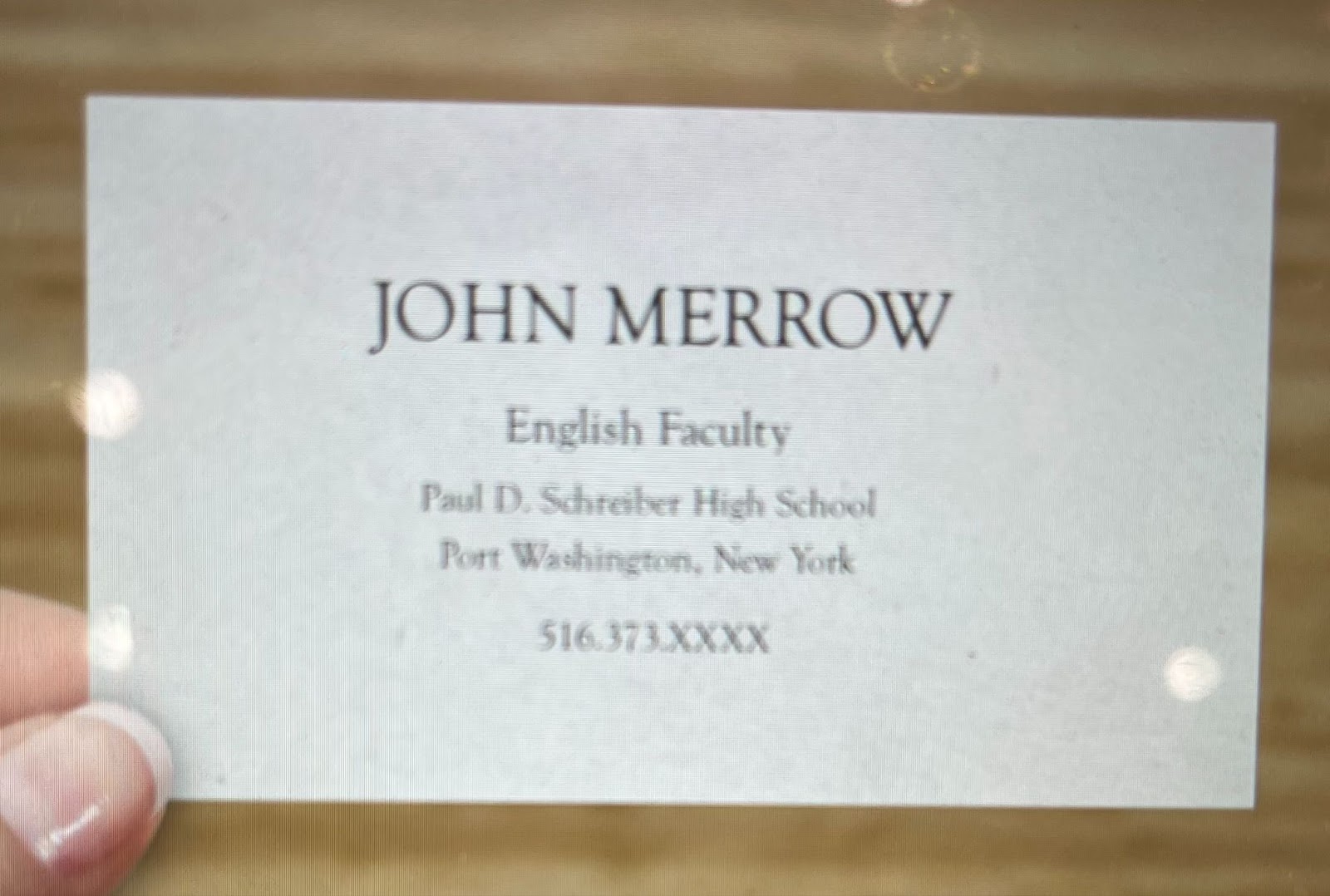
Here’s what mine might look like if I were transported back in time to my teaching days in the mid-60’s:

A box of 250 business cards costs just over $15.  So, if your school has 40 teachers, the PTA needs to raise about $600.  But–THIS IS IMPORTANT–do not under any circumstances allow some business to ‘sponsor’ the business cards and put their own name on each card.  Yes, that would save a few bucks, but it would render the cards USELESS because it would convey to the teachers that you didn’t care enough to pay for the damn cards!  

(I know this from experience: At one of my college reunions, we allowed a local bank to ‘sponsor’ the windbreakers, which had their logo splashed all over them; I don’t think any of us ever wore them!)

This step may strike some as exceedingly small, even trivial, but I would disagree.  Supporting teachers means treating them as professionals.  We want them to recognize that education is a team sport, and we want them to be eager to work in partnership with parents. However, this small step is not a substitute for other, bigger ones, but it’s of a piece with an essential campaign to save public education from predators and ideologues.  It all matters.  

Please take a look at Steps One, Two, and Three, endorsing Looping, Play, and Democracy. Share them with others if you are so inclined.  And please stay tuned for more steps….

Improving Public Schools (#3): Practice Democracy

The first two posts of this series recommend Looping and Play as simple, inexpensive steps that will improve public schools.  The third step, Practice Democracy, is also simple, but this one will not be easy because undemocratic behaviors are baked into the structure of public education. By that I mean that almost no one inside a school has a vote or even a say in what they have to do. Teachers are told when to show up, what to teach, where to teach it, and sometimes even when to teach it–down to the day and hour!  Students are told when to show up, where to sit, when and how to walk in the halls, when they can eat, what they can and cannot wear, and when they can leave.  This routine, over 180 days for 12 or 13 years, is probably the least ideal (i.e., worst) preparation for life in a democratic republic. That’s what needs to change.

But, as an important aside, this series of simple and inexpensive steps is in no way intended to minimize or obscure the need for major changes we need to make in our public schools, such as smaller classes, better ventilation, higher salaries, and improved physical facilities.  In fact, I hope that, if enough parents and school supporters work for small changes and see their impact, they will then work hard(er) in support of the big changes.

So how can schools begin to practice democracy, by which I mean sharing in making the decisions that affect their lives? But what better place to start than in classrooms, where kids of varying backgrounds are supposed to learn how to live and learn together.

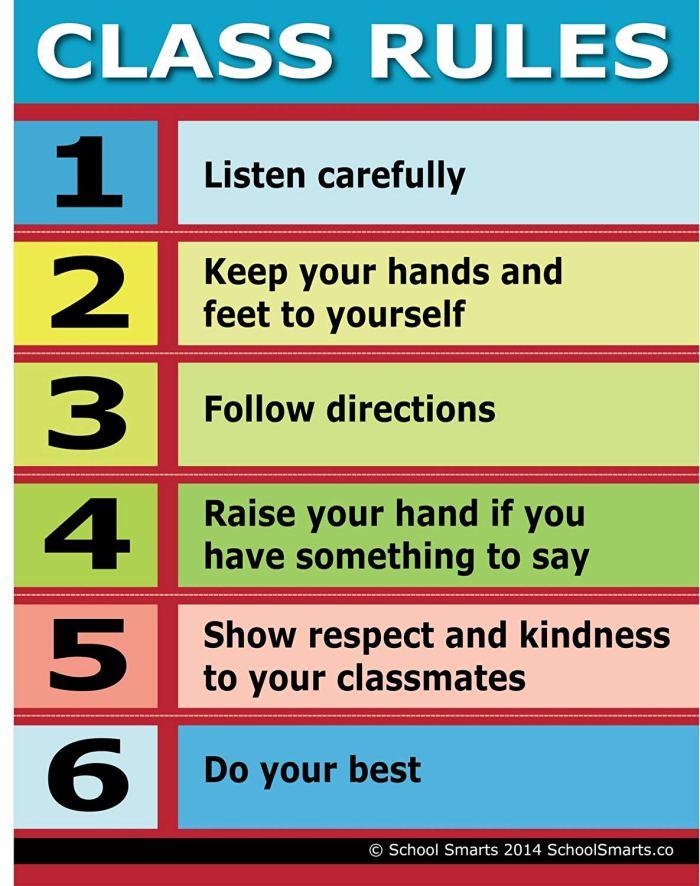
Start with rule-making. In 41 years of reporting, I visited thousands of elementary school classrooms, and I’m certain that virtually every one of them displayed–usually near the door–a poster listing the rules for student behavior.  These were store-bought, glossy, laminated posters.  No editing possible, and no thought required. Just follow orders!  Here’s an example:best 'class rules'

I can imagine teachers reading the rules aloud to the children on the first day of class and referring to them whenever things got loud or rowdy.

“Now, children, remember Rule 4.  No calling out unless I call on you.”

Here’s a great opportunity to practice democracy. Teachers and their students can spend some time during the first few days of school discussing what sort of classroom they want to spend their year in.  That is, what rules should we establish?

Teacher:  Kids, let’s make some rules for our classroom.  What do you think is important? 

Skilled teachers will lead the conversation in certain directions:

What if someone knows the answer to a question?  Should they just yell it out, or should they raise their hand and wait to be called on?

Or: If one of you has to use the bathroom, should you just get up and walk out of class? Or should we have a signal?  And what sort of signal should we use?

I watched that process a few times, and, no surprise, the students invariably came up with reasonable rules much like those on the laminated posters: Listen, Be Respectful, Raise Your Hand, Be Kind, and so forth.  But there’s a difference, because these were their rules, and they owned them and were therefore more likely to adhere to them.

Don’t stop with rule-making. Practicing Democracy also means giving students more say in what they study, because I believe that a good education system is–insofar as it is possible–both personalized and child-centric.  Giving students–at all levels–more ‘agency’ over their education means figuring out what each student is interested in and then using those interests to see that they learn to read with comprehension, work with numbers, speak in public, and work well with others.

Of course students should not get to make all the decisions about what they’re studying.  After all, a central purpose of school is the transmission of knowledge, and so the basics are also part of the deal.  Young children need to learn spelling rules (“I before E, except after C”), the multiplication tables, how to divide and carry, and other basics. They need to know that letters have sounds associated with them (i.e., Phonics and Phonemic Awareness).  Someone has to teach them that, if you put an E at the end of words like ‘ton,’ the O sound changes from ‘short’ to ‘long.’  

But giving students some amount of power over their learning will, eventually, make teaching easier.  When I was a high school English teacher many years ago, I was assigned students in the lower academic tracks. They were supposed to write a few papers (we called them ‘themes’) during the year, and I probably gave them assignments based on whatever play or novel we were reading.  So I ended up reading 125 papers about ‘Macbeth,’  ‘All Quiet on the Western Front,’ or Shirley Jackson’s short story, ‘The Lottery.’   That takes a toll on the teacher!

(Side note: NO English teacher should be responsible for 125 students! That’s an impossible task that forces teachers to triage.)

If I were teaching high school English today, I would ask each student to identify three or four things they were curious about. Then I would spend a few minutes with each student, getting that list down to one topic.  I’d ask for a 1-page ‘memo’ of their thoughts about how they would approach the topic, followed a week or so later by an outline.

When I discovered that some students shared an interest in the same general topic, I would connect them and urge them to share their pursuit of knowledge. 

Because I would be looking at drafts of their work, the chances of them using AI or downloading someone else’s work from the internet would be minimized.

I would also ask students to create a webpage where essays could be shared with students and the community at large.  Pride of publication is a great motivator!

Math teachers could invite students to create word problems that reflect their own interests.  A youngster interested in farming oysters might create problems that provide data about the cost of ‘seed,’ the rate of loss, the time involved in transferring the ‘seed’ as it begins to mature, the labor costs involved in harvesting. What’s the rate of return on investment if…..?

Preparing young people for life in a functioning democracy means that adults have to change their behavior.  Their challenge is to ask and answer a different question about every young person–How Is This Student Smart?  Humans are curious by nature, and every child has interests and abilities that can be built on, and so teachers might consider asking questions, instead of simply giving assignments: 

          What would make this material appealing to you? 

          What would persuade you to invest your energies in this subject? 

          What else are you interested in?  

I also believe young people should be deeply involved in figuring out how their efforts will be measured.  It makes no sense to wait for end-of-the-year bubble test results or for teachers to arbitrarily say ‘This passes” or “This doesn’t.”  Teachers and students should assess progress frequently, take a clear-headed look at the results, and adapt accordingly. 

Democratizing schools for students won’t happen unless teachers also gain some measure of control over their professional lives, and that’s going to be complex. The initial step is for teachers to have more say in how their students are evaluated. They should, of course, because they know them better than anyone (this will be doubly true if schools adopt Looping!).  The power to judge/evaluate now rests with adults outside the building, who must be persuaded that trusting teachers will improve student performance.  Teachers also need to be empowered to work together to create curriculum, because (just like rule-making by students) they will own what they have helped create.  

Practicing democracy would also mean involving teachers in the hiring of new faculty. Why shouldn’t they participate in building their team of colleagues?  

Education is much more than knowledge transmission. Much of what goes on–in and out of school–is the development and creation of the individual.  What Jacques Barzun called “Building a Self” involves discovery and trial-and-error, and that journey becomes much more interesting when kids are creating knowledge, not just giving back the right answers in order to get good grades.  Because, per Aristotle, “We are what we repeatedly do,” inculcating the habit of democracy in children of all ages is the best way to ensure that our democratic republic endures.

The goal of education, wherever it’s occurring, is not correct answers. The end game is life-long curiosity.  And young people who get accustomed to practicing democracy are probably much more likely to value its traditions and to be active citizens.

(I will be off the grid for about two weeks but will be back with Steps four, five, six, seven, and who knows how many more….)

Improving Public Schools (#2): Play!

My hope in this series of short posts is to call attention to some simple steps that will improve public schools (and, by extension, the life chances of more children). Last week in this space I lobbied for LOOPING, the practice of keeping a teacher with her/his students for two consecutive years.  

Another easy step: PLAY.  Schoolchildren used to enjoy recess, which was recognized as an important part of developing ‘sound minds in healthy bodies.’ (And play’s benefits are extensive and well-documented.) However, the disastrous federal law known as No Child Left Behind (2002, George W. Bush) and the equally bad federal policy known as Race to the Top (2009, Barack Obama) changed public education dramatically. Henceforth, instead of test scores being one means of evaluating individual students, entire schools would be judged (and penalized) according to their students’ overall performance on standardized tests, and test scores alone.  Overnight, this forced public schools to focus their energy on standardized test scores in Math and English Language Arts, because their schools could be closed and their jobs eliminated if the school did not make ‘Adequate Yearly Progress.’  As a direct consequence, most public schools eliminated or severely curtailed recess, free play and Physical Education, instead forcing teachers and students to spend that time getting ready for tests.  “Drill and Kill” replaced the thrill of running around the playground or playing dodgeball in the gym.  Gone too were ‘non-essential’ classes like Art, Music, and Drama, even though their benefits are also well documented, as in this recent New York Times article.  

Another immediate consequence: widespread cheating by some administrators and teachers, under duress and fearful of losing their jobs. They ‘helped’ students get the right answers and also changed answers before sending the tests to be machine-scored.

While what is called ‘test-based accountability’ cannot be made to disappear, recess, free play, and Physical Education (along with Art, Music, Drama, and other extra-curricular courses can be brought back.  And change is in the air.  As the Washington Post reported, “In January, Education Secretary Miguel Cardona acknowledged that the testing regime needs to change, saying in a speech: “We need to recognize once and for all that standardized tests work best when they serve as a flashlight on what works and what needs our attention — not as hammers to drive the outcomes we want in education from the top down.”

The push to reduce testing has one good friend in Congress, former public school principal turned Congressman, Jamaal Bowman of New York. He has introduced the More Teaching Less Testing Act (HR 1741), which would eliminate the current federal requirement for annual testing in Math and English Language Arts in grades 3-8 (and once more in high school) and some testing in science. It would allow sampling, a cost-effective and efficient way to measure progress. 

(If you’re dubious about sampling’s accuracy, then you should ask your doctor to withdraw and test ALL your blood at your annual physical!)

Bowman told the Washington Post that he knows from his own personal experience that “standardized tests don’t provide teachers with any information about their students they don’t already know and that the massive amount of test preparation robs students of quality learning time.

“Test-based accountability” has turned too many public schools into pressure cookers, unhappy places for children and adults alike.  Because I’ve written about this entirely preventable educational disaster  in Addicted to Reform, I won’t go into detail here, but, if you want children to actually enjoy learning, please push your local school boards for more PLAY.   

A New and Improved “War”

If you are fortunate enough to have a grandchild young enough to enjoy playing ‘War,’ this blog post is for you, because you are  going to learn how to make ‘War’ more enjoyable, exciting, and–roll of drums–shorter!

You know the basic rules of War:  Each player turns up a card at the same time, and the player with the higher card takes both cards. When the cards are the same rank, it is War. Each player turns up one card face down and one card face up. The player with the higher cards takes both piles (six cards). If the turned-up cards are again the same rank, each player places another card face down and turns another card face up”, and the higher card takes the whole pile.

Played that way, a game of ‘War’ will last for hours and days, seemingly forever.  

And so my 12-year-old granddaughter and I recently modified War in six ways. Here’s how to play the new and improved War:    

1) Two full decks each with two jokers.  108 cards in all. Each player starts with a complete deck.

2) For the first War, each player puts down two cards, face down, and turns over the next one, with the higher card winning everything, but, for the SECOND War, each player puts down THREE cards.  For the third War, FOUR cards. This number keeps going up and up and up and up (In our first tournament playing with these rules, she and I had Wars with 17 cards being placed face down!).

3) If there is a War and one player does not have enough cards to put face down, the game is over and that player has lost. (We each lost a game that way.)

4) if one player wins THREE consecutive wars, the game is over. This adds incredible tension to the game, because Wars occur all the time. (I lost a game that way.)

5) If there is a “Joker War”, the winner of that war wins the game.

6) While ‘Double Wars’ occur occasionally, ‘Triple Wars’ are very rare, and so, in the event of a “Triple War,” its winner of wins the game.

Playing by these rules, she and I were able to complete a Best-of-Seven series, over three evenings, in less than three hours.  

And if you really want to know, my granddaughter won, 4-3, and is now calling herself “World Champion.”  

I can’t wait for the rematch!! 

Improving Public Schools (#1): Looping

Want to make public schools better for students and teachers?  Try “Looping.”

All over the US, public schools are reopening.  You can picture what’s happening  in about 85-90% of the classrooms: The teachers are spending the first week just getting to know their students, explaining (or developing) the rules for classroom behavior, working out the routines, setting expectations, and doing other important (but not particularly educational) stuff.  It’s a week of getting to know one another, with very little teaching and learning.

But in the other 10-15% of classrooms, the teachers will say “Welcome back” to their students, perhaps spend some time hearing about their summers, and then get down to work.  That’s because they taught the very same students last year and then moved up a year with their kids.  In other words, if they taught students the Fourth grade curriculum last year, this year they’ll be working together on the Fifth grade curriculum. They have the benefit of beginning the year with established personal relationships, and, as the MD turned educator James P. Comer has said many times, “No significant learning occurs without a significant relationship.” 

This practice is so rare in the United States that it has its own name, ‘Looping,’ but its effectiveness has been demonstrated in research studies over the years, most recently in a 7-year study in Tennessee. This sums it up: “(W)e find that having a repeat teacher improves achievement and decreases absences, truancy, and suspensions. These results are robust to a range of tests for student and teacher sorting. High-achieving students benefit most academically and boys of color benefit most behaviorally.”

“This is a nearly zero-cost policy,” says Leigh Wedenoja, a senior policy analyst with the Rockefeller Institute of Government and a lead researcher on the study. “Longer relationships are likely resulting in better behavior.”

As Kate Rix noted in US News & World Report in February 2023, “Spending more than one year with students is not a new idea in education. In multiage classrooms, such as in Montessori schools, children typically stay with the same teacher for several years. And Waldorf schools have looped teachers for more than a century. About 12% of public schools across the U.S. used some form of teacher looping in the 2017-2018 school year (the most recent year for which federal data is available). The practice is most common in Vermont, where more than half of schools use it.”

The professional organization of the nation’s school superintendents, AASA, explored the pluses and minuses of Looping back in 2010, making a compelling analogy with other professionals in a child’s life.  

“The notion of finding a new dentist or physician each year for every child seems absurd. We want children to know their doctors and to feel comfortable with them. It is important for physicians to know their patients as they grow and develop. Yet for many of these same children, their schools assign them to a new teacher and require they learn a new set of classroom routines and adult expectations every year.

Toward the end of the school year, many teachers have the feeling that “if I could just have more time with these students, I could teach them what they need to learn.” After spending eight months with a group, a teacher has learned each child’s academic and emotional needs–just when the educational opportunity is ending. Looping allows the relationships between teachers and students to blossom and deepen over a two- or three-year period.”

When the public schools in Attleboro (MA) studied the effects of Looping in grades 1-8 over a 7-year period, the results were stunning: 

  • Student attendance in grades 2 through 8 increased from 92 percent average daily attendance to 97 percent;
  • Retention rates decreased by more than 43 percent in those same grades;
  • Discipline and suspensions, especially at the middle schools, declined significantly;
  • Special education referrals decreased by more than 55 percent; and
  • Staff attendance improved markedly from an average of seven days absent per staff member per year to fewer than three.

The aforementioned AASA article, “In the Loop,” explores the history of the practice, noting that it was studied by the US Department of the Interior in 1913 (64 years before there was a federal Department of Education).  The pro-Looping writer asked, Shall teachers in graded schools be advanced from grade to grade with their pupils through a series of two, three, four or more years so that they may come to know the children they teach and be able to build the work of the latter years on that of the earlier years, or shall teachers be required to remain year after year in the same grade while the children, promoted from grade to grade, are taught by a different teacher every year?” 

Today, of course, those who question Looping raise the specter of a child having a bad teacher two years in a row, or being taught the same material over and over because a disorganized teacher can’t get his act together.  The 1913 article anticipated those legitimate concerns. “The answer to both objections is easy and evident. The inefficient teacher should be eliminated. The man or woman who is unable to teach a group of children through more than one year should not be permitted to waste their money, time and opportunity through a single year.”

Looping also tells teachers that they cannot give up on a child.  They cannot shrug their shoulders about some difficult child and say to themselves, “Well, he won’t be my problem next year.”  Because he will be!  Which means that teachers have to figure out how to get through to every child, using all the available resources, and calling on peers for help, and so on.  No giving up on anyone!  Truly, no child left behind….

Looping isn’t perfect, because sometimes a teacher and a student just do not connect.  That requires intervention and a new arrangement.  

But Looping works, so why isn’t it common practice?  Inertia is probably the most important reason. Change requires effort, and it’s easier to just go on doing what you’ve always done.  Sadly, that means that a teacher becomes known not for his or her teaching but for the students they teach.  “He’s a Sixth grade teacher.” Or “She teaches Second grade,” instead of “They are teachers. They teach children!”

Doing Looping properly requires an effective teacher, responsive administrators, and support of the teachers’ union and the parents.  That’s workable, but it is real work. However, Looping is virtually cost-free, educationally effective, and, by most reports, extremely satisfying for the participating teachers, who finally have time to develop relationships with their students….and often with their parents.

That additional benefit–connecting with families–in a time when insidious forces are working hard to undermine public trust in public schools strikes me as reason enough for school administrators and school boards to seriously consider embracing Looping.