The ‘alien structure’ of education, and other thoughts

http://www.facebook.com/plugins/likebox.php?href=http%3A%2F%2Fwww.facebook.com%2Flearningmatters&width=292&colorscheme=light&show_faces=false&stream=false&header=true&height=62

As always, remember that John’s book The Influence of Teachers is for sale at Amazon.

I am reading a collection of essays called “I Used to Think … and Now I Think,” which is billed as reflections by leading reformers on how they themselves have changed over the years. The essays I’ve read so far make me think about testing, cheating, the ‘Save our Schools’ rally in Washington, DC, and the approaching school year.

In her essay, Deborah Meier reflects on “how utterly alien” the basic structure of school is to “normal human learning.” We saw that when we reported for PBS Newshour on P.S. 1 in the South Bronx, where first graders were reading competently but fourth graders were failing the reading test. A reasonable person would have to conclude that, to borrow Debbie’s phrase, the ‘structure of school’ was conspiring against the joy of learning. That is, from second grade on, the emphasis is on testing reading, not reading itself.

In his essay, Marshall (Mike) Smith reflects on the rise in testing, which he says has nearly doubled during the years of No Child Left Behind.

Today the ‘structure of school’ includes ever more testing, this time with high stakes for teachers and administrators, who stand to lose their jobs if scores don’t go up. Under Michelle Rhee, Washington D.C. led the way in ‘holding teachers accountable,’ but now about 30 states have laws that connect test scores and adult evaluation.

Given the high stakes for adults, many predicted a wave of cheating, and that seems to be occurring: Washington, New Jersey, Baltimore, Houston, Philadelphia and elsewhere.

Atlanta is the poster child: nearly half the schools and 178 adults implicated, with confessions from about 80 teachers and administrators already recorded. What makes Atlanta unique is the investigation — which was done by an outside group, the Georgia Bureau of Investigation.

In every other place I am familiar with, the investigations were directly or indirectly controlled by the adults in charge of the schools. Even Atlanta’s first ‘investigation’ — which turned up no problems — was done by insiders.

In a few days, PBS Newshour will air our report on Atlanta, focusing on the children who were cheated. That’s a perspective that’s been missing from much of the reporting.

Speaking of Atlanta, “I Used to Think…” includes an essay by recently departed Atlanta Superintendent Beverly Hall. In eight largely self-serving pages, Dr. Hall celebrates her accomplishments. She tells us that it took her three years to bring the school system under her direct control and “to institutionalize strong ethics requirements limiting the school board’s direct involvement with the day-to-day operations of the system.” (The added emphasis was mine.) Since the Georgia Bureau of Investigation report traces the cheating right to the superintendent’s desk, the sentence resonates with irony.

Dr. Hall has denied any knowledge of or involvement in cheating. During her tenure, she received nearly $600,000 in bonuses. How much of that was for raising test scores (fraudulently) is unclear, but the Board wants to ‘claw back’ those dollars.

I worry that the ‘lesson’ of these cheating scandals will be missed and instead districts will spend time and money on protection and detection. Indeed, New York State announced yesterday that it was investing in new detection systems.

In this age of accountability, testing is punitive. That’s the bottom line, and that’s what must be addressed, but we can’t abandon testing or accountability.
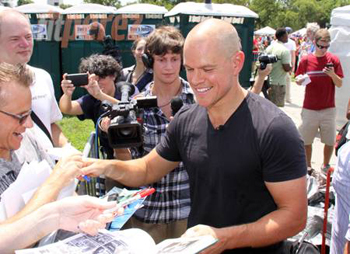
Matt Damon
Matt Damon appeared at the Save Our Schools rally in Washington, D.C. last weekend -- was he the main reason for subsequent media coverage?

The Save our Schools event in Washington was hoping to call attention to the damage that our testing frenzy is doing. What did it accomplish? From one perspective, it was a bust. The organizers predicted a crowd of between 5,000 and 10,000, but head-counters from Education Week said 3,000 tops. While it got coverage on local outlets and in the Washington Post, most of the reporting can be explained in two words: Matt Damon. His star power drew media attention.

The speeches that I have read or watched on YouTube did little to move the ball forward. Organizers met with Education Secretary Arne Duncan — whose resignation they later called for. I have it from reliable sources that they turned down the opportunity to meet with Roberto Rodriguez, the President’s education advisor and a man whose power may be equal to Duncan’s, because they wanted an audience with the President.

What was the tone of the gathering? A good friend who attended the rally wrote me afterwards about ‘the corporate reactionaries,’ noting:

They are dead set on imposing a business model on our pedagogical practices … Bashing unions, demanding the end of tenure, collective bargaining, seniority, and headstrong pushing the cheap and deeply flawed metric as The only valid measure of academic achievement. John, you well know that the new so-called education consultants, and the huge mega-billionaire and corporate testing and assessment industry is all about profits! … They want to take the public out of all decision-making. They want to privatize as much as they can! …. They are determined to destroy all that we built, and all our good works that are proven successful, and to dismiss and devalue and degrade our greatest achievements.

But are the ‘bad guys’ all on one side? In Newark, New Jersey, a well-meaning ‘reform’ is being scuttled by a union contract (also signed by a school board) that prevents schools from replacing ineffective teachers. The Wall Street Journal describes in detail how failing schools simply shuffled ineffective teachers — ’you take my five, and I will take your five’ — because the contract guarantees jobs to tenured teachers. That outrage adds more fuel to the fire for those who see unions as the source of education’s problems.

And, come to think of it, when unions behave as classic trade unions bent on protecting their members at all costs, they are a huge part of the problem.

One change that must happen if public education is to survive: unions must become professional, not trade, organizations.

On my blog last week the respected educator Grant Wiggins posted a long and thoughtful response that some of you may have missed. I hope you will jump back a week and read it in its entirety. Here’s one paragraph:

Until and unless school is defined as talent development and not a march through The Valued Past, we will fail. School is boring for many if not most. When was the last time you folks shadowed students for a day? It is a grim experience. It is endlessly easy to blame Others, those Outsider bad guys. But from where I sit, the problem is a Pogo problem: I have met the enemy; it is us.

It’s in the vein of ‘physician, heal thyself.’ At the rally and elsewhere, my progressive friends have been so busy attacking their bad guys that they have lost sight of what drew them into teaching in the first place.

In my post last week, I recalled Ronald Reagan’s “Trust but verify” commandment. That prompted Grant to write:

The only way John’s pleas for a sensible middle can be achieved is if educators finally get honest and say, “mea culpa; school is more boring and ineffective than it needs to be, so let’s get our own house in order before the outsiders force us to do dumb things with their crude policy levers.

Had unions and other groups lobbied hard for alternatives to current policy we also might not be in this mess. But for 25 years the educational establishment has just lobbied hard to complain about what it doesn’t like. Washington works the old fashioned way: write the laws and give them to legislators. When was the last time all the key players got together and did that?

I don’t know if we need to get together, but I do know that testing’s critics need to think about accountability, the ‘verify’ part of Reagan’s formula, because Americans won’t accept either extreme, and by not adequately addressing that issue, the progressives are leaving the field to the verifiers.

We are a few weeks away from the reopening of schools across the country. This fall will be different because of the harsh economy, but kids will still arrive on that first day full of hope and optimism, just as they do every year. Somehow they manage to convince themselves that ‘this year will be different.’

Most often, that’s not the case. The ‘unnatural structure of school’ sorts children into groups of “A kids,’ ‘B kids’ and (for most) ‘C kids.’ That structure works against good teaching and deep learning. For children, September, not April, is ‘the cruelest month.’

I believe that teachers can make a difference this year if they band together to focus on what kids need. They may need to make common cause with parents, instead of being distant. They may need to tell taxpayers just how much of their money is being wasted on excessive testing. They may need to inform their union leaders that they are going to violate the contract and work late or meet with administrators or parents after school.

Above all, they have to be pro-child, and pro-learning, not anti-this or anti-that.

The international divide

http://www.facebook.com/plugins/likebox.php?href=http%3A%2F%2Fwww.facebook.com%2Flearningmatters&width=292&colorscheme=light&show_faces=false&stream=false&header=true&height=62

As always, remember that John’s book The Influence of Teachers is for sale at Amazon.

Is it possible that the US has been heading in the wrong direction for most of the 30 years it has been focused on school reform? That’s the conclusion a reader of “Standing on the Shoulders of Giants” would be hard pressed not to draw. The paper, written largely by Marc Tucker of the National Center for Education and the Economy, contrasts the approaches taken by five high performing (but quite different) entities — Toronto, Japan, Finland, Shanghai and Singapore — with what we have been doing here.

You can read the paper here.

Continue reading

Can American teachers truly be ‘nation builders?’

http://www.facebook.com/plugins/likebox.php?href=http%3A%2F%2Fwww.facebook.com%2Flearningmatters&width=292&colorscheme=light&show_faces=false&stream=false&header=true&height=62

In his State of the Union speech in January and in subsequent appearances, President Obama has likened teachers to ‘Nation Builders.’ Here’s what he told Congress and the American people:

“…(A)fter parents, the biggest impact on a child’s success comes from the man or woman at the front of the classroom. In South Korea, teachers are known as ‘nation builders.'”

But are American teachers “nation builders?” Could they be? What tools does a ‘Nation Builder’ (or any other builder) need to be able to get the job done?

Continue reading

WNET’s Celebration of Teaching and Learning needed more embrace of conflict

The two-day event run by New York City’s public television station (WNET) isn’t called “A Celebration of Teaching and Learning” for nothing.

I spent most of last Friday and Saturday sampling the smorgasbord of education offerings and came away impressed by the event’s focus on that operative word: celebration.  More than 2,000 people — most of them teachers — came to the Hilton to be buoyed up by dozens of speakers.  The stated goal was to “share insights and perspectives on what it takes to provide the absolute best in educational opportunities for our students.”

Among those sharing insights were Dr. Mehmet Oz, Newark Mayor Cory Booker, Oliver Sacks, NBC’s Brian Williams, and ABC’s Cynthia McFadden.

Continue reading

Now more than ever, we must speak up for teachers

American public education remains front and center, which is mostly good news.  Let me start this ‘news summary’ in Washington, DC, where President Obama and Education Secretary Arne Duncan are calling for fundamental changes in the law known as No Child Left Behind, the Bush Administration’s version of Title One of the Elementary and Secondary Education Act.

No Child Left Behind

I doubt you could find more than a handful of educators who like NCLB these days, but whether anyone in the nation’s capital will be able to agree on what a new version should call for is highly questionable.

Continue reading

In education, a lack of response to basic demand

I started writing this blog entry on a flight to California from New York; I’m headed there for another book party and a meeting of the Learning Matters board.

For the last 30 minutes or so, I have been listening to a father talk about his two young children, ages 7 and 10.  He’s an older Dad with at least one adult child, and he radiates child-like enthusiasm about what amounts to a second go-round of childrearing. He’s been telling me about their endless curiosity; they always are asking “why?” and “how does this work?” and so on.

As I listened, a dark cloud flickered across my eyes and I wondered: what would their schools do to their spark?

Nurture it, tolerate it, or extinguish it?

Continue reading

E.D. Hirsch, Mike Smith and Linda Katz offer insights on reading development

If journalism is history’s first rough draft, then perhaps blogs like this one are journalism’s notes and outline. For me, this blog continues to be a wonderful learning opportunity, largely because of thoughtful readers who question my assumptions and provide me with information I have either forgotten or never seen.

In the few days since I posted my thoughts about early reading, I have received several (welcome) wake-up calls from E.D. Hirsch, Jr. (of Core Knowledge fame), Marshall ‘Mike’ Smith (former Deputy U.S. Secretary of Education under Bill Clinton), and Linda Katz (Director of the Children’s Literacy Initiative in Philadelphia).

Continue reading

The Campaign for Grade-Level Reading helps with a national crisis

I am currently in Washington, DC attending the kick-off of what is being called “The Campaign for Grade-Level Reading,” a three-day event focused on an issue constantly growing in importance. Its organizers, led by the irrepressible Ralph Smith of the Annie E. Casey Foundation, initially expected to attract between 50 and 70 participants; more than 200 of us signed up, including Secretary of Education Arne Duncan, who will deliver the closing address on Tuesday.

Because we are now editing a piece for PBS NewsHour about what is often called ‘the vocabulary gap’ that develops in the first three years of life, I am especially aware of the need for public action.  We know that about 75 percent of the children who aren’t reading competently and confidently by the end of third grade will never catch up.

No mistake: This is a crisis!

Continue reading

The hypocrisy of Scott Walker … and whether teachers are becoming the enemy

EDITOR’S NOTE: In concurrence with the launch of John Merrow’s book, The Influence of Teachers, he’ll be using this space as a place to discuss some central ideas explored in the book. All proceeds from the book, available on Amazon for $14.95, are being donated to Learning Matters, a 501(c)(3) organization committed to independent coverage of education. We invite you to join in the conversation by commenting on these posts or reviewing the book online!

Is the direct attack on collective bargaining for teachers in Wisconsin likely to spread around the US the way the demand for democracy is spreading across the Middle East? I think it just might.

Continue reading

The Influence of TFA

EDITOR’S NOTE: In concurrence with the launch of John Merrow’s book, The Influence of Teachers, he’ll be using this space as a place to discuss some  central ideas explored in the book. All proceeds from the book, available on Amazon for $14.95, are being donated to Learning Matters, a 501(c)(3) organization committed to independent coverage of education. We invite you to join in the conversation by commenting on these posts or reviewing the book online! Learn more about the book at www.theinfluenceofteachers.com.

By all reports, Teach for America’s 20th Anniversary Celebration in Washington last weekend was a star-studded event–as well it should have been given TFA’s growing importance. What began as a Princeton student’s senior thesis has become the proverbial 900-pound gorilla in education, a leader and a lightning rod. I’ve been part of what I believe has been balanced coverage of Teach for America, on the NewsHour, in a web-based series, and in my new book; that is, I’m not in either of the two large camps—those who love TFA and those who detest/fear/suspect it. The middle can be lonely, by the way.

Quick story here:  We followed seven Teach for America corps members in New Orleans for an entire year, part of our NewsHour coverage. We were being opportunistic: that is, we knew that only two or three of the teachers would make a NewsHour piece but we imagined that we could also get a pretty darn good documentary out of it.  By year’s end, we had some terrific material, and at that point I began looking for money.  I went to a number of foundations and individuals who have an interest in teacher education generally or in TFA specifically and made my pitch: 7 profiles, lots of good video of the nitty-gritty of the life of a first- or second-year teacher.

Fund-raising is tough sledding under normal circumstances, but this was downright depressing.  In every instance, I was asked a bottom line question, essentially “Is it all positive?” or “Is it all negative?”

Well, duh, of course it wasn’t.  We had captured reality, and reality is full of small victories and defeats.  A couple of the TFA teachers were splendid, seemingly born to teach.  Two were flops.  One got a raw deal from his principal and never hit his stride.  It was life, but no potential funders were interested in that story.
We ended up creating seven profiles and putting them on our web site, where you can see them for yourself and make your own judgments.
But it’s a shame that the world of teacher training has become so political. There’s no question that Wendy Kopp and Teach for America have changed the landscape and made a significant contribution.  But let’s not pretend that it’s all good or all bad.

As I write in my book, “It may well be that Teach For America’s greatest contribution to education will not be the kids who are helped or the talented young men and women who develop a connection with and affection for public education, but its relentless self-examination – a process that quite simply puts the rest of teacher education to shame. If Teach For America can work hard to figure out why some of its trainees become better teachers than others, why can’t regular schools of education?”