Be careful what you wish for

http://www.facebook.com/plugins/likebox.php?href=http%3A%2F%2Fwww.facebook.com%2Flearningmatters&width=292&colorscheme=light&show_faces=false&stream=false&header=true&height=62

John’s book, The Influence of Teachers, is currently available on Amazon; you can learn more about it at the book’s official website, or, if interested in buying copies for your class or discussion group, you can consult this page.

I have a simple request for my left and right-wing friends: “Be Careful What You Wish For.” Here’s why I say that. I know right-wingers who lust for vouchers, and I know left-wingers who live for the day when all children will have ‘individualized education plans,’ a la those in special education.

The latest call for vouchers comes from the Republican Governor of Pennsylvania (whom I do not know), but let’s imagine how vouchers might work. Suppose that the voucher (basically a check that parents could take to the school of their choice for their child’s education) was actually worth enough to buy a decent education, say $12,000. Just imagine how quickly that would attract scoundrels, scalawags and crooks, all posing as committed educators. Even cheap vouchers will attract an odd crowd, men and women who feel a calling to do some God’s work. And, unfortunately, there will be no shortage of parents who will drink the Kool-Aid (which is more of a comment about how bad some public schools are than it is about the parents’ gullibility).

And since the right-wingers want vouchers to be valid currency at religious schools, expect a flood of new schools — and maybe some new religions too.

But that’s actually not my big worry. We live in a society that protects religious freedom, and so all sorts of already-established religious institutions will be eligible for voucher-paid students. Be ready for a church school that teaches snake-worship, because those churches exist.

But you also should be ready to see an Islamic madras open in a neighborhood near you, perhaps one that preaches that Islam rejects violence and suicide bombers — or perhaps preaching and teaching that America is the source of evil in the world.

You voucher supporters don’t get to apply a litmus test here. Hand out the vouchers and get out of the way: that’s the way it will work.
Be Careful
As John says...

(Milwaukee voucher advocate Howard Fuller told me that his city has avoided those religious traps by having strict rules for participants, but I have a sneaking suspicion that Milwaukee’s low dollar figure — about $6,000 — has a lot to do with the non-participation of zealots. Double the money, and they will come.)

As I say, “Be Careful What You Wish For.”

Now to my left-wing friends and their desire for ‘individualized education plans’ for all children, an idealized vision of schools that focus on the needs of each child. An end to cookie-cutter, one-size-fits-all education.

Wake up, folks, and take a clear-eyed look at Special Education, the birthplace of the IEP. For every IEP that has actually worked out, I am willing to wager that an equal number are in some sort of litigation. I say that because special education has turned into a cottage industry for lawyers, who have discovered that school districts are bureaucratic nightmares, often unable to walk and chew gum at the same time. So when a district cannot meet the precise specifications of an IEP, bingo: a lawsuit, which often leads to private school for the kid.

So if my left-leaning friends got their way and we had IEPs for all, that ‘cottage industry’ of lawyers would be transformed into a ‘mansion industry.’ But I doubt if very many others would benefit, including the kids.

As I say, “Be Careful What You Wish For.”

The fascination with panaceas afflicts left and right. I stand pretty much square in the middle, as do, I suspect, many of you. So here’s what I would like to suggest: A new narrative for our conversations about public education.

Right now our conversations and debates focus either on teachers (“Do we have enough good ones, and how can we get rid of the bad ones?”) or on accountability (“We know that test scores are flawed, but they’re the best we have, and we have to have accountability, don’t we?”). The ‘teacher’ narrative is demeaning to the profession, for openers. The ‘accountability’ narrative ultimately justifies the status quo of cheap tests, a dumbed-down curriculum and, often, widespread cheating.

The narrative I propose addresses education’s inconvenient truth.

Which is this: “There is close to a 1:1 correlation between parental income and educational outcomes, whether the parents are rich, poor, or somewhere in between. Kids with rich parents do well in our education system, and kids with poor parents do poorly. On one level, that seems to mean that schools basically do not matter. Only money talks.”

“However, we know that’s not true because we have in front of our eyes hundreds of examples of schools and teachers that do change lives.”

“So do not be mad about schooling’s failure to dramatically improve the lives of all 15 million children living in poverty. Instead, let’s insist that our schools imitate the successful places, people and practices. We should demand to know what’s keeping educators from imitating success. Eliminate the obstacles and — here’s where you should get mad — get rid of the educators who refuse to be copy-cats.”

If you saw our PBS NewsHour piece this week about schools in rural America, you know that the challenges facing schools are growing. With unprecedented numbers of children in poverty (a growing number of them homeless), public schools will be forced to step up to the plate even more than usual.

And so, ignoring my own advice, here’s what I wish for: We abandon the search for magic bullets and instead copy what successful schools — and successful networks of schools — are doing.

Trust, but verify

http://www.facebook.com/plugins/likebox.php?href=http%3A%2F%2Fwww.facebook.com%2Flearningmatters&width=292&colorscheme=light&show_faces=false&stream=false&header=true&height=62

John’s book, The Influence of Teachers, is currently available on Amazon; you can learn more about it at the book’s official website, or, if interested in buying copies for your class or discussion group, you can consult this page.

Editor’s note: This column originally appeared in the Sacramento Bee; it was co-authored by John and Learning Matters Board Chair Esther Wojcicki.

Two Californians, one a Republican and the other a Democrat, may yet save American public education. The first is the late Ronald Reagan. The Democrat is Darrell Steinberg, a state senator from Sacramento who is very much alive.

Public education is on life support. America’s students routinely score in the bottom half on international tests, 7,000 students drop out every school day, a half-dozen large school systems have cheating scandals on their hands, and our schools are teetering on the edge of obsolescence in today’s technology-driven society.

The heart of the problem is a near-total lack of trust, which is why we bring up former President Reagan and his phrase, “Trust but verify.” He was referring to the Soviet Union and nuclear weapons, but that essential combination is what’s required in education.

Years ago we trusted teachers but had no system for verification; today, however, trust has virtually disappeared, and education is about verifying — using scores on standardized tests. Neither extreme works. The challenge is to gain the middle ground.

Ronald Reagan
A comment that Ronald Reagan made with regards to the Soviet Union could also be a potential turning point for American public education.

When teaching was one of the few jobs open to competent women, classrooms were staffed by smart, responsible and caring women, women who would probably be attorneys or executives today.

When a changing economy opened doors for women, our schools suffered. The teaching force changed, and trust gradually eroded as we learned the hard way that trust alone did not produce results. Perhaps the final nail in the coffin came in 2003, when a high school valedictorian in New Orleans failed the math portion of the state’s graduation test five times.

By then we were well into the test-intensive era of No Child Left Behind, the federal law that requires all children to be achieving at a basic level by 2014. Today, public education is all about verifying, and states are falling over themselves to rate teachers according to their students’ test scores. Washington, D.C., led the way, but now about 30 states require the evaluation of teachers based on test scores.

It didn’t take a genius to predict what would happen when jobs became dependent on one test score. Cheating scandals have erupted in dozens of places, with Atlanta’s public schools taking the crown for most egregious.

But if neither trust nor verifying alone works, what would the middle ground, “trust but verify,” look like?

Valid, reliable measures of accountability are essential. We need a high-stakes test, but it cannot be the whole ball of wax. Because testing kids in every subject — including art and music — just so their teachers can be rated is an idiotic notion, we recommend that the unit of measurement be the school, not individual teachers.

Enter Steinberg and his legislation, Senate Bill 547, which has passed the Legislature and been sent to the governor. While it would use test scores to evaluate schools, it insists upon multiple measures, including graduation rates and college/career readiness. Moreover, it would open the door for other factors, such as classes in the arts, to be used when judging schools.

We think that no school should be allowed to stay open if most of its students cannot pass the state’s tests. But we also think that no school should be allowed to focus only on those tests, because that leads to “drill-and-kill” and dumbing down of the curriculum.

Trust but verify. The state’s high-stakes tests are the means of verifying. As for trust, we think Steinberg’s bill’s insistence on multiple measures can be interpreted to mean: Trust each community to create the kinds of school programs it wants for its children, instead of a school board or Sacramento making the rules.

A community might choose:

  • Significant programs in art, drama, journalism and music.
  • A community service requirement.
  • Project-based learning.
  • Competence in a second language.
  • At least 30 minutes of recess daily.
  • Honors recognition for academic excellence.
  • Technology to teach students to collaborate.
  • Teacher-made tests to regularly measure student progress.
  • Uniforms for all students.
  • Economic and racial diversity.
  • Early college opportunities for advanced students.

Give a community one point for each vibrant program it establishes. For argument’s sake, let’s say a school must get at least 10 points to stay open. However, merely having some or all of these programs would not be enough to earn a “passing grade” for a school, because every school must also earn points by doing well on the high-stakes test and demonstrating that its graduates are capable of moving on. That’s the verification side of the equation.

Give three points if 60 percent of kids score basic or above; four points if 75 percent reach that level; and five points for a score of 85 percent or above.

The idea is to establish multiple priorities and provide a program that is valuable to the community. A school couldn’t just “drill and kill” to pass the test, because it wouldn’t earn enough points to stay open. Nor could it just have a host of wonderful programs that make everyone feel good, because passing the state test and preparing graduates for their future are also requirements.

Trust the community to decide what kinds of programs it wants for its children, but look to the high-stakes test results and the college/career readiness results for proof that the community’s trust is justified — or, in worst cases, evidence that changes must be made.

Like the federal government, we endorse verifying the progress of a school, not its teachers. We trust teachers and administrators to see that everyone is pulling their weight or to do something about those who are not.

SB 547 represents the best hope for revitalizing public education, even though it doesn’t go as far as we would like regarding the role of the community. Steinberg’s bill leaves too many details to the state Department of Education and the State Board of Education. Our hope is that the powers-that-be at the state level will seize this opportunity to relax the reins and trust communities to do right by their children.

Only by coming together to address what we want for all our children can we hope to lower the temperature in education — and begin to catch up with other industrialized societies.

Honoring teachers — again?

http://www.facebook.com/plugins/likebox.php?href=http%3A%2F%2Fwww.facebook.com%2Flearningmatters&width=292&colorscheme=light&show_faces=false&stream=false&header=true&height=62

John’s book, The Influence of Teachers, is currently available on Amazon; you can learn more about it at the book’s official website, or, if interested in buying copies for your class or discussion group, you can consult this page.

Would you believe that tomorrow we are expected to put aside our own important work and honor teachers? That’s right, we’re supposed to drop everything and pay homage to those lazy, overpaid, spoiled, money-grubbing, summer-vacationing, ‘we’ve-got-tenure-and-you-don’t’ incompetents.

That’s because Wednesday, October 5th, is “World Teachers’ Day,” an occasion recognized by more than 100 countries around the world. But it’s also “Teacher Day” on Thursday, October 6th, the following day, in Sri Lanka.

In fact, I wouldn’t be at all surprised to find that every day of the year is “Teacher Day” somewhere in the world.

Teachers have October locked up, that’s for sure. Beside this Wednesday’s celebration for those 100 countries and Sri Lanka’s on Thursday, Australia, Armenia, Uzbekistan, Belarus, Brazil, Poland, Chile, Ukraine and New Zealand all have chosen an October day to celebrate their teachers. In Ukraine, students give their teachers chocolate! (You and I work hard. Does anyone give us chocolate?)

Teachers
All over the world, teachers receive gifts on various appreciation days -- but what should be making of the overall dialogue on the profession?

Here in the USA we have at least two Teacher Days and an entire Teacher Week. The first full week of May is “Teacher Appreciation Week,” with that particular Tuesday being designated as “Teacher Appreciation Day.” This official celebration is apparently the result of hard work by the National Education Association and the National PTA. Massachusetts celebrates its own “Teachers’ Day,” the first Sunday in June.

February 28th is a good day for teachers in the Middle East. That’s when 12 countries celebrate: Morocco, Algeria, Tunisia, Libya, Egypt, Jordan, Saudi Arabia, Yemen, Bahrain, Qatar, UAE and Oman.

Because we were asleep at the switch, we have already missed India’s “Teacher Day” (September 5), China’s and Hong Kong’s (September 10th), Brunei’s celebration on September 23, Taiwan’s (September 28) and Singapore’s (first Friday of the month). India makes a teacher’s cushy job even easier because on that day senior students take over the responsibility for teaching.

The only month that does NOT have a “Teachers Day” to call its own is, predictably, August. June has four (Bolivia, El Salvador, Hungary, and Guatemala), March has five (the Czech Republic, Slovakia, Albania, Lebanon, and Iraq), but the merry month of May tops them both, with six country celebrations: Iran, Bhutan, Jamaica, Malaysia, Mexico, and Colombia.

Teachers really live the life of Riley in Vietnam. November 20th is set aside to allow students “to express their respect to their teacher. Students begin preparing a week in advance, and many classes usually prepare literature and art to welcome teachers’ day, while other students prepare foods and flowers for the parties held at their schools. Students usually visit their teachers at their homes to offer flowers and small gifts, or organize trips with their teachers and classmates. Former students also pay respect to their former teachers on this day.”

To be serious for a moment, what are we to make of all these celebrations honoring teachers? While I am all for honoring those men and women, I hope the respect neither begins nor ends on that particular day. Somehow I keep thinking of Jon Stewart’s wry comment at the end of February when he noted that, now that Black History Month was over, we could get back to White History Year.

I have a modest proposal. In addition to the celebrations, how about a concerted effort to end the dishonoring of teachers and teaching? I’m talking about the Fox News commentators who rattle on about overpaid teachers; those school principals who treat teachers as interchangeable parts; union reps who bargain for rigid and bizarre work rules that hamstring dedicated teachers and administrators alike; curriculum designers who labor to create ‘teacher-proof’ curricula; education school leaders with low standards and undemanding programs; cheap-shot politicians and so on. I am sure that there are a few million teachers who would like to see any of them try to do for just one day what teachers do every day of the school year.

Me, I would give anything to capture that on film. We could call the ensuing television program “Real Hypocrites in Classroom 203” or maybe “America’s Got Bozos.”

Thanks, teachers. Enjoy the day — and the career.

Some thoughts on Education Nation

http://www.facebook.com/plugins/likebox.php?href=http%3A%2F%2Fwww.facebook.com%2Flearningmatters&width=292&colorscheme=light&show_faces=false&stream=false&header=true&height=62

As always, remember that John’s book The Influence of Teachers is for sale at Amazon; you can also check out a Sacramento Bee editorial he co-authored with Esther Wojcicki, the Learning Matters Board Chair.

Although I left before the final event — an appearance by former President Bill Clinton — I was on hand for almost everything else, and I am comfortable declaring Education Nation 2011 a success, a 180-degree turn from last year’s disappointment.

Last year, education wonks will remember that Education Nation was badly tilted in favor of charter schools and against unions and the ‘bad teachers’ they protect. It was as if everyone running the show drank the Kool-Aid poured by “Waiting for ‘Superman’”, Davis Guggenheim’s well-made but fundamentally-flawed movie.

Not this year. Balance was the order of the day. Both union presidents and lots of regular public school teachers got ample stage time. Because NBC’s talent pool is deep, lots of good questions were asked.

For me, the absolute hit of the two days was the 65 minutes on Monday morning devoted to “Brain Power: Why Early Learning Matters.” We were treated to four snappy, insightful and short presentations by professors from the University of Washington, UC Berkeley and Harvard, after which NBC’s chief medical editor, Dr. Nancy Snyderman, presided over a lively discussion about the educational implications of what we had just seen and experienced.

This hit home with many audience members because much of it was new and because the pedagogy modeled what all of us are arguing for in today’s schools.

But there was other good stuff: Brian Williams herding a panel of ten (10!) governors, Tom Brokaw talking with Sal Khan and Arne Duncan, Williams again with an examination of inequality (“What’s in a Zip Code?”), and David Gregory refereeing a debate between Diane Ravitch and Geoffrey Canada.

Secretary Duncan was everywhere, taking questions gracefully and speaking earnestly about education as ‘the civil rights issue of our time.’

At least 271 people labored to make Education Nation run seamlessly, which they did with a smile. Hats off to them.

And Education Nation is also a great opportunity to see and be seen. I had a dozen or more stimulating conversations and left with four or five really good story ideas for PBS NewsHour.

And so, I think it’s fair to say that Education Nation is close to achieving that lofty ‘must attend’ status, no small feat for an enterprise that stumbled so badly out of the gate and is only two years old.

Is Education Nation all talk, or mostly talk, or will good things happen because of these conversations? I don’t know, but in defense of education and Education Nation, I don’t believe that comparable events are being held around health care, energy and transportation, to name just three other issues of great importance.

Now to the tough part — and here I have a choice between being nice and being not-so-nice. For once, I choose the former. And so I am couching my critique in the form of a proposal for next year’s Education Nation, instead of complaining about missed opportunities.

Next year, NBC’s journalists must tackle two of the elephants in the room. One is the obstacles to innovation. The second is the problem inherent in overemphasizing ‘innovation.’

Start with obstacles: In an early morning session on Monday, Melinda Gates of the Gates Foundation spoke eloquently about the possibilities of blended learning. Kids, she said, could now explore and advance at their own pace in many subjects. And she’s right. We know that students using the Khan Academy math program (which I watched in action in a school in Mountain View, CA, last week) can move through three, four or five ‘grade levels’ in math without ever being aware of how rapidly they are moving — because there are no “Stop, you have reached the end of 5th grade!” signs.

So far so good, but, unfortunately for those fast-moving kids, current ‘seat time’ and course credit rules mean that a student earns just one year of credit no matter how many levels he or she actually moves up. In fact, that kid’s teacher is probably going to have to tell him to slow down, which is a terrible message to send.

Education Nation
In its second year, Education Nation is close to 'must-attend' status.

But that issue wasn’t addressed, and, until it is, lots of wonderful innovations are going to rust on the sidelines. I mentioned this to Tom Brokaw, and he got it right away, connecting it to the one-room school that his mother had attended. There, he said, the teacher had to let kids move at their own pace because she was responsible for six or seven grades. Perhaps that proves that there is no new thing under the sun. The point is learning can be ‘customized’ in theory, but it won’t happen in practice until the system loosens its rules on ‘seat time.’

A few educators told me that some schools and districts are experimenting with approaches that judge students based on competency, instead of weeks of seat time, and that’s good news. Next year NBC ought to make this a centerpiece and show us how and where it’s being done — and what problems this new approach creates.

My second issue is deeper, and that’s all the enthusiasm for ‘innovation.’ I say, “Enough already.” Please give equal time to ‘imitation.’ We have lots of good schools and good programs and good teachers, stuff that can and should be copied.

Notice that I am not saying ‘replicate’ or ‘go to scale.’ Those fancy terms are part of the problem, frankly, because they scare away folks — or they become an excuse for not doing anything. Educators can rationalize that they don’t have support for ‘innovation’ and don’t have the apparatus for ‘going to scale’ and ‘replication,’ and that’s why they aren’t doing anything out of the ordinary.

Sorry, those excuses don’t cut it any longer. Just imitate. It’s easy to do, and it doesn’t have to be earth-shattering, headline-grabbing stuff. Here’s an example: KIPP kindergarten teachers explain to their kids why they are going to walk in a line and why they are expected to be quiet in the halls. Lots of regular teachers just tell the kids to line up and be quiet. The first way is respectful and creates shared responsibility, while the second seems likely to create behavior problems down the road.

Teachers who copy that are not ‘endorsing’ KIPP or sleeping with the enemy. They are just doing something that works.

I strongly believe that education needs a new narrative to replace the current one (‘honor teachers’), which replaced last year’s narrative (‘charter schools are good, unions are bad’).

I suggest a narrative that is tougher on schools but also closer to reality. It’s this: “For as long as anyone can remember, there has been close to a 1:1 correlation between parental income and educational outcomes, whether the parents were rich, poor or somewhere in between. On one level, that seems to mean that schools basically do not matter. Only money talks.

“However, we know that’s not true because we have in front of our eyes hundreds of examples of schools and teachers that do change lives.

“So do not be mad about schooling’s failure to dramatically improve the lives of all 15 million children living in poverty. Instead, imitate the successful places, people and practices. Find out what’s keeping educators from imitating success. Eliminate the obstacles and — here’s where you should get mad — get rid of the educators who refuse to be copy-cats.”

Congratulations, NBC, for sparking a national conversation that will be ongoing. I hope you will invite me back next year.

Get out the blender, kids

http://www.facebook.com/plugins/likebox.php?href=http%3A%2F%2Fwww.facebook.com%2Flearningmatters&width=292&colorscheme=light&show_faces=false&stream=false&header=true&height=62

As always, remember that John’s book The Influence of Teachers is for sale at Amazon.

I think I have just glimpsed the future, or at least what could be the future, of public education. I’m talking about the effective use of today’s technology to enhance learning, or what insiders are calling ‘blended education.’ Michael Horn, a co-author of Disrupting Class, provided a definition: Blended learning is any time a student learns at least in part at a supervised brick-and-mortar location away from home and at least in part through online delivery with some element of student control over time, place, path, and/or pace.

Some, including Michael Horn and his colleagues at Innosight, are predicting that by 2019 50% or more of high school classes will be delivered online, a staggering concept until you consider that in 2007 only one million students were taking courses online, and today four million are. ‘Virtual classes’ qualify as blended learning, because most of those kids are enrolled in traditional high schools.

That’s a growth industry: Just a few years ago only eight states allowed virtual courses or schools; today, nearly 40 states allow it — and a few require students to take at least one virtual class. The best-known virtual school, Florida’s Virtual High School, now enrolls over 100,000 students.

I spent Tuesday watching and listening, first at a school in Mountain View, California, where sixth graders were using iPads to work through mathematical lessons, a curriculum created by Sal Khan and his colleagues at the Khan Academy. Some were working together, some were online, some were doing paper-and-pencil problems, while the teacher monitored their progress on her own iPad or helped kids who asked for assistance. These teachers did not seem to be either ‘the sage on the sage’ or ‘the guide on the side’, as the jargon has it. In fact, one teacher likened herself to ‘an education designer.’ The image of a conductor came into my mind — of an orchestra and a train.

Someone else compared teachers in blended learning situations to today’s doctors, who do not sit by the side of their patients until they recover. Instead, much of the care is provided by nurses (classroom aides), and the doctor is called in only as needed.

Loaded onto the sixth graders’ tablets was a curriculum that covers math well into high school, well over 200 ‘lessons’ that the teacher admitted she herself had not completed. Think about that for a minute — and contrast it with today’s approach, where sixth graders and their teachers have a ‘Sixth Grade Math Book’ as their starting and stopping places.

iPad
Can a 'blended learning' approach help save American education?

This approach — again, blended learning — has no such borders or border guards, meaning that kids in 6th grade can move on up. (The curriculum includes lots of ‘refresher’ points, we were told, to insure against ‘learning and forgetting.’)

Later that day the group of about 30 journalists convened at Google to hear from school leaders about their own embrace of technology. Karen Cator, who is Education Secretary Arne Duncan’s chief advisor on technology, told us that it was time for the US to ‘ratchet up.’

“It’s an inflection point,” the former Apple executive said, because our children are digital natives, because most teachers are now using technology in the own personal lives, and because we all recognize that our schools are failing too many kids.

That said, Cator and others acknowledge that major obstacles stand in the way of widespread adoption of blended learning. One is textbooks, which are, as noted above, divided by grades. Textbooks reflect our slavish devotion to ‘seat time’ as the measure of accomplishment — fifth graders have to spend one year doing fifth grade stuff, and so on. Another obstacle: school funding and graduation credit hours are based on ‘seat time,’ not competency — except in Florida’s Virtual School, where state funding only arrives after a student completes a course successfully. That means that schools don’t have a strong incentive to allow kids to move along at their own pace.

This new educational world of ‘high tech’ will demand ‘high teach,’ former West Virginia Governor Bob Wise noted. Places that train teachers need a major overhaul, and that could be the weak link in the chain.

Today’s bubble tests are a gigantic barrier, because they are ‘dumbed down’ and are not likely to reward those who move ahead. One school leader told us that, before his state tests, he had to ‘ratchet back’ his 9th graders, because most of them were doing 11th grade math. What a message to send to students!

It’s an absurd situation, said ex-Governor Wise.

“We spend about $10,000 a year on each student but trust evaluation to a $5 instrument.” He spends $200-300 a year ‘evaluating’ his $15,000 car. When he said that, I saw heads nodding in agreement.

We also have a long tradition of using schools as a sorting mechanism to identify those who are ‘college material’ and weed out those who are not. That has to change.

And blended learning faces another challenge: because we all went to school, we are experts and know how school is ‘supposed to be.’

Quite by chance, I had spent part of the previous day talking education with a friend who works in an entirely different field. When I told him about the next day’s ‘blended learning’ agenda, he laughed. “My son did that 18 years ago,” he said and proceeded to tell me the story of his 7th grader who, stuck with an uninspiring math teacher, signed up with a new program at Stanford, EPGY, for ‘education program for gifted youth.’ Via computer and with occasional meetings on the Stanford campus, the young man moved through math classes and levels at his own pace. By senior year in high school he was taking advanced calculus at Stanford. There is no new thing under the sun, it’s fair to say, but today’s students should not have to search outside the schools for opportunities to learn. It’s time for them to step up — or fade into obsolesence.

The intersection of technology and test scores

http://www.facebook.com/plugins/likebox.php?href=http%3A%2F%2Fwww.facebook.com%2Flearningmatters&width=292&colorscheme=light&show_faces=false&stream=false&header=true&height=62

As always, remember that John’s book The Influence of Teachers is for sale at Amazon.

“In Classroom of the Future, Stagnant Scores” blared the headline in New York Times on September 4th. The paper’s editors decided that the top-of-the-fold story on Page 1 also warranted two full pages inside, plus four color photos and a graph. That’s a huge part of the news hole on any day, but particularly on Sunday, when circulation is at its highest.

The long piece is worth reading, but at the end of the day what stood out for me was what the article failed to take note of: the unimaginative uses of the technology, essentially digital versions of routine stuff: One teacher gave a true-false quiz but handed out wireless clickers for students to record their answers. In other classes, kids were playing a math game (“Alien Addition”) and an interactive spelling game, while other students were videotaping a skit that they could as easily have simply performed for the class.

In none of the examples presented were teachers using the technology to burst the boundaries of their classroom to connect with students in other cities, or even elsewhere in their district. None were using the Internet to do original research. I’ve written about this before, and Learning Matters producer John Tulenko helped craft a great piece related to the topic:

http://learningmatters.tv/wp-content/plugins/wordtube/player.swf

It seemed to be all about entertainment or delivering more efficiently what the adults had decided the kids need to know, rather than allowing and encouraging students to follow their own interests — at least occasionally. I fault the reporter for not drawing that distinction and for not pressing the adults who are spending all this money on the paucity of imagination.

But my real point is that the Times reporter could — and should — have written a very different story:

“Schools spend billions on technology but use it to do the same old stuff in more entertaining ways!”

Why is this happening, the reporter could have asked? Is it because teachers don’t understand the technology’s power, or because they want to make sure the kids learn what the adults have decided they must learn — or because they are ruled by fear of low test scores?

Running throughout the article is a constant refrain about the limitations of test scores. Adult after adult complained that “Test scores were not an adequate measure of the value of technology” but then went on to say, in effect, “Well, that’s what we have to live by.”

Tech
Why is technology being used in rote ways?

That really gets my dander up. They are endorsing spending billions on technology — it’s not their money — and they complain about the tyranny of bubble tests, even while their pedagogy is focused on test scores.

If they understood what today’s technology can do, and if they were enabling their teachers to go there, and if scores were still stagnant, that would be a story. (But the story might now be about how inappropriate bubble tests are to measure this new learning.)

Something must be done. The Times reports that school systems spent $1.89 billion on software in 2010 and perhaps five times that amount on hardware. That’s real money, especially at a time when school districts are going to four-day weeks, cutting art and music, eliminating Advanced Placement classes, and making other draconian cuts.

And then this expensive technology is used in woefully unimaginative ways!

Establishing a ratio of dollars for training to dollars for software and hardware is not the answer, because there aren’t sufficient incentives for teachers to try new approaches — at least not as long as their main job is to get those test scores up.

To find the solution, go back to the whining mentioned above, the constant complaints about the lack of adequate measures.

That brings me to a conversation I had last week with a leader in the reform movement. I asked his thoughts about the erasure scandals in Atlanta, Washington D.C., Philadelphia and elsewhere. He said it was a wake-up call and a clear message that we need better security. “Since those scores count for so much,” he said, “systems have to do a better job of protecting the tests.”

He’s not alone. A few days ago a panel of experts in New York recommended tighter security, including giving all tests on the same day and requiring proctors to certify that they have been trained in ‘security procedures.’

Wrong, guys! That barn door is off the hinges and the the horse is long gone. As long as adults’ jobs and students’ promotions and graduations are determined by test scores, there will be cheating. Students can use wireless devices to share answers, for example, while ‘fully certified’ proctors can still nudge nudge wink wink their way around the room, helping students pass.

We ought to be searching for multiple measures of academic progress, measures that are valid, reliable and reasonably affordable.

Who should be doing the searching? Wonderful as the U. S. Department of Education’s i3 ‘innovation’ grant program sounded, it was never set up to support risky investments of the sort I think will be required. It bet on such ‘innovations’ as Teach for America and KIPP, and that’s fine, but what’s needed here is some real risk-taking.

I have three candidates:

1. The companies now making megabucks on testing, Pearson and McGraw-Hill, ought to be protecting their revenue stream by finding better ways.

2. Apple, Microsoft, Dell and others hawking their products have a strong interest in public evidence of the power of technology.

But the best candidate might be the New Schools Venture Fund, who I think are the brightest folks on the block. That organization has never been shy about taking chances, probably because it exemplifies the spirit of its founder, John Doerr. In the Venture Capitalist world, only a small percentage of investments hit a home run, and the NSVF gets that. It’s putting dollars behind a number of new approaches to teacher training, for example, in the expectation that some of them will be a distinct improvement on the current approach — while others will fall short.

(I don’t know how NSVF finances work, but maybe Apple, McGraw-Hill, et alia should be making large donations to that organization?)

We need that venture capitalist mentality and approach to the world of measurement. So what if most of the schemes don’t pan out, as long as we emerge with a few that actually work?

This matters because right now school systems have almost no incentive to trust technology — because they don’t know how it will affect those test scores.

Look, educators are excessively literal and overly reactive. They haven’t gotten where they are by taking chances, so don’t expect them to take the lead now. Society has been telling them that we want good reading scores (we haven’t said, “we want kids who love to read,” just good reading scores). So why are we surprised when they drill kids on reading tests?

Bottom line: schools will never realize the power of technology until they get out from under our current way of holding them accountable. We need accountability, but what we are now doing is stifling learning and teaching. It’s making public education worse, not better.

The pendulum swings, and choices await

http://www.facebook.com/plugins/likebox.php?href=http%3A%2F%2Fwww.facebook.com%2Flearningmatters&width=292&colorscheme=light&show_faces=false&stream=false&header=true&height=62

As always, remember that John’s book The Influence of Teachers is for sale at Amazon.

(See more of the interview with Emily Feistritzer on this topic here.)

Time was, this country had about 130,000 school districts; today we have somewhere around 14,000. The pendulum has swung toward centralization.

No question that the pendulum swings. Not all that long ago about the only beers you could buy were Budweiser, Miller and Coors, but today you can choose from among thousands of microbrews. And that’s just the pendulum swinging back to the days before the Coors/Miller/Budweiser ‘beeropoly’ because in an earlier day, your parents could buy Schiltz, Schaefer, Piels, et cetera.

When I was a kid, there were thousands and thousands of radio stations; today Clear Channel owns about 1250 stations and dominates the market. But perhaps not for long, because the internet makes it possible for anyone to have his own ‘radio station.’

Pendulum
... and so the pendulum continues to swing...

Time was, the only way you could become a teacher was to go to a normal school, later called schools and colleges of education. Not any more, thanks to Wendy Kopp and Teach for America, the New Teacher Project, Troops for Teachers and a host of other alternative certification programs.

I could go on, because consolidation and expansion have occurred and are occurring in television, the music recording industry, health care and a ton of other industries.

It must be clear by now that I am not one of those who feels the sky is falling in because of monopoly or near-monopoly conditions. The strength of this country is our stubborn insistence on both change and independence. Take the consolidation of school districts as an example. Yes, the number of districts has dropped by close to 90 percent, but many of those districts are now experiencing their own mini-revolts, in the form of charter schools, which can actually resemble a school board — largely free of central regulation but accountable for results. Take New Orleans, where 70 percent of students are in charter schools. Is that one district, or 40+?

Did I mention textbooks and testing, where Pearson and McGraw-Hill now rule the roost? Their domination upsets a lot of observers, who fear and resent what mass testing seems to be doing to our children’s learning.

But that too will change in time. In fact, when I read that more families are home-schooling these days, I wonder if we are now seeing the beginning of change, because I have no doubt that a major motivation for some families is to escape the ‘cookie cutter’ schooling that they feel the testing regime imposes on schools.

When the Secretary of Education says, as he did in his Twitter Town Hall, that any more than 10 days spent on testing and test-prep was a cause for concern, that could be a sign that the times will soon be a-changin’.

And as McGraw-Hill and Pearson are well aware, school systems are moving away from textbooks and embracing the iPad and other tablets.

That the pendulum swings is undeniable. Whether the arc is toward equality, fairness, opportunity and justice is largely up to us.

The wild card in education today is emerging Common Core standards, which inevitably will lead to pressures for national testing. This pendulum is swinging strongly toward centralization. So the question is “Can we have high national standards without narrowly prescribing the single path that schools must follow to get there?” Can we ‘let a thousand flowers bloom’ in our schools?

My bet is, we can. What do you think?

Steven Brill and the berated dog

http://www.facebook.com/plugins/likebox.php?href=http%3A%2F%2Fwww.facebook.com%2Flearningmatters&width=292&colorscheme=light&show_faces=false&stream=false&header=true&height=62

As always, remember that John’s book The Influence of Teachers is for sale at Amazon.

Please imagine this scenario: While walking in the park, you see someone famous ahead of you. This person is berating his dog, yelling at it, slapping it and then giving the poor whimpering dog a hard kick or two. Before you can intervene, the person drags the dog away.

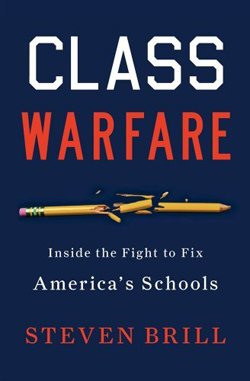
Brill
The cover of Steven Brill's new book.

I ask you, would you ever be able to read about or even think about that person — let’s say he’s running for office or donating millions to charity — without that image coming into your mind?

I think something like that happened to Steven Brill, the lawyer/writer who broke the story of New York City’s infamous ‘Rubber Room,’ where teachers that no principal would hire were stashed — and paid — while awaiting arbitration. In that New Yorker article, Brill painted an unforgettable picture of hundreds of adults wasting their days (including a middle school teacher making $85,000 a year who brought in a beach lounge chair). In the piece, Brill correctly identifies the problem: a union contract that establishes procedures for dismissal that are so complex as to make firing even the most incompetent teacher impossible. It’s a good guy-bad guy story, with the teachers union being Brill’s villain (even though someone sat on the opposite side of the table and agreed to those provisions).

I use that word, ‘unforgettable,’ advisedly, because it seems that the experience colors just about every page of his new book, the very readable Class Warfare.

Brill seems to admit as much in an August 21 column distributed by Reuters:

I’ve now read all the white papers and commission reports. I’ve learned all the policy wonk acronyms, and logged hours with everyone from teacher trainees, to the secretary of education, to Weingarten and Ravitch. Yet after all of that it still seems as uncomplicated as it did when I saw my first Rubber Roomer with his head resting on a card table. I mean no disrespect to all the dedicated people who are the “experts” in education policy, but for me the problem and its root causes still seem as undebatable as the practice of paying that guy to sleep for three or four years.

That’s a shame, because the story is more nuanced and ultimately more interesting, as Brill finally acknowledges in his final chapter, which is roughly 180 degrees different in tone from the rest of the book.

In the body of Class Warfare, teacher unions are the villains — the ‘education deformists’ — and a handful of (mostly) Democrats who challenge them are the heroes. He blithely labels people and organizations as anti- or pro-reform. So, for example, the Washington Post’s blog, “The Answer Sheet” is identified as “an anti-education reform blog.” (Brill’s tunnel vision was also discussed in detail in Sara Mosle’s Aug. 18 review of the book for The New York Times ).

Even worse is his treatment of the movie “Waiting for ‘Superman,’” a badly-slanted film that distorts the reality of public education, praising charter schools despite their muddy record of success and ignoring successful traditional public schools. He explains away the millions of dollars the filmmakers received from large foundations, suggesting that since all that money came in after the fact, it did not influence the message and the filmmakers are not hypocrites or worse.

But he has no trouble implying that one of his villains, Diane Ravitch, is for sale. In a short chapter about Ravitch, he comes very close to saying that she changed her views to accommodate those who pay her speaking fees.

But Brill, a tough man who does see the big picture, does not seem to be able to criticize his heroes directly — those ideas, he puts in footnotes (two in particular about Wendy Kopp, one about Michelle Rhee and the Gates Foundation).

His heroes are Eva Moskowitz of Harlem Success Charter Schools, Jon Schnur, Joel Klein, Michelle Rhee and a few others in that camp. Never once does he take on school boards, although it seems to me they bear equal responsibility for our having a system that puts adult interests ahead of those of children.

It’s not a book to read in one gulp, largely because of his format — dozens and dozens of chapters that are only three or four pages in length. Each chapter ends with the transitional equivalent of “meanwhile, back at the ranch” that becomes a distraction after a while.

However, there’s a lot to like about the book — including his inside stuff about Race to the Top. I have to admit that those sections made me professionally jealous, because we had negotiated access to the Race process for our video crew with Assistant Secretary Peter Cunningham, approved by his boss, Arne Duncan, until the Department’s lawyers vetoed it.

I think all wonks will enjoy Class Warfare. It might ruin the book for you, but I’d suggest reading the last chapter first.

The meaning of the rain

http://www.facebook.com/plugins/likebox.php?href=http%3A%2F%2Fwww.facebook.com%2Flearningmatters&width=292&colorscheme=light&show_faces=false&stream=false&header=true&height=62

As always, remember that John’s book The Influence of Teachers is for sale at Amazon.

I’ve been on vacation lately: fishing with grandchildren, playing on the beach, riding my bike, and — here in the east — walking in the rain. Vacation is supposed to be a time to decompress, to get away from my normal preoccupation, which is education and its complexities.

Wish it were that simple, but, unfortunately for me, almost everything seems to work its way around to education sooner or later.

I mean, take the songs that I sing (quietly to myself) while walking my dog. As I said, we’ve had plenty of rain, so maybe it was inevitable that I would sing songs about rain.

After a while I noticed that songs about bad weather are cheerfully, even blindly, optimistic — starting of course with “Singing in the Rain.”

Think about “Raindrops Falling on My Head,” the song that runs through the movie “Butch Cassidy and the Sundance Kid.” In that song, the singer says he’s “never gonna stop the rain by complaining” and insists that there’s one thing he knows:


The blues they send to meet me won’t defeat me
It won’t be long till happiness steps up to greet me

In other words, don’t worry, be happy, because happiness is just around the corner. You don’t have to do anything — happiness is coming.

“Soon It’s Gonna Rain” from the musical The Fantasticks is another happy song about bad weather. It’s a duet between the two young lovers, and it’s completely optimistic. They decide to build a house (in a tree) that will protect them from the harsh weather and ‘happily we will live and love within our castle walls.’

For optimism, however, I don’t think you can beat Johnny Nash’s “I Can See Clearly Now” because, when “the rain is gone,” there are “no other obstacles in my way.”

Perhaps it’s human nature to think in extremes and avoid nuance. Certainly, sunny optimism makes for a good song. That song would not have rocketed to No. 1 on the charts if the lyrics were “I see more clearly now, the rain has gone; I can see obstacles in my way.”

The blind optimism of the song makes me think of the education policy makers who have ignored reality for years when setting their K-12 academic standards. As Stephanie Banchero wrote in the Wall Street Journal recently:

In fourth-grade reading, for example, 35 states set passing bars that are below the “basic” level on the national NAEP exam. “Basic” means students have a satisfactory understanding of material, as opposed to “proficient,” which means they have a solid grasp of it. Massachusetts is the only state to set its bar at “proficient” — and that was only in fourth and eighth-grade math.

It’s not really raining, these policy makers decided, and so they lowered the academic bar, thus producing lots of apparently ‘proficient’ graduates. For years their schools have asked very little of students, despite the reality of No Child Left Behind’s approaching deadlines (100% proficiency by 2014) and the existence of an independent standard, the National Assessment of Educational Progress.

How bad is it? As a federal study noted (again quoting Banchero), there are “huge disparities among the standards states set when their tests are converted to the NAEP’s 500-point scale. In eighth-grade reading, for example, there is a 60-point difference between Texas, which has the lowest passing bar, and Missouri, which has the highest, according to the data. In eighth-grade math, there is a 71-point spread between the low, Tennessee, and the high, Massachusetts.”

Rain
... come again another day?

Blind optimism may be fine for a song, but it’s not appropriate for education policy.

There’s also blind negativism, which seems to me to be the position taken by a lot of education pundits. To these folks, that’s not just rain; that’s doom and gloom, Noah’s flood and the end of the world as we know it. To me, these nay-sayers sound like Benton Brook’s “A Rainy Night in Georgia,” an unrelentingly mournful song in which It seems like it’s rainin’ all over the world

The song goes on:


How many times I wondered
It still comes out the same
No matter how you look at it or think of it
It’s life and you just got to play the game

The song ends on the same endlessly depressing note, fading away into silence: You’re talking ’bout rainin’, rainin’, rainin’, rainin’, rainin’, rainin’, rainin’, rainin’, rainin’ rainin’, rainin’, rainin’ (fade).

Lighten up! Things are not as bad as the ‘rainin all over the world’ folks would have it. We have thousands of outstanding schools, superb approaches like Core Knowledge, KIPP and Jim Comer’s school reform program, to name just three.

But education also has problems that cannot be whistled away or ignored: 7000 dropouts every school day, huge gaps in educational outcomes; a teacher dropout rate that approaches 50% in five years, and so on. The rain may be gone but there are other obstacles in our way!

I am not arguing for compromise: Blind is blind. The challenge is not to find a healthy balance between blind optimism and blind pessimism, because those polar opposites have only one thing in common: complete faith in their own rightness. One side is convinced that the sun’s going to come out tomorrow, while the other feels it’s raining all over the world.

We don’t need compromise. We need to lighten up. We need to listen. Above all, we need a measure of humility, some admission that perhaps we cannot see clearly. Another line comes to mind, though not from a song: We see ‘as through a glass, darkly.’

I think I need a vacation.

An ‘act of war?’

http://www.facebook.com/plugins/likebox.php?href=http%3A%2F%2Fwww.facebook.com%2Flearningmatters&width=292&colorscheme=light&show_faces=false&stream=false&header=true&height=62

As always, remember that John’s book The Influence of Teachers is for sale at Amazon.

The news that Education Secretary Arne Duncan is willing to give waivers to states struggling to meet the demands of No Child Left Behind (NCLB) has been greeted with a sigh of relief in lots of places. He calls the law ‘a slow motion train wreck’ while bemoaning the failure of Congress to write a new version of the law, which actually expired in 2007.

Whether the ‘relief’ will be anything more than a Band-Aid remains to be seen, because the Secretary and Domestic Policy Advisor Melody Barnes made it clear that, to get waivers, states will have to meet certain federal expectations regarding charter schools, the evaluation of teachers, and the acceptance of common core standards. The Feds are not backing away from intense federal involvement in public education and may in fact be ratcheting up.

Even so, I don’t see the Secretary or anyone in the Administration examining what strikes me as the root of the problem: NCLB’s demands for more and more testing in reading and math.

Here’s what I have come to believe: we test too much in reading and math, and that narrow focus means schools are not teaching other basic subjects like history. A 2007 study by the Center on Education Policy (PDF), a middle-of-the-road organization, found that “approximately 62% of school districts increased the amount of time spent in elementary schools on English language arts and or math, while 44% of districts cut time on science, social studies, art and music, physical education, lunch or recess.”

What’s more, I believe that an unintended consequence of focusing on reading test scores is that many kids end up detesting reading.

NCLB
What should we be focusing on to make sure that no child is truly left behind?

Start with reading: When 83 percent of ALL of our low-income third graders, whatever their color or ethnic origin, cannot read competently or confidently, our country has a reading crisis. And because we know that 75 percent of those who are behind grade level at the end of third grade are unlikely to ever catch up, it’s a crisis that demands action now.

But what exactly is the crisis? Do we teach reading incorrectly? Badly? Are educators still fighting the reading wars over whole language versus phonics? While the correct answer to all three questions is probably a qualified yes, it is our emphasis on passing reading tests that is the most significant piece of the problem.

I don’t question the test scores: they are what they are, but what they reveal is how well the kids did on the reading test, and not much else. I say that because I have confidence in my own observations over recent years, and I have seen and heard low-income FIRST graders reading competently and confidently — in schools where the fourth graders score poorly on reading tests.

They can and do read in first grade, but by fourth grade they cannot pass a reading test. And my conversations with a few of them suggest that they basically don’t like to read:

http://learningmatters.tv/wp-content/plugins/wordtube/player.swf

I know that the plural of anecdote is not data, but here’s my hypothesis: Popular curricula — no doubt created in response to NCLB — emphasize (and drill in) the skills of reading in ways that actively teach children to dislike or even detest reading itself, because the goal is high scores on reading tests, not ‘a nation of readers’. The net result is children who can read but basically hate it. They don’t do well on reading tests because they instinctively rebel against being treated as little more than numbers; they aren’t allowed to read for pleasure but instead are drilled in ‘identifying the main idea’ and so on.

As E. D. Hirsch, Jr. has observed on many occasions, if we want children to pass reading tests, they should read, and read, and read.

Perhaps you are rolling your eyes: “Here Merrow goes again, blaming tests,” you may be thinking, but that’s not the point. Tests don’t kill curiosity; it’s the constant testing and the primacy of tests that turns kids off.

NCLB is the villain of the story. Since NCLB became law in 2002, the amount of standardized bubble testing has doubled, according to Marshall ‘Mike’ Smith, former US Undersecretary of Education — and other observers.

Schools do not teach what isn’t going to be tested, and they do a bad job of teaching a subject when all that matters is the test score. Treat a human being as little more than a number, and the results are predictable.

Because state-wide testing is essentially limited to math and reading (with a smattering of science now), those subjects are highlighted, while other important subjects — like history — are sidelined. What is the effect of this policy? We can answer that because we have a reliable national test in other subjects, including history. Witness the 2010 National Assessment of Educational Progress (NAEP): Just 17 percent of 8th graders scored at a proficient or higher level (which was an increase over 2006!!). In the 4th and 12th grades, history repeated itself, with no statistically significant changes since the last analysis: Only 12 percent of seniors and 20 percent of 4th graders reached proficiency. How bad is our students’ understanding of history? Over half of all 12th graders scored below the ‘basic’ level.

The apparent outcome of this national policy: citizens who do not know much about history and are unlikely to pick up a book (where they might learn some history).

To echo “A Nation at Risk” (1983), if a foreign power had done this to us, we’d consider it an act of war.

But we are doing it to ourselves.

I am curious to know your thoughts.