“I want to be a veterinarian, and I want to go to Princeton University,” a smiling 15-year-old girl told us when we were filming at KIPP: Believe, a high-performing charter school in New Orleans. Tell us more, we said. “I want to finish college because I want to have that pride in myself that, to know that I finished something, that I went somewhere and I finished it,” Christine Marcelin added.
Watching her speak, one senses that Christine has what it takes, and it’s easy to imagine her becoming a successful vet, or perhaps a doctor or business leader.
Her history teacher, Scarlett Feinberg, shared that view. “Christine always cared how other people were feeling, she put her team first always. She really cared that her friends were successful too, and she would talk to her classmates about being better. She embodied hope that we could be the change we want to see in New Orleans, and no matter how hard things were, she believed that we could all work together and make a difference. She was counting down the days to start high school because it was a step closer to college, getting her degree and beginning a career helping others.”
If you read that paragraph carefully, you noted that Ms. Feinberg spoke about Christine in the past tense. She won’t be going to Princeton, won’t be a veterinarian, and won’t have a long life dedicated to rebuilding New Orleans and helping others.
Christine Marcelin was brutally murdered a few days ago.
So was another KIPP: Believe student, 15-year-old Brandon Adams. The 8th grader was fatally shot a few days before Christine was killed. Brandon was a successful student, a good athlete and a student leader, according to published reports. The two 8th graders were dating.
The speculation is that Brandon got into a playground scuffle a day or two before he was murdered and that the likely killers were the young men he argued with. They went gunning for him and then, perhaps fearing that he had told his girlfriend the names of the guys he had fought with, kidnapped and executed her, then dumped her body in a deserted part of the city.
Six other New Orleans students have been shot and killed this year.
Kids murdering kids is not unique to New Orleans. We’ve seen mass murders on college campuses in Virginia and California, and school killings since the Columbine High School massacre in 1999 have become almost routine.
This is not happening because today’s kids are different. Adolescents are no more volatile, insecure, energetic and full of doubt than any previous generation. What’s different is that guns are available. We tolerate the proliferation of handguns because we won’t confront the radical minority known as the National Rifle Association, the NRA. Although the NRA apparently doesn’t even speak for the majority of gun owners, it has become one of the most powerful forces in American politics, powerful enough to scare politicians into silence or — more likely — acquiescence.
(Not all politicians are afraid. I live in a city whose mayor, Michael Bloomberg, has been forceful and courageous on this issue. He knows that the flood of guns endangers his police officers and his constituency, and he’s willing to speak out. But even when other mayors join with our Mayor, the Congress remains dominated by a collection of cowards.)
In terms of dealing with anger, everything has changed across just a matter of one or two generations.
Because of the NRA, we are courting anarchy. A growing number of states have laws that allow proto-fascist vigilantes to strap on a gun and go searching for trouble, knowing that, even if they kill someone, they can walk because the law allows them to ‘Stand Their Ground.’
The NRA’s mantra, “Guns don’t kill people. People kill people,” is nonsense. People with access to guns kill people. The autobiography of charismatic educator Geoffrey Canada describes in vivid detail how things have changed. In fact, his brilliant title says it all: Fist Stick Knife Gun.
When I was a kid, we wrestled and maybe threw some punches when we were out of control mad. Today, we shoot someone.
But this column is not an assault on the wackos who run the NRA and people who believe that carrying a gun — anywhere and everywhere — makes everyone safer.
I want to know where all the leaders have gone. Where are the university presidents, once moral and ethical leaders of our nation? Remember Clark Kerr, Fr. Theodore Hesburgh, James Bryant Conant, Fr. Timothy Healy, Bart Giamatti, Kingman Brewster and Robert Maynard Hutchins? The nation once looked to them for counsel, and they were willing to speak forcefully on the key moral issues of our time.
We are living in an age of economic inequality that is unprecedented, but have the Presidents of Stanford, Harvard, Yale, Chicago or Princeton spoken out? They must be aware that nearly 25% of our children are growing up in poverty and being denied a fair shot at what we used to call The American Dream, and yet they are silent.
Gun violence is tearing our urban centers apart, and the blood that’s most often shed seems to be that of promising young children. Why the deafening silence from our leading campuses?
I was on the campus of Notre Dame earlier this week and had the privilege of spending 30 minutes with Fr. Hesburgh, now nearly 95. ‘Father Ted’ happens to be one of my heroes, but this was the first time I’d had the opportunity to shake his hand. Though hampered by failing eyesight, he is as bright, strong and forceful as anyone I know, and I walked away from our meeting inspired by him — but depressed by the resounding silence of those occupying university presidential suites today.
Why the silence? One Notre Dame sociologist suggested that presidents are too busy raising money these days. They can’t risk offending the hedge fund managers they are counting on to write big checks.
If so, it’s a bitter irony. As government continues to withdraw its support from higher education, higher education is becoming more dependent upon the generosity of the very wealthy…and that makes it difficult for university presidents to speak out about the dangers of income inequality (and perhaps other controversial subjects as well). By not supporting higher education, government is, it turns out, buying its silence! It’s not pleasant to envision where this downward spiral leads.
Whenever you vote, think about Christine Marcelin, Brandon Adams, Trayvon Martin and the other young lives snuffed out because we haven’t cared enough to insist on building a civil society.
Can April be the cruelest month, as T. S. Eliot declares in his bitterly pessimistic “The Waste Land”? For Eliot, April’s inherent cruelty is — ironically — precisely because of its vitality. April’s burgeoning life force engenders hope in a world that is both dark and hopeless.
But for many public school students and perhaps for teachers as well, the line is literally true: April is the cruelest month of the school calendar. April days that are not devoted to ‘test prep’ are spent on testing itself.
And some of what is going on in this crazy month defies the imagination. For example, critics of testing are having a field day with what they are calling “Pineapplegate.”
A pineapple, a hare and a swift outcry against a handful of confusing questions on this week’s English Language Arts exams have led the state’s education commissioner to scrap a portion of the eighth grade reading test.
The disputed section of the test contained a fable about a talking pineapple that challenged a hare to a race. But students and teachers complained that none of the multiple choice answers to several questions made sense.
In response to the complaints, the New York State Education Commissioner John B. King Jr. concluded the questions were “ambiguous” and will not be counted against students.
“It is important to note that this test section does not incorporate the Common Core and other improvements to test quality currently underway,” Mr. King said in a statement, referring to a new teaching curriculum and standards that are being adopted in New York and other states. “This year’s tests incorporate a small number of Common Core field test questions. Next year’s test will be fully aligned with the Common Core.”
Pearson, a test preparation company, has a $32 million contract with the state to make the exams more rigorous.
State Education Department officials were blind to the feelings of deaf students on this week’s English exams — heartlessly asking them questions about sounds such as the clickety-clack of a woman’s high heels and the rustle of wind blowing on leaves, educators claimed.
One sixth-grade teacher of hearing-impaired kids said they were completely thrown off by a lengthy listening passage rife with references to environmental noises — such as a cupboard door creaking open or the roar of a jet engine.
The kids were then asked to write how a boy who hears those sounds as music in his head is like a typical sixth-grader.
“My kids were looking at us like we had 10 heads. They said they didn’t understand the story,” the teacher said, referring to herself and a sign-language interpreter.
“It was all based on music and sounds in the world they don’t know,” added the perturbed teacher. “They definitely were upset.”
The teacher’s sound criticism was among a host of complaints about the new exams administered to students in Grades 3 to 8 this week, part of a five-year, $32 million deal with the testing company Pearson.
You may have noticed those two stories have one thing in common: Pearson. The giant company is also ‘field-testing’ its questions for next year’s tests — by extending the testing period for young kids this year, sometimes actually doubling the amount of time kids are being tested.
Not to pick on Pearson, but the company is offering $5 Starbucks cards to educators who will fill in its survey … and the opening sentences in the accompanying letter from this education giant contain basic grammatical errors.
In an effort to learn more about the challenges being faced by K-12 educators, would you please spare a few minutes to complete an online survey? It should take less than 15 minutes, and will provide us with very valuable feedback to improve our services and offerings.
The opening phrase, ‘In an effort….by K-12 educators,” modifies the closest noun or pronoun, which is YOU. So Pearson is asking me to fill out the survey so I can learn more?
Pineapples have caused an issue on some state tests.
The second sentence is compound, one subject (it) and two verbs (‘should take’ and ‘will provide’), and the grammatical rule is clear: no comma.
Much of the uproar seems to be coming from teachers, and cynics may suggest that’s because their ox is now being gored; after all, these tests are now being used to grade — and fire — teachers, so of course they are paying closer attention. Perhaps some teachers are late to the party, but so what! They’re here, and teachers like Anthony Cody have been in the forefront all along.
Peggy Robertson, a former public school teacher turned stay-at-home mom, leads the group, which she acknowledges has about 1,427 members — and no money — right now. “We are not against either testing or assessment, just this high stakes testing madness,” she told me. The number of Colorado families who kept their children at home last year was “five times more” than in 2010. It’s still only a few hundred, but Robertson is convinced that the numbers will grow “as more people become aware of the harm these tests are doing.”
There’s also a national effort, one that began in Texas, to slow down the testing express. As of April 23rd, 380 school boards in Texas, representing 1.8 million students, have signed this petition; that’s been rolled into a national petition.
What’s the alternative? This short piece was written by Pasi Sahlberg, the author of Finnish Lessons (Teachers College Press). It may make you think twice about the course we are on.
But it doesn’t follow that we could just ‘blow up’ our increasingly centralized approach and do what Finland does. Ted Kolderie of Education Evolving believes we need a new kind of school, one in which teachers have largely autonomous control. I’ve just finished reading the galleys of a new book, Liberating Teachers, that argues that position persuasively. Currently there are around 60 schools with autonomous teachers, cutting across all sorts of arrangements — district, chartered and independent. Some are union-affiliated, others are not. Urban, suburban and rural, serving students from preschool to age 21.
These schools are invariably small (like schools in Finland) and less reliant on standardized assessments (like Finnish schools).
And now — a final poem for April, Elizabeth Barrett Browning’s lovely sonnet, “How Do I Love Thee?”
I first thought it should be “How Do We Test Thee? Let Me Count the Ways” until I realized that we basically have a ‘one size fits all’ approach to testing. No way to get a sonnet out of that.
So I went back to the drawing board and produced the following (with apologies to EBB):
How do I love thee? Let me count the ways.
Is it A? “I love thee to the depth and breadth and height
My soul can reach, when feeling out of sight
For the ends of Being and ideal Grace.”
Or B? “I love thee to the level of everyday’s
Most quiet need, by sun and candle-light.
C? “I love thee freely, as men strive for Right;”
D? “I love thee purely, as they turn from Praise.”
Or “All of the Above?”
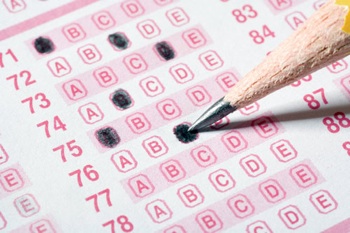
Please mark your answer below with a No. 2 pencil, taking care to fill in the box completely without marking the area outside the box. If you do not follow directions, the machine may not be able to read your answer, and you will be marked down accordingly.
Question: You moderate a lot of panel discussions at education meetings, and you have a reputation for doing a pretty good job at it. In fact, some of those appearances are embedded above in this post. Can you pass along some tips to the rest of us?
John: Sure, but why are you asking me now?
Question: Well, you’re not getting any younger, are you?
John: Fair enough. There’s really just one unbreakable commandment for running a worthwhile panel discussion: No opening remarks!
Question: Why not?
John: Because if I ask panelist so-and-so to make a few remarks, I have given up control of the microphone. That means when he or she goes off on a tangent or goes on too long, I cannot interrupt without being rude. But if it’s all Q&A, it’s always my microphone, and I can interrupt without being rude. Remember, it’s supposed to be a ‘discussion,’ not a series of presentations or ‘opening remarks.’ How many of these events have you been to where they never even get to a discussion because each panelist takes 10 or 15 minutes — even though the moderator had told them ‘5 minutes max!’
Tell me more...
Question: What are your other ‘rules’?
John: There are two expressions I try to use as often as possible. One is “I don’t understand,” and the other is “Tell me more.”
Question: Tell me more.
John: That’s cute.
Question: Well, I’m just trying to follow your example.
John: OK. Here’s why. When I hear jargon, even if I understand it, I will say “I don’t understand’ because that forces the panelist to come down to earth and speak in understandable English. He may be thinking that I am pretty stupid, but he will invariably provide a better, clearer explanation. “Tell me more” works on that same principle.
Question: So those are the secrets?
John: Well, there’s more. The moderator has to listen to what people are saying and respond to that. Some moderators seem to feel that it’s their job to ‘balance’ the conversation, giving equal time to everyone. I don’t worry about that. In fact, I often tell panelists that they have to speak up if they want to be heard. Life is unfair, and so are panel discussions.
Question: What else?
John: I always ask panelists ahead of time if there’s a question they want to be asked. If there is, I ask it, because that allows them to say what they would have said if there had been opening remarks. Everyone has a set speech, a shtick, and I want to make it easy for them to get it out there for the audience.
Question: How do you see the moderator’s role?
John: Good question. Kind of like a conductor.
Question: Orchestra or train?
John: Both, I guess. If the panel has been chosen well, then there will be different voices (instruments), and a good conductor will help them create something worth listening to. But a moderator is also driving a train toward a clear destination, greater understanding of the issue. Remember, the operative word is ‘discussion,’ but if you look at most convention programs, these events are usually billed as ‘panels,’ whatever that means. It’s all about having a decent conversation, one that sheds light and holds the audience’s interest.
Question: You feel pretty strongly about this.
John: Sure, because pedagogy matters. We shouldn’t be lecturing when we know that the more interactive and participatory an event is, the more likely it will be interesting to the audience.
Question: Is there an ideal number of panelists?
John: No, but two is too few. I would say that three or four is probably best. I’ve juggled as many as seven, but that’s no fun for anyone.
Question: What about taking questions from the audience?
John: Essential, but here the moderator has to be tough and occasionally rude. A lot of so-called questioners really want to hold forth with their opinions. I always make it clear that I won’t tolerate that, but even so someone always gets up and tries to make a speech. I am always forced to interrupt someone and ask (or demand) ‘What’s your question?’
Question: Your blog is usually about education. In fact, you usually complain about something or other. What’s up with this?
John: I am taking a bold stand against boredom, against lousy pedagogy and stultifying panels. Pretty courageous, huh?
Question: Chances are most people won’t read this far. You OK with that?
John: Well, if even one moderator behaves differently because of this, I will feel I have actually accomplished something.
Question: I suppose you think you’re pretty clever, putting all this information about moderating into Q&A form.
In one of his always interesting “Disruptions” column in the New York Times, Nick Bilton held forth on how robots are replacing workers at Amazon and elsewhere. These robots, a researcher at Johns Hopkins told Bilton, “will help augment people’s abilities, allowing us to use robots for things humans cannot do.” And, the Hopkins guy adds, we will always “have to have someone who builds the robots.”
Columnist Bilton is upset for the workers who will lose their jobs, but his column is also a wake-up call. I read it as an implicit critique of a narrow curriculum that puts aside just about anything that encourages the imagination in favor of ‘the basics,’ meaning basic reading and basic math.
Stressing the basics is no way to make sure that we will produce people to design, build and operate robots, or create the future in other ways. We need schools that encourage the imagination, that allow and support deep learning, and that fan the sparks of creativity — not stomp out the fires.
In the East Bay, new approaches to education are taking shape.
However, a narrow and unimaginative curriculum is not a new phenomenon. Just as armies are supposedly spending their time getting ready to fight the last war, many schools and colleges seem to focus on preparing young people for the day before yesterday — and have been doing so for a long time.
I have some direct experience in this. In the late 1960s, I taught for two years at a historically Black public college, Virginia State, in Petersburg, Virginia. For a privileged young white man from New England, it was a life-changing experience.
One sociological lesson stuck with me. The college stressed vocational training for its students, most of whom were the first in their families to attend college. While some studied to become chefs and barbers, a very popular major involved computers, which at the time were still pretty new. These students were being trained to be key-punch operators! (Ask your parents!!) It didn’t take a wizard to know that, in a very short time, absolutely no one would be able to make a living as a key-punch operator, but that didn’t slow down the training program. Disrupting that assembly line would have required more than foresight; it would have meant sticking one’s neck out and challenging the comfortable status quo –remember, this was Southside Virginia, not a safe place for African-Americans to challenge the system. Easier and safer to prepare students for yesterday than to make waves and risk one’s own career.
I’ve often wondered what happened to those young men and women. I hope they found other work, and other opportunities to learn new skills.
What about today? Not only are we not challenging the status quo of ‘basic education,’ we seem to be cutting to the bone and getting rid of ‘frills’ like the arts. While I am hearing and reading stories about larger classes and fewer ‘non-essential’ programs in lots of places, Texas seems to be leading the way in cutting education (big surprise).
So what do we do about a narrow, boring curriculum and the failing schools that generally seem to accompany that approach? It takes courage to challenge the runaway train of the current approach. As the metaphor suggests, standing in front of a train is not a recipe for a long life. The money and the power are with the status quo.
Some corporations are getting involved, although maybe not as a direct challenge. If you watched the Masters Golf tournament, you saw ExxonMobil commercials about improving America’s competitive position in math and science. That company’s foundation has spent millions on math and science education. (I also liked that many of the ads said ‘Support our Teachers,’ a too-rare message these days.)
Better news comes from San Francisco. Some high tech entrepreneurs there are resisting school-as-usual and getting their hands dirty trying to change things. Right now they seem to be involved because they have children of their own, but let’s hope they are intent on helping other people’s children as well. Let’s hope these interesting approaches to schooling become models, not just boutique luxury items for the privileged.
Cursing the darkness never did anybody any good. Let’s celebrate — and copy — those who are lighting candles to show us the way.
But a teacher I correspond with occasionally brought me up short recently. My focus on actual, literal cheating — physically changing answers or giving kids answers in advance — is too narrow, this teacher wrote.
Here’s part of a recent letter:
“While I know that the cheating scandals may be considered important, I’m frankly a bit disappointed that this is the focus because the cheating scandal doesn’t really matter in terms of the students and their futures, which should always be the focus of anything related to education. What matters is the lasting damage that is being done to them as a result of the increased pressures being put on the school system over these tests. The lasting damage is the closing of schools with no thoughts as to the repercussions on the community, the constant rotating principals, the removal of teachers connected with the community, the privatization of public schools and property, the fact that schools budgets are getting slashed while the administrative central office expands and gives money to private contractors in huge quantities that accomplish nothing, the constant lack of knowledge about our future in the schools, the increasing class sizes and removal of resources from our neediest schools, etc. The cheating scandal is next to nothing; that is a product of the testing obsession as a whole, something that Michelle Rhee certainly fed, but it is far from the worst part of her tenure. Those test scores mean nothing about how prepared our children are for their futures–whether or not there was cheating.”
Some think we haven't hit bottom yet.
Supporting her argument that the real issue is preparing kids for their futures is a new report about the arts in our schools, hard data confirming what most reporters have known for a long time: for at least 10 years, the arts have been disappearing from schools populated largely by low-income kids. The report is from the U. S. Department of Education. It tells us that fewer public elementary schools today offer visual arts, dance and drama classes, a decline many attribute to budget cuts and an increased focus on math and reading. Most high schools with large numbers of low income students do not offer music. Dan Domenech, executive director of the American Association of School Administrators, told reporters that cuts are likely to continue into the next two years because education funding has been slow to pick back up. “We haven’t hit bottom yet,” he said.
In other words, we’re cheating kids on their tests and stealing essential courses like art and music from them! Add to that, we are lying — because when kids get phony scores telling them they are proficient when they need help, that’s an out-and-out lie.
At what point does this trifecta — lying, cheating and stealing — become a felony? Seriously!
In the face of this disheartening news, one has to ask, “who benefits?” I’m stumped. Certainly not children, parents and teachers. Could it be the testing companies? Perhaps it’s the bevy of expert ‘consultants’ who advise school systems on how to raise test scores, how to calculate the ‘value added’ that individual teachers provide, and how to make education more ‘businesslike’ and efficient?
A far more important question than ‘who benefits?’ is: What are we going to do about it?
The young teacher started right off making a rookie mistake in the opening minutes of his first class, on his very first day. “How many of you know what a liter is?” he asked his high school math class. “Give me a thumbs up if you know, thumbs down if you don’t.” None of the kids responded, so he entreated, “Come on, I just need to know where you are. Thumbs up if you know, thumbs down if you don’t.”
An experienced teacher would not have asked students to volunteer their ignorance. An experienced teacher might have held up an empty milk carton and asked someone to identify it. Once someone had said, “that’s a quart of milk,” the veteran might have pulled out a one-gallon container to be identified. Only then would she have shown them a liter container, explaining that most countries in the world use a different measuring system, et cetera.
But the rookie didn’t know any better. He’d graduated from Yale that spring, had a few weeks of training that summer, thanks to Teach for America, and then was given his own classroom.
Another first year teacher made a rookie mistake in the spring. “How many of you dislike poetry,” he asked his high school seniors? “How many of you really hate poetry?” When most of the hands went up, he announced, “That’s going to change, because I am going to turn you into poetry lovers.” With that simple — and stupid — declaration, the rookie had made it all about himself, not about the poems. He had challenged his class on personal terms, making it an ego trip for himself, not an educational journey for his students.
Matters never really improved for the first rookie that year, and he was not invited back for a second year. I was the second rookie. I taught for two years and then moved on, but it wasn’t until years later that I recognized how counterproductive my approach to that poetry unit was.
So what’s the point? Rookies make rookie mistakes? Or is it that teachers need serious training (I had none whatsoever, not even the equivalent of a TFA summer) before taking over classrooms?
This brings me to the third teacher in this short essay, a young woman I observed doing a bang up job of teaching first graders to read. She seemed to have all the moves down, phonemic awareness, chunking, words that must be memorized (like ‘the’) because they don’t follow the rules, and so forth. Her first graders were reading confidently and competently. We made a piece about it, for the NewsHour:
I knew that she had completed a five-year program at a reputable state university, giving her both a bachelor’s and a master’s in elementary education and a certificate to teach. In short, she had it all.
Or did she? “That’s where you learned how to teach reading,” I stated as a half-question. “No,” she responded emphatically! “They never said a word about phonics in any of my classes. I had to learn all of that here, on the job.”
I was dumbfounded and disbelieving, but a search of that education school’s course syllabus and a phone call to a now-retired professor there confirmed what she had said. Phonics was barely acknowledged. Apparently the reading wars continue, at least on that campus, with ‘whole language’ still planted firmly in the saddle.
Given a choice between bad training and little or none, what is one to do? And if that’s the choice right now, what can we do to change the odds? Let me suggest it’s time for a 180-degree turn. We need to make it more difficult to become a teacher, which we could do by raising standards for admission into training programs and then providing one-year apprenticeships before teachers are given their own classrooms.
How are we going to raise the bar for entering the teaching profession?
The first change — tougher admission standards — applies to virtually every school and college of education: Raise the bar for getting into the profession. Improve programs by weeding out professors who are still waging old battles. Do much more of the training in real schools and real classrooms.
(Some schools and colleges of education are already going down this road, including Arizona State, Michigan, Berkeley, and Teachers College. All led by women, by the way. Add to that list Stanford, which was, until recently, also led by a woman.)
The second change — a one-year apprenticeship — applies to TFA, which already has remarkably high admission standards to its two-year program. But it’s the rare individual who can take over a class after a few weeks of summer training and be genuinely effective. Even successful TFA teachers often admit that much of their first year was a wash, at best. What if TFA were a three-year program, with the first year being an apprenticeship? Would that produce better teaching and also help TFA weed out the ambitious ones seeking largely to punch up their resumés?
As I say, I think the country needs to make a U-turn. Because most schools of education have low admission standards, it’s far too easy to become a teacher. And because many of our policies and practices are hyper-critical, and even punitive, toward teachers, it’s now very difficult to be a teacher.
It will take a concerted effort on the part of governors and university presidents to make it harder to become a teacher. Governors have to be convinced of the economic and political benefits of having their constituents’ children taught by skilled professionals. I fear that the leadership at many universities is comfortable with the ‘cash cow’ aspect of their education programs, which take in more than they spend. What sort of pressure would be required to get them to change?
But making those changes seems like a walk in the park compared to what it would take to do to reverse our current ‘blame the teacher’ approach. Making it easier for today’s teachers to teach won’t happen unless and until we come to our senses. Does anyone see that happening soon?
“My son can’t sleep at night,” his mother (and a friend of mine) said.
Why, I asked?
“Because his teacher told him that he had to do well on the tests this week or she would be fired. He’s worried sick.”
That conversation, which occurred almost exactly one year ago, continues to haunt me. What kind of teacher would say that to kids? Or, digging deeper, what were the circumstances made the teacher feel so desperate that she would say that?
It doesn’t matter where that 3rd grader and his family live, because that sort of pressure seems to be everywhere. And it seems to be increasing, as scores on state/city exams become the single most important measure of a teacher’s performance — and as pressure grows to publish the test scores of every individual teacher’s students.
Everyone is familiar with Campbell’s Law, developed by social scientist Donald Campbell:
“The more any quantitative social indicator is used for social decision-making, the more subject it will be to corruption pressures and the more apt it will be to distort and corrupt the social processes it is intended to monitor.”
Scaring the sleep out of a child is surely an example of distortion and corruption. So too is firing people based on the snapshot of one day’s bubble test score.
Tests aren't going away. But where do we go now?
And then we have the cheating by adults, proven in Atlanta very recently and over the years in Austin, TX, and Connecticut, and suspected now in Washington, DC, Philadelphia, Houston and lots of other places.
We would still be holding everyone accountable, but children would be able to sleep at night during March and April, and teachers wouldn’t feel it necessary to violate a basic code of decency.
Will the Common Core, now accepted in nearly every state and the District of Columbia, bring some sanity? That’s what the pundits and the bandwagon-builders are saying, but hold your applause. At least until you read Tom Loveless’ latest report, “How Well Are American Students Learning?” It was released by the Brookings Institution recently, the 11th in a series of “Brown Center Reports on American Education.” Loveless takes a clear-eyed look at our latest enthusiasm, the Common Core, and, since that bandwagon is picking up steam, it’s well worth your time. He writes about ‘aspirational standards,’ likening them to that diet you (and I) keep promising to go on. And he reminds us that there’s more variation within states than between states, an important dash of cold water on those who are prone to celebrate Massachusetts and put down Mississippi. In short, don’t expect the Common Core to change much.
What will it take to relieve some of the pressure? Can President Obama and Secretary Duncan really believe that weeks of test prep and tons of pressure are good for our kids? Why aren’t leaders speaking out?
Maybe parents need to say ‘no mas’ to this — if only so their kids can sleep at night.
If you are reading this during daylight hours in March, chances are that millions of our children are now engaged in what’s called ‘test prep.’ Just yesterday someone showed me the March calendar for a high-achieving public elementary school: two solid weeks of the month were blocked off for “TEST PREP,” probably in caps lest any classroom teacher forget and do some real teaching.
The banality of “TEST PREP” clashes violently with the ideas I was exposed to last week. Last Thursday and Friday, I spent quality time with syndicated columnist Mark Shields, GE Chairman and CEO Jeffery Immelt, Senator Michael Bennet (D-CO), libertarian activist Giséle Huff, Stanford’s Claude Steele, Assistant Secretary of Education Carmel Martin, and Roberto Rodriguez (President Obama’s education advisor.)
These seven separate meetings (in Washington, DC and northern California) had only one thing in common: big ideas about life and learning. While their politics are different, all celebrated the human spirit. Oh, and no one talked about TEST PREP or about what is happening in real classrooms in many schools.
Both Roberto Rodriguez and Carmel Martin expressed the faith that pushing certain policy levers from Washington will produce the desired changes in 15,000 school districts and 100,000 public schools. So, for example, “doubling down” on early childhood education, as the Administration they work for has done, will dramatically increase enrollment in early childhood programs, and that in turn will lead to early reading competence. Investing $4 billion in ‘turning around’ low-performing schools will produce dramatic gains. Creating “Career and College Readiness” programs will make more kids ready for college and careers. And so forth. If either harbors doubts about the wisdom or efficacy of any of their policy initiatives, they did not let on. If either wonders whether federal policies under Presidents Bush and Obama might be responsible for the ubiquity of TEST PREP, we saw no sign.
Is this what test prep is doing to our students and our schools?
Senator Bennet, whose previous job was Superintendent of Schools in Denver, spoke of finding new ways to train and ‘incentivize’ teachers. “What we do now makes no sense,” he said, indicating that he wanted to use federal dollars to ‘incentivize’ school districts to use technology. He told us that he was worried about all children, not just kids in poor areas, being forced to attend schools that were failing to recognize the power of technology to radically change education.
Like Senator Bennet, Giséle Huff believes that today’s technologies can transform education.
A libertarian activist who once ran for Congress, Huff now runs a small foundation. Perhaps because her office looks out on San Francisco Bay, she used a maritime metaphor to describe public education today. “Teach for America, KIPP and other programs are building rafts for a small number of kids, and that’s fine as far as it goes,” she said. “But I am worried about the ship’s direction. We cannot abandon ship, but neither can we continue doing what we are doing; we have to change course.”
GE’s Jeff Immelt was bullish on America. He gave 10 reasons for optimism, with No. 5 being, “We do education better than anyone in the world.” As evidence, he cited the number of foreign students who come here for their graduate training. However, I’d be willing to bet a new GE dishwasher that he has no clue about what’s happening in K-12 classrooms this March.
Which brings me the question posed by Claude Steele of Stanford: Is education a commodity or a public good? If it’s a commodity, who’s buying, and what’s being sold? If it’s a public good, just what are the benefits?
Steele, the new Dean of the School of Education at Stanford, suggested a double standard is at work. “For our own children, education is a commodity, a scarce resource that we are willing to pay for,” he said. “People with resources will never give up privilege willingly,” he said, which is why, he said, “When we talk about education for others, we say it’s an ‘opportunity.’”
However, if education is a commodity to be purchased, then I say ‘buyer beware.’ When even our good schools devote weeks to TEST PREP and the subsequent multiple-choice tests, that’s an education system that is training kids as if life were a bubble test.
But life is not a series of multiple-choice questions, requiring only a No. 2 pencil. Navigating the future will require improvising, regrouping, falling down and getting up, growing and changing.
We know that the predictors of success in later life include diverse experiences in what Dean Steele calls “non-routine settings,” but what could be more routine than weeks of TEST PREP? We also know that lots of reading and the experience of ‘negotiating’ with adults and other children also are preparation for, and predictors of, success. TEST PREP doesn’t make the list.
So what on earth are we doing? “Americans are pragmatists,” Mark Shields said. “While ideologues believe that what is right works, the rest of us believe that what works is right.”
If Shields is correct — and he usually is — then most Americans must not know what their children and their neighbors’ children are doing in class. If adults knew about the mind-numbing waste of time, I believe they’d do something about it.
Immelt concluded by noting that “the highway to the future is a toll road,” meaning that we Americans have to be prepared to work creatively and aggressively if we wish to ensure our future. Hard, creative work seems like a reasonable toll to pay.
The toll barriers we’ve set up in schools, however, are entirely different. We’re training kids to think inside the box and penalizing them (and their teachers!) when they don’t.
TEST PREP education probably doesn’t descend to the level of a “public evil,” but it’s certainly not a “public good.” And if it’s a “commodity,” it’s bargain basement, yard-sale stuff.
I often hear adults describing today’s young people as ‘digital natives,’ usually with a tone of resignation or acceptance: “They are so far ahead of us, but we can turn to them for help,” is the general message I hear.
My reaction is “Whoa there, Nellie,” because to me that kind of thinking smacks of abdication of adult responsibility. Yes, most young people know more than we adults because the fast-changing world of modern technology is alien to us, wildly different from the one we grew up in. But being a ‘digital native’ is not the same as being a ‘digital citizen.’ Young people have always needed ethical guidance and the security of rules and boundaries. That’s more true now because today’s technologies have unprecedented power to harm, as we have seen in documented cases of cyber-bullying and harassment.
I accept the general truth of what someone called the “Three C’s 1-9-90” rule of thumb, sad and depressing as it is. Only about ONE percent of young people are using today’s technologies to create; NINE percent are curating, collecting and critiquing, while NINETY percent are consuming.
If most youth — 90 percent — are texting, playing Angry Birds and Grand Theft Auto, and linking up on Facebook and Google Circles, then we adults should be ashamed.
Unless, of course, we are equally guilty.
And we are.
I would bet that the education community’s use of technology follows a “Two C’s 10-90” rule: TEN percent to create, and NINETY percent to control. I mean ‘control’ broadly, everything from keeping the school’s master schedule, monitoring attendance and grades, tracking teacher performance, and imparting the knowledge we believe kids need to have.
Our children may be digital natives, but we still need to channel their efforts.
If an important purpose of school is to help ‘grow adults,’ then the creative use of technology — by adults and young people — must be ramped up dramatically. We need to find ways to move kids out of the 90% and into the 1%.
If, on the other hand, a central purpose of school is to produce willing consumers, well, we’re doing fine.
What about Sal Khan and his burgeoning Khan Academy? Doesn’t his approach blend technology and traditional learning in ways that are to be admired? Yes, of course. However, at least so far most of the energy has been devoted to helping kids master the required curriculum. I think that’s necessary, but it’s not sufficient.
Schools today must provide opportunities for young people to create knowledge out of the swirling clouds of information that surround them 24/7. You went to school because that’s where the knowledge was stored. That was yesterday. Think how different today’s world is. Today’s young people need guidance in sifting through the flood of information and turning it into knowledge. They need to be able to formulate good questions–because computers have all the answers.
Here are a few ways to harness technology and foster creativity.
1. Every middle school science class could have its own hand-held air quality monitor (under $200). Students could take air quality measurements three times a day, chart the readings, share the information in real time with every other middle school science class in the city, region or state, and scour the data for consistencies and anomalies. That’s creating knowledge out of the flood of information, and it’s real work, not ‘homework.’
2. Students could use their smart phones’ cameras to map their own neighborhoods, documenting (for example) the number of trash cans on street corners. That information could be plotted and shared city-wide, and the data could be examined for patterns and anomalies. Are there more trash cans in wealthy areas? If so, ask the Mayor, the Department of Sanitation and the City Council for an explanation. Again, students will be turning information into knowledge. I wrote about this a while ago in more detail.
3. Why not measure water quality? A hand-held monitor/tester of Ph costs under $100, and the instrument that tests conductivity (ion levels, which relates to purity) is available for under $100. Turbidity — how cloudy the water is — is important to measure as well, and that can be done with an inexpensive instrument and a formula. Students could also measure the speed of the current and keep track of detritus. Then share all the data with other science classes around the city, region and state. Everyone could dig into the information looking for patterns. If one river’s water seems relatively pure until it passes point X, students could endeavor to find out why.
4. Teams of students with held-held Flip Cameras are invited to participate in our Shared Poetry Project and become producers for our YouTube channel.
If you click on the link above, I suggest you watch example #3, which was created by some middle school students in New Jersey.
Work like this is, well, real work. Students are creating knowledge; they are designing projects and seeing them through from beginning to end. These projects have to meet real-world standards because the results are in public view.
These young people will be learning (or reinforcing) real-world skills that will help them once they move out of school. They’re working together, they are gathering, assimilating and analyzing data, they are learning how to present what they are learning, and so on. This is career-track stuff, 180 degrees different from much of the ‘regurgitation education’ that is the hallmark of too many of our schools.
And here are two final benefits: the time they spend doing projects like these (and there are many more good ideas out there) is time they cannot spend playing games or otherwise consuming technology. And because they are using technology to create and are enjoying the fruits of their labor, they will be, I believe, less likely to use technology’s power negatively. Strong in their own sense of self, they are less likely to feel the need to bully and cyber-bully others.
Technology is not value-free. We have choices to make, folks.
“The educational foundations of our society are presently being eroded by a rising tide of mediocrity that threatens our very future as a Nation and a people.”
Surely everyone recognizes the 5-word phrase. Some of you may have garbled the phrase on occasion — I have — into something like ‘Our schools are drowning in a rising tide of mediocrity.”
But that’s not what “A Nation at Risk” said back in 1983. The report, issued by the National Commission on Excellence in Education, was a call to action on many levels, not an attack on schools and colleges. “Our society and its educational institutions seem to have lost sight of the basic purposes of schooling,” the Report states, immediately after noting that America has been “committing an act of unthinking, unilateral educational disarmament.” (emphasis added) Schools aren’t the villain in “A Nation at Risk;” rather, they are a vehicle for solving the problem.
Suppose that report were to come out now? What sort of tide is eroding our educational foundations? “A rising tide of (fill in the blank)?”
This is a relevant question because sometime in the next few months another National Commission, this one on “Education Equity and Excellence,” will issue its report. This Commission clearly hopes to have the impact of “A Nation at Risk.”
However, the two Commissions could hardly be more different. The 1983 Commission was set up to be independent, while the current one seems to be joined at the hip to the Department of Education.
Consider: Ronald Reagan did not want a Commission to study education because he wanted to abolish the U. S. Department of Education, which had been created by the man he defeated, Jimmy Carter. So Education Secretary Terrel Bell did it on his own.
The current Commission has the blessing of the White House and the Congress.
Secretary Bell asked the President of the University of Utah, David Gardner, to chair the Commission. He knew Gardner and trusted him to oversee the selection of the Commission members. Dr. Gardner then hired Milton Goldberg as Staff Director and they selected 15 members, plus two reliable political conservatives the White House insisted on. They asked the key education associations to nominate five candidates, then chose one from each association. They ignored the teacher unions and selected that year’s Teacher of the Year as a Commissioner. Meanwhile, Secretary Bell stayed on the sidelines, cannily keeping his distance from an effort that his boss was not in favor of.
Unlike Ted Bell, Education Secretary Arne Duncan seems to have been involved from the git-go. He has spoken to the group and recently intervened to extend its deadline. His Department named the co-chairs and all 28 members, who represent every possible constituency in the education establishment: rural, urban, African American, White, Hispanic, Asian-American, Native American, conservative, liberal and so on.
Rather than delicately balancing his Commission to be politically correct, Gardner, a University President, put five other people from higher education on his Commission and famously declared there would be “no litmus test” for Commission members.
Duncan has touched every base, at least once. Well, almost every base — no classroom teachers or school principals serve on Duncan’s Commission.
Gardner included out-of-the-box thinkers like Nobel Laureate Glenn T. Seaborg and Harvard physicist Gerald Holton. Duncan’s Commission is depressingly predictable, with the exception of Netflix founder Reed Hastings. Why no Tim Brown, Deborah Meier, John Seely Brown, Sal Khan, Laurene Powell, Larry Rosenstock or James Comer?
Because the “Risk” commission had no ex officio members, it had limited contact with the Department or the White House. Staff Director Milton Goldberg recalls that Secretary Bell read the 31-page draft report for the first time just one week before its release. (“Golly, it’s short,” was his initial reaction, Goldberg recalls.)
The current Commission has seven ex officio members, including Roberto Rodriguez of the White House and Martha Kanter, who is #2 in the Education Department. Not only that, it appears that the Department’s PR people are on hand at all times. No secrets, no surprises.
The earlier Commission held most of its meetings and hearings around the country. The current Commission held seven of its 12 meetings at the U. S. Department of Education, including the final five.
Given all that, it’s difficult to think of this as an ‘independent’ Commission. End of the day, it’s Arne Duncan’s Commission, established for the express purpose of finding ways to close the ‘resource gap’ in spending on education for poor kids in this country.
That’s a worthy goal, because the spending gap is huge. However, closing it won’t be easy. States are pretty much broke these days, so the money will have to come from Washington.
And that’s a problem, because no one in Washington seems to trust states or local school districts, which, after all, are responsible for the ‘savage inequalities’ in the first place. Because education is not a federal responsibility, Washington can send money and make rules but cannot send in the troops to punish misbehavior. As Michael Casserly, long-time Executive Director of the Council of the Great City Schools, dryly noted in the January meeting, “We haven’t really resolved this question about where state responsibility ends or where their capacity and willingness end, and where the federal government’s willingness and capacity and authority begin.”
There’s some history here. Earlier efforts to equalize spending haven’t worked all that well. The early days of Title One of ESEA saw federal dollars that were supposed to be spent on disadvantaged kids going instead to build swimming pools for suburban kids or for ‘teaching machines’ that gathered dust in locked closets. States and local districts — seemingly by instinct — took the federal money and then cut their own spending by that amount, until the feds made that illegal.
And there’s also the knotty problem of past experience with spending more on poor kids. It hasn’t produced results in Newark, NJ, or Kansas City, or anyplace else as far as I know.
More than a few of the Commissioners see the 15,000 local school boards as an impediment; they are, however, a fact of American political life. It should be noted that the Commissioner who wrote the first draft of the forthcoming report, Matt Miller, is also the author of “First, Let’s Kill All the School Boards,” which appeared in The Atlantic in January/February 2008.
It doesn't seem as if the new commission will match these efforts.
The Commission wants more preschool programs and the most qualified teachers to work in low income districts, and so on, but those are local or state decisions, and most members of the Commission — those speaking up at the meetings — do not seem to trust anyone but Washington.
So if Washington can’t just write checks to close the resource gap because it can’t control states and school districts, what does it do? Several Commissioners spoke approvingly of a more “muscular” federal governmental role in education, but it’s not clear how it would flex those muscles.
End of the day, the Commission’s big goal is to energize public opinion, just as “A Nation at Risk” did.
Read through meeting transcripts (as I have been doing) and you will find lots of discussion about how to sell the public on the big idea of what Co-Chair Edley calls a “collective responsibility to provide a meaningful opportunity for high quality education for each child.”
Shorthand for that: spend more to educate poor kids.
Slogans emerge in the discussion: “Sharing responsibility for every child,” “From nation at risk to nation in peril,” and “Raise the bar and close the gap”
At one point a Department PR man took the microphone offer a suggestion. “In the communication shop, myself and Peter Cunningham, my boss, are always happy to help you guys through this process, to the extent to which you — you know, you’d like our help. But “one nation under-served” would be kind of a way that to kind of capture that, and harken back to sort of patriotic tones and kind of a unifying theme, and the fact that you know, we’re not hitting the mark we should, as a country and international competitiveness. So, I just put that out there.”
What will probably be ‘put out there’ in April will be a document designed to make us morally outraged at the unfairness of it all and, at the same time, convince us that failing to educate all children is going to doom America to second-class status in the world. Expect rhetorical questions like “Would a country that’s serious about education reform spend twice as much on wealthy kids as it does on poor kids?”
I am virtually certain that the new Report will reflect the Administration’s technocratic faith that pulling certain policy levers will produce dramatic change — despite years of evidence to the contrary. (It’s part of ‘a rising tide of predictability’ that inhabits our land, as positions harden and debate and inquiry disappear.)
The real problem is not the Constitution’s limits on the federal role in education. For all its talk of public education as ‘the civil rights issue of our time,” this Administration, like the one before it, simply does not have a powerful vision of what genuine education might be. Full of the same hubris that led to No Child Left Behind, it believes in technical solutions.
Channeling Dr. King, this might be Secretary Duncan’s version of that famous speech: “I have a dream that all children will one day live in a nation where they will not be judged by the color of their skin or the content of their character but by their scores on standardized tests.”
That’s harsh, I know, but this Commission and this Administration ought to be asking other important rhetorical questions, such as “Would a country that’s serious about education reform devote as much as 20% of classroom time to test preparation and testing?”
or: “Would a nation that believes in the potential of all children spend about $10,000 per child on schooling and then measure the results with a $15 instrument — and swear by the results produced by those cheap tests?”
or: “Would a nation that believes in education develop a ‘reform agenda’ that attacks teachers knowing that, even absent such attacks, 50% of teachers have been leaving the profession in the first five years?”
While I agree with what I expect to be the Commission’s findings (“We haven’t been serious about leveling the playing field in education”), I find it impossible to see this Commission as anything but narrowly political.
More than that, however, I think this Commission represents a missed opportunity to engage American citizens on a more fundamental issue: the education of all our children.
Suppose the Administration had been willing to ask a group of independent thinkers an honest question–and been prepared to deal with whatever answers emerged?
My question would be “Does a rising tide threaten our educational foundations and our very future today? If so, a tide of what?”
I can find evidence for the following: Avarice, regulation, indifference, hostility, testing, and irrelevance.
You can make the case that a rising tide of avarice is a threat. After all, K-12 education is a reliable pot of big bucks, almost $600 billion a year for K-12 alone. That’s why for-profit charter schools are proliferating, why Pearson and McGraw-Hill are expanding voraciously, and why tech companies are banging on the doors of desperate school boards with ‘solutions’ to sell.
Is there a rising tide of hostility, suspicion and finger-pointing? Ask almost any teacher.
The rising tide of testing hasn’t crested. With new emphasis on evaluating all teachers according to student test scores, the high water mark is nowhere in sight.
What about a rising tide of regulation, much of it coming from Washington? Ask principals in Tennessee, who now must spend multiple hours evaluating each teacher and filling in forms to satisfy the state, which is in turn satisfying the U. S. Department’s rules for “Race to the Top.”
A rising tide of irrelevance threatens the entire enterprise. I believe public education is drowning because schools have not adapted to a changed and changing world. Consider: Of the three historical justifications for school, only one applies today. I write about this at length in The Influence of Teachers.
In the past, you had to go to school because the knowledge was stored there. Today, information is everywhere, 24/7, which means that kids need to learn how to formulate questions so they can turn that flood of information into knowledge. But most of our schools are ‘answer factories’ that offer ‘regurgitation education.’
In the past, you went to school to be socialized to get along with kids from different backgrounds, race, religion and gender. Today, however, there are Apps for that. So schools and the adults in them need to help kids understand the power — and limitations — of those Apps and technology in general. After all, kids need to learn that the 14-year-old they’re texting (and sexting?) may actually be a 40 year old sicko. Our kids may be digital natives, but that doesn’t guarantee they are or will become digital citizens. Schools need to fill that vacuum.
Finally, schools back then provided custodial care so your parents could hold down jobs. We still need custodial care, but when schools provide marginal education and fail to harness technology in useful ways, they become dangerous places for some children, and boring places for others. We lose at least 1,000,000 students a year, dropouts who may be hoping to find something more relevant on the street. (And, sorry, raising the dropout age to 18 will not solve the problem.)
Are there existing models of schools that are relevant to America’s future? Can we create incentives to expand those model programs to serve 50,000,000 children and youth?
I believe the answer to both questions is ‘yes.’ But first we have to ask those questions.
Before issuing its report, the Duncan Commission would do well to re-read “A Nation at Risk,” especially the last recommendation.
“The Federal Government has the primary responsibility to identify the national interest in education. It should also help fund and support efforts to protect and promote that interest. It must provide the national leadership to ensure that the Nation’s public and private resources are marshaled to address the issues discussed in this report.” (emphasis in original)







 The Merrow Report