Reading is a skill. Full Stop.
Reading is not a science! Full stop.
Chemistry, Biology, and Physics are sciences, but reading is a skill, much like tuning a piano or an automobile engine, or throwing a pot or a frisbee. Those who would have us believe that “A Science of Reading” exists, and that it reduces reading to a hard and fast set of rules are either devious politicians, opportunistic charlatans eager to sell snake oil curriculums, liars, or ignoramuses.
But, while reading is a skill that can be learned, teaching reading is both an art and a skill.
However, the “Science of Reading” bandwagon shows no signs of slowing down. To date, 43 states and the District of Columbia have passed legislation relating to what is called ‘evidence-based reading instruction.’ I say that’s well and good if that means making sure teachers understand the importance of phonics. Not so good, if it means hours of rigid drills in the sounds that letters make.
Don’t laugh–that’s what happened the last time we fought ‘the reading wars’ back in the 1980’s. I remember being in public schools in Connecticut where reading had been reduced to about 30 discrete steps, which could be drilled and practiced. Once the kids had mastered the steps, they were deemed to be readers. Perhaps they could read, but all the kids I interviewed absolutely HATED reading!
Phonics–matching letters and groups of letters with the sounds they make–is the engine of reading. But it’s not enough to know the rules of English because our language has almost as many ‘exceptions to the rule’ words as it has rules. So learners need to know more than just the rules. They have to recognize some words, the ones that break the rules.
Some of my favorite examples of our rule-breaking language:
If reading were a science, HE, SHE, and THE should rhyme, so why don’t they?
If reading were truly a science, PRIVATE, ESTIMATE, AND PRIMATE also should rhyme, but they don’t.
If reading were a science, MAINTAIN, OBTAIN, and CAPTAIN would rhyme.
Say these three words aloud: ANGER, RANGER, and HANGER. If reading were a science, they should rhyme too, but they don’t.
Why don’t these words rhyme? “Because reading is NOT a science.”
Let me give you one more example of our language’s irregularities: Say this word aloud: EAR. Now put a B in front of EAR to make BEAR. By the rules of Phonics, BEAR should rhyme with EAR….but it doesn’t
Now that you have learned to pronounce BEAR, it stands to reason that adding a D, making BEARD, will produce a word that is pronounced BARED. But it’s not; it’s pronounced BEERD.
Back to the rules: EAR and HEAR rhyme, as they should, but HEARD isn’t pronounced HERE-D; instead, it’s pronounced HERD.
And if we add a T to HEAR to make HEART, we don’t get HERE-T. No, it’s HART.
Back to hard core phonics: By its rules, DEAR, FEAR, HEAR, GEAR, and PEAR should rhyme…. Which they do, with one important exception. Let’s talk about the exception. Let’s add an L to PEAR, to make PEARL. It should be pronounced PAIR-L, but of course it’s not. It’s PURR-L.
So, learning our weird language is not a walk in the park. Nonetheless, properly trained teachers can teach almost any first grader to read, because most children want to be able to read. They understand, intuitively, that reading gives them more control over their environment. It’s learning with a purpose. It’s why children want to learn to walk–to get somewhere– and to talk–to be understood. The same applies to learning to read.
It’s painful but necessary to acknowledge that public schools have done a poor job teaching children to read over the years. 21% of American adults are functionally illiterate, and 54% of us read at a sixth grade level or lower. That’s embarrassing, tragic for those individuals, and damaging to our economy, but please do not blame teachers.
It’s not their fault, because almost all of them were trained by education professors in thrall to the belief that children needed above all to recognize words, not sound them out. So, for years and years the fundamental principles of phonics (letters and combinations of letters make sounds!) have been ignored or, more likely, scorned in favor of what is called ‘Whole Language,’ the curious notion that children should be taught to recognize words, not sound them out. (When Whole Language fell into disrepute, the name changed to “Balanced Literacy,” with equally disastrous results.)
Education bureaucrats compounded the problem with their catchy mantra, “First they learn to read; then they read to learn.” That’s utter nonsense! They happen together.
The craze for ‘The Science of Reading’ dates back to 2017, when a brilliant reporter, Emily Hanford of American Public Media, launched a podcast series called “Sold a Story.” If you missed it, it’s still relevant. She exposes the hypocrisy of education professors who continue to teach and preach ‘Whole Language,’ basically recognizing the shapes of words, as the one true way to teach children to read.
But I can’t imagine that Ms Hanford is thrilled with some of the unintended consequences, which I wrote about here in 2024.
If you have the time and the curiosity, here’s a good teacher at work, making learning to read a journey of discovery and pleasure.
Reading, and learning to read, should not be politicized, but they have been and are. Somehow, Phonics became ‘Conservative’ and then ‘Republican,’ while Whole Language became left, liberal, and Democratic. Ideologues in George W. Bush’s administration did a lot of damage.
More recently, the so-called Mississippi Miracle, which saw its fourth graders making huge gains in reading and math, has been oversimplified, unfortunately.
There is hope. The very red state of Texas has just issued a mandatory reading list of its public schools, and kids there will be reading lots of good books. Yes, there’s a Christian bias, but Texas isn’t giving in to the widespread idea that today’s children have such short attention spans that they can only read excerpts. Bravo to James Traub for celebrating this in a recent New York Times column.
I realize that I’m suggesting a lot of additional reading (this in a nation where only about 16% of adults read for pleasure), but here’s one more important piece, “The End of Reading is Here,” by Rose Horowitch in this month’s Atlantic.
What can YOU do? Read to your grandchildren and grandchildren; give them gift certificates for their local bookstore or Barnes & Noble. Support banning cellphones in school and at your dinner table.
One more thing: Get copies of Jim Trelease’s wonderful book, The Read-Aloud Handbook, now in its 7th edition, for everyone interested in having children read. Jim was a special guy, a reporter in Springfield (MA) with an interest in education. He visited a lot of schools in the 1970’s and 80’ and became intrigued by what was called ‘sustained silent reading.’ He thought there might be a connection between being read to and loving to read. There was, and there is. Turns out the more we read to children, the more likely it is that they will become readers.
I don’t remember how Jim and I got connected, probably through my weekly radio program on NPR, but when Jim self-published “The Read-Aloud Handbook” in 1979, he asked me to write a blurb for the cover. It was the first book I ever blurbed, and I wouldn’t mind if that fact were mentioned in my obituary, so significant was Jim’s book.
Jim passed away in 2022, but his book is a living testament to a life well-lived.
You will not regret buying “The Read-Aloud Handbook.” (And if you happen to find a first edition, my mailing address is PO Box 1381, Edgartown MA 02539.)
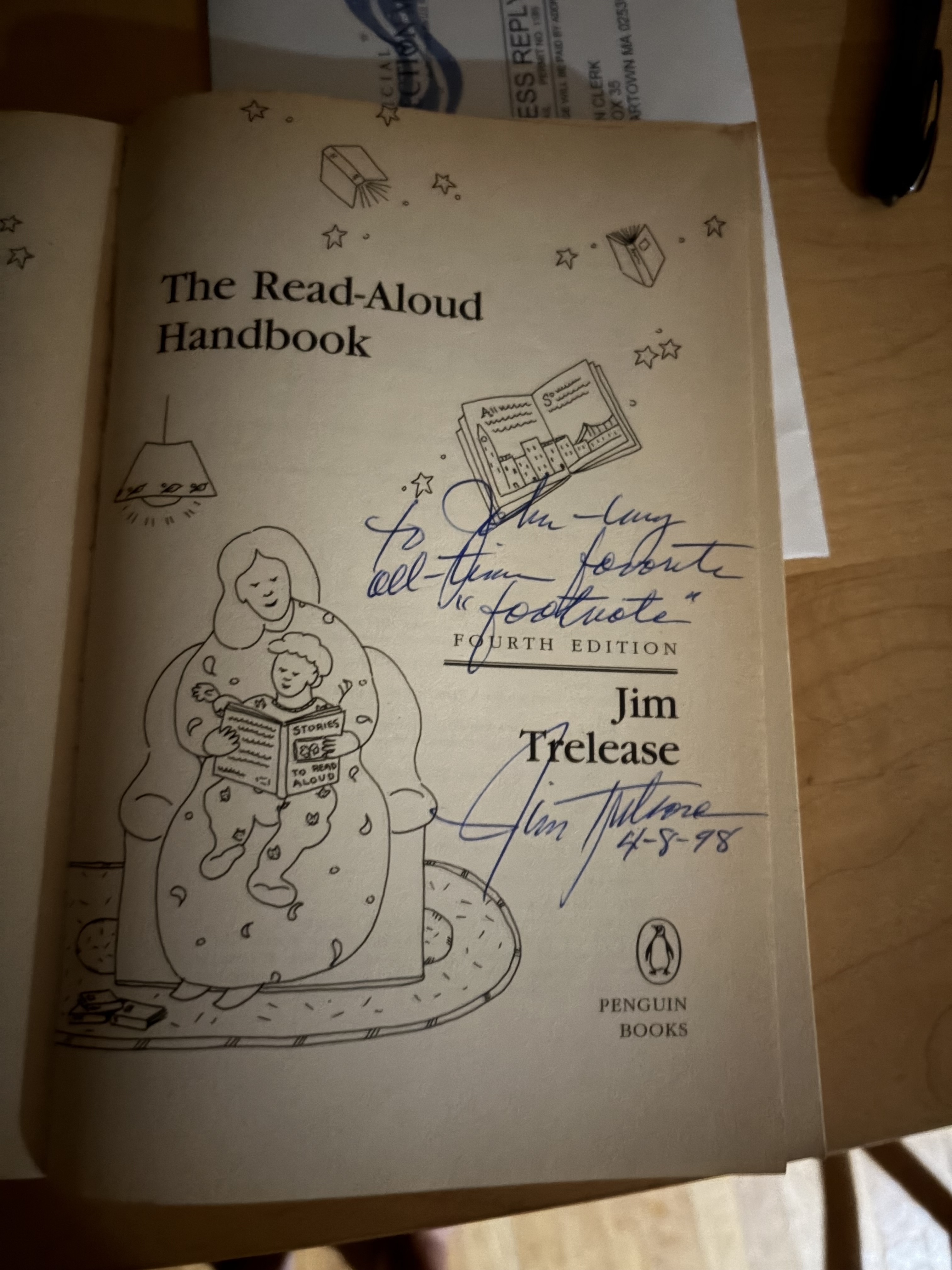
PS; I woke up in the middle of the night with a start, convinced that I had a copy of Jim’s book somewhere. Of course I got up and searched until I found it. It’s the 4th Edition from 1997. Jim signed it, “To John, my all-time favorite ‘footnote,'” and dated it 4-8-98. It’s a reference to his quoting what Captain Kangaroo told me about the negative affects of television on reading, on my NPR program. No blurb from me, or from anyone else for that matter. I’m still hoping to find a first Penguin edition from 1982 or, better yet, the self-published book.
 The Merrow Report
I read this carefully but I do not remember how I learned how to read. Wish I could- but clearly agree that reading to children who are learning hop scotch to read is very effective. Sent from my iPadOn Aug 10, 2026,
LikeLiked by 1 person
This piece reminds me of the difficulties I had in a special science class for ESL students. And on top of it all, we have borrowed words from other languages. Your piece “Menu,” reminds me of easy confusers: you may have men-you, men-oo, may-nyoo, may-noo. One could go on and on, but a 20th Century Dutch writer put together a long semi-serious poem of some 68 verses: The Chaos, by Gerard Nolst Trenité (1922). Tom Lehrer (The Element Song, etc.) would have a ball with this! Like a lot of things, the art of learning language seems to be a both…and rather than an either…or phenomenon, as you say, art AND skill. And, as a life-long science teacher, I would also add that science is also an art, in all senses. As I once heard a speaker say, “science” should be both a noun and a verb, content and process.
LikeLiked by 1 person
Good piece, especially if you don’t have any actual experience with what’s involved in effecting meaningful change in everyday instruction. For those of us who’ve been involved in school improvement for decades, the “Reading Wars” is old news and today is just the latest turn of the wheel. Much dismay is expressed about the phrase “the science of reading” but think about if it had been presented as “the research of reading”. Science is about evidence and research is evidence. The programs that are part of the current “wave” are anchored in research, unlike those lambasted by the Hanford series of articles. There’s a similar collection of research labeled by its advocates as the “science of learning”. It undergirds a new approach also anchored in research. All of these new programs have been developed by serious people who still have to decide how to give their efforts a catchy label. Regardless, as good as any of these may be, the real challenge comes when one realizes how difficult it is to find the resources to help teachers take the new knowledge on board and develop the skills necessary to become proficient in the new skills. One of the best new programs calls for 120-160 hours of professional development. That’s not realistic for most public school systems, especially given constrained budgets. Are teachers willing? My organization’s experience nationwide for decades [no longer active] is that at least 80% are willing and capable given adequate space and support. We should be advocating for those resources if we’re serious about helping kids learn how to read if they don’t enter school already reading. [BTW, guess which kids need that help the most? It’s not middle class white kids.]. Just my two cents.
LikeLike
“Willing and capable given adequate space and support” has a lot of wiggle room. My sense after 41 years in classrooms (which ended 10 years ago) is that most early grade teachers were simply not trained properly to teach reading. They were fed the ‘whole language’ line of nonsense, and they followed it. They were told that phonics was a diversion.
What will it take? Pretty intense retraining, Blowing up the Schools of Education that are still committed to ‘whole language’ and canning that faculty? Finding alternative ways to train teachers?cce
In my 2017 book, “Addicted to Reform,’ I take apart the Schools of Education and their commitment to mediocrity. As it turns out, to stay open, they need students, which mean they actually benefit from high rates of teacher turnover. They have strong disincentives to fix things. Just as we don’t put the polluters in charge of cleaning up our rivers, we shouldn’t expect schools of education to retrain classroom teachers.
LikeLike
[…] John Merrow, who has reported on education for over 50 years, argues forcefully that reading is a skill, not a science. And that teaching reading is a skill and an art, not a […]
LikeLike