The footstool in the pictures below was made by my paternal grandfather, John G.G. Merrow, probably in 1900 when he was 14 years old. Pegged and meticulously carved, it now holds a place of honor in our den

It’s more than 120 years old and still useful, although someone (my father?) put in some screws at some point, probably when some of the pegs began wearing out.

Gramp went on to finish high school and college, not all that common in those days, and now I find myself wondering what role his Woodshop class might have played in his development. It gave him the satisfaction of designing and creating something tangible and useful, and I’m assuming he was in charge of every step, A-Z. Perhaps he brought it home and gave it to his parents.
That’s what I remember doing with the wood pump-house handle lamp that I built in Woodshop class in 7th or 8th grade sometime in the 1950’s. That lamp is long gone, alas, but it looked something like this (except I remember that I put the column dead center, not in a corner):

Like my grandfather, I was in charge of the whole shooting match (under supervision of course). Nobody told me to build that object; nobody gave me the pre-cut pieces, etc etc. I wasn’t competing with other students for better grades or more praise from teachers; I was focused on trying to do the best job I could. If I did everything right, it would work, and it would be useful at home. What’s more, I was never ‘separated from the fruits of my labor,’ the way most students and workers are today. More than 65 years later, I can still recall the satisfaction of being productive. I had ‘made stuff’ that mattered.
Public schools have many self-inflicted problems these days, usually the result of foolish policies (such as over-emphasizing standardized testing) which essentially reduce children and teachers to numbers. In this series of suggestions, I’m putting forth for your consideration some small and simple (though not necessarily easy) steps that would, I believe, make schools more interesting, valuable, and challenging for our young people. Most of them entail treating students and teachers holistically–like real human beings–empowering them to become more self-sufficient, more productive, and–paradoxically–more willing to be vulnerable.
“Making Stuff” doesn’t mean simply bringing back Woodshop. Students can also “make stuff” in other classes, including Home Economics (now often called ‘Culinary Arts’), Automotive Technology, Horticulture, Building Trades, Ceramics, and even Marine Studies.
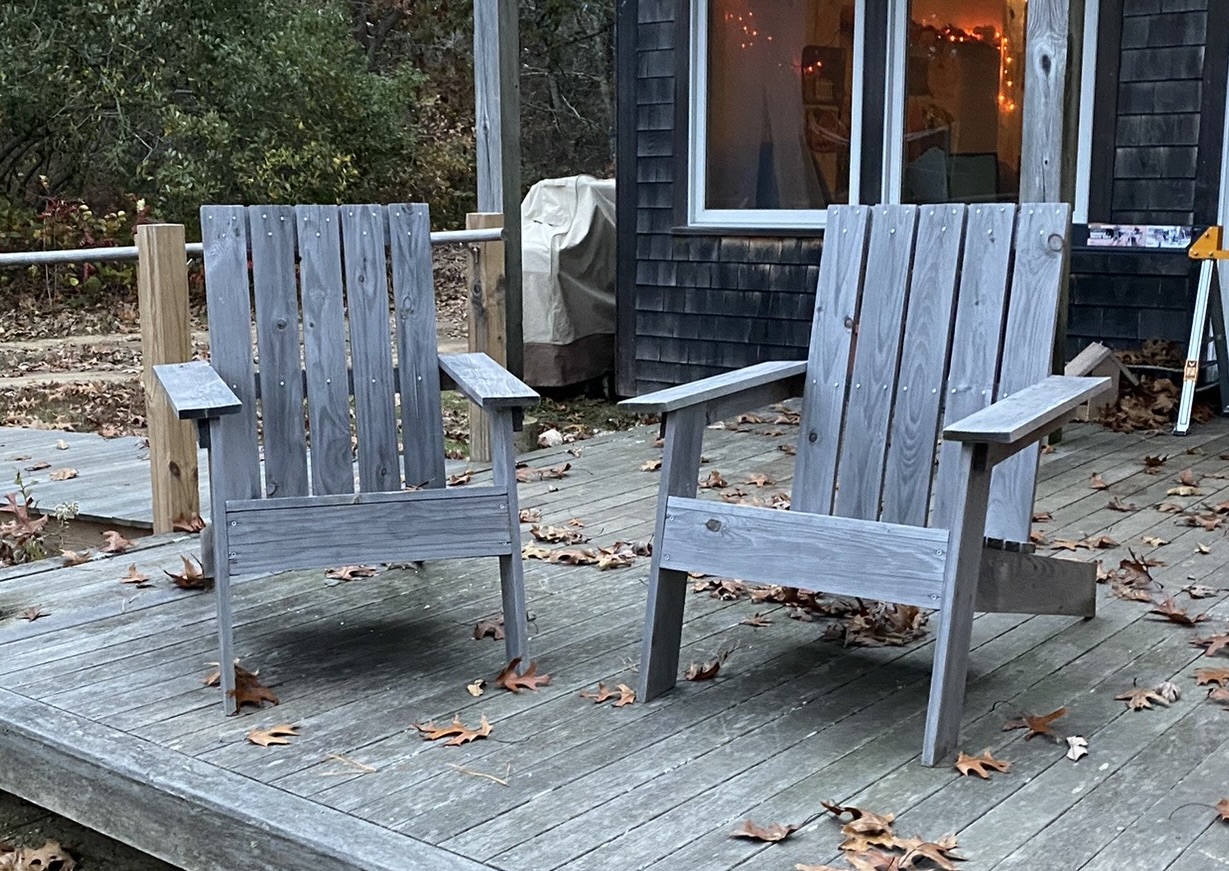
The granddaughter of a friend of mine is a college-bound junior, but she’s taking a carpentry class at her high school. My friend tells me she’s already built two Adirondack Chairs and a bench on her own, and working with a team of other young women, a shed. (She’s almost as proud of her work as he is!)


Pamela Paul, an Opinion writer for The New York Times, wrote a fascinating piece on this subject early in October. I urge you to read the entire article, and perhaps these excerpts will push you to read it in its entirety.
She writes: “First, to state the obvious: Kids need a break. The advantages of getting up from one’s desk — standing, walking around, going outside, taking 15-minute breaks — are well known to adults, especially for people who spend much of their days on screens. Yet we don’t extend the same courtesy to schoolchildren. An hour or two each week grappling with wood planks or mixing batter can leaven a long and monotonous school day.”
AND
“Educators may extol the value of collaboration and its desirability in today’s workplace, but in school, those lessons rarely extend beyond the confines of a Google Doc. Whereas in home economics, collaboration means taking turns cleaning up and requires social skills to determine who does what and how. Working with one’s hands also rewards patience. Kids accustomed to immediate results and instant gratification must grapple with the tedium and rewards of slower processes; even the best math and chemistry students don’t automatically bake a bread that rises.”my
My friend Tony Wagner, the distinguished scholar, sent me an interesting and important piece about career readiness in other countries by Sam Abrams of Teachers College, Columbia, with particular attention to Finland. It’s well worth your time. Among the points: “U.S. vocational education does not compare to the Finnish version. While 40 to 45 percent of students at the upper-secondary level in Finland attend vocational schools, only 5 percent do so in the U.S. While Finland spends 1 percent of GDP on job training, the U.S. spends only 0.1 percent.”
Our children live under intense pressure today, which many try to escape by consuming–social media, video games, fast food, alcohol, and drugs. Why not teach them the joys of producing, not consuming?
Making stuff–whether it’s an Adirondack Chair or a Soufflé–those are accomplishments, which should be understood as the successful completion of an activity that one has chosen to undertake–i.e. your choice, your challenge, your risk, your possibility of failure, and your success. Unfortunately, many young people today are under intense pressure to compile a list of achievements, to build a resumé that will impress others. As Adam Gopnik puts it, “Achievement is the completion of the task imposed from outside — the reward often being a path to the next achievement. Accomplishment is the end point of an engulfing activity we’ve chosen, whose reward is the sudden rush of fulfillment, the sense of happiness that rises uniquely from absorption in a thing outside ourselves.“
When Henry David Thoreau observed that ‘The mass of men lead lives of quiet desperation,’ he meant that their empty lives were a result of unfulfilling work, lack of leisure time, and misplaced values. Today, rather than railing against the modern world, let’s do something about it.…in our schools. With some simple changes in public school curricula, we can enable young people to take control of their lives, by creating opportunities for them to ‘make stuff.’
(Here are links to the previous steps: Looping, Play, Practice Democracy, Business Cards for Teachers, Involve Outsiders, Multiple ‘Talent Nights’, Extended Homeroom, Ask the Right Question, “Education Grand Rounds”, and Looping (revisited).)
 The Merrow Report
John
LikeLike
John, I suggest you use the performand of students instead of schools. They are not in competition. It’s each student improvement. The rest is confusing.
LikeLike
I am confused by what you have written. Can you try again? Thanks
LikeLike
Sent from my iPad
<
div dir=”ltr”>
<
blockquote type=”cite”>
LikeLike
What does this mean?
LikeLike
Read “performance” instead of the typo made “performand” which I doubt is a word, but like you, I am not sure…..thanks, Tom
LikeLike
John, I love #11. We have lots of “stuff” around our house th
LikeLike
Not only should kids have the opportunity to “make something, but everyone should be required to immerse themselves in the arts. Art and music are always the first to be cut. The kids who learn to make something are generally those who don’t do well academically. I sure wish I had learned to repair a car !
Unfortunately the measure of success has become how much money you earn, not the joy of making something , singing something or painting something.
LikeLike
[…] (The Previous Steps: Looping, Play, Practice Democracy, Business Cards for Teachers, Involve Outsiders, Multiple ‘Talent Nights’, Extended Homeroom, Ask the Right Question, “Education Grand Rounds”, Looping (revisited), and “Making Stuff”) […]
LikeLike
From the great Hank Levin, now at Teachers College, Columbia: “I agree completely. The only thing that I would add is that making stories, articles, and books is also making something. I had the same kind of shops that you did, but we need to broaden the making things definition to extend into all facets and subjects in education.”
LikeLike
[…] Your Community is one route to engagement, and I believe that many of my other suggestions, such as “Make Stuff,” will also help young people become productive participants in their own […]
LikeLike
[…] consider some of my earlier suggested changes, including Extending the Homeroom Period (#7), Making Stuff (#11), and Serving Your Community (#13). A longer homeroom period will give students more time to […]
LikeLike
[…] “Making Stuff”. There’s nothing more satisfying that creating something useful. Bring back […]
LikeLike
[…] 10) “Making Stuff”. There’s nothing more satisfying than creating something useful. Bring back wood shop! […]
LikeLike