WHAT’S MAKING OUR CHILDREN OBESE?

Summer is upon us, which means an increase in street crime and ice cream consumption. However, neither one causes the other; they are both highly correlated with summer’s heat, which brings more people out of their homes and onto the streets, where some eat ice cream and some get mugged. Correlation is not causality.

Here are two more facts to ponder: American children take lots of standardized, machine-scored, multiple-choice tests, and they are getting fatter. Is this just another correlation, or could one be a cause of the other? Could excessive testing be at least partially responsible for the increase in child obesity?

What makes this issue complex are two other variables, an increase in poverty and the disappearance of school recess.  This sad and entirely avoidable situation also illustrates the unfortunate truth of the maxim, “What we don’t care enough to measure does not matter.”

No question that obesity is on the rise. An astonishing 18.5% of American youth ages 12-19 are obese, and 5.6% are severely obese. If we include children who are overweight but not necessarily obese, the situation becomes direr. “31% of children ages 10 to 17 were categorized as overweight or obese. This statistic varies slightly by gender, with boys more frequently affected than girls (33% of boys versus 29% of girls).” That study by the Annie E. Casey Foundation ranks states, ranging from Rhode Island’s 39% to Oregon’s 16%. One more number from that study: Nearly half (47%) of American children do not exercise regularly.

Seven out of 10 overweight adolescents grow up to be overweight or obese adults, and the consequences are grim: high blood pressure, high cholesterol, abnormal glucose tolerance, heart attacks, and diabetes. The latter often means other serious health issues like blindness and early death; diabetes and its complications kill about 200,000 Americans every year.

Poverty and obesity are positively correlated, unfortunately. The poorer a child is, the more likely he/she is to become obese. “For a long time researchers have tracked high rates of obesity among black and Hispanic kids, but a closer look at communities shows family income matters more than race in predicting which kids are overweight.” Based on data about 111,799 Massachusetts students in 68 school districts, a study by the University of Michigan Health System showed that as poverty rises, so does the rate of obesity among children.

Testing is also increasing, making American students the most tested in the world. As Harvard’s Dan Koretz, author of “The Testing Charade: Pretending to Make Schools Better,” told me in an email, “Just the requirements in reading and math under the Every Student Succeeds Act mean being tested 14 times, and that’s the tip of the iceberg in many locations because of all of the interim and benchmark testing.” He added that countries with a reputation for being test-centric, such as Singapore, test students only two or three times during a student’s years in school.

Like obesity, testing correlates positively with poverty: the poorer a child, the more time he/she will spend being tested or practicing test-taking. According to a 2016 survey of teachers, Listen to Us: Teacher Views and Voices, 26 percent of teachers devote more than a month to test prep, and “A greater share of teachers in high- and medium-poverty schools reported spending more than a month on test-prep activities for district and state tests.” That’s at least one-eighth of the school year, and, since it all comes at once, it must seem like an eternity to those low income students and their teachers.

So, we have lots of overweight kids taking lots of standardized tests, but here’s where it gets interesting: Because the length of the school day is fixed, in order to increase testing and test-prep time, schools had to eliminate something. Sometimes the arts and science were slashed, but often the first to go was free play time, a.k.a. recess. The pressure to improve standardized test scores was particularly intense in low income communities, which fixated on ‘the achievement gap.’ Atlanta, for example, eliminated recess entirely. ”We are intent on improving academic performance,” Superintendent Benjamin O. Canada, told The New York Times in 1998. ”You don’t do that by having kids hanging on the monkey bars.”

(Incidentally, the no-recess policy was continued by Canada’s successor, Beverly Hall. During her tenure APS was engulfed in a massive cheating scandal. Here’s an irreverent question: Does lack of recess for children merely correlate positively with cheating by adults? Or is it a cause?)

The disappearance of recess is a plausible explanation for the epidemic of childhood obesity. Of course, there are other culprits, including too much screen time and fast and processed food, but lack of exercise–remember, 47% of children don’t get regular exercise–plays a huge part.

Unlike obesity and testing, recess time is negatively correlated with poverty. Simply put, richer children get more time on the playground. The poorer the children, the less time on the playground. And, sadly, cutting recess does double damage to many inner city kids, whose parents are loath to let their young children play outside after school because of dangers, real and perceived. So no play time at school may mean no daily exercise at all.

A chain of causality seems to be emerging: Excessive testing causes cuts in recess, which then contributes to widespread obesity, and poverty makes everything worse. That’s merely speculative, so let me suggest a fact-based alternative chain: Regular recess leads to better physical and mental health (i.e., no obesity and better academic performance).

And that’s not speculation, causing one to wonder about the mental acuity of educators who did away with recess. How could they not know that regular exercise pays dividends, that it reduces the risk of obesity, provides socializing opportunities, and promotes mental agility and improved academic performance? Don’t the recess-cutters understand that improved physical fitness is positively correlated with better performance on standardized tests and higher grades? As the experts put it, “Studies have found that lifestyle changes and small amounts of weight loss in the range of 5-10% can prevent or delay the development of type 2 diabetes among high-risk adults. Lifestyle interventions including diet and moderate to intense physical activity (such as walking for 150 minutes per week) were used in these studies to produce small amounts of weight loss. The development of diabetes was reduced by 40% to 60% during these studies, which lasted three to six years.”

Another intervention study found that providing overweight children with 40 minutes of physical activity increased cognitive scores. School-based physical activity can improve students’ attention, concentration, and ability to stay on task. And kids who get to run around and burn off energy behave better in class.

The World Health Organization says children need 60 minutes of moderate to vigorous physical activity every day, a goal that regular recess at school could help achieve. Unfortunately, most public schools do not provide recess. Only 11 states require either recess or “general and physical activity” during the school day. New York is not one of them, but the New York State Education Department does have a PE requirements of 120 minutes per week. Physical education must be taught by a certified teacher who provides instruction according to New York State PE standards, but, even if recess is provided, it doesn’t count toward that 120 minutes per week.  In the District of Columbia, the Central Office has a “Wellness Policy” calling for at least one 20-minute recess period per day for ‘child-initiated discretionary time,’ but it’s not clear whether schools actually adhere to this, or if there are consequences for not falling in line.  Students in Texas get on average only 20 minutes of recess per week, a decline of over an hour since 2001, which was the year the test-focused No Child Left Behind became federal law.

We’ve known about the importance of regular exercise for a long time. Presidents from Dwight Eisenhower on promoted physical fitness among young people. Ike established the President’s Council on Youth Fitness in 1956. President John F. Kennedy famously took 50-mile hikes to promote exercise. Lyndon Johnson created a special award for 10-17-year olds, the Presidential Physical Fitness Award, and enlisted baseball superstar Stan Musial to attract attention to the cause. Under Ronald Reagan we got a postage stamp honoring physical fitness. And so on.

These campaigns about the value of exercise had no appreciable impact on schools, which generally don’t respond to exhortations, only to pressure. Our schools report only what we tell them to measure, and society’s consistent message has been: Tell us your test scores!   Those scores, generally speaking, are the only educational measurement with real consequences, and they are used to reward and punish educators, schools, and students.

Assuming that no one wants children to become obese or even overweight, schools must provide regular recess, but that won’t happen unless it’s mandated and measured. Instead of just providing test scores, schools must be required to report the answers to two more consequential questions: “How many hours of recess do students have each week, and in how many separate segments?” We should provide incentives (such as playground repairs where needed) and at the same time make it clear to principals that if they fail to provide recess, they will be penalized. Before long, more children will be out on the playground or in the gym, playing.

But this will not happen until recess is both mandated and measured.

While how much recess children should have, and how many times each day, are local decisions, educators might want to look to other countries for examples: As the USPlay Coalition explains, “Japanese children get 10-20 minute breaks between 45-minute lessons or five-minute breaks and a long lunch. Finnish and Turkish children have 15 minutes to play after each 45 minutes of work. Ugandan students have an eight-hour school day, but they have a half hour of play in the morning, one hour for lunch and play, and 1.5 hours of activity time (sports, music, art, free-choice playtime) in the afternoon.”

Establishing that recess matters–with incentives for success and consequences for not measuring up–sets an interesting precedent. Perhaps we should also ask ourselves what else besides academic performance and recess matters. If we decide that art, music, and drama are important, let’s insist that schools provide them and then take pains to measure the hours of opportunity students have to pursue them.

Measuring academic achievement is clearly important, but the academic health of a school can be determined by testing a well-drawn sample of students. We can test less and still know what we need to know. Not all students need to be tested every year, as long as teachers are deeply involved in assessing student progress. Instead of practicing test-taking and taking lots of standardized tests, students could be playing, reading, writing, doing original research, and working on projects.

Excessive testing doesn’t cause obesity directly, but it has led schools to reduce or eliminate recess, which has in turn contributed to the rise of weight problems. Unfortunately, poverty correlates with excessive testing, weight problems, and reduced recess, meaning that poor children once again draw the short straw.

If we hold schools accountable for both academic results and hours of free play, educators will be forced to cut back on testing and test-prep drilling. That simple change—call it “Measuring What Matters”–is a sensible education policy that should also produce measurable health benefits. And since kids who get to exercise regularly tend to do better academically, we should also see improvements there as well.

Bottom line: This is totally on us!  If we truly want healthier children, we have to cut back on testing and test-prep and bring back recess and free play.


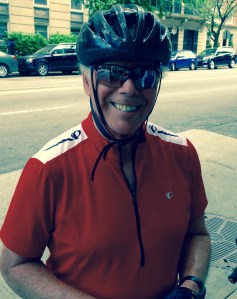
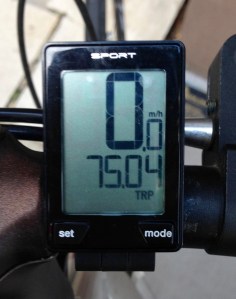
Mission Accomplished:77+ miles=$85,000+

A picture is worth 1,000 words:

2018(77)

So, Mission accomplished.  But, wait, here’s one more photo I want you to see:

2018 (83)

I biked an extra six miles because I got carried away by the beautiful day and a very flat course with a tail wind.  My birthday is tomorrow, but I moved the ride up two days based on weather reports. I began at 7AM and had the old ‘rails to trails’ path pretty much to myself.  Meaning few other humans.  Lots of wildlife: I passed a mother goose and her eight or nine goslings; a yearling deer who stayed motionless on the bike path as I glided by, maybe 3 feet from it; a woodchuck; swans; innumerable chipmunks and rabbits; and this majestic egret.

Heron 2018

One swan is barely visible from this old railroad bridge

Swan 2018

Perhaps 6 miles of the entire 83 mile ride are NOT bucolic, wooded, and peaceful;  occasionally there’s evidence of the old railroad system.

rails2 2018

Here’s what really matters: Based on what folks have reported to me, readers have pledged or donated more than $85,000 to various organizations and political candidates.  Planned Parenthood seems to be a favorite, along with the Network for Public Education.  Joan and I donated to Planned Parenthood, NPE, and Jesse Colvin’s campaign for the Congressional seat in the First District of Maryland (take a look if you have time.)  Some of you reported giving to two or three organizations.  One large donation to Tougaloo College, an HBCU, skewed the results, and I am certain that the donor, a writer friend, would have made his gift anyway, but he said he was linking it to my bike ride and urged me to include it in the total, which I have done.

(I hope those of you who pledged $77 will now round up. May I suggest $100.)

Now, to get into the weeds about my ride: I averaged 12.7 miles per hour, a decent pace for someone about to enter his 78th year of life, I think.

AVG 2018

I started riding at 7AM and finished seven and a half hours later, but that included two snack breaks, lunch, and a trip to the bike store in Yorkville Heights to replace my sunglasses (which broke, the only negative).  My total biking time was 6 hours, 28 minutes, and 23 seconds, according to my odometer.

total time 2018

I barely made it to sunset before crashing; I slept from 9PM until 6:30 this morning.

Thanks for indulging me, for reading, and for donating to a worthy organization (or two or three).  I feel blessed for being alive and healthy, but now let’s back to the serious business of rescuing public education and our children from two distinctly different groups, Betsy DeVos and her supporters and the test-obsessed corporate reformers.


Are 77 Miles On a Bike Worth $77 To You?

Friends

On June 14th, my birthday, I will once again attempt to bike my age, and this time I have a question for you: Would my 77 mile ride, if I make it, be worth $77 to you?  If I do manage to make  it, will you make a charitable donation in that amount (or larger, if you prefer)?

This will be my 8th year in a row of attempting to bike my age, and the first seven have turned out well.  

Here’s the back story. I began doing this in 2011, the year I turned 70.  For reasons I cannot recall, I decided to bike a Century to celebrate the occasion. And I made it!

DSCN0587.JPG

A Century every year?  That was a ridiculous goal, and so I decided on a different and hopefully more manageable goal: Every birthday I would bike my age. Which I did on June 14th, 2012.

2011(71)

The next year, Flag Day, 2013, I managed the required 72 miles…with a smile. (I have two road bikes, which is why you see two different odometers.)2012(72)DSC02826.JPG

The following June 14, I forgot to stop to take a picture at mile 73. I ended up biking an extra 1.66 miles (in the bank, credit for the inevitable tough year?).

2013(73.did74)

On June 14, 2015, I once again forgot to take the photo at the proper mile mark (another 1.49 miles in the bank).  My good friend Mike Joseloff rode with me.

2016(75)IMG_3539

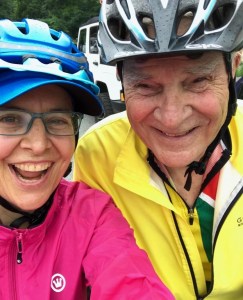
In 2016 Mike rode with me again, this time for 75 miles, and we remembered to take the photo at the right time!

2014(74.did75)IMG_3541

Last June 14th my daughter Elise rode with me–and she did the entire 76 miles on a folding bike!

2017(76)w: Elise 2017

So here’s my question for you, as June 14th, 2018 approaches: will you make a tax-deductible donation to a worthy cause if I manage to bike 77 miles?  Where you donate is up to you, of course, but let me suggest three vitally important organizations, all of which could use your financial support:   Planned Parenthood; BATS, the Badass Teachers Association; and The Network for Public Education (NPE), an organization founded in 2013 by Diane Ravitch and Anthony Cody.   

Alternatively, you might consider making a contribution to a progressive running for office in the November election.

If you want progress reports, follow me on Twitter: @John_Merrow.  I promise to post the outcome, no matter what…..

Next year I may decide to follow the sensible advice a young nephew gave me: “Uncle John,” he said, “It might be time to switch to kilometers.”

To be honest, there are mornings when I feel like switching to yards!  But just yet, not in 2018 anyway.

Please wish me luck, and thanks for donating………


The Best of Days, The Worst of Days

June 6th, 1968, began as perhaps the best day of my life. The previous afternoon my wife and I had brought our first-born child home from the hospital, and we went to bed awe-struck by the miracle of a new life.  Both political junkies, we had also watched election returns on our small black-and-white TV before falling asleep well before midnight, long before any hard news from California.

We awoke with our son on June 6th, still overwhelmed with joy….until I turned on the television to find out that Robert Kennedy was dead. He had been murdered in a Los Angeles hotel kitchen, just after accepting the cheers of his supporters, just after winning the California Democratic primary, just after taking a giant step toward winning the Democratic nomination for President of the United States.

Two months earlier, another assassin had murdered Dr. Martin Luther King, Jr. in Memphis, Tennessee.  That killing had prompted me and some friends to drive through the night from Bloomington, Indiana, to Memphis for the memorial march. The killing of RFK undid me, and many millions like me.

Those two murders poisoned our political process. They paved the way for violence at the 1968 Democratic convention in Chicago, the election of Richard Nixon, his escalation and prolonging of a senseless war in Viet Nam, and government’s retreat from efforts to end segregation and racial discrimination.

Have we recovered?  The evidence suggests we have not: The hyper-rich .001%, phony patriotism from a self-focused President, a pliant Congress, a polarized nation, looming trade wars, and a rapidly warming planet.

Where are the voices calling to our better angels? I do not hear any of Trump’s opposition saying anything that even remotely resembles JFK’s, “Ask not what your country can do for you. Ask what you can do for your country.

Instead, Trump’s opposition panders to voters with calls  for”Free College” and the like, as if anything in life were free. Bobby Kennedy reminded us that those born with advantages had an obligation to work to improve the lives of others. He made us believe that we could do better and be better, and, because of him, we did and we were.

Bobby Kennedy appealed to our better angels, and we miss him still.

Public Schools and Donald Trump

It’s an open secret that Donald Trump and his administration are not friends of public education.  His choice for Secretary of Education, Betsy DeVos, has scant understanding of, and even less appreciation for, the contributions that public schools, imperfect though they are, have made to our nation.

And while I hope you are registered to vote and are supporting progressive candidates who can take back our country, gaining control of both Houses of Congress won’t be enough to make America respected again.  We must make major changes in the basic structure of our public schools because schools are partially responsible for the fix we are in. Not the changes Secretary DeVos wants, but radical changes nonetheless.

Because, irony of ironies, it was public education’s deeply flawed “sorting” machine that helped Trump get elected.  Let’s start with who would have won the 2016 presidential election.   Approximately 130 million voters went to the polls in 2016. Clinton received 65,844,954 votes to Trump’s 62,979,8790, but more than 100,000,000 Americans of voting age did not cast ballots.  In fact, if “not voting” had been a choice, it would have won the popular vote in every presidential election since at least 1916.  While many thousands of adults have been disenfranchised by virtue of criminal records, Americans generally have a bad habit of not voting.  The turnout in what we like to believe is “the world’s greatest democracy” generally hovers around 53 to 54 percent. It has dipped below 50 percent three times since 1916, most recently in 1996, when only 49.1 percent of the voting age population bothered to vote.

Who are these non-voters? Rather than scorning them for their indifference, I have come to believe that most non-voters are behaving rationally.  Feeling that they have no stake in our government, they don’t vote. And why should they?  Schools taught them that they were insignificant, and so, as adults, they keep their heads down and stay uninvolved.

Yes, I am holding public schools at least partly responsible for low voter turnout, because public education, an efficient sorting machine, is undemocratic to its core. Schools sort young children in two basic groups: a minority of “winners” who are placed on a track leading them to elite colleges, prominence, and financial success–and everyone else. While the majority aren’t labeled “losers” per se, they are largely left to struggle on their own. That experience leaves many angry, frustrated, and resentful, not to mention largely unprepared for life in a complex, rapidly changing society. Why would they become active participants in the political process, an effort that is almost always led by the now grown-up “winners” from their school days?

Although formal tracking has fallen out of favor, schools have subtle ways of designating winners and losers, often based as much on parental education and income, race, and class as innate ability. By third or fourth grade most kids know, deep down, whether the system sees them as “winners” bound for college or “losers” headed somewhere else.

Ironically, A Nation at Risk, the 1983 report that warned of “a rising tide of mediocrity,” may have made matters worse. In response, America put its eggs in the basket of student achievement—as measured by student test scores. Believing we were raising academic standards by asking more of students, we were in fact narrowing our expectations. This practice went into high gear with the passage of the No Child Left Behind Act of 2001 and continued throughout the Bush and Obama Administrations. What I call “regurgitation education” became the order of the day. This approach rewards parroting back answers, while devaluing intellectual curiosity, cooperative learning, projects, field trips, the arts, physical education, and citizenship.

This fundamentally anti-intellectual approach has failed to produce the results our nation claims to desire. Scores on our National Assessment of Educational Progress (NAEP) have largely remained flat and in some instances have gone down. What’s more, students aren’t even retaining what we are demanding they regurgitate. For example, a survey reveals that one-third of Americans cannot name any of the three branches of our government, and half do not know the number of U.S. senators.

Reducing kids to test scores has produced millions of high school graduates who did not  develop the habits of asking questions, digging deep, or discovering and following their passions. Largely because of how they were treated in school, many Americans have not grown into curious, socially conscious adults. This is not the fault of their teachers, because decisions about how schools operate are not made in classrooms. It was school boards, politicians, policy makers, and the general public that created schools that value obedience over just about everything else.

But the end result is millions of graduates who were rewarded with diplomas but have never participated in the give-and-take of ordinary citizenship—like voting.  During the 2016 campaign, Donald Trump welcomed support from those he called “the poorly educated,” but that’s the incorrect term. These men and women are not “poorly educated,” “undereducated,” or “uneducated.” They have been miseducated, an important distinction. Schools have treated them as objects, as empty vessels to pour information into so facts and figures can be regurgitated back on tests.

The sorting process used in schools has another result: it produces elitists (in both political parties) who feel superior to the largely invisible “losers” from their school days. Arguably, those chickens came home to roost in the 2016 presidential election. Candidate Clinton’s calling Trump supporters “A bucket of deplorables” was a gaffe that probably cost her the election. However, in all likelihood she was speaking her personal truth, because, after all, her schools had identified her as a “winner,” one of the elite. It’s perfectly understandable that she would not identify with the people who had been energized by Donald Trump. Most pundits, reporters, pollsters, and politicians fell into the same trap.

Sorting is inevitable, because students try out for teams and plays, apply to colleges, and eventually seek employment, but we must learn to postpone sorting for as long as possible. A new approach to schooling must ask a different question about each young child. Let’s stop asking, “How intelligent are you?” Let’s ask instead, “How are you intelligent?” That may strike some as a steep hill to climb, but it’s essentially the question that caring parents, teachers, and other adults ask about individual children. They phrase it differently, asking, “What is Susan interested in?” “What gets George excited?” “What motivates Juan?” or “What does Sharese care about?” Every child has interests, and those can be tapped and nurtured in schools designed to provide opportunities for children to succeed as they pursue paths of their own choosing. Giving children agency over their education—with appropriate guidance and supervision—will produce graduates better equipped to cope with today’s changing world. And a larger supply of informed voters.

While the country can survive four—perhaps eight—years of Donald Trump, our democracy must have schools that respect and nurture our children. If we don’t change our schools, we will elect a succession of Donald Trumps, and that will be the end of the American experiment.

(I expand upon these themes at greater length in Addicted to Reform: A 12-Step Program to Rescue Public Education.)


John Merrow’s Idea to Rid Schools of Standardized Tests is Compelling and Saves Millions of Dollars!

Network Schools - Wayne Gerseny to https://www.nytimes.com/interactive/2022/04/03/magazine/thomas-piketty-interview u w B l.html?h I’ll smid=url-share the Is for

Diane Ravitch wrote a post yesterday that was click-bait. It was titled “If you could could make one change…“, the titled derived from a question John Merrow asked some dinner guests, which was this:

If YOU had the power to make ONE major change in American public education immediately, what would you choose to do?”

In Mr. Merrow’s post that posed this question his dinner guest gave responses like doubling spending on public schools, making spending more equitable, expanding early childhood programs, and a commitment to the UN’s Universal Declaration of Human Rights. And what was Mr. Merrow’s response?

At that point everyone turned to me, and, even though I am much more comfortable asking questions than answering them, I plunged ahead. “I would eliminate standardized testing.”

Everyone seemed shocked.  Including me.  Never before had I expressed that thought. To the contrary, like most critics of testing…

View original post 289 more words