In a recent tweet, I wondered aloud about what we should be thankful for in education (a similar discussion happened before Thanksgiving on the Learning Matters website). I got a variety of responses, including:
Students who are hungry to learn;
Parents and other family members who work in concert with teachers to support effective learning;
Growing collaboration between School Boards and Unions, often made possible by foundation grants;
A rich and broad variety of well-written blogs that assist in solving problems;
Research and documentation of pedagogy and materials that have a positive impact on learning; and
The Internet itself, which allows teachers to connect and support each other.
That’s a nice list. However, although I am basically a ‘glass half-full’ personality, it’s hard to be cheerful given what we are doing in public education. While I was in California last week, a friend in Palo Alto told me that his daughter was one of 40 students in her high school math class, one of 38 in her history class. In Palo Alto, one of the state’s richest communities! Our 2005 documentary history of California education, “First to Worst,” is due for a sequel, “First to Burst.”
Or take the U.S. Department of Education. It seems to me that the push for higher standards, the emphasis on early education, and the support for developing common tests are all positive. But, with its other hand, the Department is supporting more cheap and dumbed-down testing when it encourages grading teachers based on bubble test scores. Now, I know someone will tell me that I am misrepresenting Arne Duncan and send me quotes from his speeches, but I think we are past listening to what’s being said, and into actually watching what’s being done.
What should inspire this reaction in education?
I would be happier if the Department supported policies that rewarded entire schools, not individual teachers, because education is a team sport. After all, federal legislation punishes entire schools for not making ‘adequate yearly progress.’ So why not create some carrots to go along with the stick? How about ‘OYP’ for ‘Outstanding Yearly Progress?’
In California last week at a 1-day meeting about “next generation” assessments, I was struck by the richness of what’s being developed in New York, Ohio, California and elsewhere. In these approaches, project-based learning leads to complex and comprehensive assessments. The logic is clear: kids will dig deep into subjects, and the assessment that follows will respect their efforts. In this (future) world, simple bubble tests will be trumped by assessments that are also learning experiences.
Right now, however, bubble tests rule. Teachers spend as much as one-sixth of their time getting kids ready for the test, administering the test and test makeups, or going over the test. Imagine that: 30 out of 180 days on testing stuff, days that could be spent on learning and teaching. New York State just announced plans to expand testing, so that third graders will now take a 3-hour reading test, and Washington, DC, has announced its intention to give standardized exams to second graders!
We won’t get to a brighter future until we figure out ways to turn our backs on the idiocy of the current system–while keeping our focus on achievement and accountability.
A final note of thanks: Learning Matters has received a challenge grant that will give us $100,000 if we can raise $100,000. Right now we are about $40,000 shy of the goal. If you want to help, click here. Invest $20 or $100 or an amount of your choice, and I promise you will get that back tenfold in quality reporting.
If you live in or around NYC, John will be appearing in conversation with Randi Weingarten — the topic is “Unions and the Future Of Our Schools” — on Wednesday, December 14. Click here for tickets and info.
One benefit to my being a reporter is the opportunity to spend time with people who know more than I do. I had breakfast recently with Marshall “Mike” Smith, the Undersecretary of Education in the Clinton Administration, and our conversation inspired this blog post.
The assertion that our teachers come from ‘the bottom third’ has been in the air for some time. New York Mayor Michael Bloomberg seems to believe matters are worse than that, because he recently told a press conference that most came from the bottom 20 percent of college graduates.
In a recent post, Matthew Di Carlo of the Shanker Institute provided a credible analysis of the studies that seem to be the basis for the claim. Di Carlo says that two studies by McKinsey & Company provide the underpinnings for the assertion, and I suggest you read his analysis. One of the McKinsey reports asserts that almost 50% of US teachers come from the bottom third of college graduates, as defined by SAT scores (Other studies have debunked any link between SAT scores and teaching effectiveness, but that’s another story).
The data in these two reports have taken on a life of their own. For example, The Christian Science Monitor editorialized on March 17: “For starters, the United States needs to increase its pool of quality teachers. Almost half of its K-12 teachers come from the bottom third of college classes. Classroom leaders such as Singapore, South Korea, and Finland select from the top ranks. In Finland, only 1 in 10 applicants is accepted into teacher training.”
Where are our teachers coming from?
But even if most teachers come from the bottom two-thirds of college graduates, just what does that mean? Let’s do the math.
Begin with 100 eighth graders. After seven years (not five), how many will have earned high school diplomas or an equivalency degree?
Let’s be generous and say that 88 of 100 will have that credential.
Of those 88, how many will continue on with their education? Suppose 65 go on to a 4-year or a 2-year institution. After six years (not four), how many will have earned a 4-year degree and thus possibly be eligible for a teaching position?
Again, let’s be generous and say that 32 of 100 will have earned degrees.
That’s the group we draw our teachers from, and that suggests that our teachers come from the top 32% of our population, even if they are not at the top of that particular pyramid.
So our teachers come from an elite group — college graduates — to begin with. Where they rank within this elite is the issue, and it’s simply unfair to suggest that a large group of people in the top third is somehow fundamentally flawed.
Why does this matter? Precisely because one proposed ‘solution’ to our education crisis is ‘better people.’
Could teacher training be improved? Could working conditions be improved? Could starting salaries and the bizarre compensation system that back-loads rewards be improved? Yes, yes and most definitely yes.
Let’s devote our energies to real problems and their solutions, not to ad hominem attacks on an entire profession.
Quick programming note: if you’re in or around New York tomorrow evening (Dec. 14), I’ll be appearing live in conversation with Randi Weingarten of the AFT. Here are some details. I’d love to see some of you there.
And of course, if interested in the above topics of teacher quality and training, I suggest you consult the Learning Matters site here and here. We produced a piece recently presenting some numbers about the teaching profession in quiz format; you can view that below (it’s great if you’re a wonk).
If you live in or around NYC, John will be appearing in conversation with Randi Weingarten — the topic is “Unions and the Future Of Our Schools” — on Wednesday, December 14. Click here for tickets and info.
Some years ago, when I still believed that I was a pretty clever fellow, I dreamed up a campaign to persuade young people to stay in school. What inspired this brilliant idea was daily sightings of adults standing at intersections wearing signboards advertising one thing or another. This was, to my eye, the ultimate low-skill job because it required absolutely no mental effort and hardly any physical work. I hypothesized that the workers must have dropped out of school.
So I thought about taking photographs of the sign-wearers, blurring their faces, and then creating posters with a slogan something like “It’s your choice. Stay in School or …” with an arrow pointing to the poor guy wearing the sign.
Great message to youth, I figured, because no one could aspire to that work, and the threat of being able to get only that sort of job would be a powerful motivator.
Luckily, I did not do anything impulsive about my brilliant idea. Instead, when I replayed those images in my mind, it dawned on me that almost all of the sign-wearers were brown-skinned men and women. They might have been new arrivals to northern California and working at the one of the few jobs available. Or, a more frightening thought, they might have been dropouts from a California high school or middle school.
Can a simple camcorder be the beginnings of a new wave in education?
Sure enough, the Hispanic dropout rate turns out to be significantly higher than that of any other group. In 2010 the Pew Hispanic Center, a nonpartisan research organization, released the report “Hispanics, High School Dropouts and the GED.” It found that 41% of Hispanic adults age 20 and older in the United States do not have a regular high school diploma, compared with 23% of black adults and 14% of white adults.
Their reasons for dropping out were complex, as likely to involve school failure as economic imperatives, lack of family support or expectations, and language barriers (meaning teachers, administrators and support staff who did not speak or understand Spanish).
Suddenly my notion of a ‘stay in school’ campaign seemed to be a classic case of oversimplification and ‘blaming the victim.’
Forget my not-so-brilliant idea. What we need is not a(nother) simple-minded ‘Stay in School’ campaign aimed at the kids but a more sophisticated campaign, aimed at both youth and adults. Call it ‘Succeed in School.’ And it shouldn’t be all about how much more money you earn if you get a high school diploma, but instead about ways to succeed and ways to help others succeed. Small steps, or what B.J. Fogg of Stanford calls “Tiny Habits.” Or as another thoughtful leader, Louis V. Gerstner, is wont to say, “No more forecasting rain; it’s time to build arks.”
What small steps and tiny habits are the building blocks of success? I have written about this in The Influence of Teachers, and deeper thinkers like Larry Rosenstock, Don Shalvey, Amy Valens, and Renee Moore have turned words into deeds, so I won’t go into this more deeply here but will ask you for your suggestions. What works to make kids be — and feel — successful?
I have one suggestion, however: help them make videos where community members recite poetry or prose. I wrote about this here, and now I have an example to show you:
In my last post (linked above), I wrote about how projects like this work on several levels. They teach real-world skills like production and cooperation; they give kids the satisfaction of seeing a project through from start to finish and sharing their work with a larger audience; and they demonstrate to the 80% of households without school-age children that great things are happening in our schools.
Small steps, tiny habits.
“Success is a Team Sport” is my nomination for the bumper sticker.
If you live in or around NYC, John will be appearing in conversation with Randi Weingarten — the topic is “Unions and the Future Of Our Schools” — on Wednesday, December 14. Click here for tickets and info.
We posted a new video at Learning Matters this week; it’s an attempt to review what we know about the American teacher force — and done in quiz format. Watch it now, embedded here. After the video, check out my thoughts on “the other one percent;” I had similar ideas published in The New York Daily News this week. If interested in some of these themes, I encourage you to purchase a copy of my book, The Influence of Teachers. All proceeds go to Learning Matters.
Let’s watch the video to test your knowledge:
And now, thoughts on “the other one percent.”
I’d like to begin by thanking my teachers in 5th, 6th and 7th grades, Mrs. Pulaski, Mr. Burke and Miss Elmer. They taught us percentages and showed us how to ‘round down,’ which I am doing now, because the US population is 312,624,000, and we have 3,198,000 public school teachers, which computes to 1.02%.
That’s right. More than one out of every 100 Americans teaches in our public schools.
What, you thought I was talking about Wall Street fat cats, professional athletes, entertainers and other rich people? (If interested in some thoughts on the intersection of business and education, you should listen to a new podcast we posted with Doug Lynch of UPenn.) That’s a different one percent, and I guarantee there’s no overlap between the two groups. The average teacher today earns about $55,000. At least 75 CEOs earn that much in one day, every day, 365 days a year. According to the AFL-CIO’s “Executive Paywatch,” the CEO who ranked #75, David M. Cote of Honeywell, was paid $20,154,012, for a daily rate of $55,216.47.
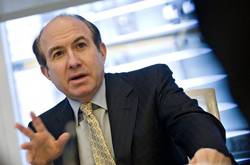
Philippe P. Dauman is not worried about his next meal.
The CEO at the top of the heap, Philippe P. Dauman of Viacom, was paid $84,515,308. My third grade teacher, Mrs. Krepela, taught me how to compute averages, so I can tell you Mr. Dauman earns a daily average of $231,549, which is more than four times what the average teacher earns in a year.
Unlike wages for teachers, CEO salaries have been soaring in recent years. Forty years ago, the average public school teacher earned $49,000, adjusted for inflation. That’s a raise of a whopping $150 a year for forty years, or about one quarter of one percent annually.
Here’s another way that the other one percent is different: teachers spend their own money on supplies for their classrooms. That came to $1.33 billion in school year 2009-2010, or $356 per teacher, according to the National School Supply and Equipment Association.
I will wager several packs of colored pencils that Mr. Dauman, Mr. Cote and the other high earners do not drop by Staples to pick up office supplies for their secretaries.
The teaching profession is often criticized because salaries are not based on performance, meaning that the best teachers earn what their less-than-stellar colleagues take home. While that’s generally true, it’s also changing fast. Twenty-four states now base teacher evaluation in part on student performance, and Denver, Washington, DC and other localities have created ‘pay for performance’ systems that reward individuals or entire schools when students do well. Connecting teacher effectiveness with student outcomes is the wave of the future, and it’s becoming easier to remove ineffective teachers than it was just a few years ago.
That doesn’t seem to be true on Wall Street and in corporate boardrooms, where the pay of the CEO is often at odd with his company’s performance. Take Cisco and John Chambers. The website 24/7 Wall Street ranks Chambers the most overpaid CEO, based on his total compensation of $18,871,875 even though the price of Cisco common stock fell 31.4 percent.
In fairness, some teachers are actually overpaid, because they have ‘retired on the job’ and are just going through the motions until they can retire for real. Of course, there’s a big difference between being overpaid at $55,000 and being overpaid at $20,500,000, which is what Carl Crawford of the Boston Red Sox earned for hitting .255 with just 11 home runs last season. Like the CEO of Honeywell, Crawford is earning about $55,000 a day, every day, 365 days a year. He ranks only 28th on the list of athletes, according to Sports Illustrated’s “Fortunate Fifty.”
As may have occurred to you, public school teachers — the group I am calling the other one percent — are actually part of the 99 percent. However, they probably were not occupying Zuccotti Park. At least not during the day, because that’s when they are otherwise occupied — teaching our children and grandchildren.
If you live in or around NYC, John will be appearing in conversation with Randi Weingarten — the topic is “Unions and the Future Of Our Schools” — on Wednesday, December 14. Click here for tickets and info.
Stop reading right now If you are a strong ‘back to basics,’ no-frills education person, because this column is about as far away as humanly possible from your notions of what should be happening in schools.
However, if you teach in high school or middle school — or if you are worried about the narrowing of the curriculum — please stay with me.
In a given month, between 30,000 and 40,000 people read this blog; I am hoping that at least a few of you are HS or MS teachers who are committed to the arts. Or perhaps non-teachers who share that enthusiasm and are in a position to help.
In a recent post about the threats to the arts in the schools, I suggested that we needed to ‘energize the 80,’ my shorthand for the need to get the 80% or so of households without school-age children involved in supporting public education.
A lot of you liked the idea, which was gratifying for a day or two — but now it’s time to do it. Or rather, for students to do it. I envision a squad of middle school or high school students, armed with a decent video camera, going door to door and persuading apartment owners and shopkeepers to look into the camera and recite poetry. A couple of lines each, to be edited together, with the speakers identified on the screen.
(For fun, we will get a couple of recognizable people — think pro sports stars, like Derek Jeter — to contribute as well)
There’s just one rule: the students must recruit adults who do not have school-age children. They are members of the 80 percent that have to be energized in support of the arts.
I ask you to imagine watching the video described below on YouTube (I’ve used characters from my Manhattan neighborhood, but you should picture folks from your world):
Mrs. Andrews in Apartment 9B:
To be, or not to be, that is the question:
Whether ’tis nobler in the mind to suffer
The slings and arrows of outrageous fortune,
Or to take arms against a sea of troubles,
And by opposing end them?
Mr. Young of Mr. Young’s Cleaners:
To die, to sleep,
No more; and by a sleep to say we end
The heart-ache, and the thousand natural shocks
That flesh is heir to …
Kimberly Wong in Apartment 17C:
… ’tis a consummation
Devoutly to be wished. To die, to sleep;
To sleep, perchance to dream …
Augie Ramos at the Deli:
… ay, there’s the rub:
For in that sleep of death what dreams may come,
When we have shuffled off this mortal coil,
Must give us pause – there’s the respect
That makes calamity of so long life.
Angela Packer at Equinox Gym:
For who would bear the whips and scorns of time,
The oppressor’s wrong, the proud man’s contumely,
The pangs of despised love, the law’s delay,
The insolence of office …
Jacob Epstein of Epstein Jewelers:
… and the spurns
That patient merit of the unworthy takes,
When he himself might his quietus make
With a bare bodkin?
Derek Jeter of the New York Yankees:
Who would fardels bear,
To grunt and sweat under a weary life,
But that the dread of something after death,
The undiscovered country from whose bourn
No traveller returns, puzzles the will,
And makes us rather bear those ills we have
Than fly to others that we know not of?
Fifth grader teacher Alice Gotteswold:
Thus conscience does make cowards of us all,
And thus the native hue of resolution
Is sicklied o’er with the pale cast of thought …
Richie O’Connor, 201 East 79th doorman:
… and enterprises of great pith and moment,
With this regard their currents turn awry,
And lose the name of action.
This could obviously be done for an assortment of literary elements.
Two roads diverged in a yellow online video, and that has made all the difference in education.
You can be certain every one of those performers will be boasting about their roles and urging others to watch. And, even more important, they will be shaking their heads in amazement at what school kids are doing these days. They will now be the schools’ advocates.
Shakespeare can be intimidating, but because everyone can relate to passion, I’d suggest the kids bring along Elizabeth Barrett Browning.
Vicki Hennigan, florist:
How do I love thee? Let me count the ways.
I love thee to the depth and breadth and height
My soul can reach, when feeling out of sight
For the ends of being and ideal grace.
Archie Samuels, counterman at Wrap ‘n Run:
I love thee to the level of every day’s
Most quiet need, by sun and candle-light.
I love thee freely, as men strive for right.
Victor Reynoso, 235 East 79th doorman:
I love thee purely, as they turn from praise.
I love thee with the passion put to use
In my old griefs, and with my childhood’s faith.
Peggy Sydak, age 83, in Apartment 21B:
I love thee with a love I seemed to lose
With my lost saints. I love thee with the breath,
Smiles, tears, of all my life; and, if God choose,
I shall but love thee better after death.
And Robert Frost is a natural. Here I would break apart the verses, divide them among performers.
Alfonso Gonfriddo, postal carrier:
Two roads diverged in a yellow wood,
And sorry I could not travel both
And be one traveler …
Amanda Morales, office manager:
… long I stood
And looked down one as far as I could
To where it bent in the undergrowth …
Joan Zrodowski, businesswoman:
… then took the other, as just as fair,
And having perhaps the better claim,
Because it was grassy and wanted wear …
Ted Bauer, web site developer:
… Though as for that the passing there
Had worn them really about the same …
Jerry Flanigan, owner of 81st Street Hardware:
… and both that morning equally lay
In leaves no step had trodden black.
Oh, I kept the first for another day!
Joe Quinlan, salesman:
Yet knowing how way leads on to way,
I doubted if I should ever come back.
The kids will quickly figure out the importance of videotaping each performer reading lines from several different poems, with multiple takes of each reading. They will figure out that doing it well will not be easy, but this is the real world, and their work product will be up there for all to see, up against lots of other student productions. A little competition is a good thing, particularly when it’s team competition.
I have stressed that these videos will build support for the arts, but it’s just as important to point out that the process will teach valuable lessons to the students. In addition to the obvious ‘soft skill’ of working on a team with a real world product, producing these videos will add to their skill set, because they are going to have to persuade the adults to relax, persuade them to ‘do it again’ quite a few times, stroke their fragile egos when they mess up (which will happen a lot), and generally persuade them to take their minds off the camera — even as they are looking into the lens.
School will be more valuable and interesting, and the enthusiasm will rub off and carry over into other aspects of their school experience. They will be become better and more discerning consumers of education precisely because they are now producers.
As they search for talent, and as they edit on their computers, I am sure that some of these young producers will start to take some chances, let their imaginations run free.
Perhaps they will have the dry cleaner saying “Out, damned spot.’
Or the local watch repair guy reciting ‘To-morrow, and to-morrow, and to-morrow, creeps in this petty pace from day to day, to the last syllable of recorded time…’
How about some pre-schoolers on the playground intoning “When shall we three meet again in thunder, lightning or in rain? When the hurlyburly’s done, when the battle’s lost and won?”
Just don’t ask the school principal to intone ‘it is a tale told by an idiot, full of sound and fury, signifying nothing.’
I understand that at least two school groups have begun working on this. That’s a start, but this is a big country with a lot of bored school kids out there, kids with drive, brains and energy.
Learning Matters will create a dedicated channel on YouTube, and we’ll try to get the big arts groups behind this.
Long ago the novelist E. M. Forster told us what matters. ‘Only connect,’ he wrote, getting it right.
If you live in or around NYC, John will be appearing in conversation with Randi Weingarten — the topic is “Unions and the Future Of Our Schools” — on Wednesday, December 14. Click here for tickets and info.
If we want our children to perform better academically, we need “better parents.” That’s what Tom Friedman wrote, perhaps ironically, on November 19 in the New York Times. The column provoked hundreds of readers to comment, and those comments provide insights into just how far apart we are as a nation, at least when it comes to public education.
Friedman cites an OECD study that reveals that “Fifteen-year-old students whose parents often read books with them during their first year of primary school show markedly higher scores in PISA 2009 than students whose parents read with them infrequently or not at all.” (My use of the verb ‘reveals’ is my effort at irony, in case you are wondering.)
Friedman cites another study, “Back to School,” from the American School Board Journal, which says that, when parents are involved in children’s learning, the kids do better. “Monitoring homework; making sure children get to school; rewarding their efforts and talking up the idea of going to college. These parent actions are linked to better attendance, grades, test scores, and preparation for college,” the study reports. It adds that these things matters more than attending PTA meetings, volunteering in classrooms, or helping raise money for the school.
There is a certain “Duh” factor — yes, involved parents make a difference in their children’s education — but what struck me was the heat and intensity of the responses, some of which I am excerpting below.
A few readers responded to Mr. Friedman’s comments about ‘better parents’ by changing the subject and preaching about the need for ‘better teachers.’
Janet of Salt Lake City was an early responder who wrote, in part: We need to place the responsibility for teaching squarely where it lies — on the teachers. A great teacher can teach anything to any child. Rather than wishing to turn every parent into the perfect parent, a goal that can’t be achieved, we need to provide the training and salaries that will attract the best and the brightest of our college graduates into a career in public education.
Moreover, suggested another respondent from Salt Lake City, SThomas: It’s the fault of the schools that parents aren’t involved. He wrote, in part: Unfortunately, most of these uninvolved parents were educated in the same school systems that are now failing our children, so naturally they lack the kinds of skill sets needed to instill in their children a thirst for learning. And it’s a vicious cycle: these same parents will then go on to elect next year’s school board members who will determine next year’s under-performing curriculum when compared to the rest of the world, thus setting up their children for failure in an ever-changing world.
Many readers attacked Janet, often in a ‘what planet are you living on?’ vein.
Persam1197 of NY was pretty typical: Janet, you said: ‘The public school system of every community has the responsibility to teach every student, regardless of the quality of the home life.’ I agree wholeheartedly, and that’s why placing the burden and responsibility of squarely on teachers as you suggest is misguided. It takes a village to raise a child, and, until our communities accept responsibility for our children, expect more of the same.
Do mom and dad need to improve?
Predictably, teachers — like Malcolm in Pennsylvania — responded defensively to the being criticized. I have taught in public schools for more than 20 years, in an inner city and in a rural setting. I wouldn’t mind being held highly accountable for achievement in children I see for 150 hours a year (50 minutes a day for 180 days) if the parents who are responsible for them the other 8,610 hours out of the year were also held highly accountable. “Accountable” means more than showing up for a 10-minute parent conference once a year.
A more common response, however, was supportive of Mr. Friedman’s point, often with hand-wringing. Here’s what Judy C of Phoenix wrote:
It goes without saying that when parents are actively involved in their children’s education, the children do better. Unfortunately, for many reasons, a lot of parents are uninvolved, and the raising of the child is essentially left up to the school. Sure, there’s nothing better than a good teacher; but really, a child’s primary, and most important, educator is his or her parent. Parents need to step up.
Don Myers of Connecticut agreed: How the parent respects learning is the key to how the child perceives and respects learning. Learning is a 24/7 deal not just limited to the school and related activities. We treat the school with disdain and with no more respect than we do the baby sitter.
Dale, a former teacher in Idaho, suggested that parents actively instill anti-school attitudes in their children: Many students regard school and their teachers as adversaries.
Jim G in DC agreed: Hostility toward education does not come from the great teacher. It comes from the parent, or from the lack of a parent. We must break the cycle of poor student performance in economically disadvantaged homes, and we cannot expect the preschoolers in those homes to do the fixing. The parents must change.
Which prompted a question from Josh Hill in Connecticut:
Sure, but how do you improve the parents?
If the challenge is to improve parents, whose job would that be?
Susan of Eastern Washington noted that “Parents often do not acknowledge that they, and not any school, are ultimately responsible for their children’s educations.”
Why is this happening? Do parents not know they are responsible, are they aware but incapable, or are they willfully ignoring their responsibilities to their children in their mindless pursuit of money and status? (Those were all popular explanations, by the way.)
None of the comments I read addressed what to me is a critical issue, and that is a false distinction between ‘education’ and ‘schooling,’ a distinction that I believe has been perpetuated and reinforced by many educators. That is, too many educators act as if they are in charge, a kind of “Leave your children — and your tax dollars — at the schoolhouse door, and don’t bother us.”
(Many superintendents and principals then set up ‘parent involvement committees’ and other patronizing activities that actually reinforce the barriers between parents and schools. It’s like saying ‘yes, we will let you be involved in your children’s education, but only through channels and by serving on committees.’ No wonder so many parents are fed up with educators!)
So what’s to be done? Ken of Hobe Sound (FL) suggested that “One powerful change a parent from an at-risk family can apply to transform their child’s defeatist approach to school is to become very involved in their student’s education on a daily basis.”
Bingo! But how can that happen? Mr. Friedman quotes from his conversation with Andres Schleicher of OECD:
“Just asking your child how was their school day and showing genuine interest in the learning that they are doing can have the same impact as hours of private tutoring. It is something every parent can do, no matter what their education level or social background.”
Sure, every parent can do that if they know they’re supposed to, but I believe that schools and teachers can actually make that happen, organically and naturally, with a carefully designed curriculum in the early grades that continues up through secondary school.
I have written about this elsewhere but here’s a short summary: beginning in kindergarten, teachers should create ‘homework’ that involves the parents or guardians of their students. It can be as simple as asking Mom or Dad about their favorite movie for the first-grader’s ‘show and tell’ the next day. Early writing assignments can be on family-connected topics: What was Mom’s favorite food growing up, and why? What was the first trip Dad or Grandma took? Why is XX your favorite (athlete, actress, political leader)? And so on. And this is not a one-off but a routine, at least once every week.
This works for math as well, with shopping and cooking and anything else that involves numbers.
When ‘homework’ is organic, the families cannot help but ‘fulfil their responsibilities, but not in an ‘eat your peas’ way. Parents will want to see what their children write, and what the teacher writes on the paper. More connections emerge.
I am thankful that we live in a country where we can speak freely, but in public education the ‘them versus us’ approach isn’t working. We all can and must get better, but finger pointing won’t get us there.
The phrase “conventional wisdom” is often an oxymoron, at least in education. At a bare minimum, conventional wisdom ought to be questioned. Which is what I propose to do here about ‘Time on Task’ and the new Common Core standards.
‘Time On Task’ is a concept educators love to talk about. It often goes this way: someone asks about extending the school day and/or the school year, prompting this response: “Good idea, because more time on task produces academic gains.”
Odds are good that what comes next is an emphatic statement about the importance of quality time on task — which strikes me as akin to supporting motherhood and apple pie.
Everyone nods approvingly at this conventional wisdom.
But they have it backwards. It’s not ‘quality time’ that matters so much. It’s ‘quality tasks.’ Anyone who’s spent much time in high school lately knows that much of what goes on there is mind-numbing. It’s the tasks, not the time, that ought to take precedence.
You may have read my earlier comments about creating knowledge, so I won’t rehash them here, except to say that teachers have remarkable opportunities to work with young people on tasks that build their skills and knowledge, tasks that challenge their creativity, and tasks that help them sort through the flood of information that surrounds them 24/7 and turn it into knowledge.
So it’s not ‘quality time on task’ that we should be talking about. Instead, it’s ‘Time on Quality Tasks.’ See that the tasks are meaningful, and we won’t have to worry about time — most students will want to complete quality tasks.
The second example of conventional wisdom that ought to be scrutinized involves the Common Core (national) standards for math and English, which have now been endorsed/adopted by 45 states. Bandwagons in general scare me, and the Common Core bandwagon is moving at high speed, endorsed not just by most states but also by teacher unions and many other education associations. Education Secretary Arne Duncan and I talked about it at our Twitter Town Hall this past Monday, and he was lavish in his praise, while taking extreme care to point out that the federal government had not written these standards.
(However, his Department of Education has thrown a lot of money at this and also made acceptance of ‘higher standards’ one of the four requirements for qualifying for its “Race to the Top” competition. Not that there’s anything wrong with that…)
Is this a sign that our children should be seeing year-to-year?
The Common Core will be a game-changer, the Secretary asserted. Perhaps they will be, but I have to wonder how many people have actually read them? (The PDFs, available for download at the site linked in the first paragraph above, are quite lengthy.)
One thing is clear: What we have now in public education is unacceptable. It’s a hodgepodge of standards, many quite low because of the ‘dumbing down’ effects of No Child Left Behind. As Robert Rothman makes clear in his valuable new book, Something in Common, America has been wrestling with this issue for years. So I am not arguing for the status quo. However, I am afraid that we are missing an opportunity to re-examine our 19th Century approach to school organization. Let me explain.
Because I taught English in high school and college at the beginning of my career, I have been poking around in the ELA standards (English Language Arts). They are very detailed, by year, and ‘strand’ and category. So be prepared to crack the code, ‘Rl.5.4,’ ‘Rl.9.10.10,’ and so on.
On the subject of ‘Range of reading and level of text complexity,’ by the end of the year, fifth graders are expected to “read and comprehend informational texts, including history/social studies, science, and technical texts, at the high end of the grades 4–5 text complexity band independently and proficiently.”
Before you say ‘huh’, read on.
In that same category, this is what’s expected of 9th graders: “By the end of grade 9, read and comprehend literature, including stories, dramas, and poems, in the grades 9–10 text complexity band proficiently, with scaffolding as needed at the high end of the range.”
“Scaffolding” is educational jargon. Think building blocks. First you learn to add and subtract, then you build on that scaffold and learn to multiply and divide, that sort of thing. An awful lot of learning does NOT occur that way, but that’s probably beside the point here.
Leaving aside the mind-numbing jargon that makes my eyes glaze over, I have a serious issue with the Common Core and the conventional wisdom that these detailed national standards are just what we need. They are pouring concrete around our antiquated, age-segregated approach to learning. Just when modern technologies allow students to move at individual and different speeds, the Common Core standards seem to set in concrete the notions of 5th grade, 6th grade, 7th grade, and so on.
I worry that these markers will become stop signs, just as the grade demarcations now operate. Not long ago I heard a school principal complain that he had to tell his 9th graders to ‘motor down’ to get ready for the 9th grade test — because they were doing 11th grade math. All they will get credit for, naturally, is the 9th grade. Isn’t “Slow Down!” a horrible lesson about the irrationality of the world for those young people to absorb?
Schools work around age segregation by creating programs for ‘the gifted,’ which allow precocious 9-year-olds to do work that’s usually for older kids. Sometimes kids skip a grade, but no one seems to question age- and grade-segregation.
I want to be clear here. I am not arguing for ‘fewer standards,’ something the writers seemed to have anticipated, because they write, “It is important to recognize that ‘fewer standards’ are no substitute for focused standards. Achieving “fewer standards” would be easy to do by resorting to broad, general statements. Instead, these Standards aim for clarity and specificity.”
‘Specificity’ they’ve achieved, but ‘clarity?’ Re-read the excerpts quoted above.
I have a suggestion. Rather than perpetuate grade-based learning, could we set standards for age groups? Standards for children ages 6-10 that say, ‘This is what every 10-year-old is expected to be able to do.’ Standards for kids ages 11-14 that say ‘This is what every 14-year-old is expected to be able to do.’ And graduation standards for those ages 15-18: ‘This is what every HS senior is expected to be able to do before getting a diploma.’ Then our system could actually be learner-centered.
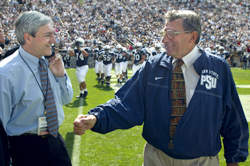
The latest example of failed leadership — what I call ‘moving the chair,’ an analogy I’ll explain in one second — comes from Pennsylvania State University. This is a tragic story of sex abuse that apparently went unchecked for years, despite the fact that a fair number of university leaders — including President Graham Spanier and legendary football coach Joe Paterno — knew of the situation.
“Moving the chair” is my analogy for what lousy, ineffective leaders do when faced with a tough decision. Envision a man sitting in his living room watching football on a large flat-screen TV when, suddenly and unexpectedly, water begins dropping on his head. He has a problem: he’s getting wet. He ‘solves’ the problem by moving the chair, and maybe also getting a pot from the kitchen to catch the water drops.
Obviously, the football fan has failed to define the problem, perhaps willfully — because it was a good game, or because he’s lazy, or because it’s a rented house, or whatever. He’s willing to limit the immediate damage, a short-term ‘solution’ that lets him watch the game.
It seems pretty clear that Penn State leaders didn’t want to disrupt their games either, because football is a huge business in Happy Valley, where Coach Paterno is revered and the economic benefits run into the hundreds of millions of dollars.
For too long we have simply ‘moved the chair’ in public education, often congratulating ourselves for having solved the problem. Here’s what I mean:
Our so-called cures for whatever is wrong in education don’t work because we haven’t diagnosed the problem correctly. Too many influential people think the problem is abysmal test scores, and those folks then design ‘cures’ with the purpose of raising the scores.
(Unfortunately, it is possible to raise test scores with malleable third and fourth graders, and so the ‘cure’ seems to be working. It’s a mirage, as the inevitable drop in scores in 8th grade and beyond demonstrates. Older kids are not so easy to manipulate. What that means is that the ‘learning’ shown in 4th grade was not genuine, more akin to sleight-of-hand than the deep learning that we should want for our children.)
Graham Spanier and Joe Paterno, the president and head football coach at Penn State, seem to have simply moved the chair.
Diagnosing the problem requires strong leadership, courage, and an informed electorate.
I believe that our fixation on tests and test scores is responsible for our having lost sight of the aims of education. What is the purpose of school? How about this?
“Schools and teachers are helping to raise adults.” Their job is not, contrary to conventional view to ‘teach children,’ because that’s too narrow an aim.
But if I am right and the job is growing adults, then we need to think about what sort of adults we want children — our own and others’ — to become.
Our founding fathers possessed great wisdom, and many today are fond of quoting Jefferson. However, I call your attention to James Madison, who wrote:
“… A popular Government, without popular information, or the means of acquiring it, is but a Prologue to a Farce or a Tragedy; or perhaps both. Knowledge will forever govern ignorance; and a people who mean to be their own governors must arm themselves with the power which knowledge gives.”
To me, as a journalist, that means putting the best possible information in front of the public, trusting it to act wisely and in its own interests. But the public also relies on leaders (like Madison and Jefferson) to do the right thing, to identify problems and possible solutions, and to have the courage to face unpleasant choices instead of running from them.
How often in education do leaders ‘move the chair’ instead of doing the right thing? For that matter, how often do politicians and policy makers go to the heart of the problem, instead of settling for the quick and superficial analysis? It’s a lot easier to focus on quick fixes that are not disruptive of ‘the way we have always done it.’
I’m not sure that courage is rewarded — and challenging the status quo, even when it represents mediocrity, is often a sure fire way to short circuit one’s career.
This is, however, not an academic discussion, because policies based on flawed logic do substantial harm to children and youth, to teachers and administrators, and to the nation’s faith in public education.
What will it take to transform schools so that their essential question, asked about each student, becomes “How are you intelligent?” instead of the ubiquitous “How intelligent are you?”
I had an interesting conversation with Barnett Berry, the lead author of Teaching 2030, earlier this week. We covered the waterfront: how teaching has changed and is changing, whether schools of education were up the the challenges facing them, why so many teachers leave, and so on. You will have to wait for our PBS NewsHour piece — it’s in a quiz format, by the way — and the accompanying podcast to find out what the brilliant Mr. Berry believes, because right now I want to explore his final comment, over coffee after the cameras had been turned off.
“Teaching is a team sport,” he opined before rushing off to a meeting, leaving me wondering.
Is it? Who says so? And if it is, why are so many politicians and state governments rushing to support ways of measuring individual teachers?
And what’s a ‘team sport’ anyway?
Well, baseball is a team sport. We watched the Cardinals perform the near-impossible, and we saw that nearly everyone in a Cardinal uniform contributed to the team’s climb from 10.5 games out in late August to win the wild card spot on the last day of the season, upset two heavily favored teams to win the National League pennant and then overcome impossible odds to win the World Series. No one who saw it will forget Game Six, when the Cards were twice within one strike of losing it all to the Texas Rangers. Twice they rallied to tie, later winning on David Freese’s 11th inning walk-off home run. Freese won the series MVP award, but his teammates put him in the position to succeed.
Case closed: Baseball is a team sport, but with individual statistics and individual honors.
Now, what about teaching? That’s a tougher argument for at least six reasons.
Baseball is clearly a team sport, as the Cardinals evidenced throughout the summer and fall. But is teaching?
The “egg crate” architecture of most schools does not support the notion that teaching is a team sport: Individual classrooms resemble cartons, isolated from each other.
The typical school schedule does not support the notion that teaching is a team sport. Most American public school teachers spent almost all of their school time in their classrooms, which means they have very little time to work as a team.
The language of education does not support the notion. Occasionally a couple of teachers will ‘team teach,’ which implies that the rest of the staff is not team-teaching! That is, you are only on a team when you are actually working in the same classroom with another teacher.
Nor does the evaluation of teachers support the notion that teaching is a team sport. It’s all done on an individual basis, with the possible exception of few rating points being given for ‘contribution to the school environment’ or something like that. In my experience, when an administrator praises a teacher for being ‘a team player,’ he means that the teacher doesn’t make waves.
The governance of most schools contradicts the notion that teaching is a team sport. Often it’s ‘labor versus management,’ with teachers punching a time clock twice a day. That’s a far cry from the St. Louis Cardinals, where manager Tony LaRussa had such trust in Albert Pujols that he let him call a hit-and-run play on his own. LaRussa was in charge, but he occasionally deferred to his coaches and his players. He left a pitcher in the game, for instance, after consulting with the catcher, who told him the pitcher had another inning in him (turned out to be wrong, but that’s not the point).
Finally, the emerging pay structure for teachers flies in the face of the idea that teaching is a team sport. The hot issue is some form of ‘merit pay’ based on the academic performance of the individual teacher, whether it’s ‘value-added’ test scores or good old standardized test scores. The policy makers who are supporting these schemes are paying scant attention to the implications (test all students in all subjects!); the fact that with high student turnover, a kid might have three different teachers in one year; or to the evidence indicating that merit pay doesn’t work.
In some places, if teachers are on a team, it’s probably their local union team, but not the PS 112 team or the Mather Middle School team.
I’m afraid my friend Barnett is letting the wish be the father of the thought. He wants teaching to be widely recognized as a team sport, which it is in the best schools. In those schools, teachers have time to meet and discuss individual students, to plan curriculum, to develop both short- and long-term goals. They have time to breathe. They work as a team and hold each other accountable. Yes, each school has the equivalent of Tony LaRussa, the manager, but he or she is not ‘management’ and the teachers ‘labor.’ They all have their eyes on the prize.
I believe that most teachers want to play a team sport. They prefer to work together and to have big hopes, dreams and goals for their school and all its students. One of my strong memories from my own high school teaching in the late 1960s was the joy of working with other English teachers, even to the point of swapping classes for a few weeks so each of us could teach a play or a poet we felt particularly well-qualified to teach.
So here’s my pitch: Teaching should be recognized as a team sport, and education as a team activity. The ‘team’ is the school, and everyone in the school is on the team, including secretarial staff and custodians. Education’s ‘won-loss’ record is more complicated than baseball’s and should include academic measures, teacher and student attendance, teacher and student turnover, community involvement, and more. (I wrote about this recently in ‘Trust but Verify’ and invite you to revisit that blog post).
And just as the Cardinal team divided the World Series loot into individual shares, so too could merit pay be divvied up when the team achieves its agreed-upon goals. Cardinal players, coaches, equipment managers et cetera shared the rewards. In this system, teachers, administrators, counselors, secretaries and custodians would all share the rewards.
But, going back to the St. Louis Cardinals, here’s the critical point: Notice that in writing about them, I described what the team did over a two-month period, not on one day or in one hour. I showed you the movie, not a snapshot.
Snapshots don’t help much in baseball or in education. In Game 3, Albert Pujols hit three home runs, had five hits for 14 total base and drove in five runs. A great snapshot that is actually very misleading, because he had a disappointing World Series overall.
Pujols also made a key fielding misplay in the series; suppose instead the snapshot had been taken in that game? It would have been just as misleading, but the movie reveals just how valuable he was to the Cardinals.
Because education now relies on snapshots — one score on one test on that one big day — and because so much of schooling tilts against the team sport concept, we have miles to go before anyone can confidently assert that teaching is a team sport.
So, here’s the question: are the arts a core subject, or a frill? Of course, just about everyone says the former, because that’s a motherhood/apple pie kind of question. But suppose instead of listening to what folks say, we watch what they are doing? What then do we conclude? Are the arts alive and well in our schools? If not, what can be done about it?
In the last week or two I have been immersed in the arts, first at the annual gala of Americans for the Arts, held at Cipriani in New York on October 17th — and then, a few days later, over a long lunch with the dynamic Director of Education at Lincoln Center, Kati Koerner. (If you don’t know Americans for the Arts, you should. It’s a fantastic organization that encourages and supports the arts and artists in just about every aspect of life, but particularly for the young.)
My lunch with Kati Koerner and Lincoln Center Board member Allison Blinken triggered memories of my own high school teaching back in the late 1960s, specifically of the role the arts played in the best teaching I ever did. My high school was rigidly tracked, and as a new teacher I was assigned the ‘4’ level kids, the ones most veteran teachers didn’t want to be bothered with. I was team-teaching with a new History teacher, and we were struggling to connect. One day she said, “Let’s have them write a play.” “Why not,” I probably responded. “Nothing else is working.”
And that’s what we did. We invited the kids to come up with a plot (with a beginning, middle and end), some characters, dialogue, the whole nine yards. To say they ran with it is an understatement. Before long they had come up with a plot: misunderstood and disrespected students (resembling guess who?) were accused of shoplifting by a local merchant. They were innocent, of course, but no one believed them. Somehow (I don’t remember the details), the merchant discovered that the real thieves were the football captain and the head cheerleader.
As our students’ excitement grew, the idea of actually staging the play emerged, and that snowballed. In the end, they built two sets (the store and their own hangout), got the props and costumes, rehearsed and rehearsed — and then staged the play for the rest of the high school. They were heroes around the school (maybe not to the kids in the top tracks!).
So I know what most of you know — the arts turn kids on, motivate them to excel, and all the rest.
Inspired by my lunch and the Americans for the Arts celebration, I then read “Reinvesting in the Arts,” the call to action issued this spring by the President’s Council on the Arts and Humanities.
Here are a couple of paragraphs from that report, the first about the need, the second about the current situation.
At this moment in our nation’s history, there is great urgency around major transformation
in America’s schools. Persistently high dropout rates (reaching 50% or more in some areas) are evidence that many schools are no longer able to engage and motivate their students. Students who do graduate from high school are increasingly the products of narrowed curricula, lacking the creative and critical thinking skills needed for success in post-secondary education and the workforce. In such a climate, the outcomes associated with arts education –– which include increased academic achievement, school engagement, and creative thinking –– have become increasingly important. Decades of research show strong and consistent links between high-quality arts education and a wide range of impressive educational outcomes.
At the same time, due to budget constraints and emphasis on the subjects of high stakes testing, arts instruction in schools is on a downward trend. Just when they need it most, the classroom tasks and tools that could best reach and inspire these students –– art, music, movement and performing –– are less available to them. Sadly, this is especially true for students from lower-income schools, where analyses show that access to the arts in schools is disproportionately absent.
In other words, things could hardly be worse.
The President’s Commission makes five recommendations:
collaborate more;
do a better job of teaching would-be teachers about the arts;
bring more artists into the schools;
educate policy makers; and
use measures besides those damn bubble tests to prove that the arts make a difference.
I would sum those five up in a bumper sticker: (IM)PROVE ARTS EDUCATION. That is, make arts education better, and find better measures of its value.
Those five recommendations are fine as far as they go, but I don’t think that’s enough to win the day. I think the key can be captured in a different bumper sticker: “ENERGIZE THE 80”
“THE 80” are the 80 or so percent are the households that do NOT have children in schools, because we know that only about 20 percent of American homes have school-age children. (It’s 23 or 24 percent in some places, and lower in others, so I landed on 80.) The 80 percent are men and women of all ages and races with at least one thing in common: they do not have daily contact with students. They don’t know how terrific our young people are. They don’t know that the vast majority of our youth are eager to do work of value.
If we find ways to put our students and the 80 percent together, the latter could be the arts’ secret weapon, supporting, speaking up and voting for arts programs in schools.
The best way to energize the 80 percent is to get them involved. Here are a few ways. I am sure you will have more.
Students could create a photo gallery of the residents of their apartment building or their street, portraits posted on the web for all to see and talk about.
Art students could sketch portraits of business storefronts, or workers and bosses, also to be posted on the web.
Or imagine a school’s jazz quintet performing at a community center with the jazz trio from another school in a neighboring county — simultaneously on Skype — which is no problem as long as the schools are within 750 or so miles of each other, roughly the speed of sound (any farther creates a sound lag and bad music).
A video team could interview adults in a senior citizen center around a chosen theme (best job, favorite trip, et cetera), to be edited into a short video for the web. They could produce short biographies of ordinary citizens — thus learning all sorts of valuable skills like clear writing, teamwork and meeting deadlines in the process.
Music and drama students could rehearse and then present their productions at retirement homes and senior centers — but with a twist: involve some of the adults in the process (a small part in the play, a role in selecting the music, and so on).
Koerner’s Lincoln Center Shakespeare Project (the password is Hamlet) offers another possibility. In that project, middle school students recite passages from Hamlet. It’s compelling and fun. Now take that concept and invite local businessmen and women to recite lines from Hamlet, then weave it into a production that everyone can watch on the web. They could go down my block and ask the woman who runs the bake shop, Mr. Young at the dry cleaner’s, the hardware store guy, and so forth.
The end game here is to have the 80 percent buzzing about what’s happening in their schools. ‘Their schools,’ not ‘the schools.’ Have them saying, “Wow, I didn’t know the kids were doing things like that in school.”
And, of course, have them saying, “Did you see me in Hamlet?”
An Energized 80 could overwhelm the small group of folks who make the rules for schools, a group that seems to be dominated by narrow concerns over bubble test scores.
What do you think? Can we ENERGIZE THE 80 and, in so doing, rescue our kids from boredom and our current system of educational neglect?






 The Merrow Report