Your parents and/or your grandparents lived through The Great Depression.
We are now living in “The Great Aggression,” an unprecedented assault on our democratic republic by Donald Trump and his army of thugs, enablers, sycophants, Christian Nationalists, and neo-Nazis.
It seems obvious that these people do not believe in democracy. Full stop.
Unfortunately, at this point, it’s an open question as to whether “The Great Aggression” will do more lasting damage than The Great Depression did.
The Great Depression began on October 28th and 29th, 1929 (“Black Monday” and “Black Tuesday,”) when the New York Stock Exchange fell by 13% and then another 12%, eventually losing the 2026 equivalent of $350 billion, destroying the lives of millions of Americans, and triggering a world-wide depression that lasted for years. In time, the Dow Jones average fell an astonishing 90%.
But problems had been festering for years, with rampant speculation, wildly overvalued stocks, and a growing income gap between the super rich and the rest of America.
“The Great Aggression” began in earnest after Donald J. Trump was inaugurated for the second time on January 20, 2025. However, one could argue that it actually began on January 6, 2021, when Trump urged his followers to overthrow an election he had lost and prevent the peaceful transfer of power.
At this moment, the most visible evidence of “The Great Aggression” is the physically aggressive behavior of thousands of ICE agents, masked, armed, and seemingly eager to engage anyone within reach. ICE and the Border Patrol have more than 3,000 agents in Minneapolis alone, a city whose police force numbers only 600. American citizens have died, including two who, the videos indicate, were murdered. What’s more, thousands of American citizens.have been attacked, arrested, detained, and deported.
But any list of aggressive attacks on accepted standards of decent behavior by Trump and his followers and enablers must also include:
Gutting FEMA, the Consumer Protection Bureau, and the Forest Service;
Breaking up families of those seeking asylum;
Ordering National Guard troops into Los Angeles, Chicago, Washington, DC, and elsewhere;
Shutting down USAID, the Corporation for Public Broadcasting, and Radio Free Europe;
“Clawing back” or refusing to distribute money authorized by Congress to support state and local organizations, including public schools;
Renaming the Kennedy Center after himself;
Summarily dismissing most Inspectors General, whose responsibility it is/was to maintain the integrity of federal agencies;
Firing hundreds in the FBI and IRS;
Flouting judicial orders;
Attempting to fire Lisa Cook, a member of the Federal Reserve, and bringing charges against Fed Chief Jerome Powell;
Weaponizing the US Justice Department and the FBI with transparently specious judicial actions against New York State’s Attorney General, Letisha James, and former FBI Director James Comey;
Slow-walking of the Congressionally-mandated release of the Epstein Files.
We survived the Great Depression largely because of federal jobs programs like the Civilian Conservation Corps, the Works Progress Administration, and other national efforts that created work opportunities for millions. In other words, the federal government saved us. (World War II also played a part in the economic recovery.)
This time, however, the federal government IS the aggressor. Because it is the source of the problem, help must come from elsewhere.
Help will not be coming from the United States Congress, because it has neutered itself.
Nor is it likely that help will be coming from federal Courts. Even though a huge majority of US District Court judges have ruled against Trump, “his” Supreme Court justices almost always do what he expects them to do.
No, help must come from within, from our own resolve to save our democratic republic from the fascists, the Christian nationalists, the white supremacists, and the just plain greedy bastards who are driving “The Great Aggression.”
Those who lived through the Depression had no way of knowing when or how it would end, but most kept the faith.
Like them, we have no way of knowing where we are in the timeline, or how this will end.
However, we do know several things for certain:
1) If we despair, we lose.
2) If we succumb to “Outrage Fatigue,” we lose.
3) If we dismiss this as a kerfuffle because, after all, our investments are doing well, we lose.
4) If we think that winning the November elections will solve the problem, we are deluding ourselves, because many of Trump’s people are determined to prevent us from voting. As Robert Kagan, a historian and senior fellow at the Brookings Institution, said on a New Yorker podcast recently, “There is no chance in the world that Donald Trump is gonna allow himself to lose in the 2026 elections, because that will be the end of his ability to wield total power in the United States.”
So HOW do we end “The Great Aggression” and save our country?
“One of these things is not like the others. One of these things just doesn’t belong. Can you say which thing is not like the others before I finish my song?”
On “Sesame Street,” three vegetables and a fruit might appear on the screen, or perhaps three birds and a fish. The challenge for pre-schoolers is to identify the outlier, the object that clearly did not belong in the group.
However, in the case of Donald Trump, convicted sex offender Jeffrey Epstein, and “60 Minutes,” the three do belong together because the curious, controversial, and largely unexamined relationship betweenTrump and Epstein stretches back more than 35 years. Recently “60 Minutes” had a 90-minute interview with Mr. Trump, the perfect opportunity to ask him why the Epstein Files haven’t been released.
So, of course, any journalist worth his/her salt would have to ask Trump about the Epstein Files. Except the “60 Minutes” Correspondent Nora O’Donnell did not.
O’Donnell asked Mr. Trump more than 70 questions, several of them more than once, but she never asked Trump about the Epstein Files.
How newsworthy are the Epstein Files? Well, Speaker of the House Mike Johnson shut down the House on September 19th and sent members home for more than six weeks, rather than risk a floor vote on releasing the Epstein Files. He has refused to swear in a duly-elected Representative from Arizona because he knows she will vote to release the files, and that might be enough to pass the resolution.
Johnson is, of course, protecting President Trump. But was O’Donnell protecting him? And, if so, why?
It’s possible that she and her bosses at “60 Minutes” agreed in advance not to bring up the Epstein Files. We may never know, but one passage in the extended interview indicates the existence of some sort of agreement. What do you make of this interchange, toward the end of the session?
NORAH O’DONNELL: Do I have the opportunity to ask you two more questions?
PRESIDENT DONALD TRUMP: If you want, if it helps–
NORAH O’DONNELL: Okay. Okay. Two more questions–
PRESIDENT DONALD TRUMP: That means they’ll treat me more fairly if I do– I want to get– It’s very nice, yeah. Now is good. Okay. Uh, oh. These might be the ones I didn’t want. I don’t know. Okay, go ahead.
“These might be the ones I didn’t want,” Mr. Trump blurted out. Is it reasonable to infer that CBS and Trump’s people had an agreement?
A few minutes later, this interchange took place:
PRESIDENT DONALD TRUMP: I can’t say, because– I can’t say– I’m not concerned. I don’t– I’d rather not have you ask the question. But I let you ask it. You just came to me and you said, “Can I ask another question?” And I said, yeah. This is the question–
NORAH O’DONNELL: And you answered–
PRESIDENT DONALD TRUMP: I don’t mind. Did I let you do it? I coulda walked away. I didn’t have to answer this question. I’m proud to answer the question.
It’s important to note that “Off limits” is not inherently wrong. An interviewer might agree in advance to not ask questions about the subject’s personal life, marriage, children, and so forth. But under no circumstances should a journalist ever agree to avoid controversial (and potentially embarrassing) subjects.
If that means not getting the interview, so be it. And maybe that becomes a story in itself!
The full transcript of the Trump-O’Donnell interview consists of 18,567 words, of which I’d estimate that at least 15,000 were uttered by the President. He blusters, he talks over O’Donnell, and he lies about the rate of inflation, the 2020 Presidential election, and the wars he has stopped, among other things. She doesn’t fight him on these, but that’s more understandable and even forgivable than not asking about the Epstein Files, because Trump is a steamroller who ignores whatever he chooses to.
In the interview Trump mentions former President Joe Biden 42 times, often modifying his name with the adjective ‘worst.’ That obsession probably deserved a question from O’Donnell, but that didn’t happen either.
(Incidentally, Laura Ingraham, not a journalist but a Fox commentator with her own nightly program, recently interviewed Mr. Trump. Again, no mention of Jeffrey Epstein or the Epstein Files, but it wouldn’t surprise me if she agreed to whatever conditions Trump’s people demanded.)
I learned the hard way about interviewing politicians. It was late in 1974, and I had just been given my own program on National Public Radio. Because I was focusing on education, my producer suggested an hour about Pell Grants, the federal government’s program of financial assistance for low income college students. “Interview Senator Claiborne Pell, the force behind the Pell Grants,” he suggested, and so I called up the Senator’s office to request an interview. “Sure,” an aide told me. “Just send over the questions.” Because I hadn’t studied journalism and was new to Washington, I didn’t know enough to refuse that request. I wrote up some questions and faxed them over. When I showed up to interview the distinguished Democrat, he simply read off the answers to my questions. I’m not sure he ever even made eye contact!
Here’s the lesson: whenever the person you want to interview wants to keep some subjects off limits, or wants your questions in advance, the only response is some polite form of NFW.
“60 Minutes” was once the flagship of CBS News and (with the PBS NewsHour and “Frontline”) a gold standard of American journalism, but it seems to have sold its soul.
The so-called ‘Main Stream Media’ has lots to answer for in its failure to hold (first Candidate and then President) Trump to account for his lies, and in its failure to question the mental acuity of President Biden. This is, I think, the final straw. “60 Minutes,” RIP…..
I will start with the fun stuff, some grist for dinner and cocktail party conversations about the cost of going to college these days. Then I will try to connect these dots with six interconnected points: 1) The dramatic increase in the number of colleges shutting down; 2) The approaching ‘Enrollment Cliff;’ 3) The growing number of colleges offering three year Bachelor’s Degrees; 4) Increased questioning whether college is worthwhile; 5) President Trump’s attacks on colleges and universities; and, finally, 6) How much if not all of this can be traced back to the policies of Ronald Reagan.
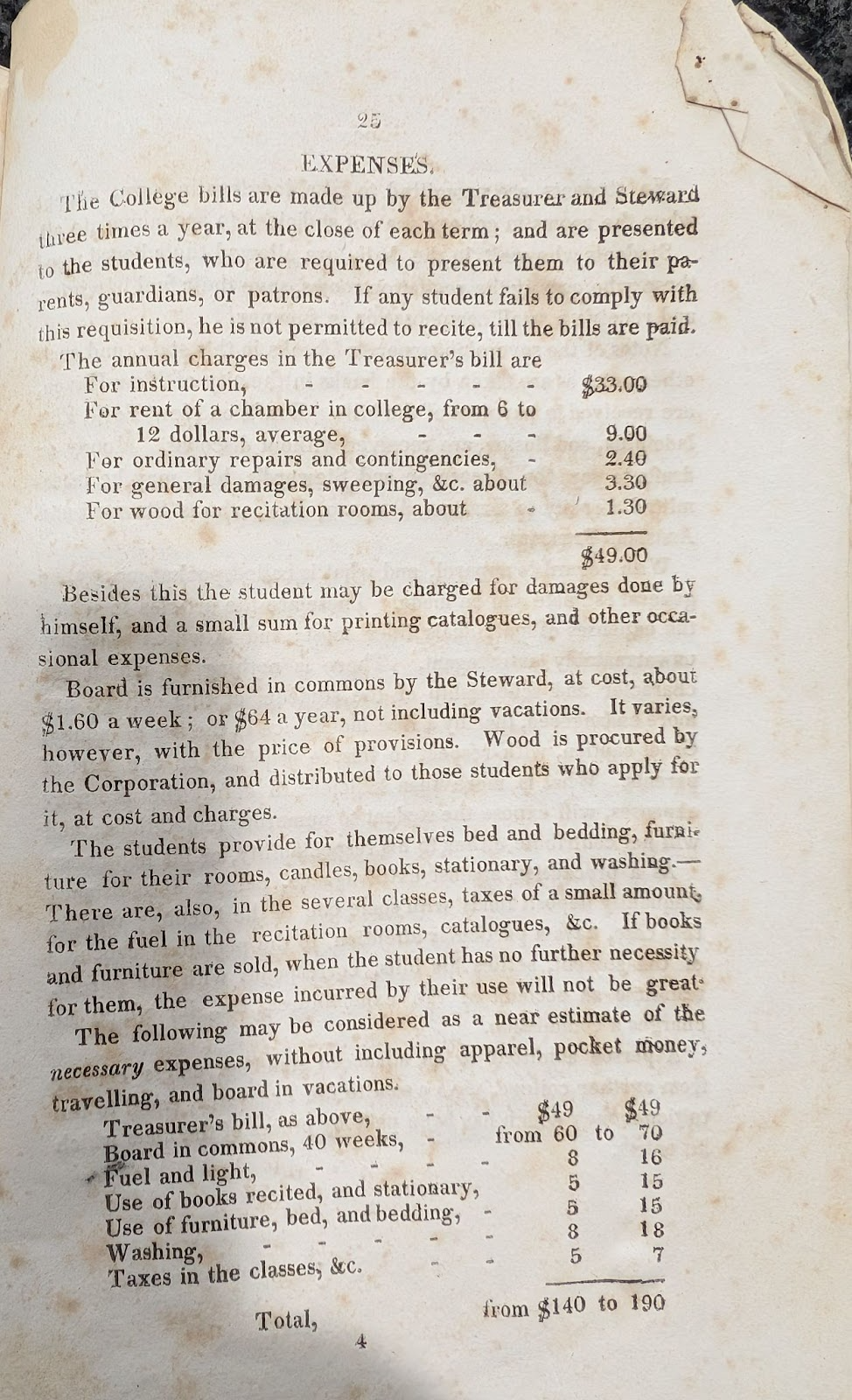
THE FUN STUFF: Two hundred years ago, 1825, it cost less than $200 to attend Yale; this fall it will cost more than $90,500. This includes tuition of $69,900 and a combined cost of housing and meal plans at $20,650. (Simply adjusting for inflation, that bill for $200 would be less than $7,000 today, in case you’re wondering whether the cost of college has gone up a wee bit more than other parts of the economy!)
My brother sent me this from the 1825 Yale student handbook; he also shared it with a grandnephew who is a Sophomore at Yale:
A clever friend of mine reacted with this additional information about life in America 200 years ago: “Those ‘good ole days’ meant a life expectancy of 40 years, an 25-30% infant mortality rate, an annual income of $500-600, and a good bath twice a year, once in the spring and another in the fall.”
A FEW FACTS AND FIGURES: We have nearly 6,000 colleges and universities, both 4-year and 2-year. About 1,900 of these are public institutions, another 1,750 are private and nonprofit, and an estimated 2,275 are for-profit.
More than 60% of today’s high school graduates enroll in college. In the fall of 2024, approximately 19.28 million undergraduate students were enrolled across the United States. Unfortunately, most of them will probably not graduate; in fact, nearly 20% will drop out during their freshman year.
Dropping out is a significant, if largely ignored, issue: Nationally, more than 44 million American adults have some college credits, no degree, and, perhaps, student loan debt weighing them down.
It’s also worth noting that American higher education generally opposed the GI Bill, which allowed millions to attend college, which jump-started the American middle class, and which created a post-war economic boom that lasted for generations.
Another important piece of background information: While most European countries created independent scientific research institutions after World War II, the United States government forged partnerships with colleges and universities. Eventually, the Feds subsidized research at hundreds of American universities to the tune of billions and billions of dollars every year. For years the partnership worked, and the scientific breakthroughs are legendary.
However, there is a down side, because, as the perverse Golden Rule cliché has it, “Whoever Has the Gold Rules.” Every research university has become dependent on those dollars, giving the federal government a powerful hold over higher education. This is, of course, playing out in front of us right now.
Now to the business at hand, my 6 interconnected ideas:
1) COLLEGE CLOSINGS: As noted, nearly 6,000 colleges and universities today, but in 2011, we had more than 7,000. Between 2008 and 2024, two or three colleges closed or merged every month. Today, however, colleges are now closing at an increasing rate–some say it’s one every week! The causes are myriad: Enrollment continues to decline due to natural population trends, operating costs continue to rise, colleges don’t seem to be willing or able to lower their tuition, and young people–concerned about debt–are increasingly skeptical about the value of higher education.
Late in 2024 the Federal Reserve Bank of Philadelphia estimated that up to 80 colleges could close this academic year because of financial distress caused by a worst-case-scenario drop in enrollment. While for-profit colleges once drove closure rates, since 2020 traditional private colleges have been closing at a higher rate. The closures have affected the lives of more than 50,000 students, thousands of faculty and staff, and the economies of the communities where these institutions are located.
2) THE ENROLLMENT CLIFF:This term refers to changes in the size of the traditional college-going population, 18-24. The so-called ‘Cliff’ that’s fast approaching is generally attributed to a drop in fertility during the Great Recession. “Between 2008 and 2011, the U.S. birth rate plummeted, and despite an economic recovery facilitated within the next decade, did not bounce back. As a result, the college-age population was reduced, and enrollment figures fell from 19.9 million in 2017 to 19.1 million in 2024. Within this time period, public 4-year colleges maintained the most enrollment, totaling 7.8 million students in 2020. Demonstrating the tip of the enrollment cliff, this number dropped to 7.6 million by 2023. Along with declines in demographics, the number of prospective college students may have been impacted by the recent COVID-19 pandemic, in which the switch to online learning led to an additional 1.1 million high school dropouts. Additionally, Americans may be further inclined to defer pursuing higher education on account of the exceedingly high costs – and subsequent debts – incurred from attending college in the United States.”
The Enrollment Cliff gets steeper when one considers the dramatic drop in foreign students. Two years ago, about 6% of all US college students came from foreign countries, more than 1.1 million (tuition-paying) students. This year those numbers are dropping. About half of American colleges anticipate big drops, because the Trump Administration proposes to limit foreign enrollment to 10-15% of a college’s student body.
Meanwhile, a record number of American students have decided to study elsewhere; granted, it’s a small number, but it’s a trend.
While it’s true that college enrollment is up slightly this fall, this is apparently the last gasp, and tough times will soon be upon most institutions.
3) THREE-YEAR BACHELOR’S DEGREES: If you attended college, you spent at least four years earning your degree, but that’s changing. “The first three-year degree programs in the country—online programs at Brigham Young University–Idaho and Ensign College in Utah—gained approval just two years ago. Since then, the number of shortened degree programs has expanded exponentially, with nearly 60 colleges nationwide now offering or working toward developing such programs.”
That’s the lead paragraph of a fascinating article in Inside Higher Education, and I hope you will click on this link to read the entire piece.
When you do, you will discover that almost all of the accrediting agencies (major power-brokers in higher education) are now willing to recognize the 3-year Bachelor’s Degree, something they have resisted for years. Four years and 120 credits have been part of the landscape forever, but just because something is normal does not make it right or inevitable. The 3-year program will require 90 credits, so you can say goodbye to electives, of course. However, if a student is focused on a career, why not push through as fast as possible? Recently a friend told us about his grand-niece, who is majoring in ‘Golf Tournament Management’ at a university in Kentucky. She has to complete internships at three golf clubs during the summers, but why should she have to spend four years on campus?
The same logic applies to graphic design, physical therapy, hospitality management, and cyber-security, and a host of other fields.
It’s also worth noting that higher education systems in some other countries have embraced the 3-year Bachelor’s Degree.
This trend is evidence that higher education is in survival mode, on high alert, perhaps because of #4, below.
4) QUESTIONING COLLEGE: It’s apparent that many young people–and their parents–are questioning the value of higher education in the United States; although 79 percent of Americans believed it was more or equally as important for people today to have a college degree in order to have a successful career, only six percent said that everyone in the U.S. could access a quality, affordable education after high school if they wanted it. In addition, current students have been vocal about the negative impacts of attending higher education, with over half considering dropping out of school due to emotional stress. College dropouts tend to be worse off than when they started due to high levels of debt, and student debt is also a major factor on the financial decisions that Americans can make after college.
5) DONALD TRUMP: He is very much part of higher education’s problem, because he’s not a fan of higher education, and, if you have read this far, I am certain you are familiar with Trump’s attacks on Harvard and other leading private institutions, or his forcing the resignations of the president of the University of Virginia, George Mason University, and others. Under the banners of ‘fighting DEI’ and ‘ending anti-semitism,’ Trump and his allies have seemingly brought most of higher education to heel.
To some extent, higher education has brought some of this on itself, with its embrace of ‘safe spaces’ and ‘micro-aggression’ and ‘identity politics,’ all of which seem to have made many campuses places where it’s dangerous to talk about controversial ideas and even riskier to actually hold divergent views.
Trump’s so-called ‘cure’ may be worse than the disease, unfortunately, but the roots of higher education’s problems can be traced back to another politician who was famously hostile toward higher education, the Great Communicator himself.
6) THE LEGACY OF RONALD REAGAN
If you needed financial help to go to college before Ronald Reagan became president, the chances are you received most of what you needed as a grant, not a loan. From the right-leaning publication, The Intercept: “For decades, there had been enthusiastic bipartisan agreement that states should fund high-quality public colleges so that their youth could receive higher education for free or nearly so. That has now vanished. In 1968, California residents paid a $300 yearly fee to attend Berkeley, the equivalent of about $2,000 now. Now tuition at Berkeley is $15,000, with total yearly student costs reaching almost $40,000. Student debt, which had played a minor role in American life through the 1960s, increased during the Reagan administration and then shot up after the 2007-2009 Great Recession as states made huge cuts to funding for their college systems.”
And from The New York Times in late 1981: Since taking office last January, the Reagan Administration has set out to curtail the cost of Federal student assistance and to alter the philosophy as well. ”I do not accept the notion that the Federal Government has an obligation to fund generous grants to anybody that wants to go to college,” said Budget Director David A. Stockman in Congressional testimony in September. ”It seems to me that if people want to go to college bad enough, then there is opportunity and responsibility on their part to finance their way through the best they can.”
Most of us have lived through a sea change, going from a time when we collectively believed that investing in higher education paid social dividends that far outweighed the costs, to a time when the federal government and all state governments have reduced their support. Now, the operating philosophy seems to be, “Hey, you want an education? Pay for it yourself!”
I don’t know if anyone has a solution for higher education’s problems, but I am certain that “education reform” is NOT the answer. I see higher education’s challenges as part of a larger picture: our declining commitment to almost anything ‘public,’ such as public transportation, public libraries, public spaces, public schools, public health, public safety, and on and on.
Absent a strong commitment to the common good, coupled with disgraceful–and growing–income inequality, our national experiment in “a more perfect union” seems doomed.
Let me begin with an assertion that may upset some readers: Most American colleges and universities are glorified vocational institutions whose primary purpose is to prepare people for the work force. Most students understand this and go about ‘building a resumé’ that will earn them a good job. This is, I think, a devil’s bargain for the vast majority of students.
It’s the rare college student who focuses on the challenge of ‘building a self,’ even though jobs come and go, and one’s inner self is your only sure companion for the rest of their lives. And while some professors push their students toward personal discovery and intellectual growth, the primary drivers of higher education are jobs and careers: ”Learn to Earn.”
It has always been thus: Harvard, the country’s oldest college, was established in 1636 to train ministers, and Yale was founded in 1701 to serve the same purpose.
That said, I think that colleges have an obligation to guide their students in directions that are likely to lead to gainful employment, and perhaps to “lives of significance” as well. Teach ‘the Principles of Management,’ not ‘Stagecoach Maintenance.’ But also expand your students’ horizons and encourage their dreams.
Universities cannot accurately predict the future or the future job market, and that can have awful consequences for their students. I encountered this in 1969 when I was teaching English at Virginia State College, in Petersburg, Virginia. Virginia State (now a university) was and is an HBCU, serving mostly first generation African American students, many of them from challenging economic circumstances. A Virginia State education and diploma offered a huge opportunity, the chance to join the middle class.
Remember now, 1969 was the dawn of the computer age. You’ve seen photos of large main-frame computers and the armies of key punch operators who punched, collated and then fed cards into the machines. But even then savvy people knew change was coming. It didn’t take long: The first personal computer was introduced in 1971, and three years later, 1974, the Altair-8800 became commercially available.
I was shocked to discover that some VSC officials were steering students into a major that essentially taught them to be key punch operators, and I learned that that particular major was the college’s most popular. Students were being told that good jobs would await them upon graduation, and they believed it.
Fast forward to 2025, and something similar is happening. While nobody is being taught how to key-punch, thousands of students majored in computer science and other math-related fields because they were told that good jobs would be theirs for the taking. Now they are discovering that to be false.
“Growing up near Silicon Valley, Manasi Mishra remembers seeing tech executives on social media urging students to study computer programming.
“The rhetoric was, if you just learned to code, work hard and get a computer science degree, you can get six figures for your starting salary,” Ms. Mishra, now 21, recalls hearing as she grew up in San Ramon, Calif.
Those golden industry promises helped spur Ms. Mishra to code her first website in elementary school, take advanced computing in high school and major in computer science in college. But after a year of hunting for tech jobs and internships, Ms. Mishra graduated from Purdue University in May without an offer.”
Many others are in her situation; they have degrees and debts, but no job.
How widespread is over-vocationalization, if such a word exists? In a casual conversation a few weeks ago, a friend told me that his grandniece was majoring in “Golf Course Management” at one of the country’s best programs and that her course work included a summer internship at a nearby golf course. “Do many colleges offer that major,” I asked? Yes, he said, dozens do.
He’s right. A casual Google search turns up a surprising number that offer a major in Golf Course Management, Golf Tournament Management, and/or Turf Grass Management. On the list: Penn State, Ohio State, the University of Nebraska, Florida State, the University of Colorado, the University of Maryland-Eastern Shore, New Mexico State, Western Kentucky University, Coastal Carolina University, Mississippi State University, Kansas State University, the University of Nevada at Las Vegas, and (her school) Eastern Kentucky University.
A few more institutions, such as Michigan State University, offer a “certificate” after 4 semesters and 54 credits. Sixteen of these programs are certified by the PGA, professional golf’s governing body.
Internships are a crucial part of the training; one university insists on an 16-month internship, meaning that students are working away from their university for nearly a year and a half, while presumably paying tuition!
While running a golf course can pay more than $100,000 a year, are there job openings awaiting the 600-800 or so men and women who graduate each year? The US has about 16,000 golf courses, but 75% of them are public courses, under management by a political entity. There’s probably not a huge turnover in the public or private arena, which suggests that the vocational training that these men and women have paid for (and will continue to pay for) may not lead to jobs in the field they have immersed themselves in.
What do they do now? Are they prepared to switch careers, from one that didn’t want them to something else? Has specialization done them wrong?
Colleges and universities have larger and more public problems than what I am describing: President Trump has them in his crosshairs, the supply of 18-year-olds is about to drop dramatically, and, on average, one college closes every week.
However, I believe what you’ve just read gets at the root of the issue. Higher education has embraced ‘learn and earn’ as its Golden Rule, with disastrous consequences, including isolation and polarization. How many of those young people who majored in Golf Tournament Management also took courses in philosophy or classical music, or computer science for that matter? How many of those math and computer science majors branched out?
American Higher Education is failing its students by allowing and encouraging specialization, instead of providing and requiring a broad curriculum, an experience that ‘builds a self,’ to again use Jacques Barzun’s memorable phrase.
He’s worth quoting at length on the value of a broad liberal arts education. Professor Barzun begins by asking why one should tackle the classics.
The answer is simple: in order to live in a wider world. Wider than what? Wider than the one that comes through the routine of our material lives and through the paper and the factual magazines—Psychology Today, House and Garden, Sports Illustrated; wider also than friends’ and neighbors’ plans and gossip; wider especially than one’s business or profession. For nothing is more narrowing than one’s own shop, and it grows ever more so as one bends the mind and energies to succeed. This is particularly true today, when each profession has become a cluster of specialties continually subdividing. A lawyer is not a jurist, he is a tax lawyer, or a dab at trusts and estates. The work itself is a struggle with a mass of jargon, conventions, and numbers that have no meaning outside the specialty. The whole modern world moves among systems and abstractions superimposed on reality, a vast make-believe, though its results are real enough in one’s life if one does not know and follow these ever-shifting rules of the game.
And then he addresses the consequences of living in the silo of one’s speciality:
The need for a body of common knowledge and common reference does not disappear when a society is pluralistic. On the contrary, it grows more necessary, so that people of different origins and occupations may quickly find familiar ground and, as we say, speak a common language. It not only saves time and embarrassment, but it also ensures a kind of mutual confidence and goodwill. One is not addressing a stone wall, but a responsive creature whose mind is filled with the same images, memories, and vocabulary as oneself. Otherwise, with the unstoppable march of specialization, the individual mind is doomed to solitude and the individual heart to drying up. The mechanical devices that supposedly bring us together—television and the press, the telephone and the computer network—do so on a level and in a manner that are anything but nourishing to the spirit.
The message to students should be crystal clear: do not put yourself into a pigeonhole by specializing. Instead, take courses across the curriculum. Find out who the most interesting professors are and enroll in their classes. Stretch, because you might discover parts of yourself that you didn’t know existed.
And, remember, that job that you think you want, that job may not even exist three or four years from now. Or less, as AI picks up speed. Before you’re through, you may end up having a dozen or more jobs, and two or three careers.
The way to prepare for change and uncertainty is to embrace them.
Donald Trump has inadvertently handed anguished Democrats, angry Independents, and disappointed Republicans the key to defeating MAGA and taking control of the House of Representatives and perhaps the Senate in the 2026 Midterm elections.
While I hope you will keep reading, here’s the key: support public schools (and other public institutions as well).
About 6 weeks ago, Trump ordered his Education Department to withhold nearly $7 billion in funds for public schools, money that had been appropriated by Congress.
The outcry was immediate, loud, and non-partisan. Republicans made just as much noise, maybe more, than their Democratic counterparts. And it worked! Three weeks later, the Education Department announced it was releasing the funds.
As the savvy education reporter Jennifer Berkshire noted, “And just like that, the Trump Administration has released the billions in funds for public schools it had suddenly, and illegally, frozen earlier this summer. The administration’s trademark combo of chaos and cruelty has been stemmed, at least temporarily. That Trump caved on this is notable in part because his hand was forced by his own party—the first time this has happened in the endless six months since his second term began.”
There is, as Berkshire notes, a ‘cross-class alliance’ that supports public schools, which close to 90% of students attend, in Red, Blue, and Purple states. Republicans in Congress eagerly push vouchers (chits to allow students to attend private schools), but those efforts have been soundly defeated in state legislatures for years. The best example is Kentucky, a deeply Red state whose voters last November soundly rejected a voucher proposal, 64.8% to 35.2%.
Another savvy analyst, David Pepper, has been watching, and his insights are worth your while. Here’s a sample: “10 GOP Senators stood up to the administration’s freezing of $6 billion funds for public school programs across the country. Yes, GOP politicians who are silent on almost everything were willing to call out the freeze, which was crippling public schools every day it lasted, and demand it be ended.
They actually defended the programs in a public letter: ‘This funding goes directly to state and local districts, where local leaders decidehow the funding is spent, because as we know, local communities know how to best serve students and families…These funds go to support programs that enjoy longstanding, bipartisan support like after-school and summer programs that provide learning and enrichment opportunities for school aged children which also enables their parents to work and contribute to local economies. …. Withholding these funds will harm students, families and local economies.”
Too many Democrats seem to be running against Trump and his assaults on our democracy. Too much energy is being wasted examining the plusses and minuses of potential Presidential candidates like Andy Beshear, J.B. Pritzker, Gretchen Whitmer, Jamie Raskin, Josh Shapiro, Wes Moore, Pete Buttigieg, and Reuben Gallego.
The first priority has to be articulating its First Principles, and I suggest that the first of these should be THE PUBLIC GOOD: That means strong support for all things public: public education, public libraries, public transportation, public parks, public health, public safety, public spaces, and public broadcasting. Democrats must be the party of the Common Good.
But a second pillar must be Individual Rights. Because the fundamental rights that are guaranteed in our Constitution are often subject to interpretation, debate, and even violent disagreement, Democrats must be clear. Free speech, freedom of worship, habeas corpus, and other fundamental rights are not up for debate, and nor is a woman’s right to control her own body.
Health care is a right, and Democrats must make that a reality.
Conflict is inevitable–think vaccination requirements–and Democrats should come down on the side of the public good.
Because Americans have a right to safety, Democrats should endorse strong gun control measures that ban assault weapons that have only one purpose–mass killing.
We can and should argue about other First Principles, but Democrats must take control of Congress and begin the arduous tasks of stopping Trump and rebuilding America. While the Trump regime continues to be a disaster for a majority of Americans and for our standing across the world, it’s not enough to condemn his greed and narcissism, even if he goes to prison. Let’s first acknowledge that Trump tapped into serious resentment among millions of Americans, which further divided our already divided country.
The challenge is to work to bring us together, to make ‘one out of many’ in the always elusive ‘more perfect union.’ The essential first step is to abandon the ‘identity politics’ that Democrats have practiced for too long. Instead, Democrats must support policies that bring us together. Here are five suggestions:
1) Adopt sensible and realistic immigration policies that welcome newcomers who arrive legally but close our borders to illegal immigration.
2) Adopt fiscal and monetary policies to address our burgeoning national debt. This should include higher taxes on the wealthy, emulating Dwight Eisenhower.
3) Rebuilding America also means rebuilding our alliances around the world. Democrats should support NATO and Ukraine, and rejoin efforts to combat climate change.
4) Urge states and local school districts to beef up civic education in public schools, teaching real history, asking tough questions. At the same time, federal education policies should encourage Community schools, because research proves that schools that welcome families are more successful across many measures.
5) Bring back the draft for young men and women and offer a deal to those who volunteer for two years of (paid) National Service. In return, they get two years of tuition or training credits at an accredited institution. They may serve in the military, Americorps, the Peace Corps, or other helping organizations. One may teach or work in distressed communities, or rebuild our national parks, or serve in other approved capacities. JFK famously said “Ask not what your country can do for you. Ask what you can do for your country.” Let’s ask BOTH questions. (Perhaps National Service should be mandatory, but that’s a long row to hoe, and we should begin with a voluntary program.)
But the key to defeating Trump and saving our democratic republic from his vainglorious and petty fascism is support for public education and other vital public enterprises.
(I originally posted this about 6 months ago, before Trump’s “Big Beautiful Bill” slashed taxes for the very rich while cutting services for many less fortunate Americans, before Trump began his erratic embrace of tariffs, before ICE began grabbing thousands of non-white and ‘foreign-looking’ people off the streets, and before Trump persuaded the Republican-controlled Congress to claw back the money it had appropriated to support public broadcasting, and before…et cetera, et cetera, et cetera. I think it’s even more relevant today, and I think it’s long past time for Democrats to leave their circular firing squad and embrace everything that is in the public good: public transportation, public parks, public schools, public health, and more.)
For the sake of argument, let’s assume that your family’s wealth is roughly average, which means that you’re worth about $1 million, a big jump from 2019. “Both median and average family net worth surged between 2019 and 2022, according to the U.S. Federal Reserve. Average net worth increased by 23% to $1,063,700, the Fed reported in October 2023, the most recent year it published the data. Median net worth, on the other hand, rose 37% over that same period to $192,900.”
So if you are the average American, you are a millionaire, but before you get too excited, you are worth roughly 1/600,000 of what Elon Musk is worth!
I’m talking about the same Elon Musk who spent $300,000,000 to buy the last presidential election and, as it turns out, to purchase our government. Three hundred million dollars is a fortune for nearly everyone else, but for Musk it was chump change.
Suppose you ( just barely a millionaire) had spent the same portion of your wealth that Musk did. $300 million of his estimated worth of $600,000,000,000–SIX HUNDRED BILLION DOLLARS– is .0005%
And .0005% of your fortune is $500!
Maybe you’re richer, worth $3 million. Well, 5 thousandths of 1 percent of your $3M is $3000.
Even if you’re really rich–worth $30,000,000–your ‘Musk equivalent cost’ is still chump change, $30,000.
That’s right, we sold our country for a pittance. And as I see it, those who willingly and wittingly bought into the MAGA line have also sold something–their souls. (Those Trump voters have been misinformed and miseducated by the Fox/right wing media machine for years deserve sympathy, not condemnation.)
Those who sell themselves are, to put it crudely, whores. And those who sell themselves for .0005% are CHEAP WHORES.
That’s where America is right now, in the hands of greedy megalomaniacs, power-hungry opportunists, and vengeful white Christian nationalists.
How do we escape their grasp and recapture our country? I suggest at least five courses of action: 1) support the ACLU and other organizations that are filing lawsuits, 2) join forces with anyone who supports local public institutions like schools and libraries, 3) support Democrats, Republicans, and Independents who take public stands against MAGA, 4) support independent journalism wherever you find it, and 5) stand with those the Trump Administration is attacking (which now includes Lutherans and Catholics who are supporting compassionate services for immigrants).
It’s long past time for liberal Democrats to stop focusing on sectional interests like gender, race, and immigrant status and pay attention to the needs of a shrinking middle class suffering from growing income inequality.
Vermont Senator Bernie Sanders sounded the warning back in 2017, when he urged everyone to “understand that absolutely these are very difficult and frightening times. But also understand that in moments of crisis, what has happened, time and time again, is that people have stood up and fought back. So despair is absolutely not an option.”
If we don’t work together, MAGA will eventually come for you, and for me, and all of us!
More than five million demonstrators in about 2000 communities stepped forward to declare their opposition to Donald Trump, on June 14th. “No Kings Day” was also Trump’s 79th birthday, Flag Day, and the anniversary of the creation of the American army.
So now we know what many of us are against, but the central question remains unanswered: What do we stand FOR? What do we believe in?
Just as FDR called for Four Freedoms, the Democratic party needs to articulate its First Principles. I suggest three: “The Public Good,” “Individual Rights,” and “Rebuilding America after Trump.”
THE PUBLIC GOOD: Democrats must take our nation’s motto, E pluribus unum, seriously, and they must vigorously support the common good. That means supporting public libraries, public parks, public schools, public transportation, public health, public safety, public broadcasting, and public spaces–almost anything that has the word ‘public’ in it.
INDIVIDUAL RIGHTS: Because the fundamental rights that are guaranteed in our Constitution are often subject to interpretation, debate, and even violent disagreement, Democrats must be clear. Free speech, freedom of worship, habeas corpus, and other fundamental rights are not up for debate, and nor is a woman’s right to control her own body.
Health care is a right, and Democrats must make that a reality.
Conflict is inevitable–think vaccination requirements–and Democrats should come down on the side of the public good.
Because Americans have a right to safety, Democrats should endorse strong gun control measures that ban assault weapons that have only one purpose–mass killing.
REBUILDING AMERICA AFTER TRUMP: The Trump regime was and continues to be a disaster for a majority of Americans and for our standing across the world, but it’s not enough to condemn his greed and narcissism, even if he goes to prison. Let’s first acknowledge that Trump tapped into serious resentment among millions of Americans, which further divided our already divided country.
The challenge is to work to bring us together, to make ‘one out of many’ in the always elusive ‘more perfect union.’ The essential first step is to abandon the ‘identity politics’ that Democrats have practiced for too long. Instead, Democrats must adopt policies that bring us together, beginning with mandatory National Service:
National Service: Bring back the draft for young men and women to require two years of (paid) National Service, followed by two years of tuition or training credits at an accredited institution. One may serve in the military, Americorps, the Peace Corps, or other helping organizations. One may teach or work in distressed communities, or rebuild our national parks, or serve in other approved capacities. JFK famously said “Ask not what your country can do for you. Ask what you can do for your country.” Let’s ask BOTH questions.
Additionally: 1) Urge states to beef up civic education in public schools, teaching real history, asking tough questions. At the same time, federal education policies should encourage Community schools, because research proves that schools that welcome families are more successful across many measures.
2) Rebuild Our Aging Infrastructure: This is urgent, and it will also create jobs.
3) Adopt fiscal and monetary policies to address our burgeoning national debt. This should include higher taxes on the wealthy, emulating Dwight Eisenhower.
4) Adopt sensible and realistic immigration policies that welcome newcomers who arrive legally but close our borders to illegal immigration.
5) Rebuilding America also means rebuilding our alliances around the world. Democrats should support NATO and Ukraine, and rejoin efforts to combat climate change.
In addition to adopting Three “First Principles,” Democrats must act NOW to ensure that the 2026 elections are free and fair. Senator Chris Murphy, a Democrat from Connecticut, is concerned about this. In an email he wrote: “For me, the essential question for my party is this: do you think this political moment is frenzied but still normal, and thus our job is to use our tried and true political tactics to make Trump as deservedly unpopular as possible so that we win back levers of power in 2026; or, do you think this moment is without precedent, and that Trump’s assault on democracy is so serious that all our work must be directed not toward winning the 2026 election, but making sure there is a free, fair election in 2026?”
Murphy is launching a fund to support citizen-led, grass roots, state and regional efforts to protect the vote. American Mobilization will provide money and logistical support, Murphy promises. The first $400,000 is going to three organizations: the Committee to Protect Health Care, the Georgia Youth Justice Coalition for Action, and Project 26 Pennsylvania. He explains, “The Committee to Protect Health is organizing doctors and nurses to protect Medicaid in Michigan, Louisiana, and Utah, and Georgia Youth Justice and Project 26 are organizing young people, including college students, to join the fight.”
It’s worth supporting Senator Murphy because Trump presents a genuine and serious threat to our democratic republic. Democrats have to fight.
In a column in the New York Times, David Brooks argued that we are in a ‘world-shifting’ time, and that Democrats haven’t realized how they are being left behind. In other words, sharpening their message won’t cut it. He writes, “This is not about policies. Democrats have to do what Trump did: create a new party identity, come up with a clear answer to the question: What is the central problem of our time? Come up with a new grand narrative.”
The three non-negotiable requirements for Democratic success are 1) First Principles that articulate a clear set of core beliefs, 2) Effective messengers, and 3) Mastery of the medium(s) that conveys the message. Call it the 3M concept: message, messenger, and medium. Right now too many Democrats are spinning their wheels on #2 and #3, instead of figuring out what they stand for.
Rebuilding America also requires looking forward, because AGI, artificial general intelligence, is both an existential threat and a huge promise. At a minimum, AGI will be a job-eliminator in ways we cannot even imagine, and that reality must be addressed. If we cannot create enough new jobs, what will adults do with all that free time?
And Ukraine’s drone attack deep into Russia must also be seen as another new reality. We are now vulnerable in ways we never imagined, now that an ordinary freight truck can be converted into an aircraft carrier.
These are perilous times, the worst possible time to have a shallow narcissist in the White House, enabled by Fox News ‘personalities’ and other toadies in positions of power.
But that’s our reality until the 2026 elections, when we can begin to retake control of our destiny and begin to repair America and our standing in the world.
Just SAYING “No” to kings won’t cut it. Organize, register to vote, register others, contribute to the ACLU, and speak up and speak out.
Anybody else out there feeling depressed about what’s happening in our country? Frightened? Angry? All of the above?
Well, join the crowd!
Although the fire hose of disturbing news can be overwhelming, panic and despair cannot be options, not on Memorial Day and not ever. The smart people I’m listening to suggest at least three courses of action: 1) Support the ACLU and others who are fighting Trump in the courts;
2) Focus on taking back the House, and perhaps even the Senate in 2026; and
3) Help figure out what Democrats stand for, rather than playing the parlor game of arguing about the strengths and weaknesses of Gretchen Whitmer, Kamala Harris, Pete Buttigieg, JB Pritzker, and others. Parlor games and being against Trumpism aren’t enough; it wasn’t enough in 2016 or 2024, and it won’t be enough in 2026 and 2028 either.
#3, Figuring out what Democrats and the Democratic Party stand for could lead to ‘Project 2029,’ which should be the opposite of ‘Project 2025,’ the GOP’s blueprint for dismantling much of the federal government. In sharp contrast, ‘Project 2029’ has to be forward-looking and positive, even as it seeks to undo the damage Trump has done and is doing.
So….what should be in Project 2029? For openers, I would argue that Democrats should support almost anything that has the word ‘public’ in its name: public libraries, public parks, public schools, public transportation.
AND: Bring back the draft…for men and women….to require two years of universal National Service. This could be compensated service in a branch of the military, the Peace Corps, AmeriCorps, Habitat for Humanity, a state’s Civilian Conservation Corps, or other similar organizations. And this time National Service includes an additional reward: Two years of tuition or training credits, at an accredited institution. JFK famously said “Ask not what your country can do for you. Ask what you can do for your country.” Let’s ask BOTH questions.
ALSO:
A) Fiscal and monetary policies that help people buy their first home;
B) Higher taxes on the wealthy, a ban on trading by Congress, and other reforms of the tax code;
C) Community schools, not just stronger public schools. These schools welcome parents and take full advantage of whatever the community has to offer.
(And while we are at it, let’s make it harder to become a teacher but easier to be one. Higher entry standards and better training, and then more trust and better pay);
D) Rebuild our aging infrastructure;
E) Aggressively combat climate change;
F) Resist autocrats and support NATO and Ukraine;
G) Health care is a right. Make that a fact as well.
That’s my two cents. What would you add or subtract?
“Readers love lists. Whenever you can, build your column around a list.”
Tina Brown, the brilliant editor of The Daily Beast and, before that, The New Yorker, gave me that advice while we were sitting in her Daily Beast office overlooking the Hudson River. That was 20 years ago, and I was too immature–only 63!–to embrace the wisdom, but I realize now that she was correct.
And so here’s a column with not one but THREE lists, and an opportunity for readers to rank the current occupant of The White House on three aspects of his character and behavior: Greed, Narcissism, and Business Acumen.
(Scoring: Give Trump the points that correspond with your ranking. IE, if you rank Trump the second-greediest person in history, he gets TWO points. Third most narcissistic, he gets THREE points. Worst businessman ever, ONE point. Lowest total score wins!)
Let’s start with greed or avarice. Below are short descriptions (in alphabetical order) of 10 greedy people from human history. Where would you rank Donald Trump?
Caligula, the Roman Emperor, is infamous for his tyrannical and extravagant reign, driven by greed and madness. His rule was marked by excessive spending and cruel demands. Caligula’s desire for wealth led to heavy taxation and confiscation of property, causing public unrest. His erratic behavior and lavish projects drained the empire’s resources.
Marcus Licinius Crassus was a Roman general and politician known for his immense wealth and insatiable greed. He became obsessed with wealth as a young man. He rented land and bought slaves to sell later on for profit. Rome’s failure to provide housing fueled his business. He organized teams of firefighters who would save the burning houses (fires were quite common) and then buy them cheap so he could rebuild them and rent them. He had a net worth of $2 Trillion in today’s money.
Hetty Green, known as the “Witch of Wall Street,” was one of the wealthiest women of her time. Her frugality and aggressive investment strategies earned her a reputation for greed and shrewdness. Green amassed a vast fortune through real estate and railroads, often lending money at high interest rates. Her financial decisions were marked by extreme thrift and an unyielding focus on profit.
Leona Helmsley, dubbed the “Queen of Mean,” was an American businesswoman known for her opulent lifestyle and notorious greed. Her harsh management style and tax evasion convictions marked her career…Her downfall came with her conviction for tax evasion, exposing her lavish spending and disdain for the law. Helmsley’s story is a testament to the consequences of greed and the importance of integrity in business leadership.
Leopold II of Belgium amassed a $500,000,000 fortune from his rubber plantations in Congo. In the process he killed some 8 million people and maimed uncountable men, women and children. He did not kill for pleasure or political/military gains. He did not kill with guns and swords. He killed for profit, and killed with overwork, hunger and punishment (his favourite was chopping off the hands of child-workers when they failed to meet inhuman work production requirements).
Bernie Madoff was an American financier who orchestrated the largest Ponzi scheme in history, defrauding thousands of investors of billions of dollars. His greed and deception shattered lives and financial institutions. Madoff’s reputation as a trusted financier concealed his fraudulent operations for decades.
Imelda Marcos, the former First Lady of the Philippines, became infamous for her extravagant lifestyle and accumulation of wealth. Her collection of shoes and lavish spending symbolized her greed. Marcos wielded significant influence during her husband’s regime, using her position to amass personal fortune and power. Her opulent lifestyle was funded by embezzled public funds and corruption.
Queen Ranavalona I of Madagascar ruled Madagascar with an iron fist from 1828 to 1861. Her greed for power and wealth was evident in her harsh policies and isolationist stance. Ranavalona’s regime was marked by forced labor and heavy taxation, which enriched her court but impoverished her subjects. Her ruthless approach to governance ensured her control over Madagascar, but at a significant cost to her people. Despite her reputation for cruelty, she maintained power for over three decades, leaving a legacy of greed and tyranny that still resonates in Madagascar’s history.
Cecil Rhodes was a British imperialist known for his exploitation of African resources and people. His insatiable greed fueled colonial expansion in southern Africa, leading to the establishment of Rhodesia. Rhodes’ pursuit of wealth was driven by diamond mining, which he monopolized through De Beers.
John D. Rockefeller, an American industrialist, became the richest man in modern history through the establishment of Standard Oil. His relentless pursuit of wealth led to monopolistic practices that crushed competitors and controlled the oil industry.
(Contemporary nominees include Elon Musk, Jeff Bezos, Larry Ellison, Mark Zuckerberg, Vladimir Putin, Xi Jinping, and Charles Koch.)
Where would you put Trump on that list? Here’s his own assessment:
My whole life I’ve been greedy, greedy, greedy. I’ve grabbed all the money I could get. I’m so greedy. But now I want to be greedy for the United States. I want to grab all that money. I’m going to be greedy for the United States.
You have to admire how Trump takes a very negative quality and turns it to his political advantage. He always makes it about himself….which is a perfect segue to Narcissism, and another list: The World’s Worst Narcissists. First, a definition: Narcissists, who have an inflated sense of self-importance, rarely think about others but instead prioritize their own needs and desires.
Here’s a list of ten candidates (in alphabetical order) for “History’s Worst Narcissist.”
Ted Bundy was an American serial killer and a psychopath who was convicted of killing more than thirty people, most of them young women. He was a manipulative, extremely self-centered, and charismatic man who loved attention and limelight.
Cleopatra, the last active ruler of the Ptolemaic Kingdom of Egypt, is often characterized as a narcissist, particularly in her pursuit of power and dramatic life choices.
Adolf Hitler, the Nazi politician who started World War II, slaughtered 6 million Jews and many other innocent people in his goal of establishing white Germans as the superior race.
Jim Jones was an American cult leader and a preacher who persuaded more than nine hundred followers to accompany him to Guyana. There he forced his followers to drink poison in the name of spirituality. Those who declined to commit suicide were murdered.
Kim Jong Un, the North Korean dictator, is known as a brutal and self-obsessed leader. North Korean citizens are required to worship him as their leader, and do so out of terror and fright.
Kim Kardashian is a businesswoman, media personality, and model who relentlessly promotes herself, her wealth, and her pompousness publically.
Madonna, the American singer, actress, and songwriter, is known for her exploitative behavior towards her employees and staff members by making unreasonable and unfair demands. She is known for abusing her employees by making them work unreasonably long hours.
King Louis XIV of France, known as The “Sun King,” was infamous for his extravagant lifestyle and his firm belief in his divine right to rule, emphasizing his grandeur and importance. “L’etat c’est moi,” he is said to have pronounced.
Elon Musk: The CEO of X, Tesla and, SpaceX is often considered a modern-day narcissist due to his self-promoting behavior and controversial public statements.
Joseph Stalin, the Soviet dictator, exhibited many traits associated with narcissism, including a cult of personality, paranoia, and a ruthless pursuit of power.
Is Donald Trump a textbook narcissist? He is said to have almost all the traits that a narcissist might possess. He only cares about his personal needs, dismissing the needs of his family members; he is thin-skinned when it comes to criticism. He promotes himself above the needs of the nation, while sidetracking or ignoring his Constitutional responsibilities as President.
And, finally, the worst business leaders of all time. Here are 10 candidates, again in alphabetical order
John Akers – IBM Under John Akers’ leadership in the late 1980s and early 1990s, IBM encountered significant challenges adapting to the rapidly evolving technology landscape. Akers’ inability to foresee the shift from mainframe to personal computing led to a loss of market share and financial stability for IBM. By 1992, the company reported an unprecedented annual loss of $8 billion, marking a significant downturn from its previous market dominance.
Leo Apotheker – Hewlett-Packard (HP): Leo Apotheker’s brief tenure as CEO of HP in 2011 was characterized by a series of strategic missteps that significantly impacted the company’s market position and shareholder value. His decisions to discontinue HP’s smartphone and tablet lines and the announcement of plans to spin off its lucrative PC business potentially caused confusion and uncertainty among investors, customers, and employees alike. These moves, along with the costly acquisition of Autonomy for $11 billion—a decision later mired in controversy over allegations of financial misrepresentation—resulted in a sharp decline in HP’s stock price and a loss of confidence in the company’s strategic direction.
Steven Ballmer – Microsoft: Steven Ballmer’s tenure as CEO of Microsoft from 2000 to 2014 was marked by financial success but also significant strategic oversights, particularly in mobile computing and internet services. Despite maintaining profitability and growing revenues, Microsoft, under Ballmer’s leadership, failed to capitalize on the early stages of the mobile revolution and the rise of search engines like Google, allowing competitors to dominate these critical market segments.
Carly Fiorina – Hewlett-Packard (HP): Carly Fiorina’s leadership at HP was marked by bold decisions, most notably the contentious acquisition of Compaq in 2002 for $25 billion. This move was intended to solidify HP’s position in the personal computing market but instead led to significant internal and external turmoil.
Fred Goodwin – Royal Bank of Scotland (RBS): Fred Goodwin’s leadership of RBS is often cited as a prime example of the dangers of overexpansion and the risks associated with high-stakes acquisitions. His aggressive pursuit of growth led RBS to acquire ABN Amro in 2007 for approximately £49 billion, just before the global financial crisis. This acquisition stretched RBS’s financial resources thin and exposed the bank to significant risks, contributing to its near-collapse and the largest bailout in British history, costing taxpayers around £45 billion.
Elizabeth Holmes – Theranos: Elizabeth Holmes promised to revolutionize the healthcare industry with Theranos’ technology, which claimed to perform comprehensive blood tests with just a few drops of blood. However, investigative journalism and regulatory scrutiny revealed that the technology was fundamentally flawed and incapable of producing accurate results. Holmes’ ambition led to over $700 million in investor losses and a criminal conviction for her.
Ron Johnson – J.C. Penney: Ron Johnson’s attempt to transform J.C. Penney’s retail strategy was bold and forward-thinking but ultimately disconnected from the reality of the company’s customer base and market position. By eliminating coupons and sales in favor of everyday low prices and rebranding stores with an upscale flair, Johnson alienated long-time customers without attracting a new clientele. This misalignment led to a 25% drop in sales in his first year alone, a loss from which the company never recovered.
Kenneth Lay and Jeffrey Skilling – Enron: The Enron scandal, masterminded by CEO Kenneth Lay and COO turned CEO Jeffrey Skilling, represents one of the most dramatic collapses in corporate America. Their use of off-the-books special purpose vehicles (SPVs) to conceal debts and artificially inflate the company’s stock price not only misled investors but also compromised the integrity of the financial reporting system. The fallout from Enron’s bankruptcy in 2001 was profound, leading to the loss of thousands of jobs, the erasure of $74 billion for shareholders, and the dissolution of the Arthur Andersen accounting firm.
Bob Nardelli – Home Depot: Bob Nardelli’s tenure at Home Depot is often criticized for prioritizing cost-cutting and operational efficiency at the expense of customer service and employee satisfaction. His focus on centralizing operations and reducing staff levels deteriorated the company’s core competency of knowledgeable and friendly customer service. This approach, coupled with his autocratic leadership style, decreased employee morale and customer loyalty.
Martin Winterkorn – Volkswagen: Under Martin Winterkorn’s leadership, Volkswagen became embroiled in one of the largest scandals in automotive history. The “Dieselgate” scandal, involving the manipulation of emissions tests through software installed in diesel engines, highlighted a failure in ethical leadership and a systemic issue within the company’s pursuit of market dominance. The scandal resulted in over $30 billion in fines and settlements and a significant tarnish on Volkswagen’s reputation for reliability and trustworthiness.
Where does Donald Trump, with five bankruptcies, a failed airline, a failed professional football team, a failed on-line university and so on, rank? His less-than-admirable track record of 15 or more failures, include these four:
Trump Airlines — Trump borrowed $245 million to purchase Eastern Air Shuttle. He branded it Trump Airlines. He added gold bathroom fixtures. Two years later Trump could not cover the interest payment on his loan and defaulted.
Trump Beverages — Although Trump touted his water as “one of the purest natural spring waters bottled in the world,” it was simply bottled by a third party. Other beverages, including Trump Fire and Trump Power, seem not to have made it to market. And Trump’s American Pale Ale died with a trademark withdrawal.
Trump Game — Milton Bradley tried to sell it. As did Hasbro. After investment, the game died and went out of circulation.
Trump Casinos — Trump filed for bankruptcy three times on his casinos, namely the Trump Taj Mahal, the Trump Marina and the Trump Plaza in New Jersey and the Trump Casino in Indiana. Trump avoided debt obligations of $3 billion the first time. Then $1.8 billion the second time. And then after reorganizing, shuffling money and assets, and waiting four years, Trump again declared bankruptcy after missing ongoing interest payments on multi-million dollar bonds. He was finally forced to step down as chairman. .
So where does Donald Trump rank among the worst business leaders of all time? Please tally up your results, and, if you want to share, post your scores here.
More than 100 years ago H.G. Wells observed that “Human history becomes more and more a race between education and catastrophe.” Wells was stacking the deck in that binary choice, because no one in their right mind would choose ‘catastrophe‘ over education. That would be unthinkable, particularly just after the end of World War I.
Wells wrote more than 50 novels, including “The War of the Worlds,” as well as short stories, history and other nonfiction, an autobiography, and social commentary. Little read today, Wells is best known for that one line, which supporters of public education cite time and again.
How the tables have turned! In 2025, education is not one of the binary choices. Instead, we seem to be in a race between the burgeoning fascism of the Trump Presidency and catastrophe. And, given that binary choice, it appears that ‘catastrophe’ is now the good guy in the equation, the potential savior of our Democratic Republic. In other words, we should be rooting for catastrophes–note the plural, because just one castatrophe won’t do it. We need a critical mass of awful stuff, sufficient to serve as a wake-up call for Americans, so that we are motivated to take action.
That’s how quickly Trump has upended American politics and governance. The entire Republican party has abdicated its responsibilities, and a surprisingly large percentage of American adults now seem to be pleased that Trump and Elon Musk are ‘draining the swamp’ and ‘driving out the deep state.’ They’re happy now, but how long will that last?
Because Trump-caused catastrophes loom….and some have already arrived. Here’s a partial list: Delayed or missing social security checks, diminished veterans’ medical care, rising prices of food and consumer goods as the impact of tariffs becomes real, actual food shortages, a tanking stock market that bites into retirement security, rising interest rates, cuts in services for children with disabilities, the closing down of museums and libraries, increased financial pressure on farmers, a growing measles epidemic and perhaps bird flu as well, no FEMA help when natural disasters strike, diminished American prestige abroad (with China and others filling the vacuum), weaker relationships with close allies, including our neighbors Canada and Mexico, collapse in consumer confidence, and rising unemployment.
H.G. Wells’ next two sentences are worth your attention: “Let us learn the truth and spread it as far and wide as our circumstances allow. For the truth is the greatest weapon we have.”
I hope you are making plans to participate at a Hands Off! Protest on Saturday, April 5th!
 The Merrow Report