What follows is a journal of response and reflection after a remarkable 4-day journey along what might be called the Civil Rights Trail, from Jackson, Meridian and Philadelphia in Mississippi, and Selma, Montgomery and Birmingham, Alabama. My wife and I and about 40 others made this trip at a time of rising anxiety among minorities and many whites about the increase in hate-related behavior following our recent presidential election. The question hanging over us: will we allow the past to repeat itself?
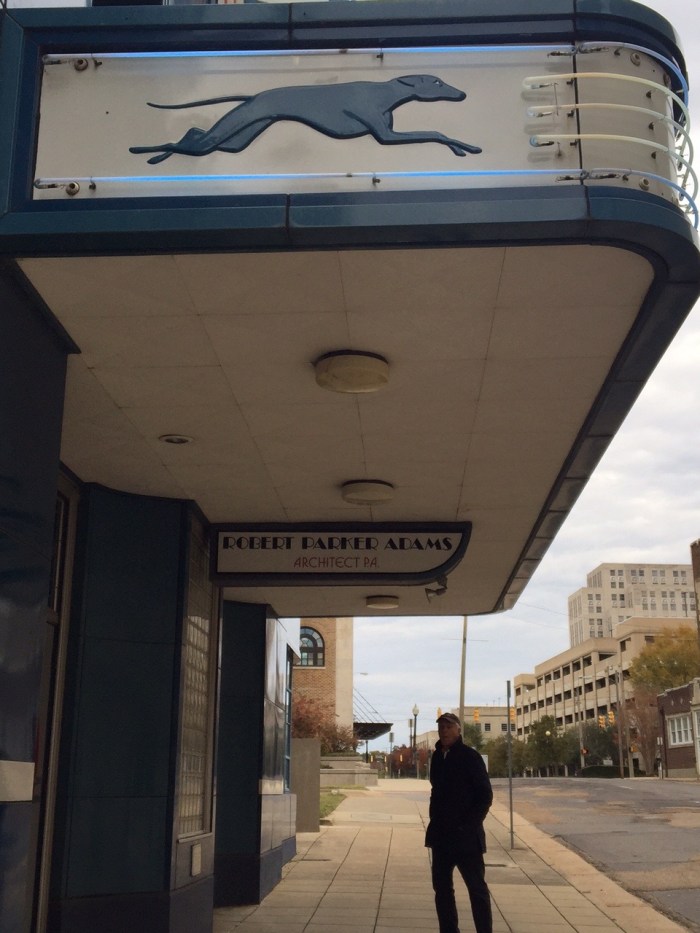 JACKSON, MISSISSIPPI: (Our first stop) The Greyhound bus station in downtown Jackson has been restored since the days of the Freedom Riders, who were seeking to desegregate public accommodations (as required by the Supreme Court). It takes a powerful imagination to visualize busloads of Freedom Riders arriving May 24th, 1961, guarded by tight security. In other cities the Freedom Riders had been viciously attacked, their buses burned, and the city of Jackson was determined to avoid violence (fearing for its reputation, not the Civil Rights activists.) And so, on arriving at the Greyhound station, the activists got off the buses and walked into the ‘White Only’ waiting room, where they were immediately arrested, marched into other buses, and taken to jail or directly to Parchman Farm, Mississippi’s notorious maximum security state prison. At their trial (and before convicting them), the judge actually turned his back whenever their defense attorney was speaking. He sentenced 161 Freedom Riders to 60 days in Parchman, although the convictions were eventually overturned. While at Parchman, most were held in isolation. Mississippi’s Governor, Ross Barnett, is supposed to have told prison officials, “Break their spirits, not their bones.”
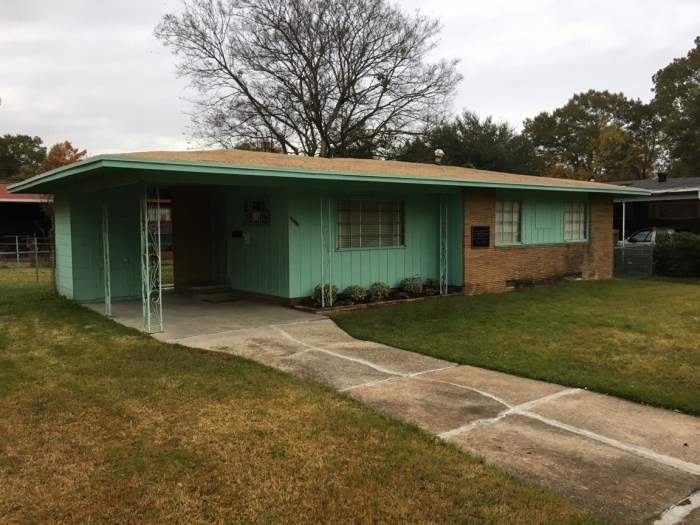
Medgar Evers, a college-educated World War II veteran and a prominent civil rights activist, lived and died here. Died on June 12, 1963, shot in the back by Byron De La Beckwith, a prominent member of the White Citizens’ Council. Mr. Evers had survived two earlier assassination attempts; a Molotov cocktail was thrown into the carport of his home and, one week before his murder, someone tried to run him down as he was crossing the street outside the local NAACP office.
Our guides on the trip were former ‘foot soldiers’ in the struggle for Civil Rights. One told us how Mr. Evers had been taken to the local hospital, where he was denied treatment because of his race and only admitted when hospital officials realized that he was ‘important.’ It was too late. He died..and was later buried with full military honors in Arlington National Cemetery.
De La Beckwith got away with murder…for 31 years. Finally, in 1994 he was brought to justice and sentenced to life imprisonment (Two previous trials in 1964 had resulted in hung juries). De La Beckwith died at age 80 in 2001, seven years after being convicted. We heard this gripping story, and others, from a remarkable reporter, Jerry Mitchell of the Clarion-Ledger in Jackson.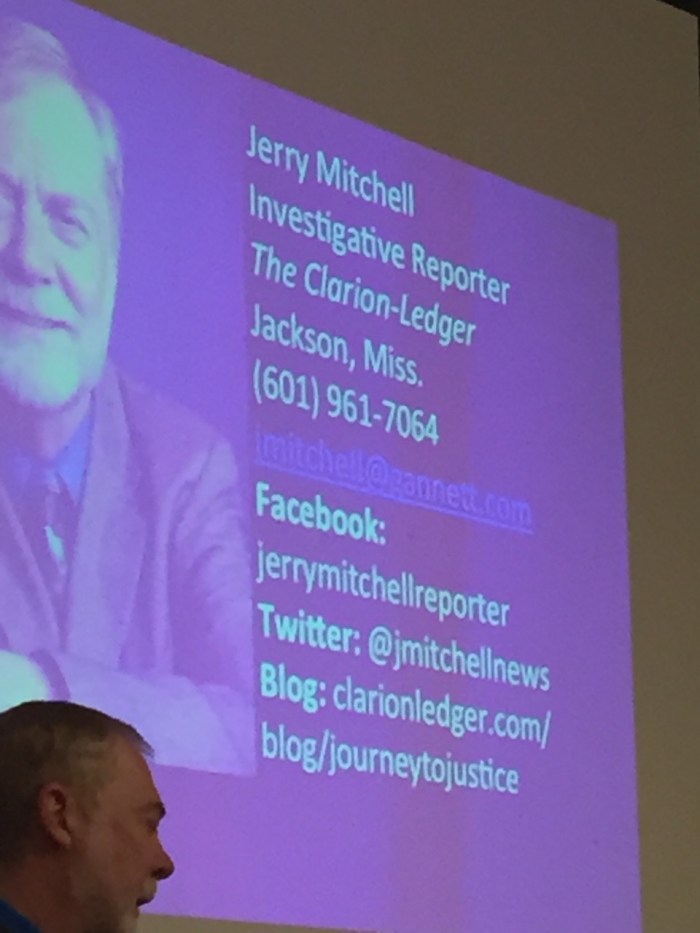 Jerry, whose numerous awards include a MacArthur ‘Genius’ grant, is a fearless reporter whose work has put at least four notorious race-baiting Klansmen behind bars…including one of the men who bombed the Birmingham church in 1963 and one of the Klansmen who murdered James Chaney, Michael Schwerner and Andrew Goodman in 1964. Jerry is also a warm, generous, engaging story-teller as well as a credit to the profession I recently retired from.
Our trip was organized by the John C. Stennis Institute of Government at Mississippi State University and the Education Policy Center at The University of Alabama. Most participants worked at Community Colleges in Alabama and Mississippi and were serving as Educational Policy Fellows in a program run by the Institute for Educational Leadership. My wife and I gained (paid) admission because I serve on the IEL Board.
This was our next stop, Mt. Zion United Methodist Church, which is in rural Mississippi but near both Philadelphia and Meridian.
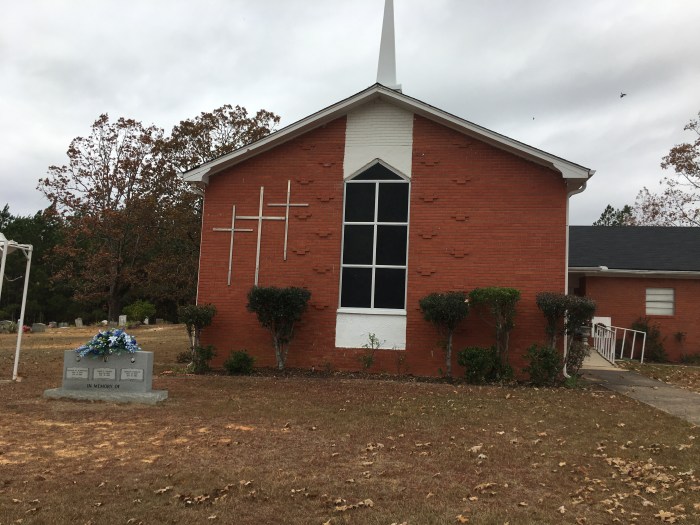
This church has been burned twice, in 1964 and again in 1971. The first burning occurred in June of 1964 when two groups of Klansmen surrounded the church, expecting to find Michael ‘Mickey’ Schwerner inside. The Church’s leaders had agreed to allow a Freedom School to operate there, and someone had shared that news with the wrong people. We learned that the Klansmen fought among themselves about the ‘appropriate’ punishment for the Church and parishioners. They savagely beat some churchgoers and then left, but one of the two Klan groups later returned and torched the church, destroying it.
We were privileged to hear from parishioners and church officials everywhere we visited, and what remains most striking, unforgettably so, is the forgiving attitude of those who were victimized by white racists. When I expressed amazement, one woman said simply, “If you let hate fester, it will kill you.” She paused and added, “And then they win.”
When word that Mt. Zion Church had been burned to the ground reached Mickey Schwerner in Oxford, Ohio, where he and his wife were helping train the Freedom Summer volunteers, he packed his bag and left for Mississippi. Accompanying him were his close associate James Chaney, a native of Mississippi and an African American, and one bright volunteer, Andrew Goodman of New York City.
Arriving in Meridian, they went to their headquarters to tell the two young people at the office of their plans. One of them was Roscoe Jones, then 18 years old, who was one of our guides on this remarkable tour. Roscoe told us that James Chaney asked him to come along, but Mickey said Roscoe couldn’t come without his mother’s permission, which he did not have. Because he stayed behind, he is alive today. Roscoe, now 69 years old, is pictured below at James Chaney’s gravesite.

On the drive from Mt. Zion back to Meridian, their station wagon got a flat tire. While they were changing the tire, local law enforcement noticed two whites and one black and stopped to question them. When a cop recognized Schwerner (known to them as ‘The Goatee’), the police waited until the three drove away and then arrested them. The charge was ‘speeding.’ They were held in the Philadelphia jail (below) until well after dark–long enough for the law officers to inform the Klan and for members to gather near the jail.
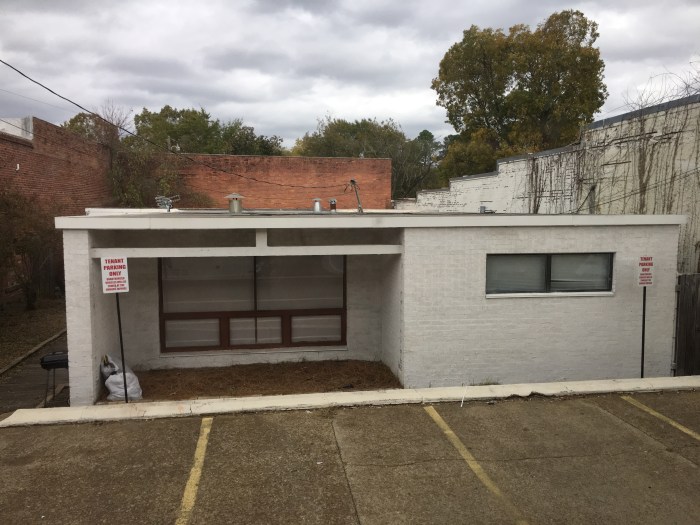
As Chaney, Schwerner and Goodman left town late that night they were followed by law enforcement and others. Before they reached the Neshoba County line (and perhaps safety), their car was pulled over after a high speed chase, and all three were abducted, driven to another location, and murdered. Schwerner and Goodman were shot on the spot, but Chaney was savagely beaten before being killed. Andy Goodman, a New York college student, had been in Mississippi less than 30 hours. They were murdered close to this spot below. Buried in an earthen dam, their bodies were not discovered for 44 days…and then only after a substantial reward was offered.
(During the search, which included dredging canals and ponds, searchers discovered NINE additional bodies, victims of earlier violence.)

That was in 1964, and, sadly, the race hatred remains. Plaques commemorating their deaths are ‘routinely’ trashed. Notice in the photo below the TWO plaques near Mt. Zion Church, the vandalized one on the ground, its new replacement recently installed. 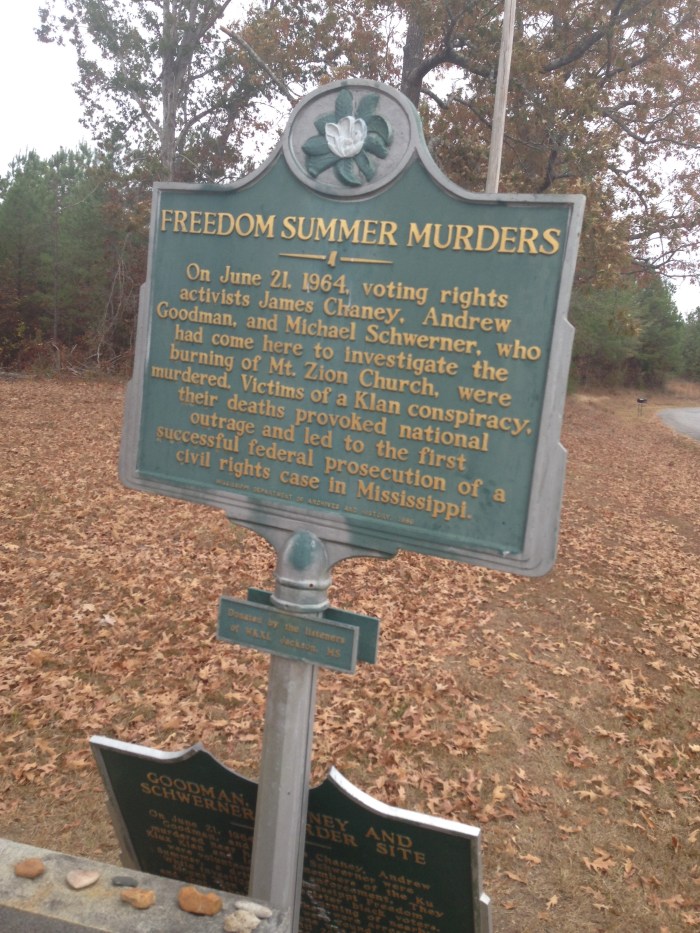
And James Chaney’s grave has been vandalized so many times that some local citizens have welded bars to keep it from being toppled over. The bars are clearly visible behind the tombstone.
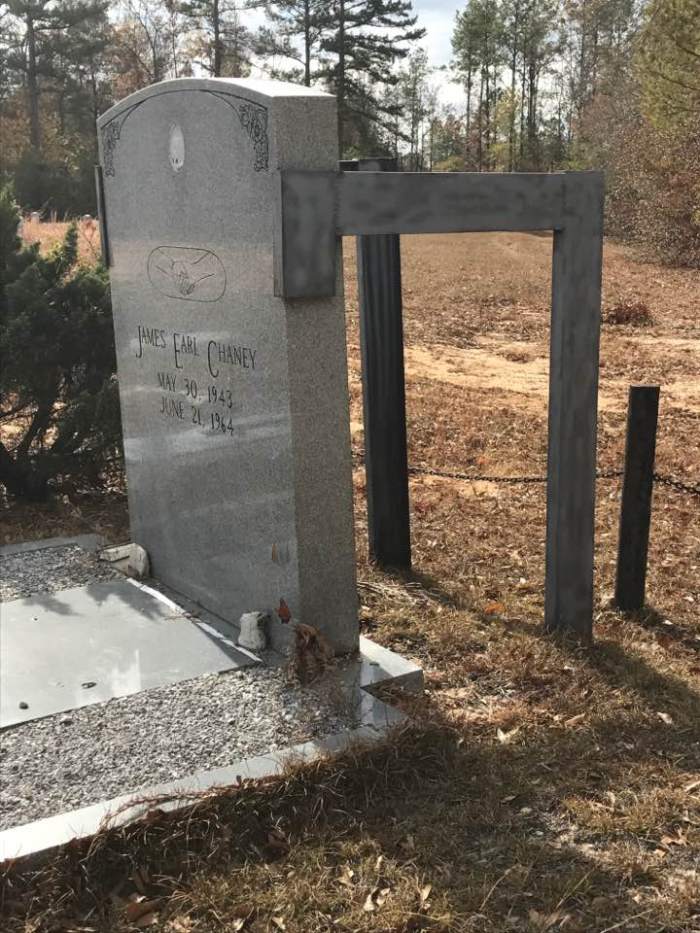
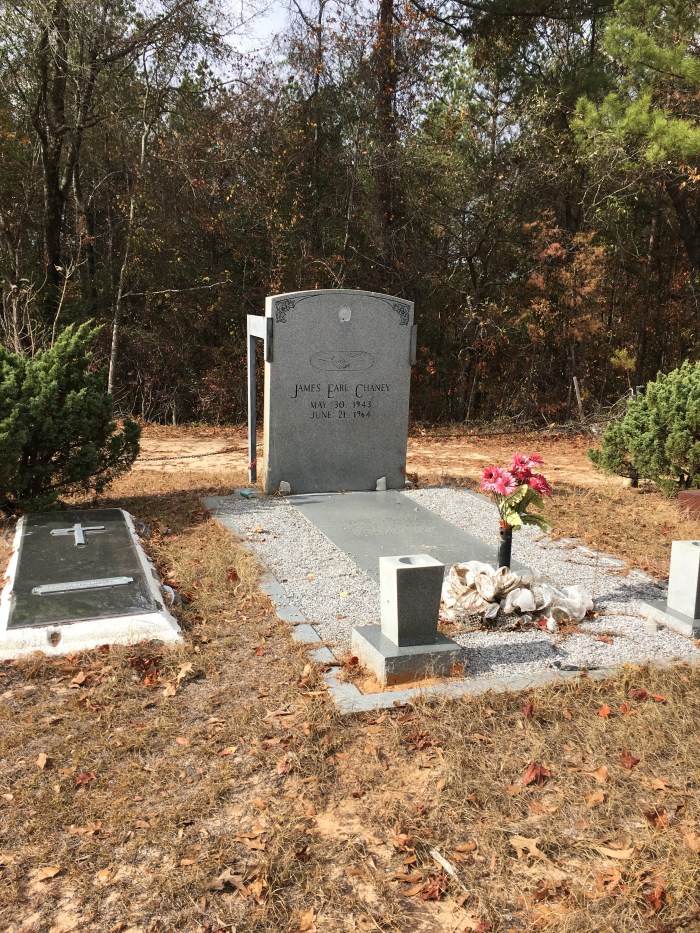 On James Chaney’s tombstone are these words: “There are those who are alive yet who will never live. There are those who are dead yet who will live forever. Great deeds inspire and encourage the living.”
When the state of Mississippi refused to prosecute, the US Government charged 18 men with civil rights violations. Seven were convicted in 1967 but served only minor sentences.
However, the murders of James Chaney, Michael Schwerner and Andrew Goodman changed history. One consequence was the passage of the Voting Rights Act of 1965, after which minority registration soared from about 6% in Mississippi to over 60% today, for example.
And to come full circle, 41 years after the murders and after extensive investigations by reporter Jerry Mitchell, one perpetrator, Edgar Ray Killen, was charged. Killen, an ordained Baptist minister and active Klan member, was convicted in 2005 on three counts of manslaughter and is serving a 60-year sentence. Killen was known to all as “Preacher.”
With that, our bus left Mississippi and headed for Alabama, which I will write about next. Meantime, I urge you to watch “Freedom Summer,” a superb PBS film from WGBH and American Experience.
(The photos were taken by Julia Parker, Leslie Worthington and Joan Lonergan.)
 The Merrow Report