The Influence of TFA

EDITOR’S NOTE: In concurrence with the launch of John Merrow’s book, The Influence of Teachers, he’ll be using this space as a place to discuss some  central ideas explored in the book. All proceeds from the book, available on Amazon for $14.95, are being donated to Learning Matters, a 501(c)(3) organization committed to independent coverage of education. We invite you to join in the conversation by commenting on these posts or reviewing the book online! Learn more about the book at www.theinfluenceofteachers.com.

By all reports, Teach for America’s 20th Anniversary Celebration in Washington last weekend was a star-studded event–as well it should have been given TFA’s growing importance. What began as a Princeton student’s senior thesis has become the proverbial 900-pound gorilla in education, a leader and a lightning rod. I’ve been part of what I believe has been balanced coverage of Teach for America, on the NewsHour, in a web-based series, and in my new book; that is, I’m not in either of the two large camps—those who love TFA and those who detest/fear/suspect it. The middle can be lonely, by the way.

Quick story here:  We followed seven Teach for America corps members in New Orleans for an entire year, part of our NewsHour coverage. We were being opportunistic: that is, we knew that only two or three of the teachers would make a NewsHour piece but we imagined that we could also get a pretty darn good documentary out of it.  By year’s end, we had some terrific material, and at that point I began looking for money.  I went to a number of foundations and individuals who have an interest in teacher education generally or in TFA specifically and made my pitch: 7 profiles, lots of good video of the nitty-gritty of the life of a first- or second-year teacher.

Fund-raising is tough sledding under normal circumstances, but this was downright depressing.  In every instance, I was asked a bottom line question, essentially “Is it all positive?” or “Is it all negative?”

Well, duh, of course it wasn’t.  We had captured reality, and reality is full of small victories and defeats.  A couple of the TFA teachers were splendid, seemingly born to teach.  Two were flops.  One got a raw deal from his principal and never hit his stride.  It was life, but no potential funders were interested in that story.
We ended up creating seven profiles and putting them on our web site, where you can see them for yourself and make your own judgments.
But it’s a shame that the world of teacher training has become so political. There’s no question that Wendy Kopp and Teach for America have changed the landscape and made a significant contribution.  But let’s not pretend that it’s all good or all bad.

As I write in my book, “It may well be that Teach For America’s greatest contribution to education will not be the kids who are helped or the talented young men and women who develop a connection with and affection for public education, but its relentless self-examination – a process that quite simply puts the rest of teacher education to shame. If Teach For America can work hard to figure out why some of its trainees become better teachers than others, why can’t regular schools of education?”
REQUIRED READING: 6 Titles Not To Be Missed

February is a great month for books about education, with very readable releases from John Seely Brown, Richard Whitmire, Ron Dietel, Alexander Russo, Gene Maeroff and one of Peg and Gris Merrow’s sons. It’s a short month, so you might not have time to read them all before March 1, but I hope you will give at least some of them a try. Below are my somewhat biased reviews of some notable titles.

For those who are looking forward to what schooling might become, “A New Culture of Learning: Cultivating the Imagination for a World of Constant Flux” is essential reading. While I don’t know co-author Douglas Thomas, I assure you that John Seely Brown is a deep thinker whose interests encompass just about everything. He’s one of the smartest people I know. To give you a taste of their thinking, here are a couple of quotes from the book. “We propose reversing the order of things. What if, for example, questions were more important than answers? What if the key to learning were not the application of techniques but their invention? What if students were asking questions about things that really mattered to them?” And “The ability to play may be the single most important skill to develop for the twenty-first century.” Amen to that, I say.

“A New Culture of Learning” turns school on its head, which the authors say is essential because the world our kids live in is already upside down. In short, play is the new work, and questions are the new answers. The book, which is short and punchy, is only available on Amazon. (Full disclosure: I blurbed this book.)

Richard Whitmire is an engaging writer and a fine story teller. Marry those talents with a charismatic subject, which Whitmire has done, and the result is a terrific read. “The Bee Eater” is a semi-authorized biography of Michelle Rhee, the former Chancellor of the Washington, DC schools. As some readers may know, we followed Rhee for 3 years  on PBS NewsHour (the 12 resulting episodes are viewable online). Whitmire, a friend and colleague over many years, essentially shadowed Michelle Rhee for months, and the result is an insightful portrait of a bold, courageous but flawed leader.“The Bee Eater” is published by Wiley.

Ready for a break, for a romp? Pick up Ronald Dietel’s biting spoof, “The Perfect Test.” It’s a dystopian vision of a world gone crazy, a science fiction portrait of the future that often comes wickedly close to where we are now. “The Perfect Test” will make you laugh, but it will also make you mad and make you think. (Full disclosure: Ron has generously signed over the royalties to the Education Writers Association and Learning Matters, my non-profit company.)

With all these books, I worry that Alexander Russo’s  will get lost in the shuffle, and I hope that does not happen. “Stray Dogs, Saints and Saviors” is the gritty story of an unlikely attempt to fix a broken Los Angeles high school, Locke High School in South Central L.A. Alexander, also a friend and colleague, seems to have had complete access to the process, and the result is an engaging story with several complex characters, including Green Dot founder Steve Barr. (Full disclosure: I also blurbed this book.)“Stray Dogs, Saints and Saviors” is published by Jossey-Bass.

“School Boards in America: A Flawed Exercise in Democracy” is the latest book from the tireless Gene Maeroff, the veteran New York Times reporter turned scholar. This is a dense but rewarding book, enlivened by stories of Gene’s own experience as a member of the school board in his home town of Edison, New Jersey. It’s not ‘tales out of school’ but a serious examination of the past and future of school boards. Given all the bad stuff that’s being written about school boards lately, this book is a necessary balance.“School Boards in America”, which is Gene’s 14th book, is published by Palgrave MacMillan.

And finally, I come to “The Influence of Teachers,” a book that comes out in a few days on Amazon. Neither Peg nor Gris Merrow, the author’s parents, are here to tell you to buy the book, but others are speaking up. Here’s a sample:

“Terrific” – Jim Lehrer

“Invaluable” – Marian Wright Edelman, Children’s Defense Fund

“Important and enjoyable, warm and thoughtful” Former US Secretary of Education Richard C. Riley

“Passionate, persuasive, and eminently readable” Chris Cerf, co-creator of ‘Between the Lions’ and recipient of the 2010 McGraw Prize in Education

“A book that will move you to tears and to action” Tony Marx, incoming President of the New York Public Library and current President of Amherst College

“If only there were more John Merrows!” E.D. Hirsch, Jr., founder of Core Knowledge and author of Cultural Literacy

By now you have figured out that I wrote “The Influence of Teachers,” which LM Books published on Amazon. It’s available on February 15th, although you can put in your order right now, by clicking this link. (All of the proceeds go directly to Learning Matters.)

Happy reading…

On Teachers: Let’s Stop Bashing and Get Proactive

Last week in this space I wondered why the President had singled out for high praise a school in Denver where the teachers had taken on their own union to get work rules relaxed. Was he, I asked, sending a not-very-subtle message to teacher unions, “Put kids’ interests first. Stop with the trade union behavior”?

I asked Peter Cunningham, the Department’s uber-capable Assistant Secretary for Communications and Outreach, how that particular school was selected. He responded in an email that he had had nothing to do with it.

So if it wasn’t the Department of Education, then who? The likely suspects are on the President’s White House staff or in the Office of Management and Budget. Perhaps someone is off the reservation.

Or perhaps a speechwriter didn’t perform due diligence. That happens.

Or maybe eager staffers who work for Colorado Senator Michael Bennet (former Denver Superintendent of Schools) did their job—promoted their boss—effectively. (We saw the Senator and others from Colorado give their own standing ovation at that point in the speech.)

I wish the President had singled out a successful school that also models what many of us would like to see everywhere: teachers and their unions working with management to give kids maximum opportunities to learn. That would have been a great lesson for his audience, and it would have helped tamp down the teacher-bashing and teacher-union bashing. Instead, he added fuel to their fire, which is already hot and getting hotter, as more governors go after tenure and seniority.

But what matters more right now is what the Department and others are actually doing. Lots, it turns out. For instance, later this month the Department will host 150 school districts (in Denver!) for two days about ‘labor management collaboration.’ In the press release, Education Secretary Arne Duncan is quoted as saying, “Union leaders and administrators across the country are finding new ways to work together to focus on student success. The leaders from these 150 districts are committed to bold reforms and are showing the country what is possible when adults come together, particularly in tough times, to do the right thing for kids.”

This event is sponsored by the two teacher unions, the American Federation of Teachers and the National Education Association, the National School Boards Association, the American Association of School Administrators and the Council of the Great City Schools. That is, just about everyone.
The Ford Foundation is picking up this tab, according to the press release. Elsewhere, the Gates Foundation is putting serious dollars behind collaborative efforts in Hillsborough, Florida and other districts.

The skeptic in me wonders about two phrases the Secretary uses: ‘bold reforms’ and ‘student success.’ If by the latter he means higher test scores, this meeting won’t amount to much. If by ‘bold reforms,’ he means ‘turnaround specialists’ and other half-hearted changes, the meeting will probably be a waste of time.

I hope he (and Peter Cunningham) insist that everyone prepare for the meeting by reading or re-reading the two most recent surveys of teachers done by Met Life and Scholastic/Gates Foundation. Use those documents as the foundation, and something great could come out of these two days in February.

Stopping teacher bashing is not enough. Nor is “better communication” between labor and management. What’s needed is a proactive effort to make teaching a better job.

NB: “Better Job” does NOT mean shorter hours or higher pay, if you trust what the teachers themselves say. What they want, according to MetLife and Scholastic/Gates, are opportunities to collaborate, involvement in curriculum, trust and respect.

The State of The (Teachers) Union

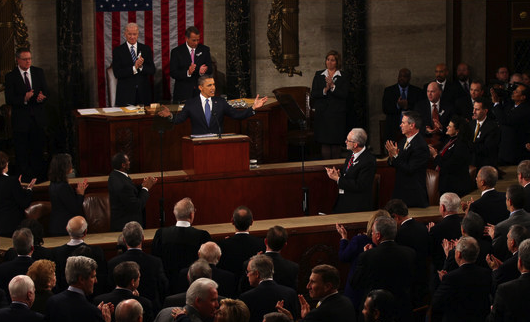
2011 SOTU address (photo NY Times)

Was the President sending a strong message to teacher unions last night? Sure looks that way in the light of day.

What most of us saw and heard was high praise for education. He put it #2, behind ‘innovation’ on his list. Five of his 23 guests were students, and a 6th—Jill Biden—is a community college teacher. That’s all good. Mr. Obama praised “Race to the Top” and called for rewriting No Child Left Behind, and that’s all good too.

He went out of his way to praise teachers and remind us all that parents must do their job—turn off the TV, and engage with their children. That provided a welcome relief from all the teacher- bashing going on now.

And—icing on the cake–he made an eloquent plea to young people: become teachers!

Friends of public education had to be smiling and may still be today. The National School Boards Association and others have issued press releases full of praise, for example.

You may remember that he singled out one public school for high praise.

Here’s what he said:

Take a school like Bruce Randolph in Denver. Three years ago, it was rated one of the worst schools in Colorado; located on turf between two rival gangs. But last May, 97% of the seniors received their diploma. Most will be the first in their family to go to college. And after the first year of the school’s transformation, the principal who made it possible wiped away tears when a student said ‘Thank you, Mrs. Waters, for showing… that we are smart and we can make it.’ [The reference is to principal Kristin Waters.]

I confess that the significance of the President’s choice went right over my head, but Andy Rotherham didn’t miss it. He provided context on the NY Times blog. Here’s what Andy wrote:

The president singled-out a Denver school that was turned around only after its teachers took on their own union to get out from under the standard collective bargaining agreement. Needless to say that’s a strategy the two national teachers’ unions don’t want to see replicated around the country. I wrote about that episode on The Times’s Op-Ed page a few years ago. Michael Bennet, now a senator from Colorado, was the superintendent in Denver at the time and the move was controversial then and the idea remains contentious today. Of all the schools the president could have chosen to highlight, it’s a fascinating choice.

Andy’s op-ed (March 10, 2008) provides more background:

When teachers at two Denver public schools demanded more control over their work days, they ran into opposition from a seemingly odd place: their union. The teachers wanted to be able to make decisions about how time was used, hiring and even pay. But this ran afoul of the teachers’ contract. After a fight, last month the union backed down — but not before the episode put a spotlight on the biggest challenge and opportunity facing teachers’ unions today.

This morning’s Denver Post explained further:

The high-poverty school was the first to petition for and be granted innovation status — an agreement by union teachers to waive certain district and union rules. The idea was to give teachers more time, money and other resources to work with struggling students. The school has been climbing in achievement over the years.
In its transformation, Bruce Randolph changed from being a straight middle school into a school serving grades 6-12. Its first class graduated last spring into the open arms of a tearful Waters.

Bruce Randolph had been on the list of schools to be closed. Today it’s not the slam-dunk success that the President implied. It’s still on the ‘watch list’ and ranks 66th out of about 150 schools in Denver, but it clearly has improved dramatically.

But the story is not how much the school has improved; it’s how. Union rules were in the way, and so teachers took on their union. With the support of the superintendent, they forced union leadership to back off.

It seems pretty clear that last night the President was firing another shot across the union bow, much as he did last year when he sided with a Rhode Island school board that fired its high school teachers when they wouldn’t go along with a reasonable ‘restructuring’ plan.

“Stop with the trade union stuff,” the President was saying. “Start putting the interests of students first.”

Unions don’t seem to have much choice in the matter, given the outpouring of anti-union and anti-teacher rhetoric and actions in New Jersey, Alabama, Wyoming and just about any state you can name. Randi Weingarten of the American Federation of Teachers, the smaller of the two unions, seems to get it, but she has to persuade her mostly urban locals to move. The far larger National Education Association hasn’t shown any signs that I have seen that it recognizes that the ground has shifted, dramatically and probably permanently.

[Click here for the full text of President Obama’s address]

Teacher Bashing

Teacher bashing is all the rage these days, unfortunately.

Teachers are leaving the profession, and I am hearing from teachers I trust that the exodus would be greater if the economy were better. While I think that aspects of the profession ought to be criticized, particularly the ‘trade union’ mentality of some—but not all—union leaders, the bashing is way out of line.

I write about this in my forthcoming book, The Influence of Teachers, but here today I am simply presenting the words from one veteran teacher, a woman I know to be dedicated to her students and the profession.

Please read and reflect.

I teach in a public high school whose students reflect the full socio-economic range of our county.  But rich or poor and regardless of the educational backgrounds of their parents, many of my students seem to need me to parent them as well as teach them. 
On any given day, in order to teach I must also address the results of this kind of parenting:

–The gay teen whose mother tells him she wishes he had never been born and refuses to come get him when he cuts himself in the school bathroom;

–The-15-year-old whose smell makes us wretch because his clothes aren’t washed and he doesn’t bathe regularly;

–The 15-year-old girl who is shoved through a pane glass window by her mother’s boyfriend when she asks him not to smoke around his new infant daughter (her half sister);

–The affluent boy whose parents’ acrimonious divorce (his father’s 3rd) forces him to quit the tennis team this spring because the shared custody arrangement (alternating homes nightly) leaves no way for him to get home from school after practices and games;

–The mother who corners me in the parking lot at Safeway to challenge a grade on her son’s paper, saying it’s because he rushed that he didn’t clean up the evidence of plagiarism in his essay, and I have to re-grade the paper because his IEP entitles him to extended time (the plagiarism itself didn’t trouble her);

–The 14-year-old boy who cannot stay awake in class because he is out until after midnight most school nights; his mother says, “he doesn’t listen to me,” and add that, in her opinion, he’s “too old to have a bedtime;”

–The mother who tells me to stop calling her about her child’s behavior and says, “When she’s at school she’s your problem.  Stop expecting me to do your job.”

–The phone that does not ring when report cards and interims go home showing failing grades.

–The father who berates me for chastising his daughter (who has 3 Es and 2 Ds) when I find her hanging out with her friends in the hallway rather than participating in an optional after-school Exam Review session which the teacher is running voluntarily and on his own time.

  I am not alone. Many teachers feel like punching bags and crash test dummies.

Now, dear reader, ask yourself: would you trade places with that teacher? Could you last in the job as long as she had and still be as effective and caring as she is? Does she have a right to be upset?

For reasons I don’t understand, many powerful people are defining public education’s problem as “Bad Teachers.” That’s simplistic and dangerous.

Your thoughts on what we can do to make things better?

Is Tenure Finally Up for Debate?

“If I could change one thing, I would get rid of tenure.” – Larry Rosenstock, founder of High Tech High and winner of the 2010 McGraw Prize in Education, at a public forum, September 2010

“So would I.” – Stephen McMahon, President of San Jose (CA) Teachers Union, in response.

“I could care less about tenure.” – Dal Lawrence, former president of the Toledo Federation of Teachers, in an interview, November 2010

“I have started using the words ‘due process’ myself.   I think ‘tenure’ is a loaded word.” – Randi Weingarten, President of the American Federation of Teachers, in an email, November 2010

What on earth is going on here? Is the question of tenure actually up for debate and discussion?  If so, it’s long overdue.  And is it possible that teacher unions will take the initiative?

Teacher tenure is closely connected to the flawed evaluation process.  After all, an evaluation system–like the current one–that finds 97 percent of teachers to be ‘satisfactory’ or better will have no trouble handing out lifetime jobs.

“Tenure should be a significant and consequential milestone in a teacher’s career,” notes the National Council on Teacher Quality.  “Unfortunately, the awarding of tenure occurs virtually automatically in just about all states, with little deliberation or consideration of evidence of teacher performance. Teacher effectiveness in the classroom, rather than years of experience, should be the preponderant criterion in tenure decisions.”

In the current system, most public school teachers gain tenure, generally speaking a lifetime job, after just three years of teaching. In eight states, including California and Maryland, tenure is granted after two years. Hawaii and Mississippi offer tenure after just one year, and our nation’s capital requires no set amount of teaching performance before granting tenure.  In other words, many school administrators are forced to make this critical and lasting decision halfway through a teacher’s first or second year in the classroom.

That’s changing.  Several state legislatures may pass laws that eliminate teacher tenure.  The New York City school administration has just acted to make attaining tenure more difficult, by requiring principals to do more than check off a box or two (the old way).  New York has a problem: In the last school year, only 234 teachers out of the nearly 6,400 who were eligible for tenure were denied it; that’s 3.7 percent.  It was even easier four years earlier, when only 0.4 percent of those eligible were denied tenure.  Under the new rules, principals must now consider a teacher’s contributions in and out of the classroom and his students’ performance on standardized tests.

What’s the right course of action?  Get rid of tenure while maintaining due process protections?  Make it more difficult to achieve?  Or perhaps have term contracts for five or ten years at a clip?
I have an opinion on this but would like to hear yours first.

Thanksgiving Tricks & Treats: Klein, Tenure, NAEP and more

Somehow this Thanksgiving seems more like Halloween, full of tricks and treats.

#1. The big treat was, of course, Tom Friedman’s column in the New York Times, telling the world that, if he were starting out in journalism today, he would be an education reporter. He’s right. It’s a happening beat.

Joel Klein, Bill Gates, Randi Weingarten, Cathie Black#2. This next one is either a trick or a treat, depending on where you are sitting: Bill Gates continues to speak out, leading some to label him ‘the shadow Secretary of Education. This time he chose the annual meeting of the Council of Chief State School Officers in Louisville to call for huge changes in how teachers are paid. He said that the ‘bonus’ for having a Master’s degree was a waste of money (lots of money too, an estimated $8.6 billion in extra pay), because there’s little evidence that extra degrees add to positive student outcomes.  There’s a mighty wind blowing on the issue of teacher pay. Continue reading

MOVIE REVIEW: The Lottery

Put one notion to rest: The Lottery is not a poor cousin of Waiting for Superman.  In some respects it’s a purer and more honest film, ferocious in its anger.  And although an NPR reviewer called it “a devastating piece of propaganda,” the filmmaker begs to disagree.

Madeleine Sackler, not yet 30 years old, says The Lottery simply tells the stories of the lives of four families as they struggle to find better educational opportunities for their children.  “That word, propaganda, has a negative connotation,” she said. “This movie is true.”


Continue reading

Four Days IN Education Nation

I’ve spent the past four days immersed in public education. First in Texas, where I spoke with and listened to superintendents and school board members; then at Education Nation, a day-and-a-half event put on by NBC and sponsored by the University of Phoenix and some major foundations, and finally at the annual dinner where the McGraw Prize in Education is awarded.Education Nation by John Merrow

Remember that classic western, “The Good, the Bad, and the Ugly”? Just like the movie’s title, I’m starting with the good. That would be the McGraw Prize, an annual black tie event I hadn’t attended for five or six years. Last night three educators who are making a huge difference were honored, men who are challenging the status quo by demonstrating better ways to educate Americans of all ages. They spend their time lighting candles, not cursing the darkness. You can read more about Larry Rosenstock of High Tech High, Bob Mendenhall of Western Governors University, and Chris Cerf of Between the Lions here (and I hope you will).
Continue reading

Further Proof that Teachers Matter

Last week I endorsed the use of data to identify ineffective teachers and—THIS IS IMPORTANT—the administrators who have known the identity of the underperforming teachers and have not acted.  That set off a firestorm, which I take to be indicative of the issue’s importance.

Credit: Sally Ryan / The Chicago News Cooperative

The LA teachers union is outraged, but according to reports it is also now being pressured by the school district and by AFT president Randi Weingarten (!) to reconsider. Here’s part of what the Los Angeles Times reported:

The Los Angeles Unified School District will ask labor unions to adopt a new approach to teacher evaluations that would judge instructors partly by their ability to raise students’ test scores — a sudden and fundamental change in how the nation’s second-largest district assesses its educators.

The teachers union has for years staunchly resisted using student test data in instructors’ reviews.

The Times also reports that LAUSD has had this information for years but has not acted because of inertia and fear of the union. I disagree: I think it goes back to the system’s willingness to tolerate mediocrity.

A number of respondents to last week’s post attacked my reasoning. Knowing that I am an opponent of simple bubble tests and have spoken out on the importance of multiple measures, they wondered how I could get behind a system that was using so-called ‘value added’ data and nothing else.

I cop to the charge of inconsistency and defend myself thusly: nothing else was happening! Continue reading