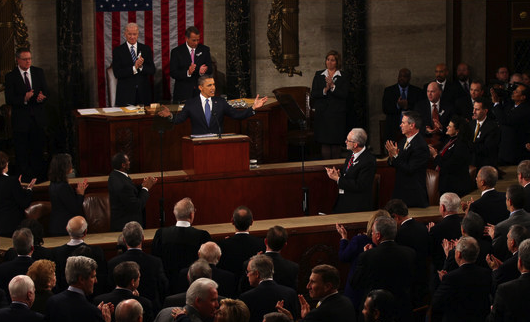
The State of The (Teachers) Union

2011 SOTU address (photo NY Times)

Was the President sending a strong message to teacher unions last night? Sure looks that way in the light of day.

What most of us saw and heard was high praise for education. He put it #2, behind ‘innovation’ on his list. Five of his 23 guests were students, and a 6th—Jill Biden—is a community college teacher. That’s all good. Mr. Obama praised “Race to the Top” and called for rewriting No Child Left Behind, and that’s all good too.

He went out of his way to praise teachers and remind us all that parents must do their job—turn off the TV, and engage with their children. That provided a welcome relief from all the teacher- bashing going on now.

And—icing on the cake–he made an eloquent plea to young people: become teachers!

Friends of public education had to be smiling and may still be today. The National School Boards Association and others have issued press releases full of praise, for example.

You may remember that he singled out one public school for high praise.

Here’s what he said:

Take a school like Bruce Randolph in Denver. Three years ago, it was rated one of the worst schools in Colorado; located on turf between two rival gangs. But last May, 97% of the seniors received their diploma. Most will be the first in their family to go to college. And after the first year of the school’s transformation, the principal who made it possible wiped away tears when a student said ‘Thank you, Mrs. Waters, for showing… that we are smart and we can make it.’ [The reference is to principal Kristin Waters.]

I confess that the significance of the President’s choice went right over my head, but Andy Rotherham didn’t miss it. He provided context on the NY Times blog. Here’s what Andy wrote:

The president singled-out a Denver school that was turned around only after its teachers took on their own union to get out from under the standard collective bargaining agreement. Needless to say that’s a strategy the two national teachers’ unions don’t want to see replicated around the country. I wrote about that episode on The Times’s Op-Ed page a few years ago. Michael Bennet, now a senator from Colorado, was the superintendent in Denver at the time and the move was controversial then and the idea remains contentious today. Of all the schools the president could have chosen to highlight, it’s a fascinating choice.

Andy’s op-ed (March 10, 2008) provides more background:

When teachers at two Denver public schools demanded more control over their work days, they ran into opposition from a seemingly odd place: their union. The teachers wanted to be able to make decisions about how time was used, hiring and even pay. But this ran afoul of the teachers’ contract. After a fight, last month the union backed down — but not before the episode put a spotlight on the biggest challenge and opportunity facing teachers’ unions today.

This morning’s Denver Post explained further:

The high-poverty school was the first to petition for and be granted innovation status — an agreement by union teachers to waive certain district and union rules. The idea was to give teachers more time, money and other resources to work with struggling students. The school has been climbing in achievement over the years.
In its transformation, Bruce Randolph changed from being a straight middle school into a school serving grades 6-12. Its first class graduated last spring into the open arms of a tearful Waters.

Bruce Randolph had been on the list of schools to be closed. Today it’s not the slam-dunk success that the President implied. It’s still on the ‘watch list’ and ranks 66th out of about 150 schools in Denver, but it clearly has improved dramatically.

But the story is not how much the school has improved; it’s how. Union rules were in the way, and so teachers took on their union. With the support of the superintendent, they forced union leadership to back off.

It seems pretty clear that last night the President was firing another shot across the union bow, much as he did last year when he sided with a Rhode Island school board that fired its high school teachers when they wouldn’t go along with a reasonable ‘restructuring’ plan.

“Stop with the trade union stuff,” the President was saying. “Start putting the interests of students first.”

Unions don’t seem to have much choice in the matter, given the outpouring of anti-union and anti-teacher rhetoric and actions in New Jersey, Alabama, Wyoming and just about any state you can name. Randi Weingarten of the American Federation of Teachers, the smaller of the two unions, seems to get it, but she has to persuade her mostly urban locals to move. The far larger National Education Association hasn’t shown any signs that I have seen that it recognizes that the ground has shifted, dramatically and probably permanently.

[Click here for the full text of President Obama’s address]

Can We Build A Grad Nation?

We have 15 million high school students, but about 1 million drop out every year. That’s nearly 7%! This means that approximately 1 out of every 4 9th graders won’t graduate high school.

America's Promise, Building a Grad NationToday’s report from America’s Promise, “Building a Grad Nation,” indicates that some progress has been made, but not enough. The report, made possible by Target, calls for a domestic Marshall Plan to address the problem.

I had strong reactions to five points in the report. And if you are too busy to read them all, please skip to #5.

#1: Credit card companies can track us anywhere, anytime, but schools don’t have a clue about where their students end up, because states and schools don’t count graduates and dropouts the same way. We do have a common measure—but, the report notes, “The federal government will require the states to use this calculation for the 2010-2011 school year and be held accountable for their progress based on this calculation for the 2011-2012 school year.”

In other words, wait till next year!

Anybody else wondering why this is taking so long? Continue reading

On learning to read

Why children want to be able to read is not open for debate. It’s for the same reasons that they want to walk: to control their own destiny. It’s purely pragmatic; children understand that, when they know how to read, they are better able to navigate their environment successfully, just as they intuitively understand that walking is better than crawling or toddling.

on learning to readIt’s the how and when, not the why, that are the issues. Again, learning to walk has some lessons for us. Some children are early walkers, maybe because of temperament, the presence of siblings or body development. Children who are heavier, for example, shouldn’t be pushed to become toddlers and walkers early, because that can put their physical development at risk.

Encouragement is a huge part of learning to walk. Think back to your own children, if you have them, and I am sure you can conjure up images of you and your spouse smiling, clapping and otherwise encouraging your toddler. You were there to lend a hand or prevent a serious fall, of course, but you also tried to keep ‘hands off’ when you could.

And you are a walker yourself, meaning that you modeled the behavior for your child.

Learning to read follows that pattern. Encouragement, modeling, timing are all part of the recipe.

But there’s one other essential ingredient—knowing something about how to teach reading—because, unlike walking, reading is not instinctive. At bottom, it’s an unnatural act, albeit a vital skill.

Two things brought this to mind. The first is the comprehensive report from the Annie E. Casey Foundation, “Learning to Read/Reading to Learn.” That report, which came out earlier this year, is subtitled “Early Warning: Why Reading by the End of the Third Grade Matters.” It’s a wake up call that traces our status as ‘dropout nation’ back to the elementary grades. As the Casey report notes, “(M)illions of American children get to fourth grade without learning to read proficiently. And that puts them on the dropout track.”

The second reminder was more personal—packing up to move to new office space—because that process stirred up my own past. Because I’m something of a pack rat, I saved all sorts of stuff from my three children’s elementary school years. Along with their early ‘art work’ and report cards, in their folders I found some of the books that they were given as part of the wonderful program known as Reading Is Fundamental, or RIF. RIF went to inner city schools (including ours in Washington, DC) offering free books to kids. These were often the first books a child had ever owned. What’s more, RIF offered choices, not just the books that teachers and parents wanted children to read over the summer or on their own. Reading is Fundamental makes reading FUN as well as fundamental.

My kids were fortunate. Their parents were readers, their school had not bought into either reading ideology, ‘whole language’ or ‘phonics,’ and the principal encouraged what was called SSR, sustained silent reading, a daily period of 20 minutes or so when everyone—including the teacher—read something of his or her own choosing. I had sweetened the pot by telling my kids that they could travel with me (I worked for NPR) as soon as they could read.

I noted earlier that reading is not a natural act, more like swimming than walking. Most children will not learn to read (or swim) unless they are taught. But teaching must take advantage of children’s natural desire to learn. Teaching must be joyful and carefully thought out. Teachers must adapt to individual children, because, while most children can learn to read in first grade, not everyone is ready, and no one should be made to feel a failure.

While I understand the distinction between ‘learning to read’ and ‘reading to learn,’ it’s essential to remember that all kids care about is the latter. They’re pragmatists, remember.

The importance of joy and freedom of choice is reinforced by recent research done at the University of Tennessee. The 3-year study found that giving low-income children books and letting them choose which 12 titles to take had a powerful impact on what’s called the ‘summer learning gap.’ The research involved more than 1300 Florida children and included a control group of kids who got games instead of books. The kids who got the books outperformed the others by the equivalent of three years of summer school. (If the fact that a biography of Britney Spears was the most popular choice bothers you, I say, “Get a grip.”)

Tara Parker-Pope’s article also reminds us of a grim reality: schools are cutting back on the very programs that provide the building blocks for all future learning, summer programs and enrichment programs.

I believe our best teachers ought to be in the early grades. Who can make that happen? Is it happening in some places? If so, let’s spread that word.

Learn More:

Reading is Fundamental

Annie E. Casey report, “Learning to Read/Reading to Learn

Writing ‘Below C Level’

In my work for PBS NewsHour over the past three years, I am most often asked two very specific questions: “Is Jim Lehrer ever going to retire?” And “What is your personal opinion of Michelle Rhee? Do you like her and what she’s doing in Washington?”

Below C LevelTo the first question my answer is always the same. ‘I hope not.” Of course I never answer the second question when I am asked, because it’s our job to report what we see happening, not express opinions or pass judgment. I do, however, have some thoughts on the subject, which you will find in Chapter 9 of Below C Level, pages 81-105. Yes, it takes 24 pages.

I spent five and one-half years writing Below C Level. The first drafts of many of the chapters were written on an airplane—I haven’t watched an in-flight movie for years—because my work takes me to distant places, and I have been living on the West Coast for the past eight years.

But, looking back with the first copy of Below C Level on the desk next to me now, I realize that the first five years were a walk in the park, relatively speaking. The last six months were without question the hardest part of the journey. During that time I rewrote every one of the 37 chapters. Once rewritten, it then had to find a place in the structure of the book, or go into the circular file. Continue reading

Summer reading

Well, it’s finally here, the proof copy of Below C Level. I looked it over and then went on line to give my approval. That one keystroke made the book available immediately.

Below C LevelAnd if you want to be the first in your neighborhood to have a copy, please visit the Below C Level website or purchase it online directly at www.createspace.com/3422460.

When you do that, you will be getting a pretty good read and also helping Learning Matters–because I am donating most of the royalties to the company.

What’s in the book, you ask? Well, It’s 432 pages before you even get to the index, 37 chapters covering everything from pre-school through higher education.

A wry friend suggested that, if I wanted to sell a lot of books, I should just write about all the people I’ve interviewed over the past 34 years. An option, he said, was to tell the truth about them. I’ve actually followed his advice (including the option); the index is 11 pages of mostly names. Continue reading

Solving a man-made problem

One of education’s dirty little secrets is that schools give what they call their ‘end of the year’ tests about six weeks before the end of school. The school year is only 5/6th of the way done, but it’s testing time, and everything stops.

School's outThink about that for a moment, maybe put yourself in the shoes of a teacher or a student. If you’re a kid, the message is clear: the year is over! Time to kick back and relax. However, if you happen to be a conscientious teacher, you have to climb a big hill every morning and afternoon for the next five or six weeks, because you have to try to interest your students in what they know doesn’t matter.

Left unexplored is what’s being tested. Do these tests cover everything that the students are supposed to have learned, or merely 5/6ths of the material? If they cover everything, isn’t that unfair to those who are being judged by the results (students and, increasingly, their teachers)? If they cover just 5/6th of the course content, will that mean that many students will never get past, say, World War II in history?

Why this happens is no mystery: it’s done for administrative convenience, to give the test companies time to run the test papers through their machines, process the scores, and get them back to the school districts as early as possible in the summer. With so many tests and so few companies, the bottleneck is frightening, worse than the lines at the toll booths on a summer evening when everyone is driving back from the beach.

What makes this bottleneck worse are the mistakes that occur. Imagine if the toll collectors randomly collected different amounts from some drivers! That’s what happens when the machines begin their mass processing: they make mistakes! Continue reading