The State of The (Teachers) Union

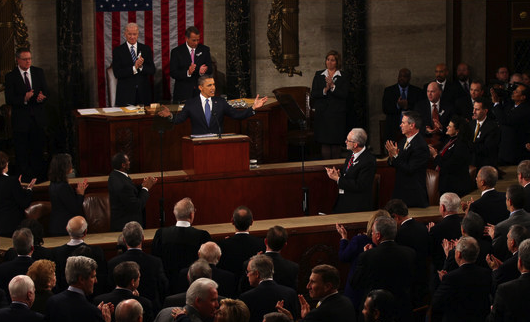
2011 SOTU address (photo NY Times)

Was the President sending a strong message to teacher unions last night? Sure looks that way in the light of day.

What most of us saw and heard was high praise for education. He put it #2, behind ‘innovation’ on his list. Five of his 23 guests were students, and a 6th—Jill Biden—is a community college teacher. That’s all good. Mr. Obama praised “Race to the Top” and called for rewriting No Child Left Behind, and that’s all good too.

He went out of his way to praise teachers and remind us all that parents must do their job—turn off the TV, and engage with their children. That provided a welcome relief from all the teacher- bashing going on now.

And—icing on the cake–he made an eloquent plea to young people: become teachers!

Friends of public education had to be smiling and may still be today. The National School Boards Association and others have issued press releases full of praise, for example.

You may remember that he singled out one public school for high praise.

Here’s what he said:

Take a school like Bruce Randolph in Denver. Three years ago, it was rated one of the worst schools in Colorado; located on turf between two rival gangs. But last May, 97% of the seniors received their diploma. Most will be the first in their family to go to college. And after the first year of the school’s transformation, the principal who made it possible wiped away tears when a student said ‘Thank you, Mrs. Waters, for showing… that we are smart and we can make it.’ [The reference is to principal Kristin Waters.]

I confess that the significance of the President’s choice went right over my head, but Andy Rotherham didn’t miss it. He provided context on the NY Times blog. Here’s what Andy wrote:

The president singled-out a Denver school that was turned around only after its teachers took on their own union to get out from under the standard collective bargaining agreement. Needless to say that’s a strategy the two national teachers’ unions don’t want to see replicated around the country. I wrote about that episode on The Times’s Op-Ed page a few years ago. Michael Bennet, now a senator from Colorado, was the superintendent in Denver at the time and the move was controversial then and the idea remains contentious today. Of all the schools the president could have chosen to highlight, it’s a fascinating choice.

Andy’s op-ed (March 10, 2008) provides more background:

When teachers at two Denver public schools demanded more control over their work days, they ran into opposition from a seemingly odd place: their union. The teachers wanted to be able to make decisions about how time was used, hiring and even pay. But this ran afoul of the teachers’ contract. After a fight, last month the union backed down — but not before the episode put a spotlight on the biggest challenge and opportunity facing teachers’ unions today.

This morning’s Denver Post explained further:

The high-poverty school was the first to petition for and be granted innovation status — an agreement by union teachers to waive certain district and union rules. The idea was to give teachers more time, money and other resources to work with struggling students. The school has been climbing in achievement over the years.
In its transformation, Bruce Randolph changed from being a straight middle school into a school serving grades 6-12. Its first class graduated last spring into the open arms of a tearful Waters.

Bruce Randolph had been on the list of schools to be closed. Today it’s not the slam-dunk success that the President implied. It’s still on the ‘watch list’ and ranks 66th out of about 150 schools in Denver, but it clearly has improved dramatically.

But the story is not how much the school has improved; it’s how. Union rules were in the way, and so teachers took on their union. With the support of the superintendent, they forced union leadership to back off.

It seems pretty clear that last night the President was firing another shot across the union bow, much as he did last year when he sided with a Rhode Island school board that fired its high school teachers when they wouldn’t go along with a reasonable ‘restructuring’ plan.

“Stop with the trade union stuff,” the President was saying. “Start putting the interests of students first.”

Unions don’t seem to have much choice in the matter, given the outpouring of anti-union and anti-teacher rhetoric and actions in New Jersey, Alabama, Wyoming and just about any state you can name. Randi Weingarten of the American Federation of Teachers, the smaller of the two unions, seems to get it, but she has to persuade her mostly urban locals to move. The far larger National Education Association hasn’t shown any signs that I have seen that it recognizes that the ground has shifted, dramatically and probably permanently.

[Click here for the full text of President Obama’s address]

Teacher Bashing

Teacher bashing is all the rage these days, unfortunately.

Teachers are leaving the profession, and I am hearing from teachers I trust that the exodus would be greater if the economy were better. While I think that aspects of the profession ought to be criticized, particularly the ‘trade union’ mentality of some—but not all—union leaders, the bashing is way out of line.

I write about this in my forthcoming book, The Influence of Teachers, but here today I am simply presenting the words from one veteran teacher, a woman I know to be dedicated to her students and the profession.

Please read and reflect.

I teach in a public high school whose students reflect the full socio-economic range of our county.  But rich or poor and regardless of the educational backgrounds of their parents, many of my students seem to need me to parent them as well as teach them. 
On any given day, in order to teach I must also address the results of this kind of parenting:

–The gay teen whose mother tells him she wishes he had never been born and refuses to come get him when he cuts himself in the school bathroom;

–The-15-year-old whose smell makes us wretch because his clothes aren’t washed and he doesn’t bathe regularly;

–The 15-year-old girl who is shoved through a pane glass window by her mother’s boyfriend when she asks him not to smoke around his new infant daughter (her half sister);

–The affluent boy whose parents’ acrimonious divorce (his father’s 3rd) forces him to quit the tennis team this spring because the shared custody arrangement (alternating homes nightly) leaves no way for him to get home from school after practices and games;

–The mother who corners me in the parking lot at Safeway to challenge a grade on her son’s paper, saying it’s because he rushed that he didn’t clean up the evidence of plagiarism in his essay, and I have to re-grade the paper because his IEP entitles him to extended time (the plagiarism itself didn’t trouble her);

–The 14-year-old boy who cannot stay awake in class because he is out until after midnight most school nights; his mother says, “he doesn’t listen to me,” and add that, in her opinion, he’s “too old to have a bedtime;”

–The mother who tells me to stop calling her about her child’s behavior and says, “When she’s at school she’s your problem.  Stop expecting me to do your job.”

–The phone that does not ring when report cards and interims go home showing failing grades.

–The father who berates me for chastising his daughter (who has 3 Es and 2 Ds) when I find her hanging out with her friends in the hallway rather than participating in an optional after-school Exam Review session which the teacher is running voluntarily and on his own time.

  I am not alone. Many teachers feel like punching bags and crash test dummies.

Now, dear reader, ask yourself: would you trade places with that teacher? Could you last in the job as long as she had and still be as effective and caring as she is? Does she have a right to be upset?

For reasons I don’t understand, many powerful people are defining public education’s problem as “Bad Teachers.” That’s simplistic and dangerous.

Your thoughts on what we can do to make things better?

Joel Klein’s Legacy

Much has been made of Joel Klein’s influence on New York City’s public schools over his 8 years as Chancellor. Most of the words have been kind, and deservedly so. After all, he took on a huge and hidebound system and began whacking away on day one, pausing only occasionally to catch a breath.

Klein in his office, December 2010

Combative by nature, Mr. Klein could bristle at the drop of an inference. Always well prepared, Mr. Klein dazzled with numbers, and, when the numbers didn’t support his case, he found other ways to attack.

His critics—and there are many—discount the academic achievements Mr. Klein boasted about, particularly after the flabby nature of the tests was exposed, leading to a re-grading of many public schools here. They say he was obsessed with test scores and didn’t pay enough attention to genuine learning. He maintains that he was the first to raise doubts about the tests.

But even his critics ought to give him credit for longevity, tenacity and some genuine improvements. Graduation rates are up, and thousands of adolescents are now attending high schools where they are more than just a number. On his watch, the New York schools opened about 125 small high schools, in the process shutting down dozens of ‘dropout factories,’ scary huge places where most students were poorly served. Because he encouraged charter schools, thousands of kids, mostly poor and minority children, are now better served.

Mr. Klein also refused to let anyone say ‘I taught it, but they didn’t learn it,’ and he wouldn’t let teachers or administrators blame families or communities for academic failure.

It would be interesting to add up the number of times Mr. Klein trotted out his familiar accusation: that unions and their three-legged stool of tenure, seniority and lock-step pay are the chief obstacle to improvement. I heard it dozens of times, and I wasn’t even covering him (although we did produce two profiles of the Chancellor for the NewsHour during his tenure).

Might his combativeness have gotten in the way from time to time? No question, and many hope that his successor adopts a new approach.

But—and I have buried the lede—the lasting legacy of Joel Klein might not be in New York City but elsewhere, in New Jersey; Baltimore; Washington, DC; New Haven, CT; Rochester, NY; and Christina, Delaware. In each of these places, someone closely connected with the Chancellor became the top educator. In fact, all but Michelle Rhee in Washington actually reported to Mr. Klein, and they worked closely when she led the New Teacher Project. As is well known, it was Mr. Klein who advised incoming DC Mayor Adrian Fenty to hire her.

The others: Deputy Superintendent Christopher Cerf is now the State Superintendent in New Jersey. Andres Alonso is Superintendent in Baltimore. Garth Harries leads the schools in New Haven; J.C. Brizzard is superintendent in Rochester, and Marcia Lyles heads the Christina, Delaware, schools.

By my rough calculations, well over 1.5 million students are now in schools led by the five former deputies of Mr. Klein. Add to that Chancellor Rhee’s 44,000 students in Washington, DC, and Mr. Klein’s 1 million-plus students for a total of 2.6 million students, give or take a few thousand.

Since our public schools currently enroll about 50 million students, that means that more than 5 percent of all US public school students were either directly or indirectly under his influence. I conclude that, in terms of his impact on schools and school systems, Joel Klein is the most important educator that most of America has never heard of.

Video, Media & Empowerment in the Classroom

Television and video have an undistinguished track record in public education, as either a baby sitter or a security measure. But things have changed in recent years, and the future is certainly getting interesting.

I cannot begin to count the number of times I have seen darkened classrooms full of kids watching some video or other. Sometimes it seemed to be relevant; other times it was clearly filler, an uninspired teacher killing time or ‘rewarding’ his students by letting them watch a movie.

Of course, some teachers have used video brilliantly to bring to life what otherwise might be words on a page. Far better to experience, say, Olivier’s Hamlet on the screen while also reading the play. (When I was a high school English teacher in the late 60’s, I used some wonderful Caedmon LP’s of Shakespeare’s play to bring Macbeth’s power and passion to life.)

Lots of schools use video cameras for security purposes. I’ve been in schools where every hallway is wired and someone sits in the main office watching multiple screens. Creepy. Other reporters tell me about schools where classrooms have cameras, allowing the principal to monitor activity.

However, in recent years we’ve seen videos of teachers losing it in class, thanks to hidden cameras or cell phones.

I wouldn’t be surprised if some teachers were now turning the tables, whipping out their cell phones to video kids who are misbehaving.

But this use is negative to the max and reflects how unhealthy the atmosphere is in some schools. Continue reading

Help Build a Bridge for Essential Schools

Every day seems to bring more interesting news in the world of public education: a new alliance of school districts and charters schools, scores on PISA, a waiver from the state department of education to allow Cathy Black to succeed Joel Klein in New York City, a front page  story in the New York Times about Bill Gates’ support for videotaping teachers and Michelle Rhee’s launch of Students First.

Perhaps all of these developments deserve our attention, even though none can claim impact—they’re all works in progress, even the semi-good news about small increases by US students on the international PISA results.  I expect to be blogging about them down the road.

If you are looking for positive impact on the lives and learning of children, I suggest the Coalition of Essential Schools, that wonderfully loose organization created in 1984 by the late Ted Sizer, a true giant in education.

CES

Whether it’s the network of like-minded teachers who have been supporting each other for years and years, sharing ideas, techniques, successes and failures, or wildly successful schools like High Tech High and the Met schools, it’s clear that CES has had a positive impact on our schools.  The CES common principles are  found in most of the good work that is going on for kids today in schools all around the nation. Continue reading

Four Days IN Education Nation

I’ve spent the past four days immersed in public education. First in Texas, where I spoke with and listened to superintendents and school board members; then at Education Nation, a day-and-a-half event put on by NBC and sponsored by the University of Phoenix and some major foundations, and finally at the annual dinner where the McGraw Prize in Education is awarded.Education Nation by John Merrow

Remember that classic western, “The Good, the Bad, and the Ugly”? Just like the movie’s title, I’m starting with the good. That would be the McGraw Prize, an annual black tie event I hadn’t attended for five or six years. Last night three educators who are making a huge difference were honored, men who are challenging the status quo by demonstrating better ways to educate Americans of all ages. They spend their time lighting candles, not cursing the darkness. You can read more about Larry Rosenstock of High Tech High, Bob Mendenhall of Western Governors University, and Chris Cerf of Between the Lions here (and I hope you will).
Continue reading

Will national standards ever arrive?

As I write this, close to half of the states have signed on to the draft of national standards, officially called the common core. Observers are predicting that well over half will be on board by summer’s end.

National StandardsThere’s a long way to go before we have genuine national standards in core subjects, and there’s no guarantee that they will be challenging enough, given the inevitable pressures to water them down.

And if we do develop worthwhile standards, some form of national testing is likely to follow.

The President of the United States is already on board for that. He said, “I believe we need some national standard education achievement tests—to be used only optionally when states and/or local school systems want them.”

Whoops, that wasn’t Obama; that was Jimmy Carter in 1977.

By the way, the public is on board. 77% of the public favors using national testing programs to measure the academic achievement of students.

Whoops, that was the Gallup Poll back in 1989. Continue reading

Game-changing innovation

Those of you who look at these posts with any regularity know that innovation is an interest of mine. I’m a fan of Clay Christensen’s observations about innovation being far more likely to succeed on the margins (where few are paying attention), but these days the margins in education are wide—because only math and English matter to the bean counters!

Innovation is education’s only hope. Even if more stimulus dollars become available, that will only put off the day of reckoning, unless educators wake up and act.

Happily, some are. Here are three examples. Continue reading

Thinking out loud about remedial education

I’m in Seattle, where about 250 people, mostly grantees of the Gates Foundation, have gathered to talk about increasing the rate of success in higher education, especially among low-income students. My role is to lead a conversation with three individuals who represent three different slices of the industry: public community colleges, for-profit institutions, and on-line universities.

The Foundation was kind enough to suggest some opening questions, such as “How can we serve more low-income students better, faster and cheaper?” and “What do each of your institutions have to offer?” and “What will higher education look like 5-10 years from now?”

Maybe it’s because I am still medicated after my recent knee replacement surgery, but I find my mind wandering to other, perhaps more provocative questions. Continue reading