(Full disclosure: The longer I work as an education reporter, the more skeptical and more bandwagon-adverse I am. And I am in my 38th year on the beat….so read on at your peril.)
A clever ad for Xerox a few years ago showed an executive at his desk listening to a succession of pitches from unseen salesmen, all of whom ended their pitch by saying “It’s almost as good as a Xerox.” As the last salesman began his windup, the (by now exasperated) executive interrupted, “I know, I know, ‘it’s almost as good as a Xerox,’” to which the salesman responded, “No, sir, it IS a Xerox.”
That old ad popped into my head the other day as I was listening to folks extolling the virtues of ‘blended learning’ and ‘the Common Core,’ two hot-button issues in education these days. Everybody in education seems to be on board for one or the other, often both, but I can’t help likening them to those earnest, well-meaning men pushing a product that is ‘almost as good as…..’
Recently I visited a school that was supposedly practicing ‘blended learning,’ but what I mostly saw was 6th graders tethered to their computers. They weren’t being lectured to by a teacher in the front of the room; instead they were reacting to the prompts of whoever designed the software they were using. There was nothing ‘self-directed’ about what they were doing, as far as I could tell. Instead, their ‘teacher’ was some team of software engineers somewhere, and the kids were — paradoxically — passively reacting. It may have looked like active learning, but there was nothing remotely creative about it.
Later the principal and chief academic officer explained how the school was using ‘blended learning’ as its path to achieving ‘the Common Core’ standards.
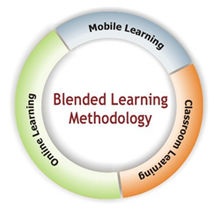
Let me unpack that. “Blended learning” is defined as schooling that is both brick and click, some combination of school-based education and online education, with the implication that the two are interrelated in significant ways so that the whole is greater than the sum of its parts. Note, however, that there is absolutely nothing in that definition that is evaluative in any way, and so ‘blended learning’ could be what I saw that day: half the day on the computer, half the day in teacher-directed activity.
For an analogy, think about the term ‘restaurant.’ What does that tell you about the food served there? Nothing. Even ‘French restaurant’ says nothing about the quality of the (French) food on the menu.
So let’s not get all gooey-eyed when educators tell you they are practicing blended learning in their schools. Before you jump on that bandwagon, ask how the brick and clicks are integrated. Ask how much time students are spending on computers. Ask what they do on those computers. Ask, ask, ask….and ask some more.
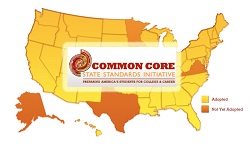
Now to the “Common Core’ bandwagon. The highly-touted ‘Common Core’ standards spell out, often in great detail, what children are expected to be able to do at various points in their schooling. These standards — adopted by nearly every state — are very specific and purportedly ‘higher’ than what now exists. We can agree that standards are good, and that higher standards better than low ones, but let’s take a second look.
What I fear is that these specific standards, intended to be the floor, will somehow become the ceiling. These benchmarks have the potential to calcify our already rigid, age-segregated system, at a time when flexibility is essential. In his brilliant book, The One World Schoolhouse, Sal Khan writes, “At a time when unprecedented change demands unprecedented flexibility, conventional education continues to be brittle.” He adds that the educational establishment seems “oddly blind (or tragically resistant) to readily available technology-based solutions.”
As I have argued elsewhere, age segregation has harmful effects on children, although it is of course convenient for the adults. The now-conventional wisdom of the Common Core will, I fear, harden the attitudes and practices of our ‘brittle’ system and keep kids segregated by age.
Too much of education is about consumption and regurgitation when it ought to be about production. Kids need to be encouraged to ask more and more questions. They need to learn how to sort through the flood of information that engulfs them, to separate wheat from chaff. If students can meet Common Core standards by spitting back answers, we’re making matters worse, not better.
On the flip side: Well-designed blended learning invites and allows kids to soar. But when a 6th grader soars past 6th, 7th and 8th grade math Common Core standards, she must be celebrated, not held back, ostracized or shamed in any way.
Despite the crowded bandwagon for blended learning and the Common Core, these men and women are often called ‘pioneers.’ But are they really pioneers? According to dictionary definitions, pioneers are “men and women who venture into unknown territory to settle, or who open up new areas of thought, research or development.”
It seems to me that rather than being true pioneers, many of these educators are simply looking for faster and more efficient ways to get to the same old destination.
Folks who care ought to be knee-deep in the struggle over measurements. We need to measure what matters, which to me means opposing those support our current ‘One Size Fits All’ approach to schooling, even when they have wrapped themselves in the glowing robes of blended learning and the Common Core.
More of our videos | Our YouTube Channel | Our Podcasts | iTunes |
Donate | Join our e-mail list | Debate the issues | Facebook | Twitter | Google+







 The Merrow Report