For a lot of Americans, Thanksgiving is a time for reflection. But since Thanksgiving now means football games, maybe it’s worth reflecting on the damage that America’s new national pastime is doing. I don’t mean the concussions, dementia and early deaths the sport is causing, because that’s already well-documented. Instead, I have more subtle issues in mind, issues that reveal how deeply ‘big time football’ has invaded our way of thinking and is — from my perspective — corrupting higher education. I want to examine, in this space, the expansion of the Big Ten from 12 to 14 universities, last Sunday’s report about big time football on 60 Minutes, and the firing of Cal football coach Jeff Tedford.
The entire rationale for the expansion of the Big Ten (and every other athletic conference) is money. The Big Ten hasn’t had just 10 teams since 1993. This week it added Maryland (from the Atlantic Coast Conference) and Rutgers (from the Big East). Big Ten Commissioner Jim Delaney made no bones about his reasoning: ‘demographics,’ by which he means viewers, which means television money.
What I find most amazing is how nobody even blinks an eye, let alone expresses outrage, at WHO is making these announcements and decisions: it’s the sports guy! There’s no pretense whatsoever that these decisions, affecting entire universities, have anything at all to do with what is ostensibly the purpose of a university. It’s all about the money.
Perhaps that explains the absence of the university presidents; maybe they are embarrassed. Let’s hope so.
Here’s another example: On Sunday 60 Minutes devoted about one-third of its hour to big time football, focusing on Michigan and Alabama. While the piece did acknowledge that only about 20 of the 125 major college football programs actually operate in the black, it then proceeded to ignore the losers. Rutgers, we know from other reports, has been losing $25 million a year, not exactly chump change. What other university programs has it taken money from in order to balance the books? How many academic programs have been gutted at Rutgers, and at the other universities whose football programs lose money?
(By the way, that estimate of 20 programs in the black is higher than any I have seen. I suspect it is closer to 5, perhaps 10.)
We learned that the Alabama coach, Nick Saban, makes $5 million a year. Although one athlete acknowledged that playing football was ‘a full time job,’ Armen Keteyian — the correspondent for the piece — did not report on the paltry piece of Michigan’s and Alabama’s millions that go to the players, euphemistically referred to as ‘scholar-athletes.’ They get 1-year renewable athletic scholarships for four years, and that’s it. But, as my colleague John Tulenko reported, players in big-time programs are sometimes urged to take a minimal academic load, one that doesn’t lead to graduating in four years. Why? Because too much study time takes away from practicing and playing, which is their ‘full time job.’ When they use up their eligibility, players are often discarded Only then do these ‘student-athletes’ discover that they are perhaps two years worth of credits shy of graduating, because their coaches had not been overly concerned about the ‘student’ part of the equation.
Instead, the piece took a ‘gee whiz’ tone about how the athletic directors look to squeeze every dollar out of the program, selling jerseys and every other imaginable tchotchke. That was journalism that did not meet 60 Minutes’ high standards, in my view.
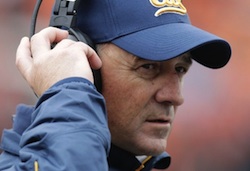
So what to make of Cal’s firing the most successful football coach in its long history? Was he fired because his team was losing too many games, or because graduation rates went down?
When Jeff Tedford was hired in 2001, Cal was awful (1-10) and the university had been found guilty of academic fraud for awarding academic credits to two players for courses they hadn’t taken. The football team’s graduation rate was below 50% — at a university whose overall graduation rate was around 90%.
Tedford put in place an ambitious academic plan: tutoring, attendance checks, individual meetings every week with every player to discuss academics, and more. In effect, Tedford turned his assistant coaches into de facto academic advisors. He even suspended at least one player for one game for cutting classes.
It worked. In 2009, 71% of Cal varsity players graduated within the 6-year window used by the NCAA to rate schools. That was a 48% increase over the rate when Tedford took the job. At the time, physics professor Robert Jacobsen, who also serves on Cal’s athletic admissions committee, told a reporter, “Tedford has changed the way the football players look at being student-athletes. One of the things he’s done is kept people in school. They don’t just leave when they’re done playing. They stay and get their degrees.”
67% of Cal’s African-American players (the majority of Cal’s roster) graduated–20 points higher than the major college average and two points higher than Cal’s overall graduation rate for black male students.
That was in 2009, just three years ago.
And the team started winning under Tedford: A Pac-12 championship, eight consecutive winning seasons, eight bowl games in 11 years, more wins than any coach in Cal history, and lots of national attention. His teams also managed to defeat Stanford, winning ‘The Axe’ for Cal.
But in 2010, Cal had its first losing season under Coach Tedford, going 5-7 and being blown out by Stanford. It rebounded to 7-5 in 2011 but lost ‘The Axe’ to Stanford again.
And this season was ugly. Cal lost to Stanford for the third straight time, fell to 3-9, and was blown out in its last two games by a combined score of 121-31.
Meanwhile, graduation rates fell. They now are back in the 50% range, about where they were when Tedford was hired.
Some say he got the axe for not winning ‘The Axe,’ but that’s not how the athletic director presented the story, although she did bring Stanford into the conversation. “As hard as it has been to watch our student-athletes struggle on the field, the team’s continuing decline in academic performance is of great concern,” Athletic Director Sandy Barbour wrote in announcing her decision. “As recent NCAA data show, Cal football is now last in the Pac-12 in terms of the team’s graduation rate: 48% compared to Stanford’s conference-leading 90%.”
So apparently Cal couldn’t stand losing to Stanford on the field and in the classroom.
Does anyone believe that Tedford would have been canned if the team had continued winning? If the Golden Bears had been beating Stanford and going to bowl games, he would have been called on the carpet about graduation rates, warned and urged to improve, but would he have been fired? I doubt it.
We have a point of comparison on the Berkeley campus, the men’s varsity basketball team. Over the past four years, that team has won 91 games and lost only 47. But the team sports a graduation success rate of only 33 percent. That is the lowest in the Pac-12 and sixth-lowest among all major basketball programs!
How was the basketball coach treated? Last year Athletic Director Barbour gave him a contract extension.
But even if Coach Tedford was fired because his players weren’t graduating, that one example doesn’t change the big picture. First you have to show me a pattern of winning football coaches being fired for low graduation rates. Until then, I maintain that big time college football is about winning and money, with the young men’s academic performance way down on the priority list.
And the shame of big time sports calling the shots at our major universities continues, unexamined and unquestioned. Not something to be thankful for, today or any other day.
More of our videos | Our YouTube Channel | Our Podcasts | iTunes |
Donate | Join our e-mail list | Debate the issues | Facebook | Twitter | Google+