WILL MAY BE ‘MORBID’ OR ‘MAGICAL’?

May has been an educational ‘dead zone’ for years.  Because of our national obsession with standardized test scores, teachers–particularly in low income areas–spend class time showing students how to guess at answers, giving practice tests, and even teaching children how to fill in bubbles for the standardized, multiple choice ‘bubble’ tests that await them.  These activities come with a huge opportunity cost for students, because they are of no educational benefit whatsoever and probably set their learning back; for teachers, they are an insult to their profession.  And school districts spend billions of dollars buying, administering, and grading the bubble tests required by their states and the federal government.

When I was reporting I occasionally heard people  complaining–in song–about  “the morbid, miserable month of May,” riffing off an old Stephen Foster tune, “The Merry, Merry Month of May.”  As I recall, the expression surfaced in 2003 or 2004, which is when the unintended consequences of the 2001 federal “No Child Left Behind” law became apparent.  Because NCLB penalized schools that didn’t achieve what it called ‘adequate yearly progress’ on standardized tests, many districts eliminated art, music, drama, journalism, and even recess in order to concentrate on ‘the basics.’ 

That’s when the month of May became a ‘morbid’ dead zone, educationally speaking. 

I don’t remember where I first heard the expression. It might have been in the suburban North Carolina elementary school that held ‘pep rallies’ in advance of the upcoming state exams, or in Richmond, Virginia, where a veteran middle school teacher told me “Teaching and learning are done; now it’s all test prep.”  Or perhaps it was the Chicago high school teacher who confessed that he vomited in his wastebasket when he saw his students’ scores, or the custodian in a Success Academy charter school in New York City who said he rinsed out classroom trash cans every night because students regularly threw up in them during testing.  Another possibility is the Washington, DC, parent whose young son couldn’t sleep because his teacher said she’d get fired if they didn’t do well on the tests.  

The good news is that May 2020 does not have to be ‘morbid,’ ‘miserable,’ or ‘malignant.’  Because schools are closed and state standardized testing has been cancelled, May is a blank slate–and an opportunity for us to make it ‘magical’ and ‘memorable.’   

News reports indicate that many parents are unhappy in the role of ‘teacher at home.’  (They are also coming to realize just how hard it is to be an effective teacher!)  Teachers are frustrated because nothing in their training prepared them for teaching remotely.  And so, because the March-April experiment in ‘remote learning’ hasn’t been a rousing success and because May is a tabula rasa, let’s embrace ‘out of the box’ thinking. Stop thinking like educators whose jobs depend on high test scores.  Think differently!

(An earlier blog post about librarians, swimming instructors,  highway engineers, and gardeners is here.)

Imagine for a moment that you don’t have a captive audience (because right now you don’t).  IE, think like a librarian. Public libraries are different from schools in one important way: they do not have required attendance. But even though no one is forced to attend the library, library usage continues to climb.  To survive and prosper, librarians have had to identify their audiences and find ways to draw them into their buildings and electronic networks.  For the most part, they’ve succeeded without pandering.  That’s what’s called for in education at this moment.

With school buildings shuttered, students do not have to ‘attend’ anything.  They can log on to classes to get credit for ‘being there,’ but there’s no way for the teachers to know who’s paying attention and who’s FaceTiming friends.  More than 25% of students in Los Angeles, for example, aren’t even bothering to log on, and even parents who are monitoring their children’s efforts cannot be certain that they’re paying attention.  

So the parents and teachers might consider asking questions, instead of simply giving assignments: 

          What would make this material appealing to you? 

          What would persuade you to invest your energies in this subject? 

          What else are you interested in?  

For example, perhaps focusing on one subject at a time might be more appealing than trying to study five subjects every day.  The block schedule of 50-minute periods may work inside school buildings, but that doesn’t mean it can transfer to the home.  What if we compressed the semester of American history or American Literature into the month of May? Would a series of deep dives be more engaging?  For openers, try asking the students.

However, students shouldn’t get to make all the decisions about what they’re studying.  After all, a central purpose of the early years of school is the transmission of knowledge, and so the basics are also part of the deal.  Children need to learn spelling rules (“I before E, except after C”), the multiplication tables, how to divide and carry, and other basics. They need to know that letters have sounds associated with them (i.e., Phonics and Phonemic Awareness).  Someone has to teach them that, if you put an E at the end of words like ‘ton,’ the O sound changes from ‘short’ to ‘long.’ While that may seem like heavy lifting for parents who haven’t trained to teach, they can relax.  Free resources like the Khan Academy, ReadWorks, and Zearn are available to help children and parents with basic skills. Resources are plentiful: PBS is making all of Ken Burns’ documentaries available for screening, and former first lady Michelle Obama is on line, reading stories to young children, to cite just two examples.

Young people must be deeply involved in setting the learning goals and in figuring out how results will be measured.  It makes no sense to wait for bubble test results.  Teachers, parents, and students should assess progress frequently, take a clear-headed look at the results, and adapt accordingly. That also means that leadership must abandon the all-too-prevalent “Gotcha” attitude toward teachers. The new thinking has to be Assess to improve,” and not “Test to punish.”

Plan teaching with that in mind. Don’t take it personally when the student/your child doesn’t get it the first time, or the fifth. Explore the reasoning behind the error, but not punitively. Celebrate wherever possible.  Parents can teach their children valuable skills through family activities like cooking, playing board games, and planting a spring garden.  Above all, parents should recognize that they are learners too, because that makes it perfectly OK to say, “I don’t know, so let’s find out together.”   And leave plenty of time for play……

Accept that it’s a journey.  Be comfortable making mistakes. Teach children that failure is a huge part of learning–and learn along with the kids. 

Projects, done alone or with other children, are an important part of learning, but in May 2020 projects are essential, because they give working parents extended time away from the kids.  While creating the projects will take some time, once underway, the children can work alone, or with their friends and classmates on Skype, Zoom, FaceTime, or Google Hangouts.   For some suggestions about worthwhile projects, go here, here, here, here, and here

If they are connected to the internet, that is.  The huge gap in material resources that existed before this crisis is now front-and-center.  By some estimates, more than one million California students do not have connectivity.  While some tech companies are stepping up to provide broadband access to low income communities, more needs to be done because all students have to be able to connect with the world beyond their homes.  

While traditional school involves a lot of consumption of information–like memorizing state capitals, the Periodic Table, or the formula for the volume of a cube–the suspension of standardized testing has created a tabula rasa for the rest of the school year.  It’s an opportunity to turn young learners into producers of knowledge. Not video game players, but creators of Apps. Not watchers of films, but producers of their own documentaries.  Not drudges, but dreamers.

Education is much more than knowledge transmission. Much of what goes on in the teenage years in particular is the development and creation of the individual.  What Jacques Barzun called “Building a Self” involves discovery and trial-and-error, and that journey becomes much more interesting when kids are creating knowledge, not just giving back the right answers in order to get good grades.  

So, how should learning be assessed while schools remain closed? California flirted with the notion of giving all students A’s but abandoned that when its higher education system objected.  “Pass/Fail” may end up being the popular option, although hard-working students and dedicated teachers will object, because that ‘one size fits all’ approach discounts their efforts.  Randi Weingarten, the sensible President of the American Federation of Teachers, believes teachers and students should design ‘capstone projects.’  “We’ve got to trust educators and students to come up with meaningful projects that demonstrate student learning, and to do so in ways that minimize the inequalities of the digital divide,” she wrote in an email. “Before the pandemic, most students had seven months of learning, so let’s end the year with meaningful projects.” 

Will we resume our obsession with standardized testing once the Covid-19 pandemic begins to fade? Certainly there will be pressure to return to “business as usual” from entrenched economic interests and the powerful ‘school reform’ lobby, but it should be obvious that ‘business as usual’ just ain’t gonna happen in education or in a lot of other activities.  I hope we come together to reject the current ‘test to punish’ approach and replace it with systems that ‘assess to improve.’  Schooling cannot be a ‘gotcha game’ or a sorting system.  We need all hands on deck to rebuild our shaken economy.

As we plan for a better future, let’s stop spending billions of dollars buying, administering, and grading bubble tests and use the money instead to lower class size, improve access to technology, and raise teacher salaries.  

I believe that education’s “New Normal” has a good chance to become child-centric. This is our opportunity to create schools that pose a new question–”How Is This Child Smart?”–and then ensure that the answers determine how she/he is taught.  

This isn’t a pipe-dream of a feverish mind going bonkers in isolation.  The brilliant Andy Hargreaves has also been speculating about education’s post-Covid 19 future:

“Well-being will no longer be dismissed as a fad. Before this crisis, there were murmurings that student well-being was a distraction from proper learning basics. No more.  It’s now clear that without their teachers’ care and support it’s hard for many young people to stay well and focused. Being well, we’ll appreciate, isn’t an alternative to being successful. It’s an essential precondition for achievement, especially among our most vulnerable children.”

Before Covid-19, parents might ask their children, “What did you learn in school today?”  Going forward let’s ask, “What good questions did you come up with?  How’s the search for answers going?”

The goal of education, wherever it’s occurring, is not to get correct answers. The end game is life-long curiosity.
To Succeed in Teaching, Think Like a …..

Because the pandemic has exposed the fundamental inequities in our education system, there’s lots of ‘Big Picture’ thinking going on about American public education.  For example, Paul Reville, the former Massachusetts Secretary of Education who now teaches at the Harvard Graduate School of Education, hopes that this pandemic will be education’s “Sputnik moment.” 

I hope that he and others who are looking ahead are right and that we will fundamentally overhaul our approach. Because I have written about this in Addicted to Reform: A 12-Step Program to Rescue Public Education, I want to focus here on succeeding RIGHT NOW.  Not next year when schools have reopened, but tomorrow and next week, when teachers and parents are struggling to achieve ‘home learning.’

Four pathways to success: 

  1. Think like a librarian
  2. Think like a swimming instructor
  3. Think like a highway engineer
  4. Think like a gardener

Librarians do not have a captive audience. After all, no one is required to attend the library.  To survive and prosper, librarians have had to identify their audiences and find ways to appeal to them, to draw them into their buildings or electronic networks.  For the most part, they’ve succeeded, and without pandering.  

With school buildings shuttered, students do not have to ‘attend’ anything.  They can log on to classes to get credit for ‘being there,’ but there’s no way for the teachers to know who’s paying attention and who’s FaceTiming friends.  And we know that more than 25% of students in Los Angeles, for example, aren’t even bothering to log on. Even parents who are monitoring their children’s efforts cannot be certain that the kids are paying attention.  

So the adults must ask students the librarian’s questions: 

          What can I do to make material this appealing to you? 

          How can I persuade you to invest your energies in this subject? 

          What else are you interested in?  (Because knowing that might allow you to teach this important material at the same time,)

For example, perhaps focusing on one subject for a month at a time might be more appealing than trying to study five subjects every day.  The block schedule of 50-minute periods may work inside school buildings, but that doesn’t mean it can simply transfer to the home.  What if we compressed the semester of American history into one month, American literature into another month, and so on? Would a series of deep dives be more engaging?  For openers, try asking the students.

Swimming instructors are measured by results. If wannabe swimmers don’t learn to swim, the instructor cannot claim, “I taught them effectively, so it’s not my fault that they cannot swim.”  No, he or she has to find new ways to teach swimming, because the instructor owns the failure.  In my experience, many teachers already think the way competent swimming instructors do. But not enough!  Every teacher and parent has to live by the mantra, “If they’re not learning, then I am not teaching.”   

And I don’t mean waiting around for bubble test results at the end of the year (or later).  Teachers need to assess frequently, take a clear-headed look at the results, and adapt accordingly. That means asking for help.  That also means that leadership must abandon the all-too-prevalent “Gotcha” attitude toward teachers. The new thinking has to be: “Assess to improve,” and not “Test to punish.”

Highway engineers–the men and women who design our roads and streets–have one important goal in mind: to get us safely from Point A to Point B.  Because their data and their own life experience tells them that drivers’ attention wanders and cars sometimes stray and weave, highway engineers build roads whose lanes are about one-third wider than the cars that travel on them.  Without that extra room for predictable error, we’d have many more highway accidents. Instead, nearly all of us arrive at our destinations safely.

Apply that to teaching and learning, and we will have an education system that treats failure as nothing more than an opportunity to try again.  Let me trot out the story of WD-40 one more time. If the chemical engineers who developed that ubiquitous product had been penalized for failing, work would have stopped after their first try, which they conveniently labelled “WD-1.”  Instead, they tried and failed 38 more times before hitting on a formula that worked!

Plan your teaching with that in mind. Don’t take it personally when a student doesn’t get it the first time, or the fifth. Explore the reasoning behind the error, but not punitively. Celebrate wherever possible.

Gardeners understand that what they are involved in is a work in progress.  And works in progress take time, faith, work, and love. The last thing a gardener would ever do is pull up the emerging plant or flower by the roots to see if it’s growing.  Nurturing is essential. That’s true whether or not schools are open.  

Gardeners know that roses demand one kind of attention, which is different from what green beans, tomatoes, and hydrangeas require.  “One size fits all’ doesn’t apply to gardening or to teaching and learning. The educational equivalent of the gardener’s mind are the questions, “How is this child smart, what is she interested in, and what can I do to nurture her interests?”  

What’s more, gardeners don’t hover over their seedlings; they pay the appropriate amount of attention and then walk away, leaving nature, the sun, the earth, and the seeds to do the work of growing.  

To be like gardeners, teachers and parents cannot hover; they cannot expect students to be ‘on task’ all the time.  In fact, in these awful times, play and free time have never been more important.

Those are suggestions for successful teaching and learning now.  Looking down the road, here are three thoughts about how the system must be changed:

  1. Most likely to succeed are those school districts that have been encouraging teachers to work together and have given them the time to watch each other teach and to grow professionally in other ways.  Districts that have empowered teachers to use technology for exploration and production are better suited to today’s new reality.
  2. Least likely to succeed are districts that either are technology-poor or habitually use technology for control (counting and measuring) rather than exploration and production.
  3. The current model of teaching in most American public schools is one of ‘Crowd Control,’ and not teaching and learning.  Simply put, many teachers are assigned too many students for them to be able to help more than a handful. Sadly, things haven’t changed all that much from when I taught high school English in the mid-60’s. Back then, I was responsible for five classes of roughly 25 students each, a total of 125 high school 10th, 11th, and 12th graders.  Because I believed that students needed to write and rewrite regularly, I was reading and correcting 250 short (1 page, written in class) papers every week. I could handle this because I was 22 and fresh out of college. However, I know now that I couldn’t have kept that up for long. In fact, I left teaching for graduate school after two years–two wonderful but exhausting years.


SOME TRUTHS ABOUT TEACHERS

Last week in this space I posted an almost entirely fabricated** article about faux “research’ I claimed to have done by hitchhiking while posing as a retired teacher, CPA, doctor, et cetera. Although the piece was posted on April Fools Day, a fair number of readers took what I wrote at face value.

Why would smart people take me at face value? I think it’s because my phony research supported their core belief–teachers matter–and they simply couldn’t wrap their brains around the notion of anyone poking fun at that.

Teachers Matter” is a core belief of mine as well, so let me be serious for a moment, because what many teachers are doing during this awful pandemic again demonstrates their value.  

Our teachers are stepping up big time, judging from news reports and from the stories I’m hearing from family and friends.  In some communities teachers have organized ‘drive throughs’ of the neighborhoods where their students live, so the kids can come outside and wave hello–from a safe distance–to their teachers.  Here’s one TV report about how teachers in California are staying connected with their elementary school students.  

A high school teacher I know well is working with some of his students–at a distance–making PPE for three local hospitals.  He bought sheets of plexiglass, and they are cutting and bending it, then attaching straps, to produce the face shields that protect First Responders from the virus. 

Many educators are delivering meals or handing them out at schools because they understand that, for many low income students, meals at school might be the only food they got that day.  In fact, the nutritional needs of children is the reason politicians like New York City Mayor Bill deBlasio delayed in closing their schools (a decision that has cost New York City dearly). 

Here’s an excerpt from a report from The Pittsburgh Post-Gazette (a newspaper I urge you to consider subscribing to): The New Kensington-Arnold School District, where all 1,975 students qualify, is handing out to-go bags with breakfast and lunch items from 10 a.m. to 1 p.m. weekdays at seven locations for all students 18 and younger. The district asked parents and older students to fill out a survey to indicate continued participation in the meal program to improve efficiency and waste as little food as possible.

And the Oil City Area School District in Venango County, where more than 90% of the students are eligible, said anyone from 1 to 18 years old could receive a bagged meal that would include lunch for that day as well as breakfast for the next day. The meals are available from 11:30 a.m. to 12:30 p.m. at Seventh Street Elementary School or at the high school.

Steel Valley, one of the school districts with 100% reduced lunch eligibility, gave students backpacks of free food on a Friday to get them through the weekend and said it will continue to serve meals to students on weekdays during the shutdown.

Since 11,000,000 American children–one out of every seven–live in ‘food-insecure’ households, what teachers and school districts in Pittsburgh and elsewhere are doing qualifies as ‘life-saving’ work.

Equally important, some teachers are making ‘house calls’ via phone or Skype and other apps or they’re sharing their email addresses, making themselves available for questions. That’s an experience our grandchildren and the grandchildren of friends are having. 

Stepping up for their students during this pandemic has taken a toll, including the ultimate sacrifice, as the newspaper Education Week is reporting.

The pandemic has also revealed the fault lines in our education system and society at large, including pervasive economic inequality.  Online learning is literally impossible when students cannot get online because their homes don’t have wifi or because they don’t have the devices. “Nearly one in five students between kindergarten and 12th grade do not have computers or speedy Web connections, according to data compiled by the Pew Research Center in 2018, the latest available, which said this “homework gap” disproportionately plagues low-income families and people of color,” The Washington Post reported recently.

Two weeks ago in this space I wrote, “(A) lot of school systems seem to be reflexively behaving as if they could simply transplant school’s routines to the home.  Some are emailing or posting lesson plans that they expect students (and parents) to follow.”  It may be worse than I thought. Apparently most school districts hadn’t thought through how to respond, and so they’re simply trying to impose school’s routines on American homes, with class periods and worksheets, the whole nine yards. 

“Same old, same old” isn’t working, as The Los Angeles Times reported recently.  Profiling senior Emilio Hernandez, an honors student taking AP calculus, physics, design, English, engineering and government, The Times writes, Now, with a borrowed laptop from school and family crowded in the living room, he’s struggling to make school feel like, well, school. He has trouble falling asleep and finds himself going to bed later and later — sometimes as late as 3 a.m. “Assignments that would normally take me two hours or 30 minutes are now taking me days to complete. I just … can’t focus,” he said. “I don’t have anyone giving me direction. It’s just me reading and having to give myself the incentive to do the work.”

Think about that: An honor student who is taking an incredibly demanding schedule hasn’t learned–or been expected–to strike out on his own.  To me, that’s the bitter fruit of the top-down, standards-based, test-centric approach to ‘education’ that so many politicians and so-called ‘school reformers’ have embraced.

Superimposing school on the home is not working for students at all levels.  LA reports that on some days half of students don’t bother to log on–IE, they’re skipping school. New York City is having trouble getting kids to participate, and, of course, no one knows whether kids who do sign in are actually paying attention.  Basically, given the opportunity “to vote with their feet,” kids are (electronically) walking away from school as they know it.

That’s precisely why this is the perfect time to rethink public education.  State standardized tests (given to meet federal rules) won’t be required this year.  Many states have already relaxed their rules requiring 180 days of classroom-based instruction, but now it’s time to go further.  Randi Weingarten, the wise leader of the American Federation of Teachers, has some suggestions for evaluating the work that students are doing at home, including a ‘capstone project.’  She writes, in part: There are many ways outside of state accountability systems to show student learning, as teachers can attest. They just need the freedom to use their professional judgment. Teachers do this throughout the year — administering tests and guiding students on projects and portfolios. We know that students love to show what they know to people who matter to them. We need to trust teachers, in consultation with their principals and colleagues, to design meaningful, educationally appropriate tasks.

However, this will be harder than it sounds, because for at least the past 30 years teachers have not been trusted with student evaluation and curriculum development.  Instead, those at the top have devoted years and millions of dollars to creating “teacher-proof” materials, a concept that should boggle the minds of everyone who cares about learning.

Teachers who have gotten accustomed to being told what to do may have trouble adjusting to new freedoms and responsibilities–not to mention adapting to the new experience of teaching on-line. 

When Edutopia brought about 500 teachers together (electronically), much was learned, including “Less is More.”  Here’s an excerpt: If your district allows it, you should plan to do less. Students won’t be able to work as productively, anyway—so if you can’t scale back you’ll be sending them work they cannot do—and your own life and family need added care.  “Feedback from students and families over the last 10 days in Italy is ‘less is more,’” commented Jo Gillespie. “Consider that parents are trying to work from home, and siblings are vying for computer and Wi-Fi time. … And (Stacy) Keevan, the teacher in Hong Kong with weeks of experience, confirmed that time and distance play funny games during a crisis: “What would normally take you one class period to teach in the classroom will probably take you twice as long.”

The AFT’s Weingarten suggests a “capstone project” for all students, giving each the opportunity to shine.  I think the goal should be ‘knowledge production,’ and not the spitting back of information. Project-based learning is a good way to encourage knowledge production because when children explore their interests, they acquire and create knowledge. When children DO, they learn.

Interestingly, some commercial interests are responding to the pandemic by doing things that will make it harder for students to become producers. For example, Google is opening up its gaming venues for free–as if today’s kids needed to spend even more time playing video games.  The goal here is to set the hook even deeper, to keep everyone consuming.  

As I wrote last week, In the age of Covid-19, we ought to be encouraging children to ask good questions.  Home Learning entails the search for answers.  Before Covid-19, parents might ask their children at dinner, “What did you learn in school today?”  Now, let’s ask, “What good questions did you come up with? How’s the search for answers going?” The goal of education, the goal of Home Learning, is not the right answer. The end game is perpetual, life-long curiosity.

What changes should be made in public education once the pandemic passes? What are the lessons of this pandemic for public education?  Kiah Duncan has some suggestions

  • Remote learning days should be embedded throughout the school year once or twice a month.  School Improvement days should become remote learning half days. That would help teachers improve their digital teaching skills by working together and give students regular practice so that it is easier for them to do on their own at home.
  • Each state should ensure that all students have a device that they can use and replace any devices that are not returned.  If any state is willing to implement remote learning, they should be accountable for ensuring that each school has the necessary amount of access.
  • All teachers should be required to have a technology element integrated into a lesson that is formally or informally observed each school year.  The only way to effectively assist teachers that may require more help is by knowing what they are doing and giving them the opportunity to improve before it becomes mandatory.

Just as important, we need to reimagine public schools and teachers must be deeply involved in this process.  I write about what schools could be in Addicted to Reform: A 12-Step Program to Rescue Public Education.  We simply don’t have enough young people to continue with the current “sorting” approach to education that picks out winners and losers. Instead, we have to ask of each child, “How is she smart?” instead of “How smart is she?” and proceed accordingly.

Ironically, schools need to become more like most American homes, instead of trying to superimpose their tired routines on our households.

————————————-

**  It wasn’t entirely fabricated. When, at age 21, I hitch-hiked around the country, a lot of drivers (men and women) accosted me; however, I am not writing an autobiography called “In the Car Where (Might Have) It Happened.”

A WEEK LATE….

HITCHING AND LEARNING

I began hitch-hiking out of necessity, but before long it became an obsession, and then a serious research project.  It all began last fall when I took a job as an unpaid Media Advisor (really a PR person) for “No Nails Left Behind,” a small non-profit in the upper reaches of the Bronx that provides jobs for formerly incarcerated residents of the Borough. 

(The organization’s name was a play on the wildly successful, much admired education program, “No Child Left Behind.”)

Basically NNLB’s workers scour construction sites for damaged nails, which they collect and then straighten out for resale. I thought it was a great story that more people should know about–and perhaps contribute to (because the income from the sales of one-used nails alone, we feared, might not be enough to keep the program operating).

The public transportation from our apartment in the upper east side of Manhattan to the northern edge of the Bronx was inadequate and time-consuming, and so I ended up taking a Lyft or Uber twice a day, five days a week. I couldn’t justify that expense, and so I decided to hitch-hike.

Standing on the corner of 79th and 3rd–for what seemed like hours–was beyond frustrating, and so, in desperation, one morning I made myself this sign:

IMG_1963

Within minutes I had a ride!  I think on that first day it took three separate rides to get to NNLB’s office with only about 10 minutes of waiting.  Getting home was equally easy.  So that’s how I traveled to work for the next few weeks, saving big bucks and working on schemes to publicize NNLB.

Unfortunately, that all came to a screeching halt when one morning the organization’s Director called us all together to say that she had to close the operation.  It wasn’t the nails sales, she said. It was the fact that seven nail gatherers had been arrested the previous day; it turns out that going on construction sites at night was illegal, something no one had thought of.

So I was out of a job, but the effectiveness of hitch-hiking intrigued me. I always asked the drivers why they had picked me up. What was it about my being a retired teacher that led them to stop?  I heard great stories and began taking copious notes, not sure of what I might do with the information.

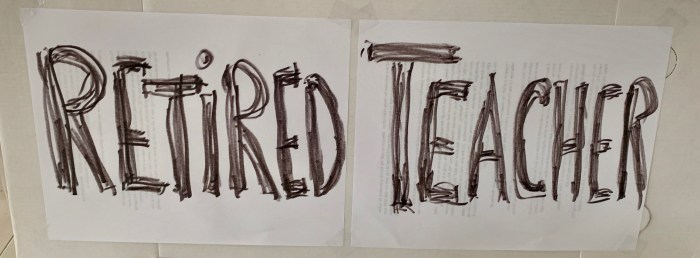
It was my wife who suggested a comparative study, a way to measure the status of teaching versus other professions.  Viola! I began making signs:

IMG_1964That’s just one.  I also posed as a Retired CPA, Doctor, Lawyer, and Politician.  The results were stunning. Whenever I displayed the “Retired Teacher” sign, I got a ride within minutes.  By contrast, most drivers ignored me when I self-identified as a retired lawyer or dentist.  
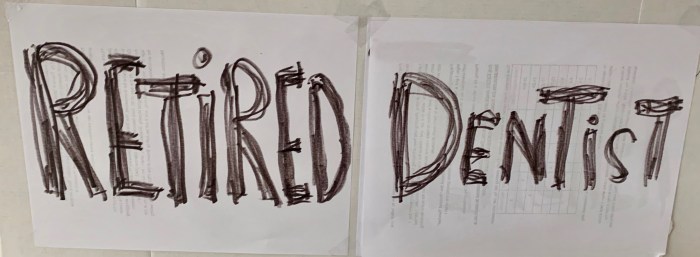
Posing as a retired dentist got me a mouthful of nasty criticism of my profession. 

EVERY driver who saw my “Retired Politician” sign seemed to speed up; a few gave me the finger. In 40+ days of trying, I didn’t get a single ride!  

This complex chart shows the average number of cars passing me by, per occupation. 

CARS PASSING ME  TEACHER CPA LAWYER MD DENTIST POL
     25-100+                    X
        21-24       X     X
        17-20   
        13-16   X
        9-12   X
        5-8
        2-4     X
        0-1

I also kept track of time, devoting one hour of hitching to each profession every day. I went “off the clock” while in a car, and I limited the rides to about 10 minutes.  I carried both a stopwatch and a clicker to keep count of passing cars. I used the audio recording app on my smartphone to keep track of results.

A sophisticated Chi Square analysis of my research results shows statistical significance to the 99th percentile, meaning that if one repeated this experiment 100 times, it would produce the same results 99 times.  A longer and more formal version of my peer-reviewed work will appear in the highly regarded quarterly Annals of Digital Mobility (ADM) this October. 

I have no doubt that, had I pursued a career in academia, this research would have resulted in my being awarded tenure.    

That’s why, when the pandemic passes, I will continue my research project, which I’m calling ‘Thumbs Across America.’  This research involved only New York City, but I plan on doing field research in the entire Lower 48, if my wife will allow me to hitch-hike around the country.

I am certain that I will discover that all of America cares about public school teachers as much as New Yorkers do.

NO FOOLING TODAY: TEACHERS MATTER

Although I left reporting more than four years ago, my blood still boils when people like Betsy DeVos, the supremely unqualified Secretary of Education, Senator Rand Paul, Representative Steve King, Laura Ingraham of Fox, former Speaker Newt Gingrich, convicted but pardoned felon Dinesh D’Souza, and other uninformed public figures blast public school teachers and public education.  

Because I’m retired, I have time to dig for the truth.  And so, to find out how real Americans feel about public school teachers, I decided to go to the grassroots. Do ordinary Americans respect teachers more than they respect lawyers, doctors, dentists, accountants, and politicians?

I’ve devoted the past seven months to original field research on this subject, and I am releasing the results today.

A quick summary: Americans care deeply about public school teachers.  And at the bottom of their list: politicians!

A second and entirely unexpected finding: Americans seem to have regained their moral compass, this despite the White House being occupied by a man who has paid off porn stars and boasted of grabbing women by the genitals.  More about that below.

(A side note to those expecting my annual attempt at tomfoolery: I jumped the April Fools Day gun when I published “No Glove Left Behind, Season Two,” a misguided attempt to lift the gloom created by the debacle of the Senate’s so-called ‘impeachment trial,’ early in February.)  

This column, however, is serious.  To test Americans’ feelings for teachers, I did 40+ days of field research in seven states.  This involved hitch-hiking short distances, sometimes at service areas on Interstate Highways but mostly on local streets in New York, Connecticut, Rhode Island, Maryland, California, Texas, and Missouri.  I did my field work in September, October, and November well before the current pandemic and have spent the past few months analyzing the data.

A sophisticated Chi Square analysis of my research results shows statistical significance to the 99th percentile, meaning that if one repeated this experiment 100 times, it would produce the same results 99 times.  My work has been peer-reviewed, and a longer and more formal version will appear in Annals of Digital Mobility (ADM) this October. ADM is the ‘gold standard’ in the field, I’m proud to say.

I have no doubt that, had I pursued a career in academia, this research would resulted in my being awarded tenure.    

By the way, this was not my first extended experience with hitch-hiking. In the early 1960’s I spent five months thumbing my way from Kansas to Florida to San Diego, up the coast to Seattle and then across the country and home to Connecticut.  Back then, I was just a 21-year-old wandering around and exploring his home country, but this time was different. 

My research design was simple.  Whenever I stuck out my thumb, I displayed a sign that identified me as a retired teacher, dentist, politician, doctor, lawyer, or accountant. I made different signs and alternated among them.  I kept careful count of the number of cars that passed me by before one stopped to offer me a ride. 

IMG_1963I also kept track of time, devoting one hour of hitching to each profession every day. I went “off the clock” while in a car, and I limited the rides to about 10 minutes.  I carried both a stopwatch and a clicker to keep count of passing cars. I used the audio recording app on my smartphone to keep track of results.

Regarding teachers, the news is good.  Whenever I displayed the “Retired Teacher” sign, I got a ride within minutes.  By contrast, most drivers ignored me when I self-identified as a retired lawyer or accountant.  

IMG_1964

Posing as a retired dentist got me a mouthful of nasty criticism of my profession. 

And EVERY single driver who saw my “Retired Politician” sign seemed to speed up; a few gave me the finger. In 40+ days of trying, I didn’t get a single ride!  

This complex chart shows the average number of cars passing me by, per occupation. 

CARS PASSING ME  TEACHER    CPA LAWYER DOCTOR DENTIST EX-POL
     25-100+                    X
        21-24            X
        17-20       X   
        13-16   X
        9-12   X
        5-8
        2-4     X
        0-1

I’m doing another pass through the reams of data, this time to develop a reliable, valid measure of how strongly Americans feel about the professions, using a 0-10 scale.  Some ratings are pretty obvious, of course: When a driver said, “My 8th grade teacher saved my life,” that’s a 10 for Teaching.  Likewise, the driver who complained, “My fucking accountant cost me $35,000,” that’s obviously a 0 for Accounting.  It’s the gray area that creates the challenges.  For example, I don’t know what rating to assign to ‘Lawyer’ based on what this driver said: “I love my wife and she loves me, but she won’t agree to a 3-way for my 40th birthday, and that’s all I want. She told me that it’s illegal in our state unless two of the three are men. What do I do now?  Goddamn lawyers!”   

I expect to publish my measurement system, the “Citizens’ Ratings of Affection for the Professions (CRAP), perhaps in the Spring issue of Annals of Digital Mobility.

But I don’t want to lose sight of the central finding: Teachers count!  What our public school teachers do day after day matters to most Americans, and I hope Secretary DeVos and others will take note. 

A second finding that may be of interest to those who believe that America is in moral decline.  Although this was not part of my original research design, I can conclusively state that Americans today are less sex-obsessed than they were 57 years ago.   

Here’s why I can make this statement with such certainty: When I was 21 and hitchhiking around the US, I probably hitched about one thousand rides, and every fourth or fifth driver (men and women) propositioned me for sex

Having dozens of attractive older women caressing my upper thighs was unnerving to a naive 6’2”, 180-pound 21-year-old with a serious girlfriend, but I was able to handle these situations by just saying NO (to most of them, anyway).  

J b&w w shades

More unnerving were the advances and attacks by men.  My worst experience was when a long-haul trucker gave me a ride. After a few minutes he told me that I had to get up into the sleeper compartment behind the cloth barrier because it was illegal for him to have riders.  That seemed reasonable, so I complied. A few minutes later, he reached in and handed me what he called ‘some reading material.’ Well, it was porn unlike anything I’d ever seen, and I got so engrossed in my own education that I failed to realize that the truck had stopped. Suddenly he was climbing into the sleeper compartment, scaring the bejesus out of me.  I kicked him in the throat, clambered over him, grabbed my stuff, and ran like hell!

(If you want to read more, please pre-order Volume One of my autobiography, ‘In The Car Where It (might have) Happened,’ which will be in bookstores this fall.)

However, I’m older now and not quite so nimble, and therefore I was quite anxious when I began my experiment. While I am happily married to a wonderful woman, what would I do when attractive women, lusting after my body, began caressing my inner thighs? Would I have the moral strength to turn them down?

And when younger men came on to me, would I–at 78– be agile enough to jump out of a moving car, or strong enough to fight them off?  

Well, I am happy and relieved to say that America’s collective out-of-control lust-driven libido seems to be under control, because not once in 40+ days of hitchhiking did any driver, male or female, proposition me for sex

Why was it safe for me to hitch-hike in 2020 when I was at risk in 1962?  What has changed in 57 years?  

thumb_IMG_9376_1024

The only explanation that makes any sense to me is that most Americans, repulsed by Trump’s “grab ‘em by the pussy” attitude, have embraced the fundamental decency that exists inside us.  Trump said he’d MAGA, ‘Make America Great Again,’ but, ironically, our immoral, narcissistic sociopath President is unintentionally MAMA, ‘Making America Moral Again.’ 

Thanks to Trump, people like me can hitchhike safely without being sexually propositioned.  

That’s why, when the pandemic passes, I will continue my research project, which I’m calling ‘Thumbs Across America.’  I plan on doing field research in the entire Lower 48 and then publishing more CRAP, which will attract the attention of struggling universities like Brown or the University of Lower Southeastern Oklahoma that are hoping to make a name for themselves.  At the age of 81, I will become an Associate Professor of Digital Mobility Studies, known on campus as “Dr. Thumbs.” Then, at age 85 when I become the oldest person in history to be awarded tenure, my phone will ring, and it will be Jeffrey Brown of the PBS NewsHour, asking for an interview.

Not long thereafter, The White House will invite Joan and me to have lunch with the President and her husband….

In the meantime, smile.  Thank teachers. Reach out to those you love.  And stay safe….