Our bus of 40+ “pilgrims” left Mississippi and headed for Selma, Alabama, the site of three historic Civil Rights marches in March, 1965. As the bus sped along, we watched “Selma,” Ava DuVernay’s wonderful film that brings to life the struggle southern Black citizens faced when they attempted to register to vote. (The narrative and photos regarding our experiences in Mississippi are here.)
Earlier we heard about the obstacles put in way of Black would-be voters from Flonzie Brown Wright, who was inspired to join the Civil Rights revolution after the assassination of Medgar Evers in June, 1963, in Jackson, Mississippi. Black registrants, she told us, had to correctly answer 21 questions, while Whites had to answer only six. Item 17 was the toughest: The Registrar cut the Alabama Constitution in small slivers, the applicant would pick one sliver and then interpret its meaning…to the Registrar’s satisfaction. The sliver Flonzie pulled said ‘habeas corpus,’ a phrase she had never heard–and which she suspected the Registrar hadn’t either. She couldn’t explain it, and so the Registrar marked her application ‘denied.’ By the rules, she had to wait at least 30 days before reapplying.
Flonzie told us that she went home and memorized the entire Constitution. 30 days later, she returned to the Courthouse, just happened to pull ‘habeas corpus’ again, and passed. Of course, she now realizes that ‘habeas corpus’ was probably written on every single one of those slivers!
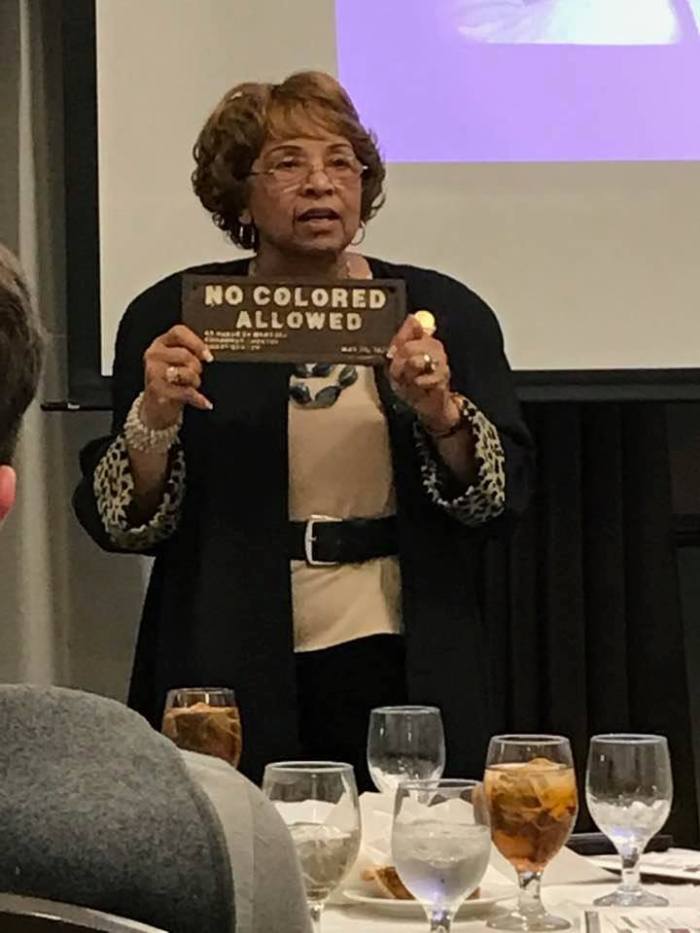
(In time Flonzie would run for office and win, eventually becoming the supervisor of the Registrar of Voters!)
Blacks throughout the South had been agitating and protesting over voter registration for some time. In fact, Dr. Martin Luther King, Jr., had spent months on a campaign in Albany in his home state of Georgia. Because Dr. King’s effort to register voters there had not succeeded, he came to Selma. He reasoned that, because Dallas County Sheriff Jim Clark (below) was known for his hair-trigger temper and stubbornness, Selma offered a better opportunity to call national attention to the cause.

Dr. King was correct. Clark ordered his troops to take action against non-violent protesters who were blocking the Selma Courthouse steps. Jimmie Lee Jackson, an African American teenager, tried to stop a police officer from savagely beating his grandmother. In response, the policeman beat and then shot Jackson, killing him.
While no Civil Rights activists were killed during the actual march from Selma to Montgomery, two others died.
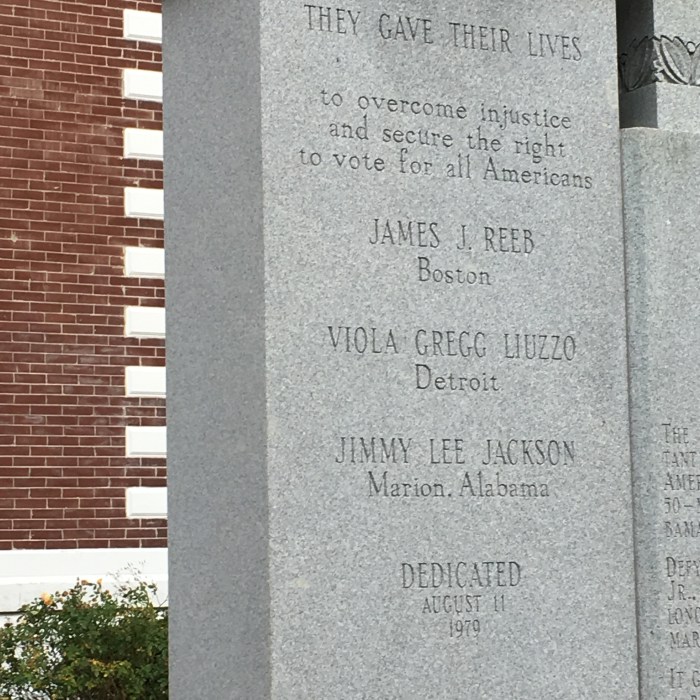
After the successful march to Montgomery, James Reeb, a White Unitarian Universalist minister from Boston, inadvertently walked into a segregationist bar. He was savagely beaten and died two days later.
Viola Gregg Liuzzo, a White homemaker from Detroit, was driving several marchers back to Selma when Klansmen drove up alongside and shot her to death.
But it was Jimmy Lee Jackson’s death that catalyzed was the March 7th march, the one we all know as “Bloody Sunday.” Organized in the Brown Chapel A.M.E Church , the march began in a vacant lot behind the red brick building. (Joan and I and many of our group each brought home a small pebble from that lot, a reminder of the courage shown by those men and women.)

The Edmund Pettus Bridge, named for a Confederate General, spans the Alabama River.
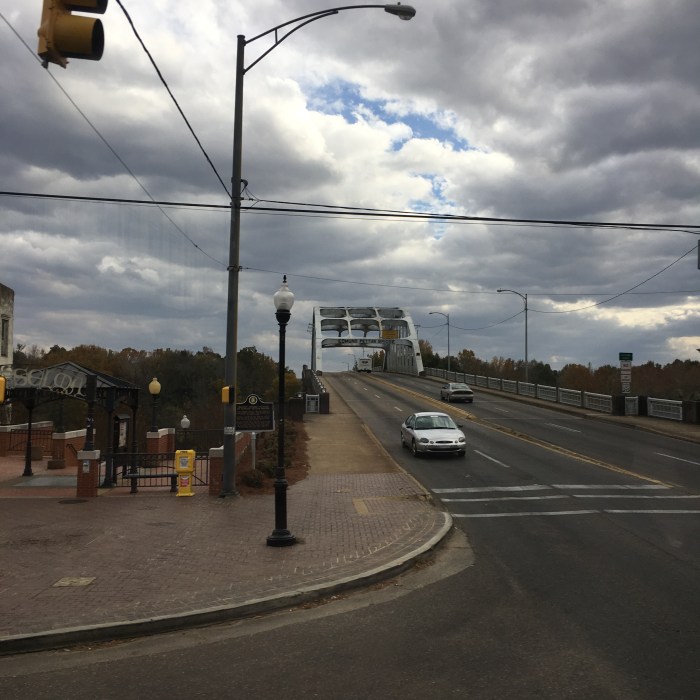
The city of Selma basically ends at the river; the other side is under the jurisdiction of Dallas County, and it was there that 200 state troopers, some on horseback carrying whips and cattle prods, were waiting for the approximately 500 marchers on Sunday, March 7th.
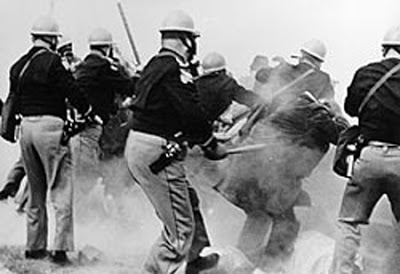
Sheriff Clark ordered the marchers to turn around. When they refused, the officers shot teargas and waded into the crowd, beating the nonviolent protesters with billy clubs and sending more than 50 to the hospital. Young John Lewis, now a long-serving Congressman, was among those savagely beaten.
(On the following Tuesday the marchers, now numbering 2000, again began to cross Edmund Pettus Bridge. On the other side, the same force awaited. But as the marchers reached the crest of the bridge, the police withdrew. Dr. King and the others knelt in prayer. When he arose, Dr. King turned around and led the marchers back to Selma in what became known as “Turnaround Tuesday.” He apparently feared a trap, which would have led to greater harm to the marchers.)

The national outcry that followed “Bloody Sunday” changed things. When Alabama Governor George Wallace refused to provide protection, President Lyndon Johnson sent in 2,000 soldiers, mobilized 1,900 members of the Alabama National Guard, and ordered the participation of FBI agents and Federal Marshals. Marchers began the 54-mile journey on March 21, averaged about 10 miles a day, and slept in Black-owned properties en route. The group–now numbering about 25,000–arrived in Montgomery on March 24, 1965.
This photo–the curb outside the Alabama State Capitol–requires some explanation.
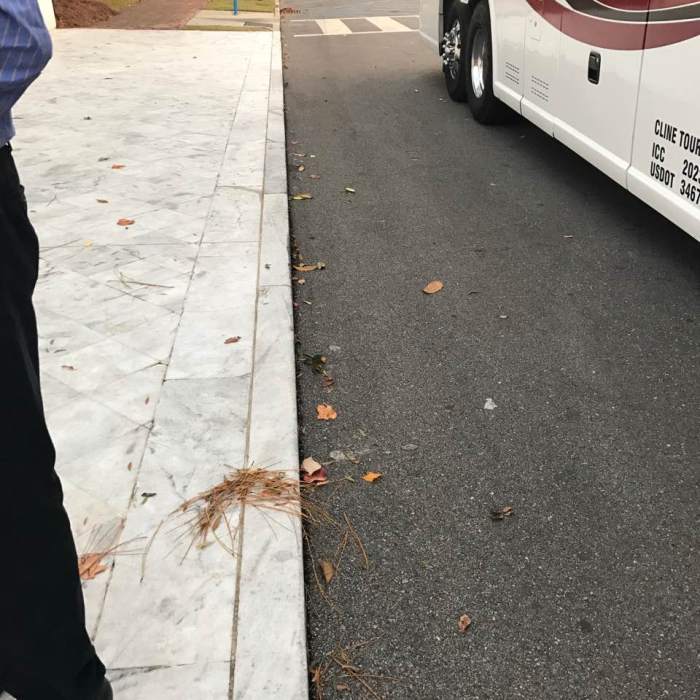
Governor Wallace refused to allow Dr. King to speak from the Capitol grounds, including the marble sidewalk. In fact, we were told that he ordered troopers to shoot anyone who set foot on the sidewalk. (Our guide said ‘shoot to kill,’ but no one has corroborated that.)
So the March organizers brought in a flatbed truck and parked it about a foot away from the sidewalk. From that flatbed and using hay bales as his lectern, Dr. King gave one of his most memorable speeches, “How long? Not long.”
Unfortunately, no plaque marks the spot or the occasion, one of the turning points in the African American struggle for equal rights. (There is, however, a star marking the spot on the Capitol steps where Jefferson Davis, the President of the Confederacy, spoke to his supporters during the Civil War.)
“Bloody Sunday” and the Selma-to-Montgomery March changed American history. Lyndon Johnson introduced the Voting Right Act of 1965 that same March, and the Congress passed it. No more trumped-up tests for voters and other phony barriers.
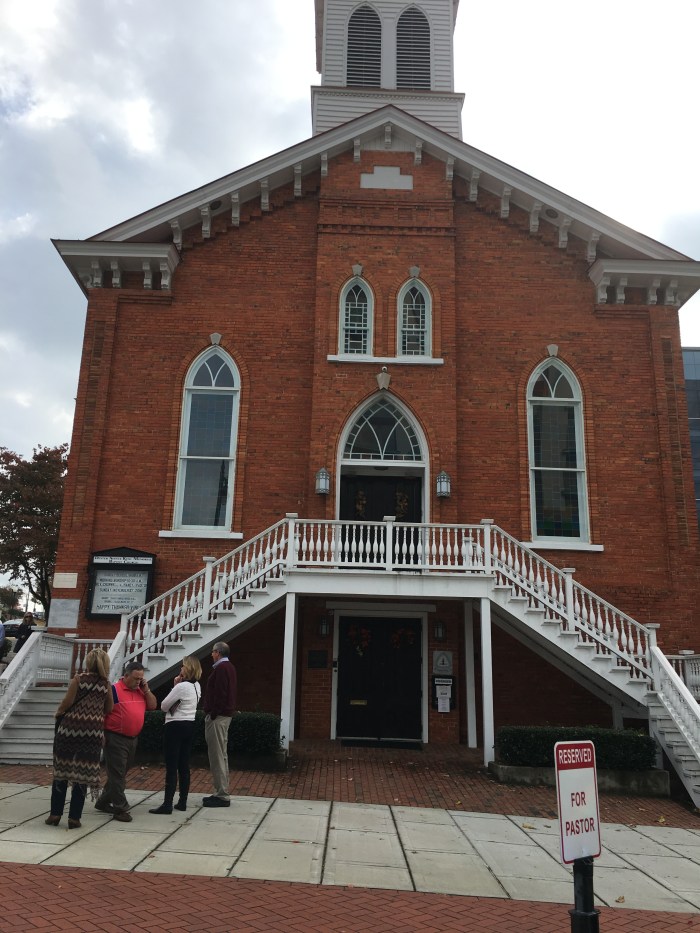
Dr. King, who delivered that memorable speech, was only 25 when he became pastor of the Dexter Avenue Baptist Church in 1954 (above). Dexter Avenue Baptist is the only church that he ever pastored, although he delivered many memorable sermons at Ebenezer Baptist Church in Atlanta, the church his father pastored. This Church, since renamed to acknowledge King’s role, is just one block from the State Capitol, and it was here that many of the meetings that sustained the Montgomery Bus Boycott were held.

Local Civil Rights activists–not including Dr. King–had been planning for some time to challenge Montgomery’s segregated (but allegedly ‘separate but equal’) bus system. All ‘colored’ riders were required to sit in the back of the bus and to give up their seats if a White passenger couldn’t find a seat. Moreover, ‘colored’ passengers had to enter the front of the bus to pay their fare but get off the bus and board through the rear door.
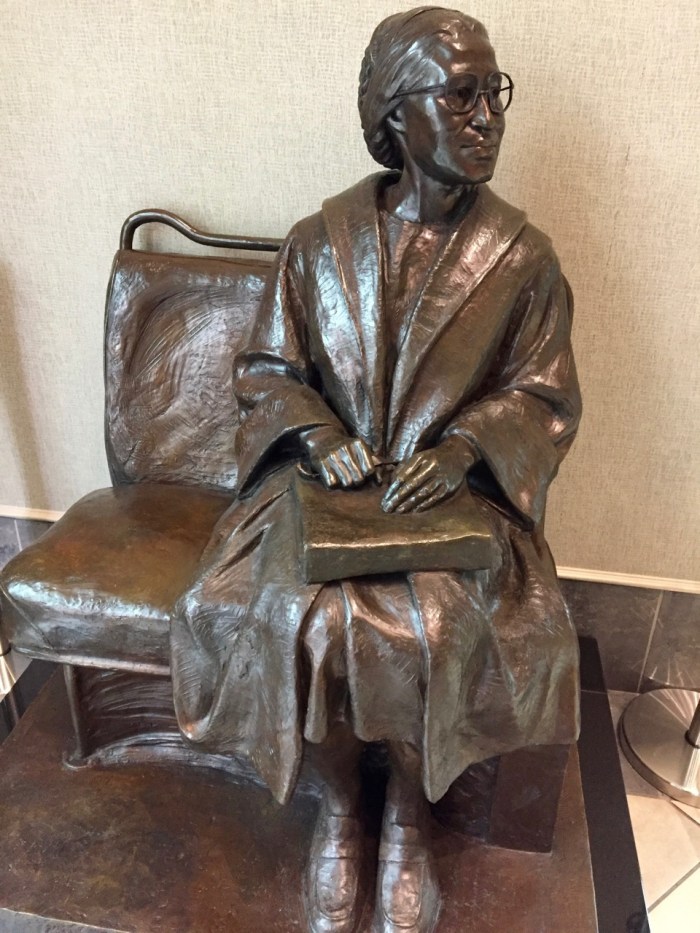
When 42-year-old Rosa Parks boarded a bus to go home from an exhausting day at work on December 1, 1955, she sat in the first row of the “colored” section in the middle of the bus. When the bus filled up and the driver noticed that several white men were standing, he demanded that Parks and several other African Americans give up their seats. Three other African American passengers reluctantly gave up their places, but Parks remained seated. The driver asked her again, once again she refused, and she was arrested and booked for violating the Montgomery City Code. At her trial a week later, in a 30-minute hearing, Parks was found guilty and fined $10 and assessed $4 court fee.
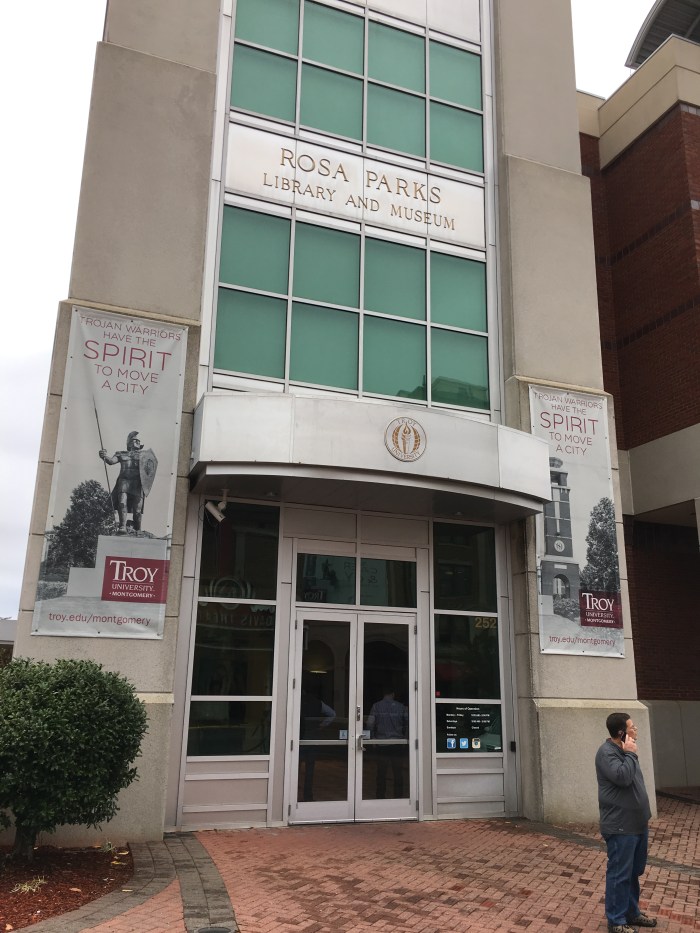
At the marvelous Rosa Parks Library and Museum, visitors virtually experience what Mrs. Parks did. You stand alongside a real city bus and watch the entire drama unfold inside. Not to be missed!
We learned that the boycott might never have come off had it not been for another unsung hero, Jo Ann Robinson of the Women’s Political Council. She mimeographed thousands of circulars and had them distributed. It said in part, “This woman’s case will come up on Monday. We are, therefore, asking every Negro to stay off the buses Monday in protest of the arrest and trial. Don’t ride the buses to work, to town, to school, or anywhere on Monday. You can afford to stay out of school for one day if you have no other way to go except by bus. You can also afford to stay out of town for one day. If you work, take a cab, or walk. But please, children and grown-ups, don’t ride the bus at all on Monday. Please stay off all buses Monday.”
Somehow the local newspaper got a copy of the circular and turned it into the lead story, which actually had the unintended effect of publicizing the nascent boycott! The world moves in mysterious ways.
And notice that Jo Ann Robinson’s circular called for a one day boycott! It lasted for well over a year, 382 days to be exact.
When 40,000 African Americans stopping riding the buses, the economic pain for the city and the company was immediate: about $3,000 per day in fares. It was a difficult struggle for the boycotters, who had to find alternate ways to get to work, if in fact they did not lose their jobs.
 As the Museum’s exhibits relate, the bus boycott meant 382 days of walking to work (for some, 20 miles), seemingly impromptu ‘car-pooling’ (because scheduling would have been illegal), harassment, intimidation, and violence for the Montgomery’s African-American community. Dr. King, who had been chosen to lead the movement because he was young and new to the city, and his family were in personal danger. His home was attacked.
Dr. King and nearly 100 others were charged with ‘interfering with a local business.’ Rather than waiting to be arrested, they turned themselves in, crowding the jail and eventually the court. He was fined $500 and served two weeks in jail.
Meanwhile, the local NAACP, under the leadership of E.D. Nixon, argued in court that the city ordinance mandating segregated seating was unconstitutional, based on the Supreme Court’s decision in Brown v. Board of Education. After being defeated in several lower court rulings and suffering large financial losses, the city of Montgomery finally conceded defeat and lifted the law mandating segregated public transportation. The bus boycott was over!
The white backlash was strong. In March 1957 the city of Montgomery passed an ordinance making it “unlawful for white and colored persons to play together, or, in company with each other . . . in any game of cards, dice, dominoes, checkers, pool, billiards, softball, basketball, baseball, football, golf, track, and at swimming pools, beaches, lakes or ponds or any other game or games or athletic contests, either indoors or outdoors.” And violence erupted. Five Black churches were burned, and two buses were fired upon by snipers, wounding several Black passengers, including one pregnant woman.
Rosa Parks eventually moved to Detroit, because neither she nor her husband could find work in Montgomery and because of death threats. She remained active in the battle for Civil Rights throughout her life.
Not far from Dexter Avenue Church and the State Capitol is the Civil Rights Memorial Center, a living monument to the Movement’s ‘foot soldiers,’ the many unsung heroes who died during the struggle. This deeply moving memorial was designed by Vietnam Veterans Memorial architect Maya Lin.
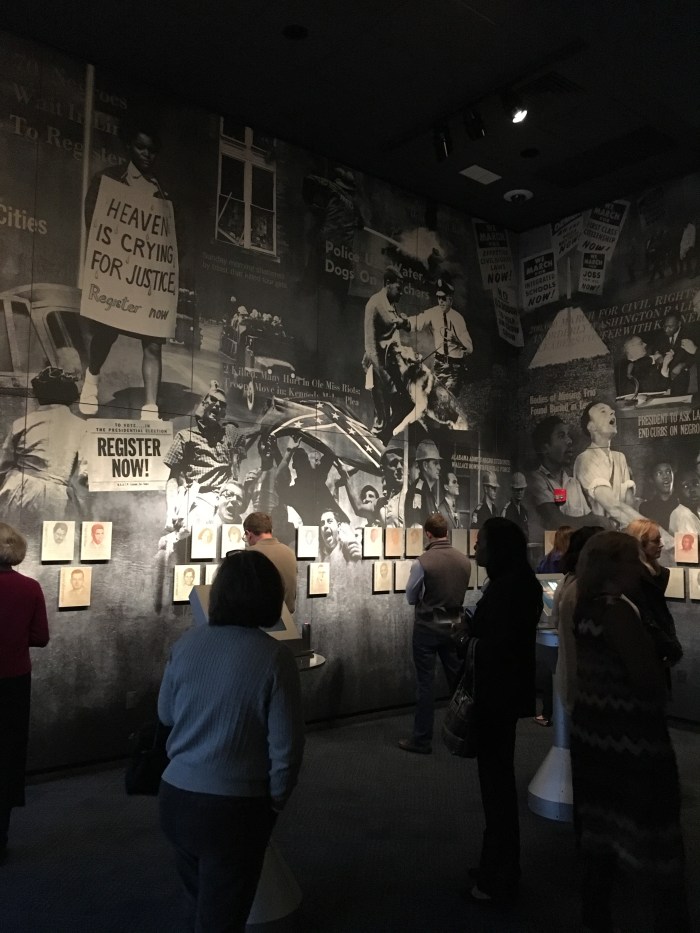
The Memorial, a project of the invaluable Southern Poverty Law Center, invites quiet contemplation and a renewed commitment to racial justice and tolerance.
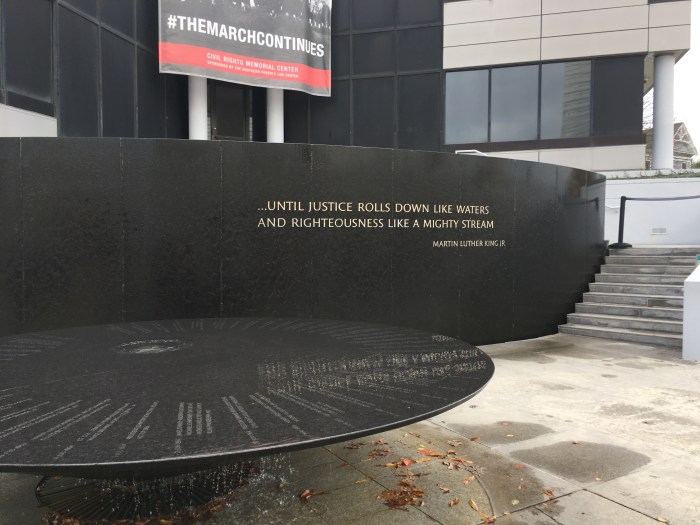
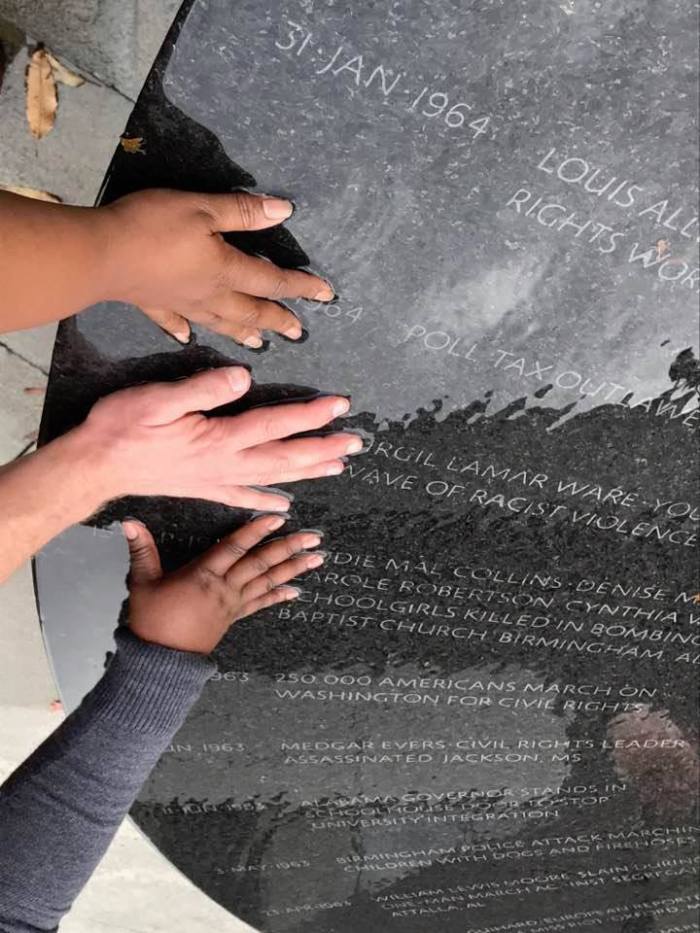
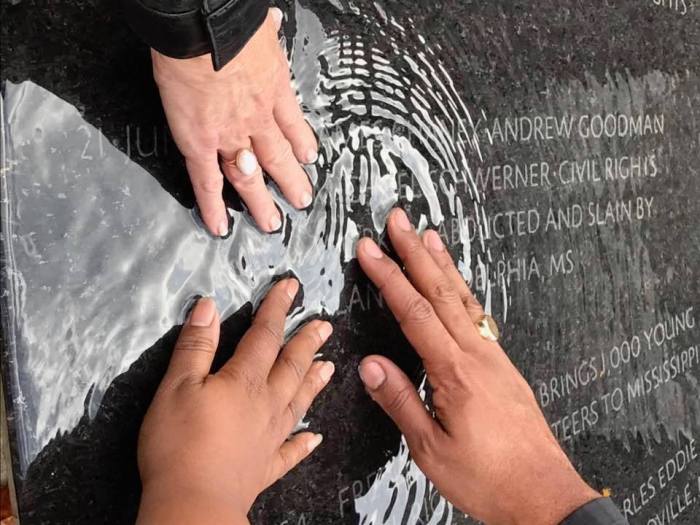
So many brave men, women and children, dead at the hands of violent racists. Most of those memorialized here were unknown to me, but look carefully at the photo below to find the names of the four little girls who died when their Church in Birmingham was bombed in 1963.
Visiting Montgomery was a deeply emotional experience on many levels, but nothing was more moving for me, and many others, than being in the King family home, a modest dwelling owned by the Church.
 Entering the King family living room, which we have all seen in photographs and on television, was a powerful moment.
 And I was not prepared for the waves of emotion that swept over me when I touched the dining room table where Dr. King, the Reverend Ralph Abernathy, Bayard Rustin, E. D. Nixon, Harry Belafonte, and others planned their next moves. (No photos because by then their small home was filled with all 40+ of us.)
Visitors are free to walk into Dr. King’s small study, even to touch his books and his collection of LP record albums. To pick up the rotary phone and imagine hate-filled voices threatening the King family. Or sit at the kitchen table where Dr. King prayed for guidance late on January 27, 1956, when he was plagued by doubts.
I was ready to give up. With my cup of coffee sitting untouched before me, I tried to think of a way to move out of the picture without appearing a coward. In this state of exhaustion, when my courage had all but gone, I decided to take my problem to God. With my head in my hands, I bowed over the kitchen table and prayed aloud.
The words I spoke to God that midnight are still vivid in my memory. “I am here taking a stand for what I believe is right. But now I am afraid. The people are looking to me for leadership, and if I stand before them without strength and courage, they too will falter. I am at the end of my powers. I have nothing left. I’ve come to the point where I can’t face it alone.”
At that moment, I experienced the presence of the Divine as I had never experienced God before. It seemed as though I could hear the quiet assurance of an inner voice saying: “Stand up for justice, stand up for truth; and God will be at your side forever.” Almost at once my fears began to go. My uncertainty disappeared. I was ready to face anything.”
Three days later his home was fire-bombed, the family barely escaping serious harm. When an angry crowd gathered outside on the streets, Dr. King emerged and spoke to the people gathered there:
If you have weapons, take them home; if you do not have them, please do not seek to get them. We cannot solve this problem through retaliatory violence. We must meet violence with nonviolence. Remember the words of Jesus: “He who lives by the sword will perish by the sword”. We must love our white brothers, no matter what they do to us. We must make them know that we love them. Jesus still cries out in words that echo across the centuries: “Love your enemies; bless them that curse you; pray for them that despitefully use you”. This is what we must live by. We must meet hate with love. Remember, if I am stopped, this movement will not stop, because God is with the movement. Go home with this glowing faith and this radiant assurance.”
As we all know, in 1968 Dr. King was ‘stopped,’ murdered by James Earl Ray in Memphis, Tennessee. The Civil Rights movement stuttered and stumbled on occasion, but, as Dr. King foretold, it has not been stopped, although, arguably, the drive for equality, tolerance and freedom faces its greatest challenges in 2017 and the years ahead.
The final stop on our memorable Civil Rights tour was Birmingham, often called “Bombingham” in the 1960s. If you have read Douglas Blackmon’s Slavery by Another Name, you know that industrial Birmingham played a central role in the South’s deliberate–and largely successful–strategy for keeping many Blacks from achieving financial and other success, from Reconstruction to the beginning of the Second World War.
(If you haven’t read Slavery by Another Name, I urge you to do so. Quite honestly, it’s an experience that demarcates my life into before I read the book and after I read it.)
In the 1960s, Birmingham had one of the strongest and most violent chapters of the Ku Klux Klan. Homemade bombs were the weapon of choice for white racists (thus the city’s nickname). Eugene “Bull” Connor, Birmingham’s police commissioner, was notorious for–and apparently proud of–using brutality in combating demonstrators, union members, and Blacks. Birmingham was also the focus of Civil Rights demonstrations, some led by Dr. King. He had been arrested in the Spring of 1963, and it was after that arrest that he wrote the famous “Letter from a Birmingham Jail.”
And many of the Civil Rights demonstrations and marches began here, at the 16th Street Baptist Church, making it an obvious target.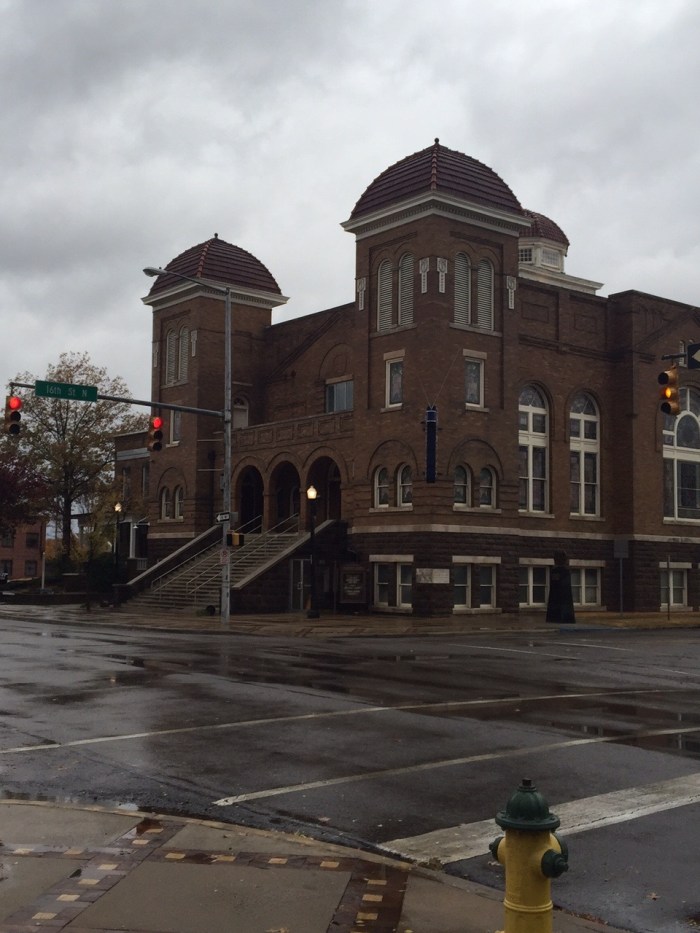
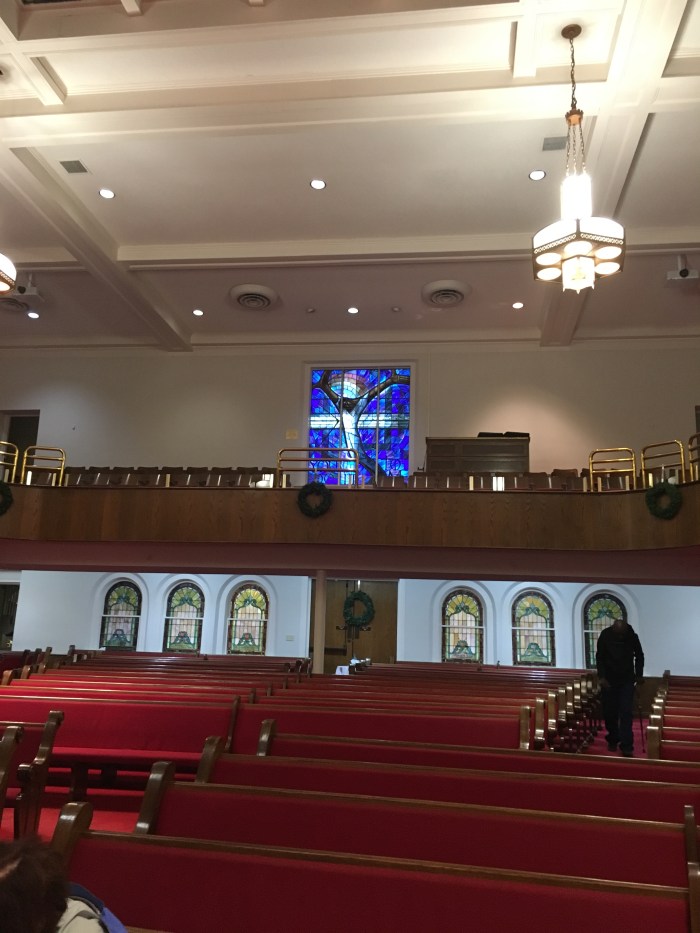
Bombers struck on Sunday morning, September 15, 1963. The bomb went off just outside the room where five teenage girls were getting ready to sing. Four died. A fifth young girl, Sarah Collins, age 10 and the younger sister of Addie May Collins, was blinded in one eye.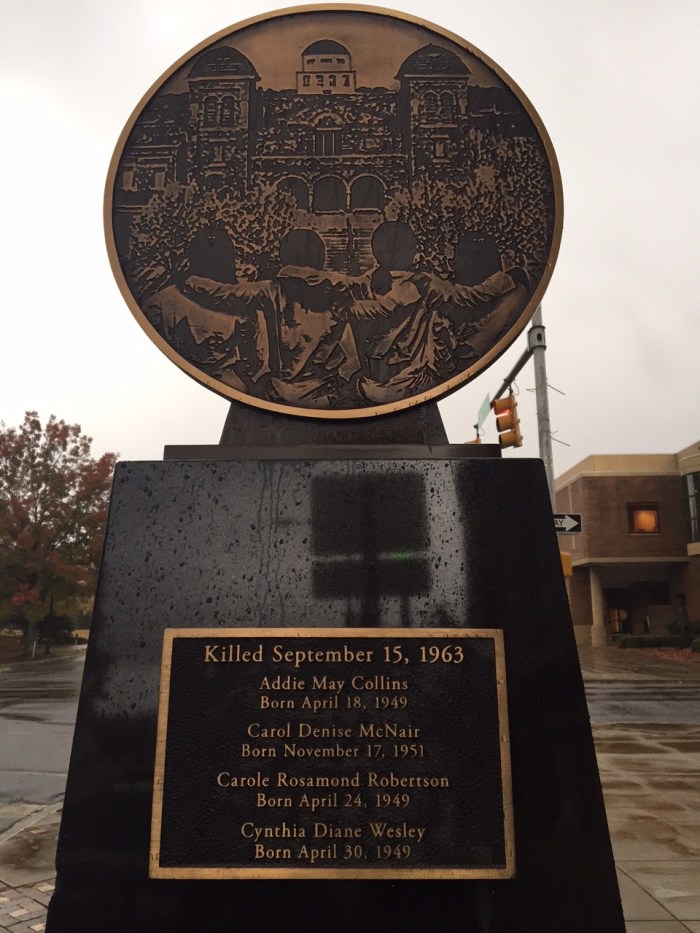
Across the street from the Church is this majestic memorial to the four girls. Note the dancing shoes.


That image remains in the forefront of my memory. Four young lives snuffed out by white racists.
After the bombing, Alabama Governor George Wallace sent police and state troopers to quell protests. Two protestors were killed. However, outrage over the killings led to the passage of the Voting Rights Act of 1964 and the Civil Rights Act of 1965. As noted in Part One, the case was reopened after Jerry Mitchell’s investigative reports. Two of the bombers were eventually brought to justice. The case was directed by former United States Attorney Doug Jones, who told the full story to our group one evening. J. Edgar Hoover, the FBI Director, had sealed the files after the bombing, thus effectively preventing prosecution of suspects. That turned out to be a blessing in disguise, Jones told us, because, if a case had been brought to trial in the 1960’s, an all-white jury would have acquitted the defendants. Mr. Jones in now in private practice in Birmingham.
Where are we as a country today, as Barack Obama prepares to leave office? Will we allow the past to repeat itself? Will our President-elect, seemingly unburdened by an understanding of history or by intellectual curiosity, unleash the forces of hatred? Has he already done so?
Even if Mr. Trump surprises us, it is still difficult to be optimistic after reading Michelle Alexander’s The New Jim Crow, which lays out in excruciating detail how the Reagan Administration’s War on Drugs has racialized our justice system and populated our prisons and parole systems with millions of African American men, thus marking them as ‘second class citizens’ who are unable to vote, serve on a jury, or qualify for valued jobs.
But, as our Civil Rights tour made manifest, America has been in the depths before, and we have emerged triumphant. The pendulum swings, and it clearly has swung in a direction that many of us find frightening and depressing.
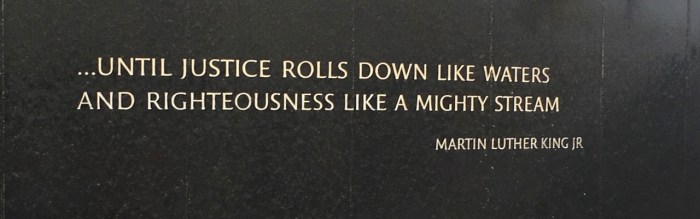
We must continue to believe, with Dr. King, that “The arc of the moral universe is long, but it bends toward justice.” And we must work together toward that end.
Thank you for taking this journey with me. Please share this 2-part journal with others, particularly your younger friends and acquaintances.
(Photos by Joan Lonergan, Leslie Worthington and Julia Parker; historical photos courtesy of the Associated Press.)
(For more information about the tour, contact the talented and energetic Tyson Elbert of Mississippi State University at tyson@sig.msstate.edu. I can be reached at john.merrow@gmail.com)


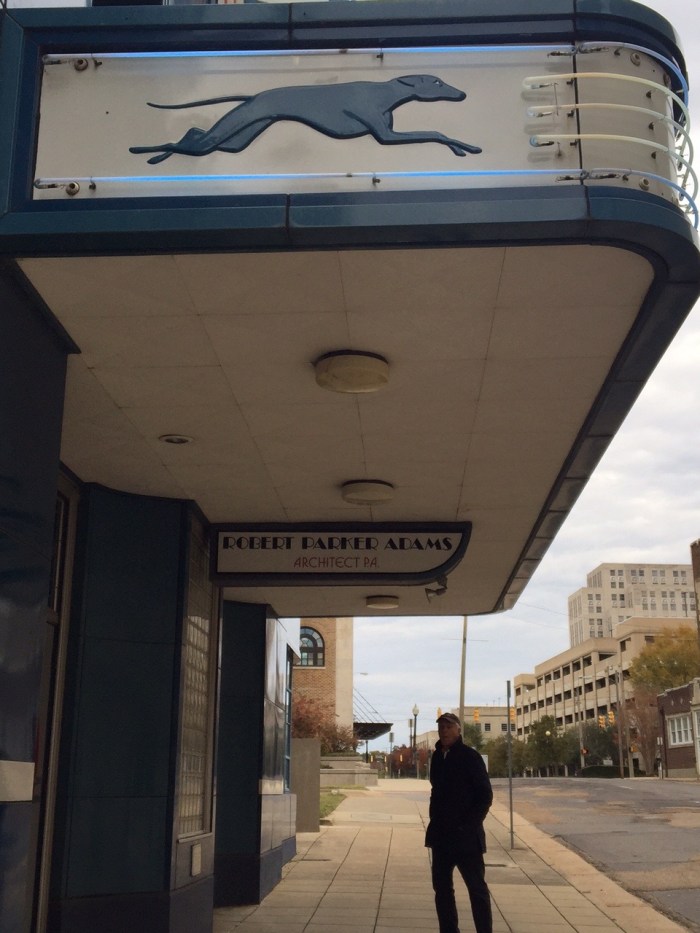 JACKSON, MISSISSIPPI: (Our first stop) The Greyhound bus station in downtown Jackson has been restored since the days of the Freedom Riders, who were seeking to desegregate public accommodations (as required by the Supreme Court). It takes a powerful imagination to visualize busloads of Freedom Riders arriving May 24th, 1961, guarded by tight security. In other cities the Freedom Riders had been viciously attacked, their buses burned, and the city of Jackson was determined to avoid violence (fearing for its reputation, not the Civil Rights activists.) And so, on arriving at the Greyhound station, the activists got off the buses and walked into the ‘White Only’ waiting room, where they were immediately arrested, marched into other buses, and taken to jail or directly to Parchman Farm, Mississippi’s notorious maximum security state prison. At their trial (and before convicting them), the judge actually turned his back whenever their defense attorney was speaking. He sentenced 161 Freedom Riders to 60 days in Parchman, although the convictions were eventually overturned.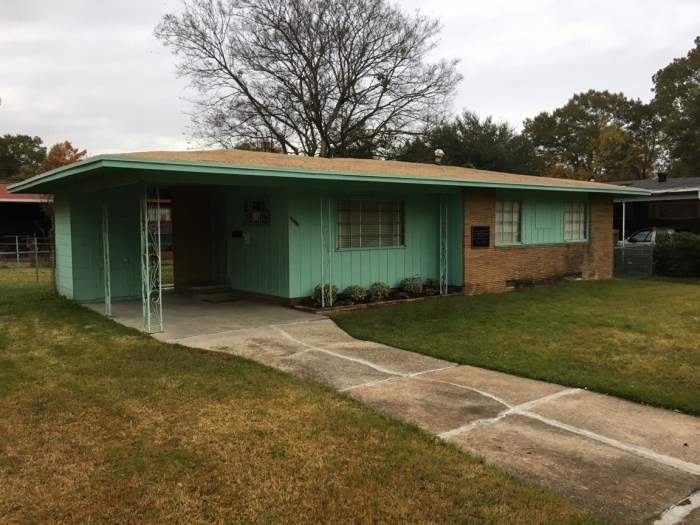
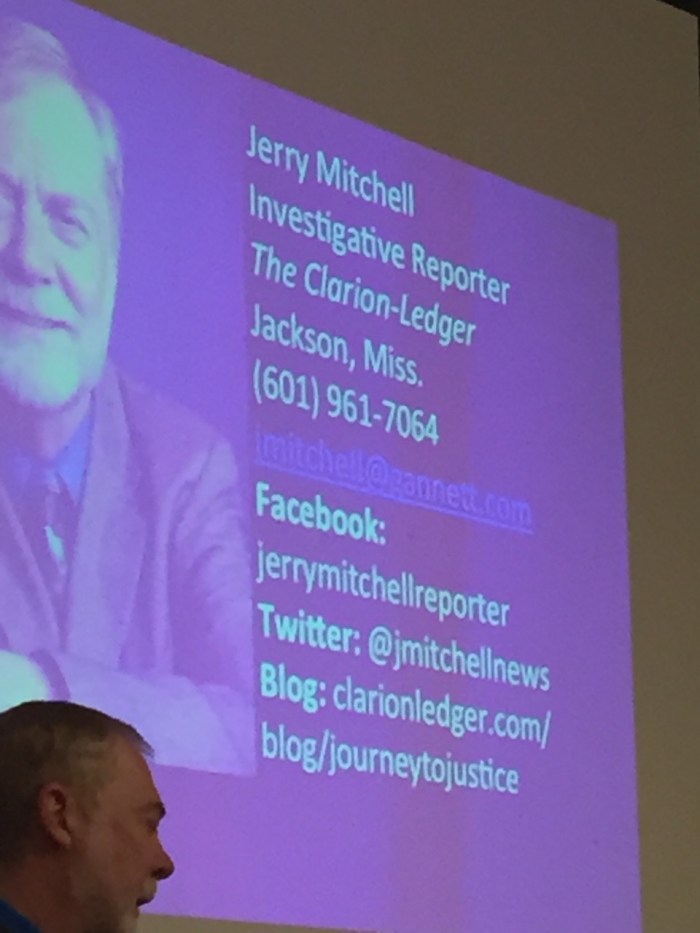 Jerry, whose numerous awards include a MacArthur ‘Genius’ grant, is a fearless reporter whose work has put at least four notorious race-baiting Klansmen behind bars…including one of the men who bombed the Birmingham church in 1963 and one of the Klansmen who murdered James Chaney, Michael Schwerner and Andrew Goodman in 1964. Jerry is also a warm, generous, engaging story-teller as well as a credit to the profession I recently retired from.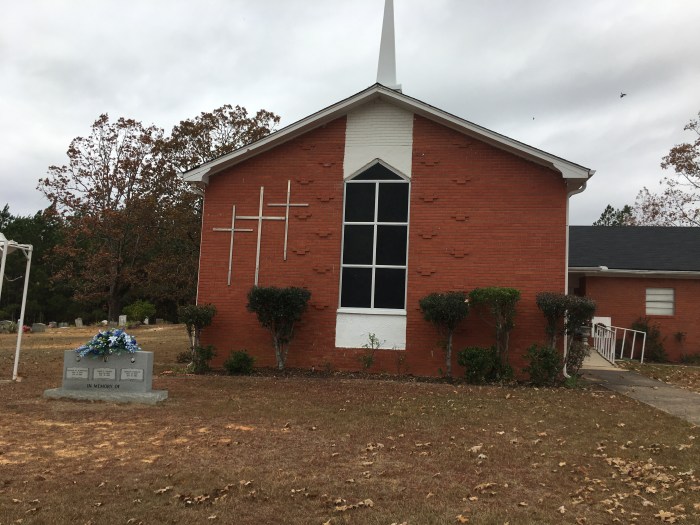


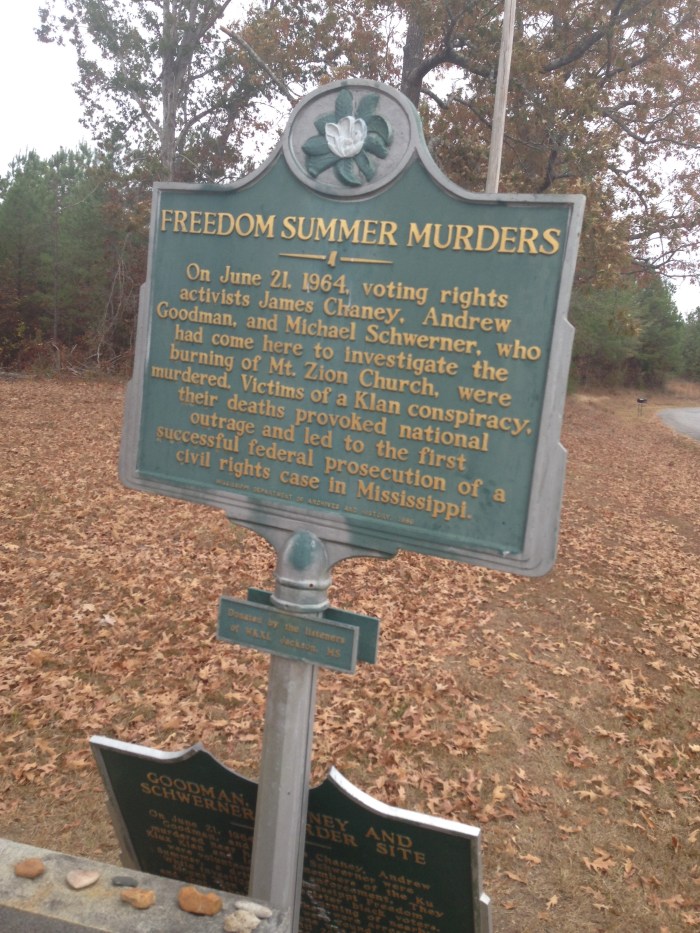
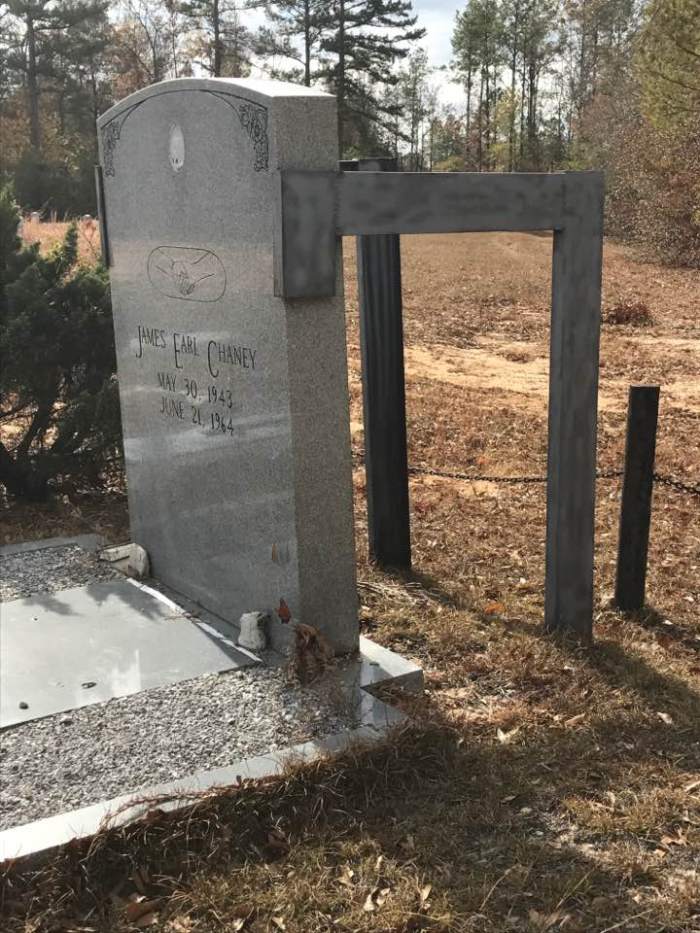
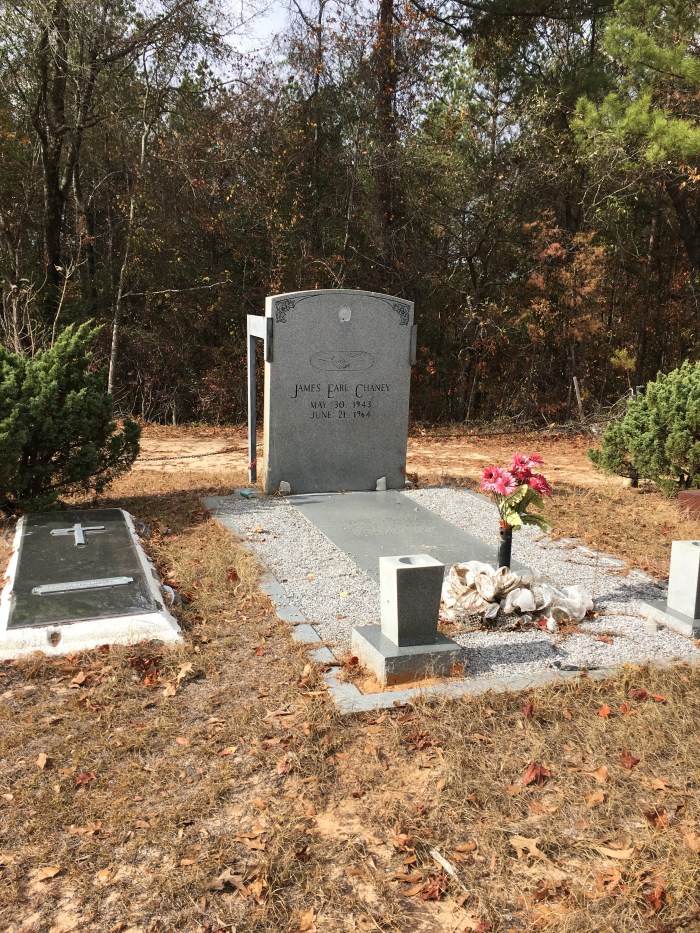 On James Chaney’s tombstone are these words: “There are those who are alive yet who will never live. There are those who are dead yet who will live forever. Great deeds inspire and encourage the living.”
 The Merrow Report